


Wikipedia:Reference desk/Miscellaneous

of the Wikipedia reference desk.
Main page: Help searching Wikipedia
How can I get my question answered?
- Select the section of the desk that best fits the general topic of your question (see the navigation column to the right).
- Post your question to only one section, providing a short header that gives the topic of your question.
- Type '~~~~' (that is, four tilde characters) at the end – this signs and dates your contribution so we know who wrote what and when.
- Don't post personal contact information – it will be removed. Any answers will be provided here.
- Please be as specific as possible, and include all relevant context – the usefulness of answers may depend on the context.
- Note:
- We don't answer (and may remove) questions that require medical diagnosis or legal advice.
- We don't answer requests for opinions, predictions or debate.
- We don't do your homework for you, though we'll help you past the stuck point.
- We don't conduct original research or provide a free source of ideas, but we'll help you find information you need.
How do I answer a question?
Main page: Wikipedia:Reference desk/Guidelines
- The best answers address the question directly, and back up facts with wikilinks and links to sources. Do not edit others' comments and do not give any medical or legal advice.
September 5
[edit]Jules Tavernier birth date
[edit] Resolved
I'm going through the Tavernier biography word by word, beginning with confirming his birth date. Strangely, no source I can find does this, except for the French Wikipedia, which lists "Acte de naissance, 27 avril 1844, état civil reconstitué, Paris, Archives de Paris lire en ligne [archive] (vue 6/51).[1] I cannot access either of those links. They just open up and show blank pages. Can someone help me? Viriditas (talk) 00:44, 5 September 2025 (UTC)
- When I go to this link (found at wikidata Q3188933 under "birth name"):
- and hit the right arrow ⮕ at the bottom left till I reach page 6, I see an acte de naissance on that date for Jules Wilhem, son of John Tavernier, confiseur and Marie Louise Woillaume. Note that the act gives the painter's middle name as Wilhem, note Wilhelm. The French Wikipedia also has Wilhem, but the scribe may have made an error in recording the name he was told.
- (I don't know how stable this is. I see no way to link directly to the page or image. I can email you a screenshot of the birth certificate.)
- Based on what I see here, it looks like Jules' maternal grandfather was also a Tavernier. ‑‑Lambiam 09:29, 5 September 2025 (UTC)
- Yes, that's correct. The linking doesn't work, but since it is listed in chronological and alphabetical order, I scrolled to the last birth certificate on that date in the civil registry and then proceeded to work my way backwards and there it was. I was able to download the image but not to save a link. Was this file reconstructed due to the fire at the Paris Commune? Viriditas (talk) 09:48, 5 September 2025 (UTC)
- Additional question: due to the Paris Commune fire, the birth certificate was recreated sometime between 1871 and 1877 (allegedly). If so, can I upload an image of the birth certificate to commons? Viriditas (talk) 10:00, 5 September 2025 (UTC)
- Yes, that's correct. The linking doesn't work, but since it is listed in chronological and alphabetical order, I scrolled to the last birth certificate on that date in the civil registry and then proceeded to work my way backwards and there it was. I was able to download the image but not to save a link. Was this file reconstructed due to the fire at the Paris Commune? Viriditas (talk) 09:48, 5 September 2025 (UTC)
September 6
[edit]"Fluorescent" light tubes
[edit]Now that true fluorescent lights have been banned (no thanks to those goddam environmentalists), where TF can I get a straight 48-inch T12 bi-pin type A (or type C) LED replacement in warm white color (with a color temperature of ~2700K or less), as opposed to "bright white" (3000K)?! I've checked at Lowe's and at Home Depot, but the lowest they have is 3000K! 2601:646:8082:BA0:93:4615:4E62:CFCB (talk) 11:32, 6 September 2025 (UTC)
- Fwiw, 2700K and 3000K are actually reasonably close in appearance. It's 5000K "daylight" color temps that are harsh and blue-ish. -- Avocado (talk) 14:26, 6 September 2025 (UTC)
- It depends on the person, and on the specific application -- to you they look almost the same, but to me there's a significant difference (also, in my case, the 2700K warm white light was combined with a daylight one in the same fixture, which gave a perfect color balance -- but as luck would have it, it was the warm-white light which burned out, and after I replaced it with the 3000K bright white light, the balance is now noticeably off!) 2601:646:8082:BA0:93:4615:4E62:CFCB (talk) 22:07, 6 September 2025 (UTC)
- Ah, I can see that being an issue with the combination. Sometimes they sell 4000K Bright White LEDs. Perhaps a pair of those would provide the color temp you need? -- Avocado (talk) 15:07, 7 September 2025 (UTC)
- OK, now that I can edit again (BTW, I hereby protest against the collective punishment to which I was subjected on here for someone else's misdeeds), where TF can I find a type A or C LED replacement for a straight 48-inch T12 bi-pin fluorescent tube with a color temperature of 2700K or less??? Also, how do you calculate the resultant color temperature for a mixture of light sources (I'm pretty sure it's not a straight arithmetic average, is it)??? 2601:646:8082:BA0:F87A:44FE:13B1:E05E (talk) 02:22, 15 September 2025 (UTC)
- Anyone??? 2601:646:8082:BA0:D5AF:2A0E:E1D8:F16 (talk) 05:15, 19 September 2025 (UTC)
- Ah, I can see that being an issue with the combination. Sometimes they sell 4000K Bright White LEDs. Perhaps a pair of those would provide the color temp you need? -- Avocado (talk) 15:07, 7 September 2025 (UTC)
- It depends on the person, and on the specific application -- to you they look almost the same, but to me there's a significant difference (also, in my case, the 2700K warm white light was combined with a daylight one in the same fixture, which gave a perfect color balance -- but as luck would have it, it was the warm-white light which burned out, and after I replaced it with the 3000K bright white light, the balance is now noticeably off!) 2601:646:8082:BA0:93:4615:4E62:CFCB (talk) 22:07, 6 September 2025 (UTC)
September 10
[edit]Source for Ethan Mollick and I can eat glass
[edit]I have nominated Ethan Mollick for Did You Know. I planned to use a hook related to Mollick's project of finding more than 150 translations of the phrase "I can eat glass, it does not hurt me." I have not been able to find good sourcing for this beyond a brief mention in the index of the book Language: Its Structure and Use by Edward Finegan, which states he translated it over 100 times, not 150. I would appreciate any assistance trying to find at least one accessible reliable source to cite this statement. Thank you, Thriley (talk) 19:01, 10 September 2025 (UTC)
- I found a brief and not very helpful mention in The Oxford Handbook of Reading pp. 10-11.
- Also a few other mentions in "snippet view", for instance Untangling the Web: Nonce's Guide to Language & Culture on the Internet p. 48, but nothing that really helps I'm afraid. Alansplodge (talk) 15:00, 11 September 2025 (UTC)
- Thank you very much! Thriley (talk) 03:58, 12 September 2025 (UTC)
- What a terribly unfortunate name for a book. I can't see it selling well, or at all, in Britain. DuncanHill (talk) 21:11, 13 September 2025 (UTC)
September 11
[edit]Person of interest sought in connection with the killing of Charlie Kirk
[edit]https://x.com/FBISaltLakeCity/status/1966169520403525760
Does anyone familiar with Utah Valley University have a clue as to where the photos have been taken? Likely somewhere near Richard D. & Joann B. Losee Center in 2005 Trade (talk) 22:29, 11 September 2025 (UTC)
- What does 2005 have to do with it? ←Baseball Bugs What's up, Doc? carrots→ 01:54, 12 September 2025 (UTC)
- The shooter was positioned on the roof on a nearby building. The photos were likely taken by security cameras inside that building, assuming he accessed the roof from the inside and not from climbing an outside wall. You would have to check news reports to see whether the name of that building has been made public. Xuxl (talk) 12:44, 12 September 2025 (UTC)
- "In 2005" implies the year. What does the year 2005 have to do with anything/ ←Baseball Bugs What's up, Doc? carrots→ 18:06, 12 September 2025 (UTC)
- The question was where the photos have been taken. This obviously asks about the position in 4-dimensional space-time, so any answer must include latitude, longitude, elevation and time. PiusImpavidus (talk) 10:29, 13 September 2025 (UTC)
- Maybe that's the year the OP will come back here and explain. ←Baseball Bugs What's up, Doc? carrots→ 15:18, 13 September 2025 (UTC)
- The question was where the photos have been taken. This obviously asks about the position in 4-dimensional space-time, so any answer must include latitude, longitude, elevation and time. PiusImpavidus (talk) 10:29, 13 September 2025 (UTC)
- "In 2005" implies the year. What does the year 2005 have to do with anything/ ←Baseball Bugs What's up, Doc? carrots→ 18:06, 12 September 2025 (UTC)
- The shooter was positioned on the roof on a nearby building. The photos were likely taken by security cameras inside that building, assuming he accessed the roof from the inside and not from climbing an outside wall. You would have to check news reports to see whether the name of that building has been made public. Xuxl (talk) 12:44, 12 September 2025 (UTC)
September 12
[edit]Inscribed stone
[edit]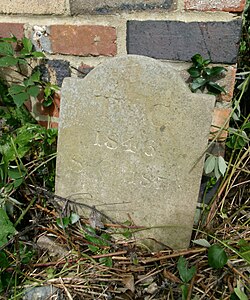
Clearing briars on the Sussex farm where I live revealed this stone. The inscription reads
- T. C.
- 1846
- S. C. 1876
Its shape suggests a headstone, but its size, 15 inches by 12, doesn't, and anyway it's my impression that in the 19th century it would have been illegal to bury anyone outside a churchyard or municipal cemetery. My best guess is that it's a marker stone left by a utilities company or some such, but can anyone identify it with more certainty? --Antiquary (talk) 12:09, 12 September 2025 (UTC)
- I don't think it's ever been illegal to bury people "at home", as it were, certainly nowadays in England and Wales as long as you have the landowner's permission (and there are no restrictive covenants or environmental regulations) you can do it. Burial on your own land was common amongst Quakers, and the simplicity and small size of the stone would be consistent with their practice. I would suggest searching old censuses etc to see if people with those initials lived or died on your farm. Of course, people also bury dogs, cats, horses, etc, sometimes with headstones. It has just struck me that they could be unbaptised infants, some priests wouldn't allow them in consecrated ground. DuncanHill (talk) 12:44, 12 September 2025 (UTC)
- I'm doubtful that a cat's or dog's gravestone would bear initials rather than "Tiddles" or "Rover" or what have you, but I like your other two suggestions. I know there were Quakers in the next parish along in the early 18th century because, unusually, a corner of the Anglican churchyard was allocated to them. I need to establish whether the farmers here had a surname starting with C. --Antiquary (talk) 12:59, 12 September 2025 (UTC)
- I'd support ChatGPT's suggestion that it's a boundary marker, like those with two-letter initials in East Sussex. This one, in particular, also bears initials, probably of the person who put it, with a year. Brandmeister talk 14:52, 13 September 2025 (UTC)
- Very interesting. Since your "Boundary stone Maesglase" image is of a stone on Snowdon I'm almost certain the initials C. C. C. stand for Caernarvonshire County Council. Could S. C. be Sussex Council then? --Antiquary (talk) 16:07, 13 September 2025 (UTC) Ah, but now I come to think of it we didn't have county councils in 1861, so strike that. --Antiquary (talk) 16:44, 13 September 2025 (UTC)
- For comparison, there's a complete guide to boundary stones in Maidenhead. Couldn't find equivalent for Sussex, but rounded tops and two-letter abbreviations with a year on some of them are quite similar. Brandmeister talk 18:51, 13 September 2025 (UTC)
- Not a boundary stone, they have the two entities on different sides, and having two different dates wouldn't make sense either. "T C" and "S C" wouldn't make sense either, you'd expect a something with P for Parish or a B for Borough. As for the Maesglase marker, not only weren't there county councils in 1861, Maesglase wasn't on a border with Carnarvonshire anyway. DuncanHill (talk) 20:35, 13 September 2025 (UTC)
- Boundary stones are marked on old six-inch Ordnance Survey maps, which are digitised here. Alansplodge (talk) 11:47, 14 September 2025 (UTC)
- That's useful. No boundary stones are marked where the inscribed stone is, and no boundary, not even a parish one, is shown there on the 19th century OS maps. --Antiquary (talk) 19:40, 14 September 2025 (UTC)
- Boundary stones are marked on old six-inch Ordnance Survey maps, which are digitised here. Alansplodge (talk) 11:47, 14 September 2025 (UTC)
- Not a boundary stone, they have the two entities on different sides, and having two different dates wouldn't make sense either. "T C" and "S C" wouldn't make sense either, you'd expect a something with P for Parish or a B for Borough. As for the Maesglase marker, not only weren't there county councils in 1861, Maesglase wasn't on a border with Carnarvonshire anyway. DuncanHill (talk) 20:35, 13 September 2025 (UTC)
- For comparison, there's a complete guide to boundary stones in Maidenhead. Couldn't find equivalent for Sussex, but rounded tops and two-letter abbreviations with a year on some of them are quite similar. Brandmeister talk 18:51, 13 September 2025 (UTC)
- Very interesting. Since your "Boundary stone Maesglase" image is of a stone on Snowdon I'm almost certain the initials C. C. C. stand for Caernarvonshire County Council. Could S. C. be Sussex Council then? --Antiquary (talk) 16:07, 13 September 2025 (UTC) Ah, but now I come to think of it we didn't have county councils in 1861, so strike that. --Antiquary (talk) 16:44, 13 September 2025 (UTC)
- Maybe it's a cat whose "close friends get to call him TC"? Chuntuk (talk) 15:49, 15 September 2025 (UTC)
- I'd support ChatGPT's suggestion that it's a boundary marker, like those with two-letter initials in East Sussex. This one, in particular, also bears initials, probably of the person who put it, with a year. Brandmeister talk 14:52, 13 September 2025 (UTC)
- I'm doubtful that a cat's or dog's gravestone would bear initials rather than "Tiddles" or "Rover" or what have you, but I like your other two suggestions. I know there were Quakers in the next parish along in the early 18th century because, unusually, a corner of the Anglican churchyard was allocated to them. I need to establish whether the farmers here had a surname starting with C. --Antiquary (talk) 12:59, 12 September 2025 (UTC)
September 15
[edit]Patriarchal naming practices
[edit]The convention of referring to women as Mrs. [Husband's Name] is widely on display in US newspapers in the 1950s.[2] The poor woman in that article doesn't even have a name other than the idea that she belongs to her husband as property. One would think this kind of thing has died out, but it lives on in the US in funerary and obituary pages. Why? Viriditas (talk) 22:01, 15 September 2025 (UTC)
- Do you have any recent examples of this convention? --Viennese Waltz 13:41, 16 September 2025 (UTC)
- If you asked a fiddler on a roof, he'd say, "Tradition." In fact, the 2023 book Honor and Respect: The Official Guide to Names, Titles, and Forms of Address specifies that the format be used "in formal situations or when you are involved as a spouse/part of a couple."[3] Clarityfiend (talk) 21:55, 16 September 2025 (UTC)
- Thank you! Viriditas (talk) 21:57, 16 September 2025 (UTC)
- Oh, wait, that rule implies that the woman cited up above might be a widow. I did not know that. "Widows are formally addressed as ‘Mrs. (husband’s first name) (Family Name)’ (unless they remarry) for the rest of their lives if they choose to be." Viriditas (talk) 22:17, 16 September 2025 (UTC)
- The rules for "formal" language evolve, and the complex uber-niceties of formal forms of address we inherited from Britain are now generally confined to the Court Circular and lists of Official Honours and Awards. Much of what may have been set out in a 1950s book of etiquette does not apply today. For ex., when was the last time you heard a single woman addressed as "Miss XXX"? (I know Americans are very fond of addressing their favourite female movie stars as "Miss XXX", but that respect never extends to mere mortals.) TV journalists often address heads of government/state by their given names now. I think it's rude and disrespectful, but the listening public tends to copy them, and here we are. -- Jack of Oz [pleasantries] 01:09, 17 September 2025 (UTC)
- JackofOz, what do you mean by "Miss XXX"? Calling Jane Smith "Miss Smith"? Nyttend (talk) 04:39, 17 September 2025 (UTC)
- Yes, exactly that. -- Jack of Oz [pleasantries] 04:47, 17 September 2025 (UTC)
- I'm a librarian in metro Melbourne, and occasionally I use that form of address when speaking with borrowers. Nyttend (talk) 04:49, 17 September 2025 (UTC)
- Well, that answers my question. Thank you for your continued courtesy in the face of everything our "culture" throws at us. -- Jack of Oz [pleasantries] 20:38, 18 September 2025 (UTC)
- I'm a librarian in metro Melbourne, and occasionally I use that form of address when speaking with borrowers. Nyttend (talk) 04:49, 17 September 2025 (UTC)
- Yes, exactly that. -- Jack of Oz [pleasantries] 04:47, 17 September 2025 (UTC)
- JackofOz, what do you mean by "Miss XXX"? Calling Jane Smith "Miss Smith"? Nyttend (talk) 04:39, 17 September 2025 (UTC)
- One thing I had never really thought about before is how civility can be considered a double-edged sword. It can be used to encourage and promote a kind of civil, more tolerant society, but it can also be used as an authoritarian or moral cudgel to enforce the status quo. This idea was recently driven home to me in a panel discussion by Teresa Bejan, Phil Withington, and John Gallagher ("Civility: talking with those who disagree with you", BBC Radio 4, 2025). It's a fantastic discussion, if you haven't already heard it. We have absolutely nothing like BBC Radio 4 in the states, and I wish we did. It would help immensely. Viriditas (talk) 01:25, 17 September 2025 (UTC)
- The rules for "formal" language evolve, and the complex uber-niceties of formal forms of address we inherited from Britain are now generally confined to the Court Circular and lists of Official Honours and Awards. Much of what may have been set out in a 1950s book of etiquette does not apply today. For ex., when was the last time you heard a single woman addressed as "Miss XXX"? (I know Americans are very fond of addressing their favourite female movie stars as "Miss XXX", but that respect never extends to mere mortals.) TV journalists often address heads of government/state by their given names now. I think it's rude and disrespectful, but the listening public tends to copy them, and here we are. -- Jack of Oz [pleasantries] 01:09, 17 September 2025 (UTC)
- Oh, wait, that rule implies that the woman cited up above might be a widow. I did not know that. "Widows are formally addressed as ‘Mrs. (husband’s first name) (Family Name)’ (unless they remarry) for the rest of their lives if they choose to be." Viriditas (talk) 22:17, 16 September 2025 (UTC)
- Thank you! Viriditas (talk) 21:57, 16 September 2025 (UTC)
September 17
[edit]Fuel gauge in EVs
[edit]Earlier this month I drove an EV for the first time. It was part of my employer's motor pool, so I doubt I'll drive this particular vehicle again; all I remember is that it was a Kia hatchback sedan. Taking the role of a fuel gauge in an ICE vehicle was a digital display that told me how many kilowatt hours remained and how far (estimated) I could drive before I emptied the battery.
Is it common for electric vehicles to have "fuel gauges" denominated in kWh, either here or elsewhere in the world? ("Here" is Australia, but since we have no automobile manufacturing, I suppose the same thing is done wherever this car was imported from.) I was quite surprised because I would have expected the "fuel gauge" to provide this information in some multiple of joules. Nyttend (talk) 04:45, 17 September 2025 (UTC)
- kWh is a unit of energy, just like the Joule, and it is in fact a multiple of Joule: 1 kWh = 3,600,000 J. Kilowatt-hour is a standard unit for measuring "electricity consumption" (might be different in Australia, of course), so it doesn't seem surprising to see it used in EVs. An advantage is that if you know the (average) power of the engine (and there may be another meter on the dash board that shows the current power? Don't know, never been in an EV) you can easily compute the remaining time that your battery lasts. --Wrongfilter (talk) 08:20, 17 September 2025 (UTC)
- (ec) For electricity, it's customary even in metric countries to use kWh (or units with larger prefixes).
- The first time I operated an electric vehicle, a battery powered boat in the early 1990s, it had no fuel gauge. As the battery drained, the power output of the motor slowly dropped. Had the battery fully drained, we would have reverted to punting. Of course, this wasn't the first time I traveled in an electric vehicle, but the electric buses and trains I used before all used overhead wires. PiusImpavidus (talk) 08:49, 17 September 2025 (UTC)
- On a Tesla display, you have a choice between number of miles left in the battery and percentage charge left. I don't think showing kWh is an option (unless I've missed it). --Viennese Waltz 11:37, 17 September 2025 (UTC)
- @Nyttend: When you buy electricity in Australia, what units do you buy it in? In the UK we buy it in kilowatt-hours. DuncanHill (talk) 21:32, 18 September 2025 (UTC)
- I don't know; my wife handles all the utility bills. I grew up with kWh in the US, but it seems rather awkward when there's a joules option (I never heard about joules in the US, except in science class); I assumed the US preference for this measurement was a result of the US preference for weird units. I'm at lunch, and I just asked a couple of coworkers, but they didn't know; they just pay the bills without looking at the details. Nyttend (talk) 02:38, 19 September 2025 (UTC)
Unusual Chinese type of sword
[edit]Is there a name for this type of “spike-hilted” Chinese sword? Thanks in advance ❖ hugarheimur 15:26, 17 September 2025 (UTC)
- The spikes may be sword guards, as shown here: Chinese sword#Qin dynasty (221–206 BC), and you might find deeper information in the references for that article and those for Chinese swordsmanship, but hopefully other responders will be more knowledgeable. {THe poster formerly known as 87.81.230.195} 90.193.153.108 (talk) 16:26, 17 September 2025 (UTC)
- Our jian article discusses various hilt shapes. Alansplodge (talk) 18:07, 17 September 2025 (UTC)