


Wikipedia:Reference desk/Humanities

of the Wikipedia reference desk.
Main page: Help searching Wikipedia
How can I get my question answered?
- Select the section of the desk that best fits the general topic of your question (see the navigation column to the right).
- Post your question to only one section, providing a short header that gives the topic of your question.
- Type '~~~~' (that is, four tilde characters) at the end – this signs and dates your contribution so we know who wrote what and when.
- Don't post personal contact information – it will be removed. Any answers will be provided here.
- Please be as specific as possible, and include all relevant context – the usefulness of answers may depend on the context.
- Note:
- We don't answer (and may remove) questions that require medical diagnosis or legal advice.
- We don't answer requests for opinions, predictions or debate.
- We don't do your homework for you, though we'll help you past the stuck point.
- We don't conduct original research or provide a free source of ideas, but we'll help you find information you need.
How do I answer a question?
Main page: Wikipedia:Reference desk/Guidelines
- The best answers address the question directly, and back up facts with wikilinks and links to sources. Do not edit others' comments and do not give any medical or legal advice.
September 5
[edit]The penis in the altar
[edit]A footnote in the short story 'Justice Tresilian in the Tower' by Ken Alden says "A survey carried out after the second world war by Professor Webb, then Secretary of the Royal Commission on Historical Monuments, showed that ninety per cent of British churches built before the time of the Black Death had a stone penis hidden in the altar." I have seen similar claims elsewhere, but have not been able to find the actual survey mentioned. Can anyone help? Thank you, DuncanHill (talk) 17:15, 5 September 2025 (UTC)
- OK, I tracked this down: it's not an official survey, but reported private conversation. It originates in The Roots of Witchcraft by Michael Harrison (Michael Harrison (writer)?), published 1974 (or 1973?). Quote follows:
-
Here we have the clue to the 'obscene', 'indecent', 'irreligious', 'blasphemous' (they have been called all these) carvings: they indicated the true nature of the church building to 'those parishioners still that way inclined'.
-
And what came they to the church really to worship?
-
Just after the end of World War II I had a clear, detailed and perfectly unambiguous answer to that question from the late Professor Geoffrey Webb, formerly Slade Professor of Fine Art at Cambridge, and then Secretary of the Royal Commission on Historical Monuments. Professor Webb's revelations, fully supported as they were by photographs, should not, I think, have astonished me as they did. For these discoveries, though revealed only by the accident of war (Mr Webb, in discussing them, claimed no merit for the discoveries as such), should, long ago, have been deduced. The important evidence of our ancestors' True Faith ought not to have waited upon the chance revelation of accident to restore them to the sight of man.
-
Professor Webb, an authority on mediaeval church architecture, especially that of England and Germany, was assigned, immediately after World War II, to the task of surveying such of England's ancient churches as had suffered damage through aerial and other bombardment ('realistic war training' of Britain and her allies was not totally innocent of some of the damage inspected).
-
The revelation was by way of an altar-top; a slat of stone that an explosion had shifted from its original position, thereby revealing the interior of the altar - for the first time since the eleventh or twelfth century.
-
Within that altar was a god - or, rather, The God.
-
This it was to which all those ambiguous, aberrant carvings, on ceiling boss and corbel, misericord and door-panel, hinted and pointed. It was the function of these carvings to reassure an adherent of the Old Faith that he or she 'had come to the right place'; so that, no matter how evident were the symbols of Christian worship, the holy place which had just been entered was one dedicated to the Old Faith, whose eternal symbol of Life Itself stood arrogantly proud - though necessarily concealed - within the apparently Christian altar.
-
Had this discovery been unique, it would still have been of the first importance. But, far from being unique, it was merely an invitation to Professor Webb to seek and find the altar-concealed, worshipful images elsewhere. He found that ninety per cent of all churches examined of a date up to, say, the Black Death of 1348 (which stopped church - and other building for purely economic reasons) had The God concealed within the altar.
-
And in which form was the Ancient Life-giver portrayed? Why, in a form rendered familiar to all who have visited a Hindoo temple. As a stone lingam; that master-symbol of the ancient, world-wide Fertility Cult: the universal Phallus by which all animal life was generated.
- Card Zero (talk) 23:28, 5 September 2025 (UTC)
- Thank you. I wonder what became of the photographs? DuncanHill (talk) 16:18, 7 September 2025 (UTC)
- See here for a Twitter thread dissecting this claim. To summarise, no such survey exists or even could exist, since the number of medieval altars that survived the Reformation is vanishingly small. To all appearances, Michael Harrison made it up. Zacwill (talk) 19:51, 7 September 2025 (UTC)
- Thank you! DuncanHill (talk) 11:25, 8 September 2025 (UTC)
Louis Wain radio appeal, 1925
[edit]Our article on Louis Wain has: "During a radio broadcast to support the 1925 appeal for Wain, the writer H. G. Wells said..."
; this is sourced to the 1960 piece in the Guardian at [1].
Can we date the broadcast more precisely? I presume it was on the BBC (it's not found in the BBC Genome search). Andy Mabbett (Pigsonthewing); Talk to Andy; Andy's edits 20:09, 5 September 2025 (UTC)
- From The Times, Thursday August 27th, 1925. Article: "The Programmes". "Scene from Cyrano de Bergerac". "The second scene of Act II of Rostand's Cyrano de Bergerac is being broadcast tonight, with Mr Robert Loraine in the part of Cyrano... Mr Loraine is also delivering a message from Mr H. G. Wells on behalf of Mr Louis Wain". I'll email it to you, together with other mentions of Wain from 1925 in The Times. It wasn't on the BBC, which did not yet exist, it was on its predecessor, the BBC. DuncanHill (talk) 22:52, 5 September 2025 (UTC)
- Received; many thanks. Andy Mabbett (Pigsonthewing); Talk to Andy; Andy's edits 18:15, 6 September 2025 (UTC)
 This section is resolved and can be archived. If you disagree, replace this template with your comment. Andy Mabbett (Pigsonthewing); Talk to Andy; Andy's edits 18:15, 6 September 2025 (UTC)
 Murder fines
[edit]Malice aforethought refers to a 12th- and 13th-century concept called the "murder fine", levied on someone responsible for causing a death by misadventure. Unfortunately murder fine is a redlink. Is this functionally the same as a weregild, or are they distinct concepts? Nyttend (talk) 21:54, 5 September 2025 (UTC)
- This originates from Englishry, where the whole district has to pay a fine for any discovered corpse of a murdered Norman, unless they can prove that the victim was merely English. In Leges Henrici Primi the crime is called murdum, and page 1 of England under the Norman and Angevin kings, 1075-1225 mentions
the so-called murdum fine enforced by William the Conqueror
. (Actually it says "murdrum", but it's "murdum" in the index.) The weregild article says it was a common practice for the Anglo Saxons and codified by the Franks: so it would be frankly weird if the Norman invaders, or any contemporaries, hadn't defaulted to punishing murders with fines. The only wrinkle is that the law in England (after 1066, when things got worse) was adapted, at first, to the context of protecting Normans in particular from the strong desire felt by the natives (or previous lot of invaders) to knife them in the back. - Oh, I should have paid more attention to that spelling: murdrum.
It was introduced into Anglo-Saxon law by the Danes. It is distinguished from simple homicide. In the laws of Cnut an unknown man who was killed was presumed to be a Dane, and the vill or tithing was compelled to pay 40 marks for his death.
So the Danes were doing exactly the same ethnic discrimination. What goes around comes around, I guess. Murder in plain sight, it says, triggered the hue and cry, but that article doesn't say what happens to a murderer after being chased down by the posse and brought to the sheriff. Card Zero (talk) 00:24, 6 September 2025 (UTC)
Who was Napoleon? Who was Jesus Christ? Who sat between them?
[edit]According to Wikiquote, David Lloyd George on being asked how he had done at the Paris Peace Conference replied "Not badly, considering I was seated between Jesus Christ and Napoleon." Wikiquote cites the article "International Relations" in The New Encyclopaedia Britannica (1993). In this version Jesus Christ is Woodrow Wilson, and Napoleon is Georges Clemenceau. I have seen this attribution to David Lloyd George in various other works over the years. BUT! Margaret MacMillan in her Peacemakers (2001) ascribes it to Clemenceau, with Wilson as Christ and Lloyd George as Napoleon. She references Old Diplomacy: The Reminiscences of Lord Hardinge of Penshurst (1947) by Charles Hardinge, 1st Baron Hardinge of Penshurst. Hardinge says it occurred immediately after the signing of the Treaty of Guarantee by Wilson, Lloyd George, and Arthur Balfour. The Dictionary of Liberal Quotations (ed. Duncan Brack, 2013) also gives it to Clemenceau, but with Napoleon first, and in response to being asked why he always gave way to Lloyd George. This is cited to "a letter from H. Nicolson to his wife, 20 May 1919". So, who is right? Did Clemenceau say it, and if so when and in what context? Did Lloyd George say it, and likewise when and to whom? Or did they both say it? Thank you, DuncanHill (talk) 22:14, 5 September 2025 (UTC)
- I can offer a 1924 citation which quotes Clemenceau in the original French, though from a Norwegian-language source yet. "Que voulez-vous que je fasse entre ces deux larrons. L'un se croit Napoléon, l'autre le Messie." (What would you have me do between those two thieves. One thinks he's Napoleon, the other the Messiah) though I doubt you need the translation. Hans P. Lødrup Efter krigen: politik ute og hjemme p. 99. --Antiquary (talk) 08:53, 6 September 2025 (UTC)
- And it was in print in America by 30 August 1919. The Independent for that date quotes Clemenceau as saying "Lloyd George imagines himself Napoleon, and Wilson imagines himself Jesus Christ." Another early source, also crediting Clemenceau, calls it "a bon mot that went around the world". --Antiquary (talk) 11:07, 6 September 2025 (UTC)
- The New Statesman, on 7 February 1920, has this expansion of the story: "The characters of two of the triumvirs are pretty well summed up in Clemenceau's mot – 'Qu'est-ce que vous vouliez que je fasse entre Lloyd George, qui veut être Napoléon, et Wilson, qui se croit Jésus-Christ?' Mr Harris quotes that; he might have added, as throwing some light on Clemenceau himself, the rejoinder of a wit who was by: 'Mais c'est vous qui pratiquez entre les deux la politique de Bismarck!'". I can find no-one else quoting the Bismarck addition, and I don't believe it for a moment. Also, is that Frank Harris who's being cited? Hardly the most reliable of sources. --Antiquary (talk) 12:03, 6 September 2025 (UTC)
September 6
[edit]Black Saturday (Lebanon) photograph
[edit]Not sure if the right place for this, but I'm looking for help finding more information about a photograph uploaded to Wikimedia Commons (this photo) I found it featured in an article here but this is not an RS and with little info about the photo's source.
Any help or direction appreciated. Thank you, IOHANNVSVERVS (talk) 17:29, 6 September 2025 (UTC)
September 7
[edit]Order of Greek tragedies in "Great Books of the Western World"
[edit]I was looking at volume 5 of the Great Books of the Western World and noticed that the order of the Greek tragedies is incongruous with the order generally agreed upon by modern scholars. This is in contrast with the plays of Aristophanes, which are ordered in a way that's more consistent (relatively speaking) with the modern agreed-upon order. So, my question is, what changed in our understanding between the publication of the "Great Books" and today that led to the chronology of Greek theater being revised? Lizardcreator (talk) 22:22, 7 September 2025 (UTC)
- You probably have to look at the detailed dating history for the individual plays. For Aischylos, the article on Suppliants says that it was originally thought to be Aischylos' earliest (extant) play for stylistic reasons; this is in accord with the ordering the Great Books. Evidence from the mid-20th century shows that it was actually much later. The German article says that we learn from a papyrus from Oxyrhynchos that Sophocles participated in the same agon that Aischylos won with the Suppliants; this makes 466 BC the earliest possible date. Others inconsistencies can possibly be attributed to editorial whims, maybe the desire to have Aischylos' "single" plays out of the way before the trilogy of the Oresteia. For Sophocles note that the three plays of the Oedipus cycle do not form a trilogy in the way the Oristeia does. It is customary to arrange them in the order given by the content of the plays rather than by date of origin. --Wrongfilter (talk) 14:07, 8 September 2025 (UTC)
Information on "M. Frida Hartley"
[edit]I'm trying to find more information on the author of a poem called "Hymn of Pity for Broken Birds and Beasts". This poem is known for the lines:
From beasts we scorn as soulless,
In forest, field and den,
The cry goes up to witness
The soullessness of men.
Quote Investigator says that it was written by "British social activist M. Frida Hartley" in a blog post. Searching the name shows no results, except for a "Frida Hartley Shelter" in South Africa, about which a news article says: "In 1923 wealthy socialite Frida Hartley left London for Johannesburg to open a shelter for destitute women, a solid one-storey brick building in Bellevue" (source). I haven't been able to find anything else.
My questions are: Is the Frida Hartley of the shelter the same as the poem author? and What other information is available on the poem author?
Even suggestions of places to research would be helpful. Thank you in advance! InfernoHues (talk) 23:07, 7 September 2025 (UTC)
- A search on Google Books [2] [3] [4] [5] shows M. Frida Hartley writing on education, Women's Institutes and suchlike causes in the 1910s and 1920s. An M. Frida Hartley was a social worker and prison visitor in South Africa in 1937,[6] and in 1947 the Superintendent of the Frida Hartley Shelter for Women in Johannesburg was M. Frida Hartley,[7] so the South African wealthy socialite definitely had the initial M. The evidence that this is the poet isn't absolutely conclusive, but if Quote Investigator is right then we would otherwise have to suppose two contemporary social activists both called M. Frida Hartley, which is a bit of a stretch. --Antiquary (talk) 09:02, 8 September 2025 (UTC)
- If you have access to the Encyclopaedia of Southern Africa, Southern African Dictionary of National Biography or Dictionary of South African Biography it looks like they all have articles on her. [8] If you don't you could always try the Wikipedia Library. --Antiquary (talk) 11:11, 8 September 2025 (UTC)
- On Archive.org Encyclopaedia of Southern Africa - Hartley, Frida, Southern African Dictionary of Biography - Hartley, Frida, and Dictionary of South African Biography - Hartley, Frida. The last of these is the fullest. DuncanHill (talk) 11:35, 8 September 2025 (UTC)
- Many results for her in British Newspaper Archive, she wrote for Common Cause/The Woman's Leader on social issues, eg treatment of young offenders, common lodging houses, etc. DuncanHill (talk) 11:45, 8 September 2025 (UTC)
- The Otago Witness of 24th October 1928 reprints the poem and appears to say it was first published in The Spectator. https://paperspast.natlib.govt.nz/newspapers/OW19281024.2.225 Some years later another paper, in reviewing a book, references an author having visited Holloway in the company of a Frida Hartley. https://paperspast.natlib.govt.nz/newspapers/THD19371023.2.69.1 Daveosaurus (talk) 11:58, 8 September 2025 (UTC)
- Hartley was an Official Visitor at Holloway. DuncanHill (talk) 13:11, 8 September 2025 (UTC)
- The original publication of the poem in The Spectator can be seen here. ‑‑Lambiam 22:35, 8 September 2025 (UTC)
- That is enough material for a Wikipedia article on the person. ‑‑Lambiam 22:37, 8 September 2025 (UTC)
- The Otago Witness of 24th October 1928 reprints the poem and appears to say it was first published in The Spectator. https://paperspast.natlib.govt.nz/newspapers/OW19281024.2.225 Some years later another paper, in reviewing a book, references an author having visited Holloway in the company of a Frida Hartley. https://paperspast.natlib.govt.nz/newspapers/THD19371023.2.69.1 Daveosaurus (talk) 11:58, 8 September 2025 (UTC)
September 8
[edit]College of Technology in Manchester, 1930s
[edit]Alfred Burgess Sharrocks was educated, in England, at "the College of Technology in Manchester, 1937–9"
None of the subjects listed at Manchester College seem relevant. To what does the quote refer? Andy Mabbett (Pigsonthewing); Talk to Andy; Andy's edits 17:38, 8 September 2025 (UTC)
- UMIST. --Wrongfilter (talk) 17:51, 8 September 2025 (UTC)
- Thank you. Andy Mabbett (Pigsonthewing); Talk to Andy; Andy's edits 18:18, 8 September 2025 (UTC)
This section is resolved and can be archived. If you disagree, replace this template with your comment. Andy Mabbett (Pigsonthewing); Talk to Andy; Andy's edits 15:13, 11 September 2025 (UTC) Hungarian diarrhoea soup
[edit]In MacMillan, Margaret (2001). "20: Hungary". Peacemakers: The Paris Conference of 1919 and Its Attempt to End War. London: John Murray. p. 267. ISBN 0-7195-5939-1. we read "A leading Budapest restaurant named a dish in honour of Marshal Foch. (Unfortunately, in Hungarian it came out as 'diarrhoea soup'.)" Inevitably I must ask for the Hungarian name of the dish, the name of the restaurant, and, if possible, the recipe. Thank you, DuncanHill (talk) 21:50, 8 September 2025 (UTC)
- Relevant: wikt:fos#Hungarian. --Amble (talk) 22:05, 8 September 2025 (UTC)
- Foch-leves probably. 2601:644:8581:75B0:B98F:F94E:669F:D6D3 (talk) 01:21, 9 September 2025 (UTC)
- That goes down well up at Schitt's Creek. -- Jack of Oz [pleasantries] 22:15, 10 September 2025 (UTC)
- British schoolchildren on their French exchanges take great delight in seeing their counterparts drink Pschitt. As for Danish sweets, the less said the better. DuncanHill (talk) 14:21, 14 September 2025 (UTC)
- Would you like some miscellaneous chemical compounds to go with that? 2601:644:8581:75B0:E3B5:40D6:7A06:A27C (talk) 20:37, 15 September 2025 (UTC)
- British schoolchildren on their French exchanges take great delight in seeing their counterparts drink Pschitt. As for Danish sweets, the less said the better. DuncanHill (talk) 14:21, 14 September 2025 (UTC)
- That goes down well up at Schitt's Creek. -- Jack of Oz [pleasantries] 22:15, 10 September 2025 (UTC)
September 10
[edit]Qatari defence in the Israeli airstrike
[edit]As I understand, during the Israeli airstrike on Hamas leadership in Qatar, the IDF fighter jets must have traversed a roughly 1700-km stretch of possibly Jordanian and apparently Saudi airspaces before reaching Doha. Hasn't that journey raised any eyebrows among Jordanian and Saudi military that might have warned Qatar? And where were Qatari air defenses? Brandmeister talk 20:27, 10 September 2025 (UTC)
- According to this news report, the US-supplied F-35I (and probably F-15I) planes are sufficiently stealthy as to be able to evade detection, utilize electronic countermeasures, and would have been able to fire their missiles from outside Qatar airspace. Qatar's US-supplied defensive Patriot missile systems are not designed to combat an attack like this, and by the time they were airborne it was too late. {The poster formerly known as 87.81.230.195} 94.1.98.196 (talk) 22:18, 10 September 2025 (UTC)
- That's a feat, thanks. Brandmeister talk 09:22, 11 September 2025 (UTC)
- There are multiple types of radar and a stealth aircraft may not be invisible to all of them. The targeting radar of radar guided missiles (surface to air or air to air) operates at a pretty short wavelength to get a sharp image. Surveillance radar may operate at longer wavelengths, were stealth technology is less effective. A wider beam allows a full scan of your surroundings in less time and longer wavelengths are less affected by water vapour and rain. It's certainly possible that the stealth fighters were seen by radar, but not sharply enough to guide a missile.
- I don't know what kind of radar the Saudis have. I'm also not sure whether the Saudis would warn Qatar even if they did know about the attack. They may want to keep the capabilities of their radar system secret and relations between Qatar and Saudi-Arabia aren't that good (IIRC). PiusImpavidus (talk) 09:23, 11 September 2025 (UTC)
- Now there's information that Israeli jets operated from over the Red Sea, where they fired missiles, avoiding Arab airspaces. This was missing from our article earlier. Brandmeister talk 18:20, 13 September 2025 (UTC)
- Ballistic missiles? Interesting. Even then, to reach the Red Sea they'd have to pass through Saudi or Egyptian airspace, but if they stayed over the Gulf of Aqaba, that would be over territorial sea. Using the right of innocent passage, that part of the mission would be legal, I think. Not that Israel cares about such legalities. PiusImpavidus (talk) 18:59, 14 September 2025 (UTC)
- Now there's information that Israeli jets operated from over the Red Sea, where they fired missiles, avoiding Arab airspaces. This was missing from our article earlier. Brandmeister talk 18:20, 13 September 2025 (UTC)
September 14
[edit]Route markers in rural Romania
[edit]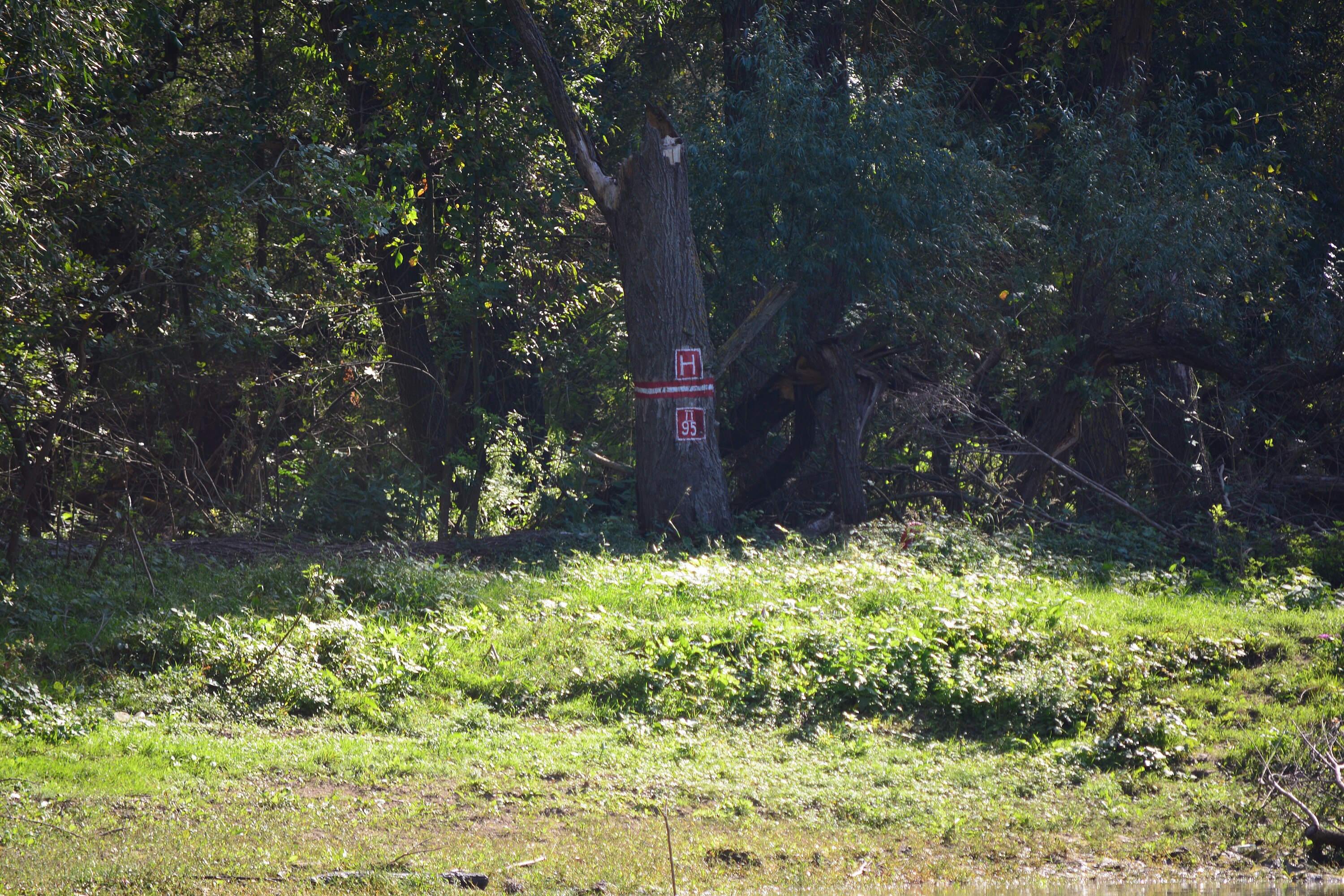
![[1]](../../../static.guim.co.uk/sys-images/Guardian/Pix/pictures/2013/8/1/1375365827102/wain-001.jpg)
Route marker of some sort, seen along a canal in the Danube Delta in Romania, near a branching off from the canal. I'm hoping someone knows something more about this. I suspect, but do not know for sure, that it is for a land route (e.g. a hiking trail), not a water route. I've been able to find some online images of similar markers, but no proper explanation. - Jmabel | Talk 22:00, 14 September 2025 (UTC)
This is a detail of a much larger photo, you can click through for some context. - Jmabel | Talk 22:00, 14 September 2025 (UTC)
- I've seen similar tree markings in Warsaw, but with blue-white-blue stripes. Romanian Wiki has an article on forest marking, saying that "the letter H is found on the main ridges, which usually separate important watersheds" and the red color, the most common, means property of the forest area. Brandmeistertalk 17:27, 15 September 2025 (UTC)
- Interesting. This is, of course, just above sea level, but could imaginably mark the divide between two canals in the Delta. - Jmabel | Talk 21:30, 15 September 2025 (UTC)
History as "Nothing more than an old almanac"
[edit]In the short story "The Thames Valley Catastrophe" by Grant Allen (The Strand Magazine, December 1897) we read "It is such personal touches of human nature that give reality to history, which without them must become, as a great writer has finely said, nothing more than an old almanac". In The Daily Intelligencer, August 20, 1867 (Atlanta, Georgia, USA) we read "Experience makes men wise in their private affairs, but national concerns, history, which is but experience on a greater scale, seems to he regarded as what a famous statesman once said of it—nothing more than 'an old almanac'." Who was this great writer and famous statesman, and when and where did he say this? Thank you, DuncanHill (talk) 23:03, 14 September 2025 (UTC)
- The "great writer" may be James Boswell; see pp. 487 f. of his Life of Johnson. The "famous statesman" on the other hand seems to be William Plunket. Speaking in support of the Catholic Relief Bill of 1825, he argued that the passage of time had rendered anti-Catholic legislation obsolete. The danger was no longer that Catholics might overthrow the king, but that the government might alienate people who would otherwise be good and loyal subjects.
There are men who persist in telling us that we are not to look at the dangers which actually beset us, but must cast our eyes back to the dangers that existed at the time of the Reformation, the reign of James the Second, and the Revolution. Sir, I will say that the present danger is the greatest, perhaps the only one that we have to consider. The other argument proves a want of acquaintance with human nature—it bespeaks a misapplication of the truths of history, and an utter ignorance of their real value.
Time, as has been said by the wisest of men and the most sagacious observer of its effects, is the greatest innovator of all. While man would sleep or stop in his career, the course of time is rapidly changing the aspect of all human affairs. It is the province of human wisdom to wait upon the wings of time—not with the vain hope of arresting his progress, but to watch his course—to adapt institutions to new circumstances as they arise, and to make their form reflect the varying aspect of events. Unless we do this, of what value is it to go back to former periods? Unless we draw lessons of wisdom from the facts which we recall, experience will become a swindler, who thrusts upon us an old coinage at a value which it has long since lost. Our knowledge will dwindle into pedantry, our prudence into dotage, and history itself will be no better than an old almanac.
- I'm sure that's right, and let me leap in to anticipate Duncan's next question: the wisest of men and most sagacious observer of its effects is Francis Bacon [9]. --Antiquary (talk) 09:20, 15 September 2025 (UTC)
- @Zacwill: Excellent, thank you. @Antiquary: I would have got that, the quotation about time is easy to find. But thank you for thinking of me. DuncanHill (talk) 10:29, 15 September 2025 (UTC)
September 15
[edit]Jacobite succession after Henry Benedict Stuart
[edit]According to Jacobite succession#Subsequent succession, Henry Benedict Stuart was the last of James II and VII's male line, and was succeeded by the descendants of James II and VII's youngest sister (Henrietta of Orleans), on the basis of male-preference primogeniture. Under male-preference primogeniture, shouldn't James II and VII's eldest daughter (Mary II) come before his sister's descendants? AlmostReadytoFly (talk) 10:58, 15 September 2025 (UTC)
- Certainly, if she had left any descendants who were still alive in 1807 when Henry Benedict Stuart died, but there were none, Mary II having died childless in 1694. Likewise Queen Anne's children had all predeceased her, hence the line of succession going to the kings of Sardinia. --Antiquary (talk) 12:52, 15 September 2025 (UTC)
- Ah, of course. Thanks. AlmostReadytoFly (talk) 13:50, 15 September 2025 (UTC)
September 16
[edit]Second-wave ("radical") feminism and 'transphobia'...
[edit]... The intersection of gender abolitionism and sex essentialism, or the intersection of women's rights (on a framework of civil rights law, in which womanhood is a 'condition of birth') - the consequence and even existence of 'woman' as a meaningful legal, social, etc., class, with malleability of legal and social gender - possibility in the society of gender transition. Deconstruction of 'internalized transphobia', or achievement of coexistence of intractable transphobia with (at least medical) sex transition. Or: "how to sow without reaping?"
| Not a question. Continue posting this whatever-it-is, and you will likely be blocked from editing. AndyTheGrump (talk) 18:21, 16 September 2025 (UTC) |
|---|
| The following discussion has been closed. Please do not modify it. |
|
Ladies and gentlemen, This past Thursday, September 11th, I visited on the recommendation of the voices (I mean not anything internal to me, since I am not afflicted in such a way, but by the so-called internet friends, those who, after the now-infamous formula, see without seeing and speak without speaking) affiliated with my university and accessible to me pro bono in that capacity (not the voices, I mean, but the shrink) a professional 'counselor'. It became necessary in answering basic questions (only basic and ultimately aimless, since, as it became clear, the very kind woman did not have any system or structure by which she desired to proceed in addressing my presentation of "gender dysphoria, confounded possibly by autism and schizoid personality" and did not directly address my question which was whether she knew very much about the condition or its treatment) After the visit (in which I did not discuss very much or deeply or candidly, for want of time, the presentation itself, but basic personal details and history i.a. of childhood trauma) the thought occurred to me that I might (following naturally from sex transition) pursue graduate study, then change my name and teach in [REDACTED] field in [REDACTED] Eastern European country. That is to say, that I might about as far as possible become a completely different person. That is, if the jumped-up twink's "unbelievable 2000 word a minute computer god brain machines" don't kill us all or make us 'obsolete' in the 'job market', etc. It is scarcely necessary to note (because I had not before, even in much worse immediate circumstances, considered anything so drastic) that even beginning to 'air' my concerns, which I had not done before in years with any real live human being, did not really improve my condition and outlook. Since John Stoltenberg, Andrea Dworkin's long-time 'domestic partner', refers in the second, I believe, chapter of his seminal work Refusing to Be a Man to sex in humans as a 'spectrum', and the performance of sex - i.e., gender roles, in every sense and 'sector' of life, as harmful to and imposing on both parties (even in a "male-supremacist" society), a position which (and he credits this with "sav[ing his] life") adopted from Dworkin, she having expressed this in 1974 (if you search the year, you can find the block-quotation which appears in the work) - on this view even male and female sexes, and even in the strictly medical sense, are socially constructed At the same time, Dworkin refers (as I mention in the title, in the context of discussion of pornography as a violation of the civil rights of women) to womanhood as a 'condition of birth' - maybe it was on Firing Line - Women Against Pornography - or else in her testimony to Congress on the subject Germaine Greer, though, another of the most prominent second-wave feminists, appears (at least now, in her eighth (?) decade) (in a recent BBC interview on the subject of transgender people) strikingly hackish and given to warble - she discusses at the very end the consequences of male supremacy and 'toxic masculinity' for males themselves, and appears (tangentially and without much preamble or thought) to diagnose male homosexuality as a "choice", and also "conscious rejection" of masculinity (competition for status, hierarchy, women ...) as embodied in all-male social groups (of adolescents) which in my mind (I mean, because it is so completely out there, it is even a hallucination) totally discredits all of her earlier remarks at least in that talk (about transgender women as basically male etc) I greatly sympathize with contemporary radical feminist critiques of transgender women i.a. as performing a 'caricature' of femininity. Of course, one cannot actually become female - not totally, at least, not perfectly, although there is something to be said, as Serano argues, for the malleability of secondary sex characteristics and the real ways in which transgender women become biologically female - and so one must 'perform' femininity to the Nth degree (even in order to 'pass' successfully) - for example, it is scarcely necessary for a biological (previously 'natal', 'genetic') woman to shave daily, or twice-daily, or to seek out laser hair removal for facial hair, etc., but the vast majority of transgender women could not 'pass' without it. Ditto with leg hair - and the practice of shaving leg, arm etc. hair is (rightfully, in my opinion) criticized by feminists as a modern Western social construct by which women are made to resemble prepubescent children. But, unfortunately, a transgender woman who failed to shave her legs regularly would appear grotesque (since hormone therapy by itself does not apparently reduce hair growth to levels typical of cisgender women) thank you now 130.74.59.59 (talk) 17:44, 16 September 2025 (UTC)
|
September 17
[edit]Australian Capital Territory local government
[edit]Not sure why, but Facebook just showed me a story about a neighbourhood dispute in the ACT — someone's running a business out of his home, and some upset neighbours are complaining to the Chief Minister. I know that the ACT has no separate layer of local government, with the entire Legislative Assembly functioning like a local council in the rest of the country, but...are the Legislative Assembly and the Chief Minister involved in day-to-day matters just as much as are a typical council and mayor, or do they have some sort of stand-in that handles a lot of the day-to-day policy stuff, above the individual ministries? It just seems awkward to imagine the Chief Minister having to leave a discussion of parking meter policy so he can go to a National Cabinet meeting, and then after that's done, having to deal with zoning matters like the Facebook story.
Essentially I'm wondering if there's anything analogous to the Cardinal Vicar, who handles local matters for the Pope — as the bishop of Rome he has to deal with local matters, but because he has bigger matters to deal with, he appoints a cardinal vicar to handle day-to-day matters. Government of the Australian Capital Territory doesn't mention anything analogous, but it's a rather minimal article that just lists the ministers and the civil service departments. Nyttend (talk) 09:51, 17 September 2025 (UTC)
- Isn't the ACT essentially a city state like there are thousands? Most of the time, the head of government is in city states is called "mayor", but has the status of a prime minister/head of state (or similar). In the case of the ACT, just the name comes from the other side of the scale, but the basic construct seems to be the same. I mean, you surely would not find it strange that the Mayor of Berlin sits in a meeting deciding about landscaping in the city parks and then hosts the Conference of Minister-Presidents to negotiate distribution of federal funds. Is the only difference that one of them is titled "mayor" and the other "chief minister"? — Preceding unsigned comment added by 91.221.58.24 (talk) 13:54, 17 September 2025 (UTC)
- I don't know how this works in Germany or most other countries where a city can exist at the top level of a federal structure, but a practical difference is that we have just a few federal units, so each of them proportionally matters a good deal, and we have this National Cabinet (Australia) with just nine members (including the ACT Chief Minister) who periodically make decisions, and because each commands a majority in his jurisdiction's parliament, together they can essentially push through legislation nationwide if they all agree to do something. Very different from the role of the Mayor of DC in my native US, who has no functional role outside Washington DC. From reading your linked article, I see that the Conference is purely informal, and I don't know enough about the German system to tell whether all the states' heads of government can put through state-level legislation as easily as premiers/chief ministers can here. Nyttend (talk) 19:42, 17 September 2025 (UTC)
Belarus and other countries
[edit]Why Belarus has evolved so different from Lithuania and Poland, despite all three being semi-presidential republics? Why Belarus has strong ties with Russia and has an aithoritarian regime? --40bus (talk) 18:04, 17 September 2025 (UTC)
- If, per User:Zacwill [10], anyone can answer this without offering 'opinion', I'd like to know how. AndyTheGrump (talk) 22:49, 17 September 2025 (UTC)
- kindly refrain from appointing yourself censor 166.199.148.78 (talk) 22:52, 17 September 2025 (UTC)
- Poland - Soviet-invaded and occupied former satellite state of the Eastern Bloc, in which the first and only working-class revolution in the world occurred - that of the Solidarity movement.
- Lithuania - Soviet-invaded and annexed former Soviet republic, in which a working-class national-liberation movement also operated during the late 1980s.
- In both countries resistance movements, exiles, and Western involvement helped to develop democratic institutions.
- Belarus - integral republic of the Soviet 'prison of nations', in which the Russian language was dominant - remained part of the Russian sphere even during Yeltsin era - Lukashenko took power in 1990, agreed Russian military presence in Belarus 1995, 'Union State' 1997, and remains 'Europe's last dictator' (although there are some new contenders for this title.)
- in short: survival of existing late-Soviet-era elite and deeper ties with Mother Russia 166.199.148.78 (talk) 22:57, 17 September 2025 (UTC)
- Keep in mind that Ukraine also had a pro-Russian guy in office in the early 2010s, until he was thrown out, which led to the current conflict. ←Baseball Bugs What's up, Doc? carrots→ 01:59, 18 September 2025 (UTC)
- Also note that Belorusians tried to get rid of Lukashenko in the 2020–2021 Belarusian protests, but these were heavily repressed with massed detentions and torture of demonstrators. Alansplodge (talk) 12:20, 18 September 2025 (UTC)
September 18
[edit]Conrad Noel, the Red Vicar of Thaxted
[edit]Why was Conrad Noel rusticated from Corpus Christi, Cambridge? Neither our article nor the ODNB say. Thank you, DuncanHill (talk) 21:20, 18 September 2025 (UTC)
- According to this lengthy book review of Conrad Noel and the Catholic Crusade: A Critical Evaluation – ed. Ken Leech, he was "rusticated for the singular zeal with which he evaded lectures for the pleasures of elaborate supper parties, effigy burning, serenading the young ladies at Newnham, and careering about the country in a dog cart: all in the name of the Catholic faith." So there you go. {The poster formerly known as 87.81.230.195} 90.193.153.108 (talk) 01:01, 19 September 2025 (UTC)
- Thank you. DuncanHill (talk) 09:27, 19 September 2025 (UTC)
Unidentified vessel
[edit]
In Tulcea, so presumably a Romanian navy vessel. I can't even guess what sort of craft this is, so any info would be useful. Note the "301" at right, if that's any help. Jmabel | Talk 21:48, 18 September 2025 (UTC)
- It looks like a floating drydock to me. PiusImpavidus (talk) 22:45, 18 September 2025 (UTC)
- @PiusImpavidus: very plausible. Have you ever seen one that looked like this? Or did I just chance upon a very unusual floating drydock? - Jmabel | Talk 03:09, 19 September 2025 (UTC)
- According to List of equipment of the Romanian Armed Forces#Auxiliary vessels, RF301 is a Lupeni class river tugboat, but the vessel in the picture looks totally different than any picture of the Lupeni tugs I can find online. — Preceding unsigned comment added by 91.221.58.21 (talk) 08:32, 19 September 2025 (UTC)
- I tried following the reference link on Lupeni in that table and Firefox gave me a bunch of warnings about the site. I got as far as the McAfee pop-up and opted out. I'm glad I use NoScript. "Romania Forum" doesn't sound particularly WP:RS to me either. The archived version here is okay, but as you say, those vessels don't look like the one pictured. Matt Deres (talk) 14:03, 19 September 2025 (UTC)
- According to List of equipment of the Romanian Armed Forces#Auxiliary vessels, RF301 is a Lupeni class river tugboat, but the vessel in the picture looks totally different than any picture of the Lupeni tugs I can find online. — Preceding unsigned comment added by 91.221.58.21 (talk) 08:32, 19 September 2025 (UTC)
- @PiusImpavidus: very plausible. Have you ever seen one that looked like this? Or did I just chance upon a very unusual floating drydock? - Jmabel | Talk 03:09, 19 September 2025 (UTC)
Holding up one hand to pray
[edit]There's a thing some USians do when performatively praying, of holding up one hand as seen here. Where, when, and why did this originate? Thanks, DuncanHill (talk) 22:30, 18 September 2025 (UTC)
- I googled the general topic and it seems to be an ancient practice. It might have fallen out of favor for a while after the Nazis hijacked it. ←Baseball Bugs What's up, Doc? carrots→ 13:11, 19 September 2025 (UTC)
- There is quite a lot (like 26000 entries) of peer-reviewed material about prayer gestures involving the hands on Wikipedia library. I would suggest @DuncanHill you might start there to find some useful information on this topic. You should definitely qualify for access. Simonm223 (talk) 14:09, 19 September 2025 (UTC)
September 19
[edit]Any media reports on the current state of mind of USA Supreme Court Justices?
[edit]Specifically, do the 6 conservative US Supreme Court justices actually think everything is fine and dandy right now? Are they really utterly unconcerned?Rich (talk) 08:33, 19 September 2025 (UTC)
- It's not their role to be concerned about the state of the nation. They deliberate on constitutional and other matters that are officially brought to their judicial attention.
- They cannot, for example, send a letter to the president saying "Dear Mr President, We think you're making a mess of things. Please lift your game or we'll do something about it." -- Jack of Oz [pleasantries] 12:03, 19 September 2025 (UTC)
- Precisely. It's rather startling that you, an Australian, understands the US Supreme Court's role better than many Americans do! ←Baseball Bugs What's up, Doc? carrots→ 13:10, 19 September 2025 (UTC)
- Baseball Bugs, there could be millions of Americans who don't understand the Supreme Court, but still, most adult Americans understand it.Rich (talk) 13:58, 19 September 2025 (UTC)
- Don't be too sure. ←Baseball Bugs What's up, Doc? carrots→ 14:06, 19 September 2025 (UTC)
- Baseball Bugs, there could be millions of Americans who don't understand the Supreme Court, but still, most adult Americans understand it.Rich (talk) 13:58, 19 September 2025 (UTC)
- Okay, Jack of Oz, but I should have said that I am asking about if they are concerned about the results of their decisions. I had this in my brain so strongly that I didn't realize it needed to be stated. Of course you can't read my mind.Rich (talk) 13:52, 19 September 2025 (UTC)
- We knew you were going to say that. ←Baseball Bugs What's up, Doc? carrots→ 14:06, 19 September 2025 (UTC)
- Precisely. It's rather startling that you, an Australian, understands the US Supreme Court's role better than many Americans do! ←Baseball Bugs What's up, Doc? carrots→ 13:10, 19 September 2025 (UTC)