


Wikipedia:Picture of the day/Archive

|
Featured picture tools: |
These featured pictures, as scheduled below, appeared as the picture of the day (POTD) on the English Wikipedia's Main Page in the last 30 days.
You can add an automatically updating POTD template to your user page using {{Pic of the day}} (version with blurb) or {{POTD}} (version without blurb). For instructions on how to make custom POTD layouts, see Wikipedia:Picture of the day.
September 18
_Freycinet.jpg/500px-Little_pied_cormorant_(Microcarbo_melanoleucos)_Freycinet.jpg)
|
The little pied cormorant (Microcarbo melanoleucos) is a species of waterbird in the cormorant family, Phalacrocoracidae. It is a common bird found around the coasts, islands, estuaries and inland waters of Australia, New Guinea, New Zealand, Timor-Leste and Indonesia, and around the islands of the south-western Pacific and the subantarctic. Measuring 56 to 58 centimetres (22 to 23 inches) in length with a short bill, it is usually black above and white below with a yellow bill and small crest, although a mostly black, white-throated form predominates in New Zealand. This little pied cormorant was photographed in Freycinet National Park in Tasmania, Australia. Photograph credit: Charles J. Sharp
Recently featured:
|
September 17

|
|
The Battle of Antietam took place during the American Civil War on September 17, 1862, between Confederate General Robert E. Lee's Army of Northern Virginia and Union Major General George B. McClellan's Army of the Potomac near Sharpsburg, Maryland, and Antietam Creek. Part of the Maryland campaign, it was the first field army–level engagement in the Eastern theater of the American Civil War to take place on Union soil. It remains the bloodiest day in American history, with a tally of 22,727 dead, wounded, or missing on both sides. Although the Union Army suffered heavier casualties than the Confederates, the battle was a major turning point in the Union's favor. This 1887 lithograph by Thure de Thulstrup depicts the charge of the Iron Brigade near the Dunker Church. Illustration credit: Thure de Thulstrup; restored by Adam Cuerden
Recently featured:
|
September 16

|
The Asaro Mudmen are a group of people in the Asaro River valley in the Eastern Highlands Province of Papua New Guinea who wear characteristic large decorative clay masks over their heads, accompanied by white body paint and long bamboo fingers. Likely inspired by traditional methods of obscuring faces during inter-tribal violence, researchers believe that the modern tradition of the Asaro Mudmen developed in the village of Komunive during the second half of the 20th century, first as a marker of village identity, and then as part of a significant tourism industry. Today, Mudmen imagery has become a cultural symbol for Asaro, the province, and to some extent the country as a whole. This Asaro Mudman carrying his clay mask on his shoulder was photographed in 2008 in the village of Kabiufa, part of the Asaro valley. Photograph credit: Jialiang Gao
Recently featured:
|
September 15
%2c_pow%c3%b3d%c5%ba.jpg/500px-2024_K%c5%82odzko%2c_zesp%c3%b3%c5%82_klasztorny_franciszkan%c3%b3w_(3)%2c_pow%c3%b3d%c5%ba.jpg)
|
|
The 2024 Central European floods were a series of floods caused by a record heavy rainfall generated by Storm Boris, an extremely humid Genoa low. The flooding began in Austria and the Czech Republic, then spread to Poland, Romania and Slovakia, and then onwards to Germany and Hungary. The floods caused 28 fatalities and over 4 billion euros in damage. This photograph shows floodwater surrounding the Franciscan monastery in Kłodzko, Poland, on 15 September 2024. Photograph credit: Jacek Halicki
Recently featured:
|
September 14
_swimming.jpg/500px-African_common_toad_(Amietophrynus_gutturalis)_swimming.jpg)
|
Sclerophrys gutturalis, also known as the African common toad or the guttural toad, is a species of amphibian in the true toad family, Bufonidae. It is found in Africa in a region stretching from Kenya west to Angola and south to South Africa, and inhabits areas of forest, savanna and wetland. Males grow up to 90 millimetres (3.5 in) and females 120 millimetres (4.7 in) in length. The upper surface is buffish brown with variable irregular dark brown markings, while the underparts are pale and granular and the male has a dark throat. This photograph shows a S. gutturalis toad swimming in Lake Sibaya, South Africa. Photograph credit: Charles J. Sharp
Recently featured:
|
September 13

|
|
Ustyurt Nature Reserve is a nature reserve in Mangystau Region, southwest Kazakhstan, near the borders with Uzbekistan and Turkmenistan. Established in 1984, it has an area of 2,230 km2 (860 sq mi) and lies within the Ustyurt Plateau. The reserve is intended to safeguard the desert as well as the rare flora and fauna in the area. It is home to 250 species of flora such as grey sage, feather grass, Anabasis salsa, and saltwort, as well as around 44 species of mammals such as the Ustyurt mouflon, saiga antelope, jeyran, fox and polecat. The reserve has a variety of landscapes, from steppes and depressions to pillars reaching several hundred metres in height, and features several Neolithic sites. This photograph shows an aerial view of the Karynzharyk Depression in Ustyurt Nature Reserve. Photograph credit: Maksat Bisengaziev
Recently featured:
|
September 12
_Oppdal.jpg/500px-Common_ringed_plover_(Charadrius_hiaticula)_Oppdal.jpg)
|
The common ringed plover (Charadrius hiaticula) is a species of bird in the family Charadriidae. Its breeding range consists of much of northern Eurasia, as well as Greenland. It is a migratory bird and many individuals spend their winters in locations across Africa. Its breeding habitat is generally open ground on beaches or flats although some birds breed inland. They are commonly found both in low coastal plains and in cold uplands with sparse vegetation, in open habitats with little or no plant cover, where they nest on the ground. Breeding occurs from one year of age, with egg laying generally beginning around May. A clutch of three to four eggs is laid at intervals of one to three days, with the downy grey-buff chicks hatching after twenty-one to twenty-seven days. The common ringed plover forages for food on beaches, tidal flats and fields, usually by sight. It eats insects, crustaceans and worms, forages both by day and by night, and sometimes uses foot-trembling to reveal location of prey. This common ringed plover was photographed near Orkelsjøen, a lake in Oppdal, Norway. Photograph credit: Charles J. Sharp
Recently featured:
|
September 11

|
|
The Austin J. Tobin Plaza was a large public square that was located on the World Trade Center site from 1966 until its destruction in 2001 during the September 11 attacks. It covered five acres (220,000 sq ft; 2.0 ha), making it the largest plaza in New York City by acreage at the time. The plaza opened as part of the original World Trade Center complex on April 4, 1973, and was renamed in 1982 after Austin J. Tobin, a former executive director of the Port of New York Authority. The plaza was damaged by a car bomb in the 1993 World Trade Center bombing, and was destroyed by Islamist terrorists from al-Qaeda eight years later on September 11, 2001. This photograph, taken in 1976 by the Hungarian-American photographer Balthazar Korab, shows an elevated view of the Austin J. Tobin Plaza as seen from 5 World Trade Center. The Sphere and Ideogram, two of several public sculptures in the plaza, are visible in the image. Photograph credit: Balthazar Korab
Recently featured:
|
September 10

|
Plantago lanceolata, also known as the ribwort plantain, among other names, is a species of flowering plant in the plantain family Plantaginaceae. It is native to Europe and western Asia and has also been introduced elsewhere in the world, including North America, Oceania, Japan, South Africa and Chile. The plant is a rosette-forming perennial herb, with leafless, silky, hairy flower stems, typically growing to 45 centimetres (18 in) in height. The flower stalk is deeply furrowed, ending in an ovoid inflorescence of many small flowers each with a pointed bract. Plantago lanceolata is used in herbal teas and other herbal remedies and is also employed as a prop in various children's games. This P. lanceolata inflorescence was photographed in Kulna, Estonia. Photograph credit: Ivar Leidus
Recently featured:
|
September 9
_male.jpg/500px-Poplar_hawk-moth_(Laothoe_populi_populi)_male.jpg)
|
|
The poplar hawkmoth (Laothoe populi) is a moth in the family Sphingidae. It is found throughout the Palearctic region and the Near East and is one of the most common members of the family in the region. The poplar hawkmoth produces one or two broods each year, the spherical, pale green eggs being laid on the underside of leaves. The larva is initially pale green with small yellow tubercles and a cream-coloured tail horn, later developing yellow diagonal stripes on its sides and growing to a length of 65 to 85 millimetres (2.6 to 3.3 in). It has a diet of tree leaves such as poplar, willow and aspen. The adult poplar hawkmoth is seen between between May and August and lives for a few weeks as an adult. During this time it does not feed, instead relying on fat built up during the larval stage. This male adult poplar hawkmoth of the subspecies L. p. populi was photographed in Cumnor Hill in Oxfordshire, England. Photograph credit: Charles J. Sharp
Recently featured:
|
September 8

|
Erin Kellyman (born 1998) is an English actress. Originally from Tamworth, Staffordshire, and a graduate of the Nottingham Television Workshop, she gained prominence with appearances in the Channel 4 sitcom Raised by Wolves (2015–2016) and the BBC series Les Misérables (2018), Don't Forget the Driver (2019), and Life (2020). In 2021, Kellyman was cast as Karli Morgenthau, the leader of the Flag Smashers, in the Disney+ action series The Falcon and the Winter Soldier, and in 2022 she appeared as Jade, a knight in training, in the series Willow. Polygon described the on-screen relationship between Jade and fellow series lead Kit, portrayed by Ruby Cruz, as "the first true franchise on Disney+ to really center a queer story". This photograph of Kellyman was taken at the 2025 Cannes Film Festival. Photograph credit: Harald Krichel; edited by Yann Forget
Recently featured:
|
September 7
_(cropped).jpg/500px-Arenal_volcano_(70785p)_(cropped).jpg)
|
|
Arenal Volcano is a stratovolcano in north-western Costa Rica, in the province of Alajuela. It is within the Arenal Volcano National Park. The volcano is conically shaped with a height of 1,633 metres (5,358 ft) and a crater with a diameter of 140 metres (460 ft). Arenal is a young volcano, estimated to be less than 7,500 years old. The volcano was dormant for hundreds of years and exhibited two craters at its summit, with minor fumaroles activity, covered by dense vegetation. In 1968 it erupted unexpectedly, destroying the small town of Tabacón. Due to the eruption three more craters were created on the western flanks but only one of them exists today. By duration, Arenal's eruption from 1968 to 2010 is the tenth longest volcanic eruption on Earth since 1750. Since 2010, Arenal has been dormant. Photograph credit: Rhododendrites |
September 6
_male_Adelaide.jpg/500px-Galah_(Eolophus_roseicapilla_albiceps)_male_Adelaide.jpg)
|
The galah (Eolophus roseicapilla) is a species of bird in the cockatoo family, Cacatuidae. It is endemic to mainland Australia and is also an introduced species in Tasmania and New Zealand. The galah is adapted to a wide variety of modified and unmodified habitats and is one of Australia's most abundant and widespread bird species, being absent only from the driest areas and the far north of Cape York Peninsula. The galah is often found in flocks of 10 to 1,000 individuals, which can be mixed flocks also including the pink cockatoo, the little corella, and the sulphur-crested cockatoo. It is known to hybridize with all of these species. The galah nests in tree cavities and lays white eggs, usually two to five in a clutch. The eggs are incubated for about 25 days, and the chicks leave the nest about 49 days after hatching. Galahs in captivity have been known to live for up to 72 years. This male galah of the subspecies E. r. albiceps was photographed in the Adelaide Botanic Garden in Adelaide, South Australia. Photograph credit: Charles J. Sharp
Recently featured:
|
September 5
.jpg/330px-John_Cage_(1988).jpg)
|
John Cage (September 5, 1912 – August 12, 1992) was an American composer and music theorist. A pioneer of indeterminacy in music, electroacoustic music, and the non-standard use of musical instruments, Cage was one of the leading figures of the post-war avant-garde. Critics have lauded him as one of the most influential composers of the 20th century. He was also instrumental in the development of modern dance, mostly through his association with choreographer Merce Cunningham, who was also Cage's romantic partner for most of their lives. Cage's best known work is the 1952 composition 4′33″, a piece performed in the absence of deliberate sound; musicians performing the work do nothing but be present for the duration specified by the title. The content of the composition is intended to be the sounds of the environment heard by the audience during performance. This 1988 head shot of Cage is in the archives of Anefo, a Dutch photograph press agency. Photograph credit: Rob Bogaerts; cropped by Jan Arkesteijn
Recently featured:
|
September 4

|
|
Lady Peak is a mountain located just southeast of Cheam Peak in the Cheam Range near Chilliwack, British Columbia, Canada. It is west of the four peaks in the eastern portion of the range known as the Lucky Four Group. The peak was named by Arthur S. Williamson, superintendent of the nearby Lucky Four Mine, to honor the Canadian mountaineer Phyllis Munday. This panoramic photograph shows Lady Peak from the trail to Cheam Peak. Photograph credit: The Cosmonaut
Recently featured:
|
September 3
%2c_mar_Rojo%2c_Egi/500px-Pepino_de_mar_(Thelenota_ananas)%2c_mar_Rojo%2c_Egipto%2c_2023-04-17%2c_DD_61.jpg)
|
|
Thelenota ananas, also known as pineapple sea cucumber, among other names, is a sea cucumber in the family Stichopodidae. It is found in tropical Indo-Pacific waters, on the sandy bottom of lagoons and in slabs near coral, from the Red Sea and East Africa to Hawaii, Polynesia, the Maldives and Australia. The species is characterized by its large size – reaching up to 70 centimetres (28 inches) in length, with a mass of 3 to 6 kilograms (7 to 13 pounds) – and has pointed, star-shaped teats covering the entire body. The body is reddish-orange in color. It plays an important role in coral reef ecosystems, for example by recycling nutrients, and is often eaten as food. This T. ananas sea cucumber was photographed in the Red Sea off the coast of Egypt. Photograph credit: Diego Delso
Recently featured:
|
September 2

|
|
The Japanese Instrument of Surrender is a written agreement that was signed on the deck of the battleship Missouri in Tokyo Bay on 2 September 1945. It formalized the surrender of Japan and marked the end of hostilities in World War II. The agreement was signed on behalf of Emperor Hirohito by Japanese foreign minister Mamoru Shigemitsu, and on behalf of the Japanese armed forces by General Yoshijirō Umezu, Chief of the Army General Staff. It was then signed by representatives from the Allied nations: the United States, China, the United Kingdom, the Soviet Union, Australia, Canada, France, the Netherlands, and New Zealand. This image shows the Allied copy of the Japanese Instrument of Surrender, which is now housed in the United States National Archives Building in Washington, D.C. Document credit: United States Department of War; restored by Lise Broer
Recently featured:
|
September 1
.jpg/500px-Castle_Square_(22346p).jpg)
|
|
Castle Square is a historic square in Warsaw, Poland, that serves as the gateway to Warsaw's Old Town. The square features the Royal Castle and Sigismund's Column, and is surrounded by historic townhouses. It forms the starting point of the Royal Route. The Old Town, including Castle Square, suffered extensive damage during World War II and was reconstructed in the postwar period. In 1980, the United Nations Educational, Scientific and Cultural Organization (UNESCO) inscribed the Historic Centre of Warsaw on the list of World Heritage Sites as an example of the near-total reconstruction of a historic town centre. This photograph shows an elevated view of Castle Square in 2024, as seen from the tower of St. Anne's Church, facing roughly northwards. Sigismund's Column can be seen in the foreground on the left, and the Royal Castle is the building on the right of the image. A part of the facade and roof of St. John's Archcathedral is visible in the background. Photograph credit: Rhododendrites
Recently featured:
|
August 31
._09-11-2023._(d.j.b).jpg/500px-Grote_sponszwam_(Sparassis_crispa)._09-11-2023._(d.j.b).jpg)
|
|
Sparassis crispa is a species of fungus in the family Sparassidaceae. It is sometimes called cauliflower fungus. It is common in Great Britain and temperate Europe (but not in the boreal zone), from July to November. Sparassis crispa grows in an entangled globe that is up to 10 inches (24 centimetres) in diameter, with larger specimens weighing up to 14 kilograms (30 lb) or more. It is considered a good edible fungus when young and fresh, but is difficult to clean before use. This S. crispa was photographed in Joure, Netherlands. The picture was focus-stacked from 20 separate images. Photograph credit: Dominicus Johannes Bergsma
Recently featured:
|
August 30
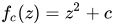
The Mandelbrot set is a two-dimensional mathematical set that is defined in the complex plane as the numbers for which the function does not diverge to infinity when iterated starting at . It was first defined and drawn by Robert W. Brooks and Peter Matelski in 1978, as part of a study of Kleinian groups, with Benoit Mandelbrot obtaining the first high-quality visualizations of the set two years later. Images of the Mandelbrot set exhibit an infinitely complicated boundary that reveals progressively ever-finer recursive detail at increasing magnifications; mathematically, the boundary of the Mandelbrot set is a fractal curve. The Mandelbrot set is well-known outside mathematics and is commonly cited as an example of mathematical beauty. These images, generated by a computer program, show an area of the Mandelbrot set known as "seahorse valley", which is centred on the point , at increasing levels of magnification. Image credit: Wolfgang Beyer
Recently featured:
|









August 29
.jpg/500px-American_avocet_(84292).jpg)
|
The American avocet (Recurvirostra americana) is a large wader in the avocet and stilt family, Recurvirostridae, found in North America. It spends much of its time foraging in shallow water or on mud flats, often sweeping its bill from side to side in water as it seeks crustacean and insect prey. The bird is around 40–51 cm (16–20 in) in length and has a bill which is black, pointed, and curved slightly upwards towards the tip. Its breeding habitat consists of marshes, beaches, prairie ponds, and shallow lakes in the Midwestern United States and southern Canada. This American avocet was photographed in Jamaica Bay Wildlife Refuge East Pond, New York City, United States. Photograph credit: Rhododendrites
Recently featured:
|
August 28
.jpg/500px-Martin_Luther_King_Jr_National_Historic_Site_(36233249121).jpg)
|
|
"I Have a Dream" is a public speech that was delivered by the American civil rights movement activist and Baptist minister Martin Luther King Jr. during the March on Washington on August 28, 1963. In the speech, which was delivered to more than 250,000 civil rights supporters from the steps of the Lincoln Memorial in Washington, D.C., King called for civil and economic rights and an end to legalized racism in the United States. He noted the Emancipation Proclamation of 1863, which declared millions of slaves free, but said that "one hundred years later, the Negro still is not free". The speech is regarded as one of the most famous moments of the civil rights movement and among the most iconic speeches in American history. This photograph, from the collection of the Martin Luther King Jr. National Historical Park, shows King shortly after concluding his speech, waving to the crowd assembled around the Lincoln Memorial Reflecting Pool. The Washington Monument is visible in the background. Photograph credit: unknown
Recently featured:
|
August 27
%2c_Zanz%c3%adbar%2c_Ta/500px-Lenguado_(Pardachirus_marmoratus)%2c_Zanz%c3%adbar%2c_Tanzania%2c_2024-05-31%2c_DD_32.jpg)
|
|
Pardachirus marmoratus is a species of flatfish in the true sole family Soleidae, native to the western Indian Ocean from the Red Sea to Sri Lanka and along the east coast of Africa to Durban. It is found in shallow, coastal waters where the seabed consists of sand or mud, often near coral reefs, and feeds mainly on benthic invertebrates. The body is highly compressed, convex on the eyed side and flat on the blind side. Its colour is frequently whitish, pale brown to pale grey with a scattering of irregular dark brown ring shape markings and many dark brown spots on the head, body, and fins. Pardachirus marmoratus's colour provides camouflage when it rests on sandy or pebbled seafloors. This camouflaged P. marmoratus individual was photographed in the Indian Ocean near Zanzibar. Photograph credit: Diego Delso
Recently featured:
|
August 26

|
|
Willistead Manor is a historic house located in the former town of Walkerville, Ontario, now part of Windsor. Designed by Albert Kahn for Edward Chandler Walker and built between 1904 and 1906, the manor was ceded to the community in 1921, a few years after Walker's death. Having served as Walkerville's town hall, the Art Gallery of Windsor, and a branch of the Windsor Public Library, it is currently used as a banquet hall. The manor is designed in the Tudor Revival style, and the grounds also include a coach house and a gate house of similar design. This photograph shows the front facade of Willistead Manor in 2025. Photograph credit: Chris Woodrich
Recently featured:
|
August 25

|
|
The date palm (Phoenix dactylifera) is a species of flowering plant in the palm family, Arecaceae, cultivated for its edible sweet fruit known as dates. The species is widely cultivated across North Africa, the Middle East, the Horn of Africa, Australia, South Asia, and the desert regions of southern California in the United States. Phoenix dactylifera is the type species of the genus Phoenix, which contains 12 to 19 species of wild date palms. This focus-stacked photograph shows two mazafati dates grown in Iran, one whole and one halved with its seed removed. Photograph credit: Ivar Leidus
Recently featured:
|
August 24

|
The Apollo Lunar Module was the lunar lander that was flown between lunar orbit and the Moon's surface during the American Apollo program. Ten Lunar Modules were launched into space between 1968 and 1972. It was the first crewed spacecraft to operate exclusively in space, and remains the only crewed vehicle to land anywhere beyond Earth. Incapable of flight through Earth's atmosphere, the two-stage spacecraft was ferried to lunar orbit attached to the Apollo command and service module, about twice its mass. Its crew of two flew the Lunar Module from lunar orbit to the Moon's surface. During takeoff, the spent descent stage was used as a launch pad for the ascent stage which then flew back to the command module, after which it was also discarded. This photograph, taken by Neil Armstrong during the Apollo 11 mission in 1969, shows Buzz Aldrin removing equipment from the Lunar Module Eagle on the surface of the Moon at Tranquility Base. Photograph credit: Neil Armstrong
Recently featured:
|
August 23
|
|
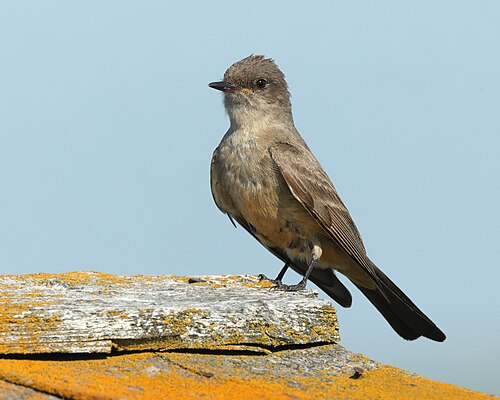
Say's phoebe (Sayornis saya) is a bird species in the tyrant flycatcher family, Tyrannidae. A common bird across western North America, it prefers dry, desolate areas. The species was named after Thomas Say, an American naturalist. It has a diet consisting primarily of insects such as grasshoppers, flies, crickets, beetles and bees, and occasionally small fish. Similar to the eastern phoebe, it sallies from a perch to catch insects in mid-air. Like other phoebes, it creates nests under bridges, canyon walls, wells and abandoned mine shafts, the cup-shaped nest created by the female out of grass and other fine materials. Say's phoebes have been found to breed anytime between late March and late August, egg clutches numbering between three and seven. Say's phoebe is known to use "song-like" displays as its main form of communication. The song is characterized as having a very loud pitch to begin and then slowly leveling off into a more steady pitch. This Say's phoebe was photographed in Grasslands National Park in Saskatchewan, Canada. Photograph credit: Simon Pierre Barrette
Recently featured:
|
August 22

|
Dua Lipa (born 22 August 1995) is a singer, songwriter and actress with British, Albanian and Kosovan nationalities. After a career as a model, she began a music career, signing with Warner Records in 2014. Her debut album, Dua Lipa (2017), peaked at number three on the UK Albums Chart and spawned the singles "Be the One", "IDGAF", and the UK number-one single "New Rules". Her second album, Future Nostalgia (2020), became her first UK number-one album and peaked in the top-three in the US. It contained singles "Don't Start Now" (another UK number one, which also ranked in the top five on the United States year-end chart of 2020), "Physical", "Break My Heart", and "Levitating". Lipa subsequently scored her third and fourth UK number-one singles with the 2021 Elton John duet "Cold Heart (Pnau remix)" and "Dance the Night" from Barbie the Album, the soundtrack of the film Barbie (2023), wherein she also made her acting debut. Her third studio album is Radical Optimism (2024), which again topped the UK Albums Chart and was preceded by the UK top-ten singles "Houdini", "Training Season", and "Illusion". Lipa's accolades include seven Brit Awards and three Grammy Awards. This photograph shows Lipa performing at the 2016 SWR3 New Pop Festival in Baden-Baden, Germany. Photograph credit: Harald Krichel
Recently featured:
|
August 21
%2c_Ras_Katy%2c_Sharm_el/500px-Coral_(Sarcophyton_glaucum)%2c_Ras_Katy%2c_Sharm_el-Sheij%2c_Egipto%2c_2022-03-26%2c_DD_113.148b8.de)
|
Sarcophyton glaucum, also known as toadstool leather coral or rough leather coral, is a species of soft coral in the family Alcyoniidae, found from the Red Sea to the western Pacific Ocean. Like other members of Alcyoniidae, it does not have a hard exoskeleton. They are sedentary and taxonomically identified by calcareous sclerites on their exoskeletons, and feature polyps with eight tentacles. Sarcophyton corals build monospecific colonies, typically found in a range of intertidal, subtidal, and near-shore reef flat habitats. Individual S. glaucum corals grow up to 80 centimetres (31 in), usually on reef flats, in lagoons, or on seaward slopes. This S. glaucum coral formation was photographed in the Red Sea off the coast of Ras Katy, near Sharm El Sheikh, Egypt. Photograph credit: Diego Delso
Recently featured:
|
August 20
|
Hallelujah is a 1929 American pre-Code musical film distributed by Metro-Goldwyn-Mayer (MGM), directed by King Vidor, and starring Daniel L. Haynes and Nina Mae McKinney. Filmed in Tennessee and Arkansas, and chronicling the troubled quest of the sharecropper Zeke Johnson (Haynes) and his relationship with the seductive Chick (McKinney), Hallelujah was one of the first films with an all–African-American cast produced by a major studio. Released on August 20, 1929, Hallelujah was Vidor's first sound film, and combined sound recorded on location with sound recorded post-production in Hollywood. It was intended for a general audience, and was considered so risky a venture that MGM required Vidor to invest his own salary in the production. He expressed an interest in "showing the Southern Negro as he is" and attempted to present a relatively non-stereotyped view of African-American life, though the film has been criticized for prejudice and stereotyping. Hallelujah entered the public domain in 2025. Film credit: King Vidor
Recently featured:
|
Picture of the day archives and future dates