A company, abbreviated as co., is a legal entity representing an association of legal people, whether natural, juridical or a mixture of both, with a specific objective. Company members share a common purpose and unite to achieve specific, declared goals.
Over time, companies have evolved to have the following features: "separate legal personality, limited liability, transferable shares, investor ownership, and a managerial hierarchy". The company, as an entity, was created by the state which granted the privilege of incorporation.
This is a Good article, an article that meets a core set of high editorial standards.
Unomásuno (English: One Plus One) is a Mexican daily tabloid newspaper circulated in Mexico City. Formed in 1977 by former employees of Mexico City's daily newspaper Excélsior, it became one of the leading leftist newspapers in Mexico during the late 1970s and early 1980s. The newspaper covered investigative topics that were often avoided by the rest of the Mexican press at the time, and it was a harsh critic of the Mexican government. By the mid-1980s, disagreements over the newspaper's management style led to internal divisions. Those who disagreed with Unomásuno and its future initiatives left in 1984 and formed La Jornada, another leftist daily in Mexico City.
In the late 1980s, Unomásuno was a victim of a backlash from the Mexican government for publishing articles highlighting a growing opposition faction within Mexico's dominant political party, the Institutional Revolutionary Party (PRI). Its founder was threatened with prison for tax evasion, and the newspaper was forced to pay hefty fines. In 1989, its founder sold the newspaper to a PRI-affiliated businessman. Under the new ownership, Unomásuno became a propaganda organ for the PRI and published articles criticizing leftist opposition groups. Its circulation declined drastically over the years, and although Unomásuno was resold in 1998, it continued to experience financial difficulties. (Full article...)
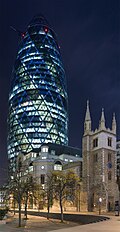
Image 530 St Mary Axe, London, widely known by the nickname "The Gherkin", and occasionally as a variant on The Swiss Re Tower, after its previous owner and principal occupier. Swiss Re is the world’s second-largest reinsurance company.
Image 11The Intel 80486DX2 is a CPU produced by Intel Corporation that was introduced in 1992. Intel is the world's second largest semiconductor company and the inventor of the x86 series of microprocessors.
A corporation' or body corporate is an individual or a group of people, such as an association or company, that has been authorized by the state to act as a single entity (a legal entity recognized by private and public law as "born out of statute"; a legal person in a legal context) and recognized as such in law for certain purposes.' Early incorporated entities were established by charter (i.e., by an ad hoc act granted by a monarch or passed by a parliament or legislature). Most jurisdictions now allow the creation of new corporations through registration. Corporations come in many different forms but are typically classified under the laws of their jurisdiction based on two criteria: whether they can issue stock, or whether they are organized to generate profit. In addition, some jurisdictions further distinguish corporations by their ownership structure and governance, such as public versus private corporations. Depending on the number of owners, a corporation can be classified as aggregate (the subject of this article) or sole (a legal entity consisting of a single incorporated office occupied by a single natural person).
Registered corporations have legal personality recognized by local authorities and their shares are owned by shareholders, whose liability is generally limited to their investment. One of the attractive early advantages business corporations offered to their investors, compared to earlier business entities like sole proprietorships and joint partnerships, was limited liability. Limited liability separates control of a company from ownership and means that a passive shareholder in a corporation will not be personally liable either for contractually agreed obligations of the corporation, or for torts (involuntary harms) committed by the corporation against a third party (acts done by the controllers of the corporation). (Full article...)
This is a Featured article, which represents some of the best content on English Wikipedia.
Ace Books is a publisher of science fiction (SF) and fantasy books founded in New York City in 1952 by Aaron A. Wyn. It began as a genre publisher of mysteries and westerns, and soon branched out into other genres, publishing its first science fiction title in 1953. This was successful, and science fiction titles outnumbered both mysteries and westerns within a few years. Other genres also made an appearance, including nonfiction, gothic novels, media tie-innovelizations, and romances. Ace became known for the tête-bêche binding format used for many of its early books, although it did not originate the format. Most of the early titles were published in this "Ace Double" format, and Ace continued to issue books in varied genres, bound tête-bêche, until 1973.
Ace, along with Ballantine Books, was one of the leading science fiction publishers for its first ten years of operation. The death of owner A. A. Wyn in 1967 set the stage for a later decline in the publisher's fortunes. Two leading editors, Donald A. Wollheim and Terry Carr, left in 1971, and in 1972 Ace was sold to Grosset & Dunlap. Despite financial troubles, there were further successes, particularly with the third Ace Science Fiction Specials series, for which Carr came back as editor. Further mergers and acquisitions resulted in the company becoming absorbed by Berkley Books. Ace later became an imprint of Penguin Group (USA). (Full article...)
Bank Central Asia (BCA), is an Indonesian bank founded on 21 February 1957. As of 2022, it was the largest private bank in Indonesia, with assets amounting to Rp 5.529,83 trillion (US$308,5 billion). It is headquartered at BCA Tower in Jakarta.
Bank Central Asia was founded by Salim Group as "NV Perseroan Dagang Dan Industrie Semarang Knitting Factory". It was expanded by banker and conglomerate Mochtar Riady, who took control of the bank. Bank Central Asia expanded rapidly during the 1980s and 90s, BCA works with well-known institutions, such as PT Telkom, Citibank, and American Express. The bank was hit hard during the 1997 financial crisis and the subsequent 1998 May riots. It was in massive debt and as a result it was taken over by the Indonesian Bank Restructuring Agency and sold to another conglomerate group Djarum.
BCA has thrived since, and took a major step by going public in 2000. (Full article...)
... that Chilean Líder supermarkets sold Cuban rum at half price to eliminate it from stock in anticipation of becoming a Wal-Mart subsidiary, causing a controversy in Chile?
This is a list of recognized content, updated weekly by JL-Bot (talk·contribs) (typically on Saturdays). There is no need to edit the list yourself. If an article is missing from the list, make sure it is tagged (e.g. {{WikiProject Companies}}) or categorized correctly and wait for the next update. See WP:RECOG for configuration options.