


Portal:Mathematics


The Mathematics Portal
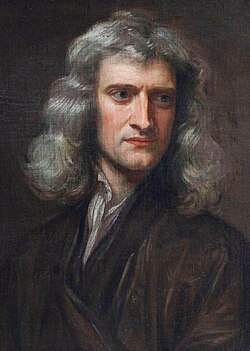
Mathematics is the study of representing and reasoning about abstract objects (such as numbers, points, spaces, sets, structures, and games). Mathematics is used throughout the world as an essential tool in many fields, including natural science, engineering, medicine, and the social sciences. Applied mathematics, the branch of mathematics concerned with application of mathematical knowledge to other fields, inspires and makes use of new mathematical discoveries and sometimes leads to the development of entirely new mathematical disciplines, such as statistics and game theory. Mathematicians also engage in pure mathematics, or mathematics for its own sake, without having any application in mind. There is no clear line separating pure and applied mathematics, and practical applications for what began as pure mathematics are often discovered. (Full article...)
Featured articles –
 Featured articles are displayed here, which represent some of the best content on English Wikipedia.
-

Algebra is a branch of mathematics that deals with abstract systems, known as algebraic structures, and the manipulation of expressions within those systems. It is a generalization of arithmetic that introduces variables and algebraic operations other than the standard arithmetic operations, such as addition and multiplication.
Elementary algebra is the main form of algebra taught in schools. It examines mathematical statements using variables for unspecified values and seeks to determine for which values the statements are true. To do so, it uses different methods of transforming equations to isolate variables. Linear algebra is a closely related field that investigates linear equations and combinations of them called systems of linear equations. It provides methods to find the values that solve all equations in the system at the same time, and to study the set of these solutions. (Full article...) -
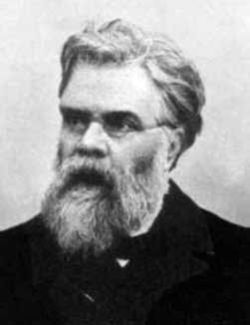
Émile Michel Hyacinthe Lemoine (French: [emil ləmwan]; 22 November 1840 – 21 February 1912) was a French civil engineer and a mathematician, a geometer in particular. He was educated at a variety of institutions, including the Prytanée National Militaire and, most notably, the École Polytechnique. Lemoine taught as a private tutor for a short period after his graduation from the latter school.
Lemoine is best known for his proof of the existence of the Lemoine point (or the symmedian point) of a triangle. Other mathematical work includes a system he called Géométrographie and a method which related algebraic expressions to geometric objects. He has been called a co-founder of modern triangle geometry, as many of its characteristics are present in his work. (Full article...) -
The number π (/paɪ/ ⓘ; spelled out as pi) is a mathematical constant, approximately equal to 3.14159, that is the ratio of a circle's circumference to its diameter. It appears in many formulae across mathematics and physics, and some of these formulae are commonly used for defining π, to avoid relying on the definition of the length of a curve.
The number π is an irrational number, meaning that it cannot be expressed exactly as a ratio of two integers, although fractions such as are commonly used to approximate it. Consequently, its decimal representation never ends, nor enters a permanently repeating pattern. It is a transcendental number, meaning that it cannot be a solution of an algebraic equation involving only finite sums, products, powers, and integers. The transcendence of π implies that it is impossible to solve the ancient challenge of squaring the circle with a compass and straightedge. The decimal digits of π appear to be randomly distributed, but no proof of this conjecture has been found. (Full article...) -
Edward Wright (baptised 8 October 1561; died November 1615) was an English mathematician and cartographer noted for his book Certaine Errors in Navigation (1599; 2nd ed., 1610), which for the first time explained the mathematical basis of the Mercator projection by building on the works of Pedro Nunes, and set out a reference table giving the linear scale multiplication factor as a function of latitude, calculated for each minute of arc up to a latitude of 75°. This was in fact a table of values of the integral of the secant function, and was the essential step needed to make practical both the making and the navigational use of Mercator charts.
Wright was born at Garveston in Norfolk and educated at Gonville and Caius College, Cambridge, where he became a fellow from 1587 to 1596. In 1589 the college granted him leave after Elizabeth I requested that he carry out navigational studies with a raiding expedition organised by the Earl of Cumberland to the Azores to capture Spanish galleons. The expedition's route was the subject of the first map to be prepared according to Wright's projection, which was published in Certaine Errors in 1599. The same year, Wright created and published the first world map produced in England and the first to use the Mercator projection since Gerardus Mercator's original 1569 map. (Full article...) -

Plots of logarithm functions, with three commonly used bases. The special points logb b = 1 are indicated by dotted lines, and all curves intersect in logb 1 = 0.
In mathematics, the logarithm of a number is the exponent by which another fixed value, the base, must be raised to produce that number. For example, the logarithm of 1000 to base 10 is 3, because 1000 is 10 to the 3rd power: 1000 = 103 = 10 × 10 × 10. More generally, if x = by, then y is the logarithm of x to base b, written logb x, so log10 1000 = 3. As a single-variable function, the logarithm to base b is the inverse of exponentiation with base b.
The logarithm base 10 is called the decimal or common logarithm and is commonly used in science and engineering. The natural logarithm has the number e ≈ 2.718 as its base; its use is widespread in mathematics and physics because of its very simple derivative. The binary logarithm uses base 2 and is widely used in computer science, information theory, music theory, and photography. When the base is unambiguous from the context or irrelevant it is often omitted, and the logarithm is written log x. (Full article...) -

The weighing pans of this balance scale contain zero objects, divided into two equal groups.
In mathematics, zero is an even number. In other words, its parity—the quality of an integer being even or odd—is even. This can be easily verified based on the definition of "even": zero is an integer multiple of 2, specifically 0 × 2. As a result, zero shares all the properties that characterize even numbers: for example, 0 is neighbored on both sides by odd numbers, any decimal integer has the same parity as its last digit—so, since 10 is even, 0 will be even, and if y is even then y + x has the same parity as x—indeed, 0 + x and x always have the same parity.
Zero also fits into the patterns formed by other even numbers. The parity rules of arithmetic, such as even − even = even, require 0 to be even. Zero is the additive identity element of the group of even integers, and it is the starting case from which other even natural numbers are recursively defined. Applications of this recursion from graph theory to computational geometry rely on zero being even. Not only is 0 divisible by 2, it is divisible by every power of 2, which is relevant to the binary numeral system used by computers. In this sense, 0 is the "most even" number of all. (Full article...) -
Shen Kuo (Chinese: 沈括; 1031–1095) or Shen Gua, courtesy name Cunzhong (存中) and pseudonym Mengqi (now usually given as Mengxi) Weng (夢溪翁), was a Chinese polymath, scientist, and statesman of the Song dynasty (960–1279). Shen was a master in many fields of study including mathematics, optics, and horology. In his career as a civil servant, he became a finance minister, governmental state inspector, head official for the Bureau of Astronomy in the Song court, Assistant Minister of Imperial Hospitality, and also served as an academic chancellor. At court his political allegiance was to the Reformist faction known as the New Policies Group, headed by Chancellor Wang Anshi (1021–1085).
In his Dream Pool Essays or Dream Torrent Essays (夢溪筆談; Mengxi Bitan) of 1088, Shen was the first to describe the magnetic needle compass, which would be used for navigation (first described in Europe by Alexander Neckam in 1187). Shen discovered the concept of true north in terms of magnetic declination towards the north pole, with experimentation of suspended magnetic needles and "the improved meridian determined by Shen's [astronomical] measurement of the distance between the pole star and true north". This was the decisive step in human history to make compasses more useful for navigation, and may have been a concept unknown in Europe for another four hundred years (evidence of German sundials made circa 1450 show markings similar to Chinese geomancers' compasses in regard to declination). (Full article...) -
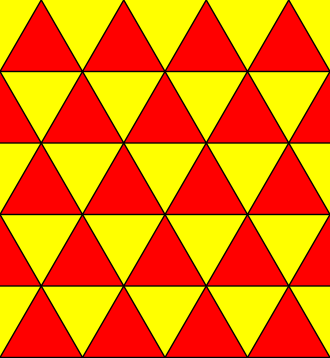
The regular triangular tiling of the plane, whose symmetries are described by the affine symmetric group S̃3
The affine symmetric groups are a family of mathematical structures that describe the symmetries of the number line and the regular triangular tiling of the plane, as well as related higher-dimensional objects. In addition to this geometric description, the affine symmetric groups may be defined in other ways: as collections of permutations (rearrangements) of the integers (..., −2, −1, 0, 1, 2, ...) that are periodic in a certain sense, or in purely algebraic terms as a group with certain generators and relations. They are studied in combinatorics and representation theory.
A finite symmetric group consists of all permutations of a finite set. Each affine symmetric group is an infinite extension of a finite symmetric group. Many important combinatorial properties of the finite symmetric groups can be extended to the corresponding affine symmetric groups. Permutation statistics such as descents and inversions can be defined in the affine case. As in the finite case, the natural combinatorial definitions for these statistics also have a geometric interpretation. (Full article...) -
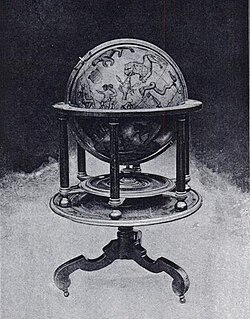
Emery Molyneux (/ˈɛməri ˈmɒlɪnoʊ/ EM-ər-ee MOL-in-oh; died June 1598) was an English Elizabethan maker of globes, mathematical instruments and ordnance. His terrestrial and celestial globes, first published in 1592, were the first to be made in England and the first to be made by an Englishman.
Molyneux was known as a mathematician and maker of mathematical instruments such as compasses and hourglasses. He became acquainted with many prominent men of the day, including the writer Richard Hakluyt and the mathematicians Robert Hues and Edward Wright. He also knew the explorers Thomas Cavendish, Francis Drake, Walter Raleigh and John Davis. Davis probably introduced Molyneux to his own patron, the London merchant William Sanderson, who largely financed the construction of the globes. When completed, the globes were presented to Elizabeth I. Larger globes were acquired by royalty, noblemen and academic institutions, while smaller ones were purchased as practical navigation aids for sailors and students. The globes were the first to be made in such a way that they were unaffected by the humidity at sea, and they came into general use on ships. (Full article...) -
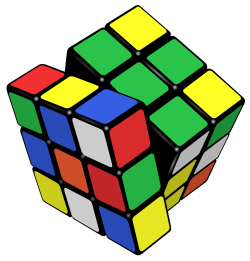
The manipulations of the Rubik's Cube form the Rubik's Cube group.
In mathematics, a group is a set with an operation that combines any two elements of the set to produce a third element within the same set and the following conditions must hold: the operation is associative, it has an identity element, and every element of the set has an inverse element. For example, the integers with the addition operation form a group.
The concept of a group was elaborated for handling, in a unified way, many mathematical structures such as numbers, geometric shapes and polynomial roots. Because the concept of groups is ubiquitous in numerous areas both within and outside mathematics, some authors consider it as a central organizing principle of contemporary mathematics. (Full article...) -

Richard Phillips Feynman (/ˈfaɪnmən/; May 11, 1918 – February 15, 1988) was an American theoretical physicist. He is best known for his work in the path integral formulation of quantum mechanics, the theory of quantum electrodynamics, the physics of the superfluidity of supercooled liquid helium, and in particle physics, for which he proposed the parton model. For his contributions to the development of quantum electrodynamics, Feynman received the Nobel Prize in Physics in 1965 jointly with Julian Schwinger and Shin'ichirō Tomonaga.
Feynman developed a pictorial representation scheme for the mathematical expressions describing the behavior of subatomic particles, which later became known as Feynman diagrams and is widely used. During his lifetime, Feynman became one of the best-known scientists in the world. In a 1999 poll of 130 leading physicists worldwide by the British journal Physics World, he was ranked the seventh-greatest physicist of all time. (Full article...) -
General relativity, also known as the general theory of relativity, and as Einstein's theory of gravity, is the geometric theory of gravitation published by Albert Einstein in 1915 and is the accepted description of gravitation in modern physics. General relativity generalizes special relativity and refines Newton's law of universal gravitation, providing a unified description of gravity as a geometric property of space and time, or four-dimensional spacetime. In particular, the curvature of spacetime is directly related to the energy, momentum and stress of whatever is present, including matter and radiation. The relation is specified by the Einstein field equations, a system of second-order partial differential equations.
Newton's law of universal gravitation, which describes gravity in classical mechanics, can be seen as a prediction of general relativity for the almost flat spacetime geometry around stationary mass distributions. Some predictions of general relativity, however, are beyond Newton's law of universal gravitation in classical physics. These predictions concern the passage of time, the geometry of space, the motion of bodies in free fall, and the propagation of light, and include gravitational time dilation, gravitational lensing, the gravitational redshift of light, the Shapiro time delay and singularities/black holes. So far, all tests of general relativity have been in agreement with the theory. The time-dependent solutions of general relativity enable us to extrapolate the history of the universe into the past and future, and have provided the modern framework for cosmology, thus leading to the discovery of the Big Bang and cosmic microwave background radiation. Despite the introduction of a number of alternative theories, general relativity continues to be the simplest theory consistent with experimental data. (Full article...) -

Logic studies valid forms of inference like modus ponens.
Logic is the study of correct reasoning. It includes both formal and informal logic. Formal logic is the study of deductively valid inferences or logical truths. It examines how conclusions follow from premises based on the structure of arguments alone, independent of their topic and content. Informal logic is associated with informal fallacies, critical thinking, and argumentation theory. Informal logic examines arguments expressed in natural language whereas formal logic uses formal language. When used as a countable noun, the term "a logic" refers to a specific logical formal system that articulates a proof system. Logic plays a central role in many fields, such as philosophy, mathematics, computer science, and linguistics.
Logic studies arguments, which consist of a set of premises that leads to a conclusion. An example is the argument from the premises "it's Sunday" and "if it's Sunday then I don't have to work" leading to the conclusion "I don't have to work." Premises and conclusions express propositions or claims that can be true or false. An important feature of propositions is their internal structure. For example, complex propositions are made up of simpler propositions linked by logical vocabulary like (and) or (if...then). Simple propositions also have parts, like "Sunday" or "work" in the example. The truth of a proposition usually depends on the meanings of all of its parts. However, this is not the case for logically true propositions. They are true only because of their logical structure independent of the specific meanings of the individual parts. (Full article...) -
In algebraic geometry and theoretical physics, mirror symmetry is a relationship between geometric objects called Calabi–Yau manifolds. The term refers to a situation where two Calabi–Yau manifolds look very different geometrically but are nevertheless equivalent when employed as extra dimensions of string theory.
Early cases of mirror symmetry were discovered by physicists. Mathematicians became interested in this relationship around 1990 when Philip Candelas, Xenia de la Ossa, Paul Green, and Linda Parkes showed that it could be used as a tool in enumerative geometry, a branch of mathematics concerned with counting the number of solutions to geometric questions. Candelas and his collaborators showed that mirror symmetry could be used to count rational curves on a Calabi–Yau manifold, thus solving a longstanding problem. Although the original approach to mirror symmetry was based on physical ideas that were not understood in a mathematically precise way, some of its mathematical predictions have since been proven rigorously. (Full article...) -
Leonhard Euler (/ˈɔɪlər/ OY-lər; 15 April 1707 – 18 September 1783) was a Swiss polymath who was active as a mathematician, physicist, astronomer, logician, geographer, and engineer. He founded the studies of graph theory and topology and made influential discoveries in many other branches of mathematics, such as analytic number theory, complex analysis, and infinitesimal calculus. He also introduced much of modern mathematical terminology and notation, including the notion of a mathematical function. He is known for his work in mechanics, fluid dynamics, optics, astronomy, and music theory. Euler has been called a "universal genius" who "was fully equipped with almost unlimited powers of imagination, intellectual gifts and extraordinary memory". He spent most of his adult life in Saint Petersburg, Russia, and in Berlin, then the capital of Prussia.
Euler is credited for popularizing the Greek letter (lowercase pi) to denote the ratio of a circle's circumference to its diameter, as well as first using the notation for the value of a function, the letter to express the imaginary unit , the Greek letter (capital sigma) to express summations, the Greek letter (capital delta) for finite differences, and lowercase letters to represent the sides of a triangle while representing the angles as capital letters. He gave the current definition of the constant , the base of the natural logarithm, now known as Euler's number. Euler made contributions to applied mathematics and engineering, such as his study of ships, which helped navigation; his three volumes on optics, which contributed to the design of microscopes and telescopes; and his studies of beam bending and column critical loads. (Full article...)



.jpg/250px-Beijing_Ancient_Observatory_20090715-19_(cropped).jpg)


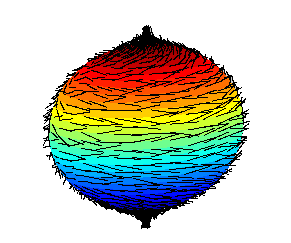
.jpg/250px-Leonhard_Euler_-_Jakob_Emanuel_Handmann_(Kunstmuseum_Basel).jpg)


Selected image –
Good articles –
 These are Good articles, which meet a core set of high editorial standards.
-
Fleiss's kappa (named after Joseph L. Fleiss) is a statistical measure for assessing the reliability of agreement between a fixed number of raters when assigning categorical ratings to a number of items or classifying items. This contrasts with other kappas such as Cohen's kappa, which only work when assessing the agreement between two raters or the intra-rater reliability (for one appraiser versus themself). The measure calculates the degree of agreement in classification over that which would be expected by chance.
Fleiss's kappa can be used with binary or nominal-scale. It can also be applied to ordinal data (ranked data): the MiniTab online documentation gives an example. However, this document notes: "When you have ordinal ratings, such as defect severity ratings on a scale of 1–5, Kendall's coefficients, which account for ordering, are usually more appropriate statistics to determine association than kappa alone." Keep in mind however, that Kendall rank coefficients are only appropriate for rank data. (Full article...) -
In order theory and model theory, branches of mathematics, Cantor's isomorphism theorem states that every two countable dense unbounded linear orders are order-isomorphic. For instance, Minkowski's question-mark function produces an isomorphism (a one-to-one order-preserving correspondence) between the numerical ordering of the rational numbers and the numerical ordering of the dyadic rationals.
The theorem is named after Georg Cantor, who first published it in 1895, using it to characterize the (uncountable) ordering on the real numbers. It can be proved by a back-and-forth method that is also sometimes attributed to Cantor but was actually published later, by Felix Hausdorff. The same back-and-forth method also proves that countable dense unbounded orders are highly symmetric, and can be applied to other kinds of structures. However, Cantor's original proof only used the "going forth" half of this method. In terms of model theory, the isomorphism theorem can be expressed by saying that the first-order theory of unbounded dense linear orders is countably categorical, meaning that it has only one countable model, up to logical equivalence. (Full article...) -

Graph of log2 x as a function of a positive real number x
In mathematics, the binary logarithm (log2 n) is the power to which the number 2 must be raised to obtain the value n. That is, for any real number x,
:
For example, the binary logarithm of 1 is 0, the binary logarithm of 2 is 1, the binary logarithm of 4 is 2, and the binary logarithm of 32 is 5.
The binary logarithm is the logarithm to the base 2 and is the inverse function of the power of two function. There are several alternatives to the log2 notation for the binary logarithm; see the Notation section below. (Full article...) -
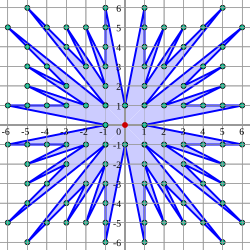
Farey sunburst of order 6, with 1 interior (red) and 96 boundary (green) points giving an area of 1 + 96/2 − 1 = 48
In geometry, Pick's theorem provides a formula for the area of a simple polygon with integer vertex coordinates, in terms of the number of integer points within it and on its boundary. The result was first described by Georg Alexander Pick in 1899. It was popularized in English by Hugo Steinhaus in the 1950 edition of his book Mathematical Snapshots. It has multiple proofs, and can be generalized to formulas for certain kinds of non-simple polygons. (Full article...) -
In number theory, specifically the study of Diophantine approximation, the lonely runner conjecture is a conjecture about the long-term behavior of runners on a circular track. It states that runners on a track of unit length, with constant speeds all distinct from one another, will each be lonely at some time—at least units away from all others.
The conjecture was first posed in 1967 by German mathematician Jörg M. Wills, in purely number-theoretic terms, and independently in 1974 by T. W. Cusick; its illustrative and now-popular formulation dates to 1998. The conjecture is known to be true for seven runners or fewer, but the general case remains unsolved. Implications of the conjecture include solutions to view-obstruction problems and bounds on properties, related to chromatic numbers, of certain graphs. (Full article...) -

A unit distance graph with 16 vertices and 40 edges
In mathematics, particularly geometric graph theory, a unit distance graph is a graph formed from a collection of points in the Euclidean plane by connecting two points whenever the distance between them is exactly one. To distinguish these graphs from a broader definition that allows some non-adjacent pairs of vertices to be at distance one, they may also be called strict unit distance graphs or faithful unit distance graphs. As a hereditary family of graphs, they can be characterized by forbidden induced subgraphs. The unit distance graphs include the cactus graphs, the matchstick graphs and penny graphs, and the hypercube graphs. The generalized Petersen graphs are non-strict unit distance graphs.
An unsolved problem of Paul Erdős asks how many edges a unit distance graph on vertices can have. The best known lower bound is slightly above linear in —far from the upper bound, proportional to . The number of colors required to color unit distance graphs is also unknown (the Hadwiger–Nelson problem): some unit distance graphs require five colors, and every unit distance graph can be colored with seven colors. For every algebraic number α, there is a unit distance graph with two vertices that must be at distance α. According to the Beckman–Quarles theorem, the only plane transformations that preserve all unit distance graphs are the isometries. (Full article...) -
Fermat's Last Tango is a 2000 off-Broadway musical about the proof of Fermat's Last Theorem, written by husband and wife Joshua Rosenblum (music, lyrics) and Joanne Sydney Lessner (book, lyrics). The musical presents a fictionalized version of the real life story of Andrew Wiles, and has been praised for the accuracy of the mathematical content. The original production at the York Theatre received mixed reviews, but the musical was well received by mathematical audiences. A video of the original production has been distributed by the Clay Mathematics Institute and shown at several mathematical conferences and similar occasions. The musical has also been translated into Portuguese. (Full article...)
-
1
In geometry, an isosceles triangle (/aɪˈsɒsəliːz/) is a triangle that has two sides of equal length and two angles of equal measure. Sometimes it is specified as having exactly two sides of equal length, and sometimes as having at least two sides of equal length, the latter version thus including the equilateral triangle as a special case.
Examples of isosceles triangles include the isosceles right triangle, the golden triangle, and the faces of bipyramids and certain Catalan solids. (Full article...) -
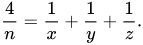
The Erdős–Straus conjecture is an unproven statement in number theory. The conjecture is that, for every integer that is greater than or equal to 2, there exist positive integers , , and for which
In other words, the number can be written as a sum of three positive unit fractions.
The conjecture is named after Paul Erdős and Ernst G. Straus, who formulated it in 1948, but it is connected to much more ancient mathematics; sums of unit fractions, like the one in this problem, are known as Egyptian fractions, because of their use in ancient Egyptian mathematics. The Erdős–Straus conjecture is one of many conjectures by Erdős, and one of many unsolved problems in mathematics concerning Diophantine equations. (Full article...) -
69 (sixty-nine; LXIX) is the natural number following 68 and preceding 70. An odd number and a composite number, 69 is divisible by 1, 3, 23 and 69.
The number and its pictograph give its name to the sexual position of the same name. The association of the number with this sex position has resulted in it being associated in meme culture with sex. People knowledgeable of the meme may respond "nice" in response to the appearance of the number, whether intentionally an innuendo or not. (Full article...) -
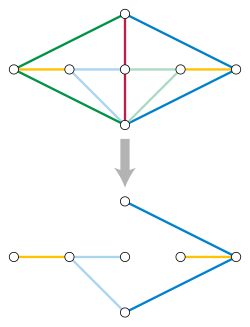
An instance of the matroid parity problem: given a graph with colored edges, having exactly two edges per color, find a forest (an independent set of the graphic matroid) with as many edges as possible that again has exactly two edges per color.
In combinatorial optimization, the matroid parity problem is a problem of finding the largest independent set of paired elements in a matroid, a structure that abstracts and generalizes the notion of linear independence in vector spaces. The problem was formulated by Lawler (1976) as a common generalization of graph matching and matroid intersection. It is also known as polymatroid matching, or the matchoid problem.
Matroid parity can be solved in polynomial time for linear matroids. However, it is NP-hard for certain compactly-represented matroids, and requires more than a polynomial number of steps in the matroid oracle model. (Full article...) -

3 + 2 = 5 with apples, a popular choice in textbooks
Addition, usually denoted with the plus sign +, is one of the four basic operations of arithmetic, the other three being subtraction, multiplication, and division. The addition of two whole numbers results in the total or sum of those values combined. For example, the adjacent image shows two columns of apples, one with three apples and the other with two apples, totaling to five apples. This observation is expressed as "3 + 2 = 5", which is read as "three plus two equals five".
Besides counting items, addition can also be defined and executed without referring to concrete objects, using abstractions called numbers instead, such as integers, real numbers, and complex numbers. Addition belongs to arithmetic, a branch of mathematics. In algebra, another area of mathematics, addition can also be performed on abstract objects such as vectors, matrices, and elements of additive groups. (Full article...)




Did you know (auto-generated) –

- ... that Hong Wang's latest paper claims to have resolved the Kakeya conjecture, described as "one of the most sought-after open problems in geometric measure theory", in three dimensions?
- ... that the first volume of Felix Klein's books on the history of mathematics does not mention the three women who originally transcribed his lectures?
- ... that Ewa Ligocka cooked another mathematician's goose?
- ... that people in Madagascar perform algebra on tree seeds in order to tell the future?
- ... that in 1940 Xu Ruiyun became the first Chinese woman to receive a PhD in mathematics?
- ... that the discovery of Descartes' theorem in geometry came from a too-difficult mathematics problem posed to a princess?
- ... that The Math Myth advocates for American high schools to stop requiring advanced algebra?
- ... that Carmel Naughton, having been told that girls were "stupid and couldn't do maths", sponsored a STEM scholarship fund?
More did you know –
- ...that every natural number can be written as the sum of four squares?
- ...that the largest known prime number is nearly 41 million digits long?
- ...that the set of rational numbers is equal in size to the set of integers; that is, they can be put in one-to-one correspondence?
- ...that there are precisely six convex regular polytopes in four dimensions? These are analogs of the five Platonic solids known to the ancient Greeks.
- ...that it is unknown whether π and e are algebraically independent?
- ...that a nonconvex polygon with three convex vertices is called a pseudotriangle?
- ...that it is possible for a three-dimensional figure to have a finite volume but infinite surface area, such as Gabriel's Horn?
Selected article –
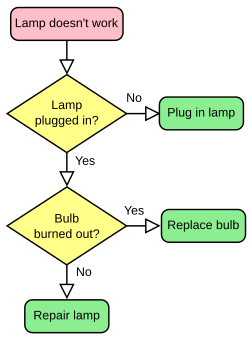 |
| Flowcharts are often used to represent algorithms Image credit: User:Booyabazooka |
An algorithm is a procedure (a finite set of well-defined instructions) for accomplishing some task which, given an initial state, will terminate in a defined end-state. The computational complexity and efficient implementation of the algorithm are important in computing, and this depends on suitable data structures.
Informally, the concept of an algorithm is often illustrated by the example of a recipe, although many algorithms are much more complex; algorithms often have steps that repeat (iterate) or require decisions (such as logic or comparison). Algorithms can be composed to create more complex algorithms.
The concept of an algorithm originated as a means of recording procedures for solving mathematical problems such as finding the common divisor of two numbers or multiplying two numbers. The concept was formalized in 1936 through Alan Turing's Turing machines and Alonzo Church's lambda calculus, which in turn formed the foundation of computer science.
Most algorithms can be directly implemented by computer programs; any other algorithms can at least in theory be simulated by computer programs. In many programming languages, algorithms are implemented as functions or procedures. (Full article...)
| View all selected articles |
Subcategories

Algebra | Arithmetic | Analysis | Complex analysis | Applied mathematics | Calculus | Category theory | Chaos theory | Combinatorics | Dynamical systems | Fractals | Game theory | Geometry | Algebraic geometry | Graph theory | Group theory | Linear algebra | Mathematical logic | Model theory | Multi-dimensional geometry | Number theory | Numerical analysis | Optimization | Order theory | Probability and statistics | Set theory | Statistics | Topology | Algebraic topology | Trigonometry | Linear programming
Mathematics | History of mathematics | Mathematicians | Awards | Education | Literature | Notation | Organizations | Theorems | Proofs | Unsolved problems
Topics in mathematics
 General
 Foundations
 Number theory
 Discrete mathematics
 Algebra
 Analysis
 Geometry and topology
 Applied mathematics
Index of mathematics articles
| ARTICLE INDEX: | |
| MATHEMATICIANS: |
Related portals


WikiProjects
 The Mathematics WikiProject is the center for mathematics-related editing on Wikipedia. Join the discussion on the project's talk page.
|
Project pages Essays Subprojects Related projects
|
Things you can do
|
In other Wikimedia projects
The following Wikimedia Foundation sister projects provide more on this subject:
-
 Commons
Free media repository -
 Wikibooks
Free textbooks and manuals -
 Wikidata
Free knowledge base -
 Wikinews
Free-content news -
 Wikiquote
Collection of quotations -
 Wikisource
Free-content library -
 Wikiversity
Free learning tools -
 Wiktionary
Dictionary and thesaurus


