|
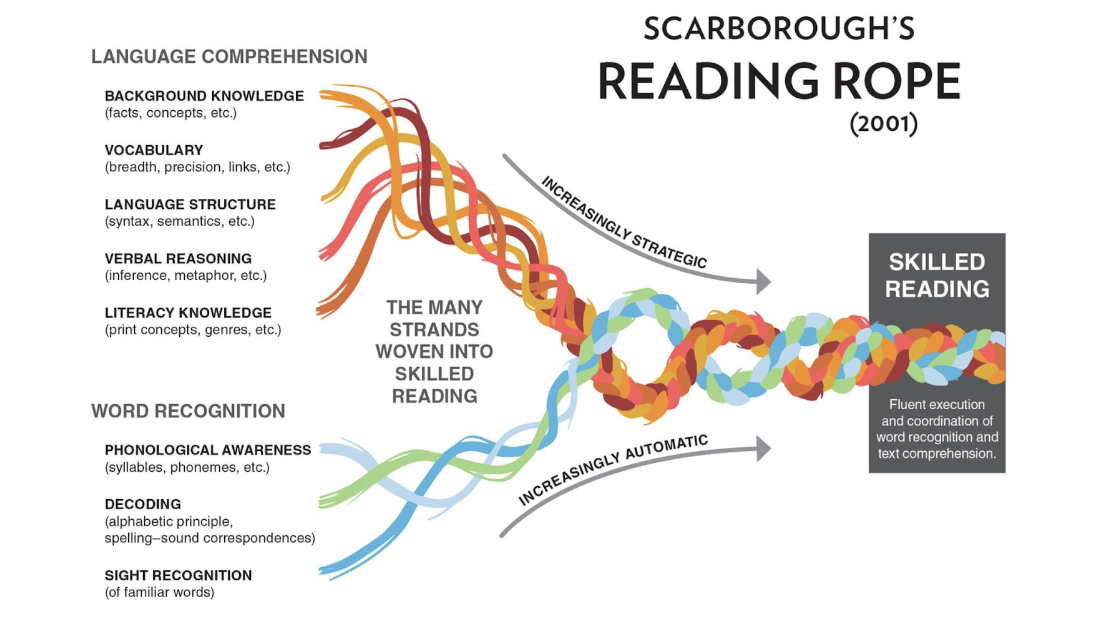
This visual illustrates the two “strands” of learning that students must master to become skilled readers. The first is “word recognition,” which boils down to being able to “lift the words off the page.” In short, a student who has mastered this strand can read grade-level text without stopping to sound out words. She may not fully understand what she’s reading, but she can turn the letters into fluent reading. At RPS, we used a reading program from the University of Florida Literacy Institute (UFLI) to teach this strand of the rope. Every K-2 teacher, principal, and literacy coach has been trained in UFLI.
The second strand is “language comprehension,” and it’s a bit trickier to teach. Making sense of a text is a complex process that involves lots of different elements, including what background knowledge a student has, the extent of their vocabulary, their understanding of complex sentence structures (syntax), and more. Reading comprehension tests usually ask students to identify the main idea of a passage, to make inferences about it, or to describe what the author meant in a particular paragraph. What’s tricky about this from a pedagogical perspective is that you can’t actually teach these discrete skills. Children’s brains develop the capacity to answer these kinds of questions by repeatedly exploring complex texts in their entirety.
That’s why our upper-elementary curriculum from EL Education spends several weeks on each book. Drilling on ‘main idea’ questions from random worksheets won’t help at all. As Timothy Shanahan, chairman of the National Reading Panel and professor at the University of Chicago, writes: “Giving students a lot of practice with those kinds of test items is not likely to improve achievement at all. It could even lower it, since there are better things that students could be doing to prepare for such testing.”
As we head into parent/caregiver conferences next month, please keep the above context in mind. If your little one is in K-3, make sure to ask your child’s teacher:
-
How is my student doing with UFLI?
-
What are some of the skills she still needs to master?
-
Can you share some of the UFLI home materials with me to help?
If your student is in 3-5, make sure to ask:
-
What book is the class reading right now?
-
What are some questions I can ask my student about the book to help develop their understanding of it?
-
What are some books of similar content that I could have my student read? (Reading books of similar content helps develop stronger vocabulary!)
If you’d like to learn more, please check out this Good Things podcast episode which features a conversation with Megan Crowe, the amazing literacy coach at Chimborazo Elementary School! You should also feel free to reach out to me directly at jkamras@rvaschools.net.
|