This star, with one point broken, indicates that an article is a candidate on this page.
Here, we determine which articles are to be featured articles (FAs). FAs exemplify Wikipedia's very best work and satisfy the FA criteria. All editors are welcome to review nominations; please see the review FAQ.
Before nominating an article, nominators may wish to receive feedback by listing it at Peer review and adding the review to the FAC peer review sidebar. Editors considering their first nomination, and any subsequent nomination before their first FA promotion, are strongly advised to seek the involvement of a mentor, to assist in the preparation and processing of the nomination. Nominators must be sufficiently familiar with the subject matter and sources to deal with objections during the featured article candidates (FAC) process. Nominators who are not significant contributors to the article should consult regular editors of the article before nominating it. Nominators are expected to respond positively to constructive criticism and to make efforts to address objections promptly. An article should not be on Featured article candidates and Peer review or Good article nominations at the same time.
The FAC coordinators—Ian Rose, Gog the Mild, David Fuchs and FrB.TG—determine the timing of the process for each nomination. For a nomination to be promoted to FA status, consensus must be reached that it meets the criteria. Consensus is built among reviewers and nominators; the coordinators determine whether there is consensus. A nomination will be removed from the list and archived if, in the judgment of the coordinators:
actionable objections have not been resolved;
consensus for promotion has not been reached;
insufficient information has been provided by reviewers to judge whether the criteria have been met; or
a nomination is unprepared.
It is assumed that all nominations have good qualities; this is why the main thrust of the process is to generate and resolve critical comments in relation to the criteria, and why such resolution is given considerably more weight than declarations of support.
Do not use graphics or complex templates on FAC nomination pages. Graphics such as Done and Not done slow down the page load time, and complex templates can lead to errors in the FAC archives. For technical reasons, templates that are acceptable are {{collapse top}} and {{collapse bottom}}, used to hide offtopic discussions, and templates such as {{green}} that apply colours to text and are used to highlight examples without altering fonts. Other templates such as {{done}}, {{not done}}, {{tq}}, {{tq2}}, and {{xt}}, may be removed.
An editor is normally allowed to be the sole nominator of one article at a time, but two nominations are allowed if the editor is a co-nominator on at least one of them. An editor may ask the approval of the coordinators to add a second sole nomination after the first has gained significant support. If a nomination is archived, the nominator(s) should take adequate time to work on resolving issues before re-nominating. None of the nominators may nominate or co-nominate any article for two weeks unless given leave to do so by a coordinator; if such an article is nominated without asking for leave, a coordinator will decide whether to remove it. A coordinator may exempt from this restriction an archived nomination that attracted no (or minimal) feedback.
Nominations in urgent need of review are listed here. To contact the FAC coordinators, please leave a message on the FAC talk page, or use the {{@FAC}}notification template elsewhere.
A bot will update the article talk page after the article is promoted or the nomination archived; the delay in bot processing can range from minutes to several days, and the {{FAC}} template should remain on the talk page until the bot updates {{Article history}}.
Before nominating an article, ensure that it meets all of the FA criteria and that peer reviews are closed and archived.
Place {{subst:FAC}} at the top of the talk page of the nominated article and save the page.
From the FAC template, click on the red "initiate the nomination" link or the blue "leave comments" link. You will see pre-loaded information; leave that text. If you are unsure how to complete a nomination, please post to the FAC talk page for assistance.
Below the preloaded title, complete the nomination page, sign with ~~~~, and save the page.
Copy this text: {{Wikipedia:Featured article candidates/name of nominated article/archiveNumber}} (substituting Number), and edit this page (i.e., the page you are reading at the moment), pasting the template at the top of the list of candidates. Replace "name of ..." with the name of your nomination. This will transclude the nomination into this page. In the event that the title of the nomination page differs from this format, use the page's title instead.
To respond to a nomination, click the "Edit" link to the right of the article nomination (not the "Edit this page" link for the whole FAC page). All editors are welcome to review nominations; see the review FAQ for an overview of the review process.
To support a nomination, write *'''Support''', followed by your reason(s), which should be based on a full reading of the text. If you have been a significant contributor to the article before its nomination, please indicate this. A reviewer who specializes in certain areas of the FA criteria should indicate whether the support is applicable to all of the criteria.
To oppose a nomination, write *'''Object''' or *'''Oppose''', followed by your reason(s). Each objection must provide a specific rationale that can be addressed. If nothing can be done in principle to address the objection, a coordinator may disregard it. References on style and grammar do not always agree; if a contributor cites support for a certain style in a standard reference work or other authoritative source, reviewers should consider accepting it. Reviewers who object are strongly encouraged to return after a few days to check whether their objection has been addressed. To withdraw the objection, strike it out (with <s> ... </s>) rather than removing it. Alternatively, reviewers may transfer lengthy, resolved commentary to the FAC archive talk page, leaving a link in a note on the FAC archive.
To provide constructive input on a nomination without specifically supporting or objecting, write *'''Comment''' followed by your advice.
For ease of editing, a reviewer who enters lengthy commentary may create a neutral fourth-level subsection, named either ==== Review by EditorX ==== or ==== Comments by EditorX ==== (do not use third-level or higher section headers). Please do not create subsections for short statements of support or opposition—for these a simple *'''Support''',*'''Oppose''', or *'''Comment''' followed by your statement of opinion, is sufficient. Please do not use a semicolon to bold a subheading; this creates accessibility problems. Specifically, a semi-colon creates an HTML description list with a description term list item. As a result, assistive technology is unable to identify the text in question as a heading and thus provide navigation to it, and screen readers will make extra list start/item/end announcements.
If a nominator feels that an Oppose has been addressed, they should say so, either after the reviewer's signature, or by interspersing their responses in the list provided by the reviewer. Per talk page guidelines, nominators should not cap, alter, strike, or add graphics to comments from other editors. If a nominator finds that an opposing reviewer is not returning to the nomination page to revisit improvements, this should be noted on the nomination page, with a diff to the reviewer's talk page showing the request to reconsider.
Elizabeth Alkin was an interesting figure, if only a minor one. A spy during the English civil war, a publisher and a nurse - she gave her time and (very limited) money freely to her causes, risking her life as she did so. This is an article I created a long while ago as part of the work I did for Women in Red and took it to GA at the time. Since then, more sources have become available (and accessible), and it's been beefed up from the rather thin piece we had previously. It's also had a very constructive Peer Review from RoySmith, Tim riley and Mike Christie. Any further constructive comments would be gratefully received. - SchroCat (talk) 13:56, 18 September 2025 (UTC)[reply]
"Newsbook seller and publisher and spy" is a tad confusing of a section title. We already know she worked as a spy, so you could make it just "Newsbook business" or equivalent
"£3 10 shillings" might be confusing for those unfamiliar with predecimal units - perhaps "£3 and 10 shillings" would be more intelligible
I think I'd prefer to keep it like this, as it's the accepted standard. If someone else complains or suggests this, we can always revisit, if that's ok? - SchroCat (talk) 18:27, 18 September 2025 (UTC)[reply]
Support. My comments at the PR were with an eye to FAC, so I don't have much to add here; the only additional point does not affect my support.
I asked at the PR whether Alkin had been spying before her husband's death, and if we know exactly when she became a spy. You replied that the sources fudge this a little so it's hard to be definite. Would it be possible to add a footnote saying something to that effect -- that the sources don't directly say when she began spying?
In 2001, the Irish Catholic historian Eamon Duffy was at the height of his popularity, still riding high on the success of his seminal work on medieval English ritual, The Stripping of the Altars. A minor character from that book is the main character of this micro-history of the English Reformation, with Duffy using the records from "a somewhat unamiable busybody" to contradict popular narratives of English Christianity. Despite its dryness, the book has had an outsized impact on both later academic works and cultural memory of faith and rebellion. ~ Pbritti (talk) 15:39, 17 September 2025 (UTC)[reply]
Not "Authorship": "Top 10 by added text" is a far more accurate analysis as it excludes templates and images, etc., from the total (and they inflate authorship substantially). HTH. —Fortuna, imperatrix16:57, 17 September 2025 (UTC)[reply]
I’ve never submitted for a featured article, so I’m not quite sure what’s being asked of me here. However I will say this, a lot if not most of the information on the article was found by my research, I spent years and hours looking for new information on the article. It’s my personal favorite album but I didn’t know much about it, since there wasn’t much information on the album on Wikipedia when I started my research. So I took the time to put the pieces together, so I could understand the acclaim and commercial impact of the album. With that said Bronx Langford has since reworked the article and added extensive information as well. So if you’re asking for my support for the nomination, then I can give that. Kanyfug (talk) 08:06, 18 September 2025 (UTC)[reply]
This article is about Rihanna, one of the best-selling artists of all time. I began working on this article while working on Beyoncé; I've done some major size reductions on this and now believe that it meets WP:FACR! If successful this will be my 12th FA and fourth biography FA. All feedback is welcomed, looking forward to your comments and enjoy the read! 750h+14:33, 16 September 2025 (UTC)[reply]
Placeholder-- you are veryyyy productive eh! I missed my chance of working together on this article but I'm happy to review the prose for this FAC; comments to follow soon. Ippantekina (talk) 21:12, 16 September 2025 (UTC)[reply]
Zhang Jingsheng, frequently nicknamed "Dr. Sex", was a controversial writer, philosopher, and yes, sexologist from early 20th century China. A revolutionary in his youth, he studied in France and became obsessed with Rousseau, eugenics, and scientific racism. He caused a massive public scandal with his 1926 book Sex Histories, after which he fell into complete obscurity.
File:Zhang_Jingsheng,_circa_1906.jpg: when and where was this first published? Ditto File:Zhang_Jingsheng_with_family_Early_1940s.png, File:Havelock_Ellis_cph.3b08675.jpg. Nikkimaria (talk) 03:39, 16 September 2025 (UTC)[reply]
@Nikkimaria: Zhang_Jingsheng,_circa_1906 and Zhang_Jingsheng_with_family_Early_1940s were unpublished and public domain at the time of the URAA date. This seems like it would mean it would be PD in the US as well due to the Bern Convention, but I'm unsure what template this would use.
For File:Havelock_Ellis_cph.3b08675.jpg, LOC says it was "created/published" circa 1913, mentions "no copyright renewal" and says no known restrictions on publication. Does this satisfy publication for copyright purposes? Generalissima (talk) (it/she) 07:51, 16 September 2025 (UTC)[reply]
On Havelock, that tells us LOC considers it out of copyright, but not why, which is what is needed for the current tagging - suggest a tag swap.
Done for Havelock. First known publication appears to be 2019 for the other two (although one appears in Rocha's 2010 doctoral thesis, cited to the Raoping County archives; I assume that doesn't count as publication) Generalissima (talk) (it/she) 01:26, 17 September 2025 (UTC)[reply]
This article is about Opifex fuscus, the saltpool mosquito of New Zealand. In their juvenile stages, they live in salt pools (pools of water formed by ocean spray) of rocky coasts throughout most of the country. To survive in this habitat, they have an unusual ability to tolerate high levels of salinity. As juveniles they also have mouthparts that can develop to specialise in filter feeding or grazing, depending on what types of food are available. They are also notable for their unusual mating behaviour. The males sit on the surface of rock pools and grab the cocoons of females and mate with them before they've even matured into adults.
This article passed GA review a couple of months ago and has just received a peer review. I feel it meets the FA criteria and is ready to undergo this process. This would be an excellent addition to the Featured Articles list since flies as a whole are woefully underrepresented. Any comments/critiques on how to improve the article further would be appreciated. AxonsArachnida (talk) 23:23, 13 September 2025 (UTC)[reply]
Oh shit, my apologies. I struck that - I had gotten people tell me to fix it so many times I just assumed it was in the MoS without checking. Generalissima (talk) (it/she) 23:06, 17 September 2025 (UTC)[reply]
This article is about a small but deadly tropical storm which affected Eastern Visayas, some other regions in the Philippines, and Brunei and Malaysia. This article became a good article on August 25, 2024, and received a big peer review by Hurricanehink. Shortly after, the article was neatly copyedited by Fluffernutter on December 17. Recently, the article was extensively copyedited by Bunnypranav who fixed a large part of the prose.
I believe this article is Featured Article quality because its prose is excellent but has a possibility of having some issues. It also has many images and GIFs which illustrate the article, and it follows MOS guidelines as well as verification for every claim stated in the article. The criterion this article exemplifies the best is its comprehension; the article details the meteorological history down to the hour, describes preparations for the Philippines, Brunei, and Malaysia from all the sources I could find, has a big Impact section for a storm this size and even uses citations of other languages for Brunei and Malaysia. This article has a big Response section, detailing the tools the rescuers use, the money other countries and the Philippine government provided, and the Rebuilding and retirement since the storm. This is my reason why the article exemplifies one of the best Wikipedia can offer. Thanks, 🍗TheNuggeteer🍗 (My "blotter") 03:32, 12 September 2025 (UTC)[reply]
The images are relevant to the text and placed in appropriate locations. They lack alt-texts, so I suggest adding them. They all have captions. I think the caption "A GIF showing..." should be changed to "An animation showing...". It makes sense to mention the full name "Tropical Storm Kai-tak" for the caption of the lead image, but you could consider shortening the name in the following captions to just "Kai-tak". Would it make sense to move the image of the storm warnings to the section "Preparations" since it discusses warnings and doesn't have an image? Phlsph7 (talk) 09:43, 13 September 2025 (UTC)[reply]
Hey everyone! This is a relatively niche YA adaptation of the famous fairy tale by Hans Christian Andersen (which received several science fiction magazine reviews, for some reason). I originally created the article for a Women in Red/Women in Green event, but it continued to interest me... and here we are! Thanks to many helpful comments from Rollinginhisgrave, TompaDompa, and Vacant0 at the GAN and PR, I think the article is approaching featured quality. I look forward to your comments! —TechnoSquirrel69 (sigh) 22:52, 10 September 2025 (UTC)[reply]
Note: Since I haven't yet promoted an FA as a solo nominator, I would welcome a round of text–source integrity/close paraphrasing spot-checks. Please let me know if you'd like pages from Findon 2018, which the article replies on quite a bit, and I'd be happy to send them over. Thanks! —TechnoSquirrel69 (sigh) 22:57, 10 September 2025 (UTC)[reply]
For now, just a few comments. Not sure how much further I'll be able to dig.
My initial impression is that this is a bit of a wall of text. There's quite a few images in commons:Category:The Snow Queen; even if they're from other adaptations of the story, adding some of them would be a good thing, especially ones which show us the characters.
I couldn't find anything else that was appropriate. I'd actually had this thought as well last year, and added the image that's currently in § Publication and reception after searching in that category. I recall thinking the Edmund Dulac pieces were very pretty, but weren't particularly relevant to this article and didn't read well at smaller sizes. I had also reached out to Kernaghan and her publisher to see if they would freely license a portrait of her for Wikipedia, but didn't hear back. —TS
Where in the article do you think would be a good place to put it? I don't think this scene from the tale happens in the novel, and I'm not seeing any obvious prose that this would illustrate. I also just uploaded this image (and a variation), which I could imagine as an illustration to the discussion of Gerda and Kai's reunion towards the end of § Development and themes. Let me know what you think. —TS
Jumping in a bit here, I think another natural image would be something to go next to the paragraph about the "idea of north". The sources have a lot to say about the importance of the snowy northern setting; either an illustration or a photograph conveying that natural world could be a good fit. ~ L 🌸 (talk) 01:29, 14 September 2025 (UTC)[reply]
This also seems like a good idea. I looked around a bit this afternoon and shortlisted some potential illustrations. I'm very much a musician and not a visual artist, so a second opinion on the selection would be appreciated! Also, RoySmith, do you have any opinion on these or the illustrations I suggested above?
Effet de neige: very moody and reads fine at small sizes, but doesn't have much snow, and probably doesn't depict Scandinavia.
Winter by the Sea: nice colors and ties into the journey across the ocean in the novel, but does look like random shapes unless viewed in fullscreen; that could lean into the "imaginative landscapes" idea, though.
Moonlight by Nordseter: my personal favorite. It clearly depicts a snowy winter night (in Norway, evidently), but is the most realistic of the bunch.
New Snow: very obviously stylized, which could be an advantage as before, and the imagery of a snowy trail through an evergreen forest struck me as appropriate.
There are others, of course (it's not very difficult to find paintings or photos of snow in the public domain), but these are a few that I liked and thought might work well here. —TechnoSquirrel69 (sigh) 06:02, 15 September 2025 (UTC)[reply]
The action seems to cover a lot of (physical) ground: the estate in Sweden, a journey north, the abandoned castle, Aurore's palace, a frozen sea. Is there some kind of map which shows all these places and travels, a la Tolkien's maps? If such a thing exists, it would be great to add.
There's no map in the novel, and none of the sources feature one, to my knowledge. I'm also unsure if I could make one; the characters do visit various real-world places, but most of the third act is depicted in completely fantastical locations that aren't on our Earth. —TS
I already had a thorough look at the article when it was submitted for PR, but I'll take another look by the end of this week just to see if I had missed anything. Vacant0(talk • contribs)10:57, 12 September 2025 (UTC)[reply]
Lovely to see a book article coming through! I've split my verification/copyvio checks and my more general comments apart, since the latter are not a matter of source-text integrity. Citation numbers are from this diff.
[2]a (Schellenberg & Switzer 2006) is good.
[4]a, [4b] (Wolf) both good.
[5]b (Bramwell 2009, p. 102) ok
[7] (Findon 2018, p. 198; Stouck 2002, p. 91.) both good.
[8]a, [8]b (Lehtonen 2019, p. 336) both good.
[10]b, [10]d (Findon 2018, p. 198) ok
[13] (Lehtonen 2019, p. 333) also good. The wikilink to radical feminism is appropriate and supported by the source.
[12]b (Wood 2007, p. 199) is good.
[15] (Findon 2018, p. 204) good.
[27] (Findon 2018, p. 205) good
[31] (D'Ammassa 2000, p. 44) is good. Also supports D'Ammassa's inclusion in [30].
[34] (Dumars 2000) is fine.
[35] (Science Fiction Awards Database) is good. Technically, they name the award as "Best Long-form Work In English" but this does appear to conventionally be considered as synonymous with "Best Novel".
I've switched the name to align with the source, and I believe one or two of the interviews use this name as well. I wonder why our article calls it that. —TS
[36] (Science Fiction Chronicle 2001, p. 6.) raises a question for me. The language in the source is that 28 novels (including Snow Queen) were "entered" for the award, and five (not including Snow Queen) were chosen as the "final nominees". Certainly, it was considered for the award, and if we see the three stages as nominated/shortlist/won, then nominated is where this one falls. But I wonder if it would give a more accurate impression to mark it as "longlisted" instead. Thoughts? ~ L 🌸 (talk) 01:29, 14 September 2025 (UTC)[reply]
Switched to "longlisted"; I think I was following the title of that article, but your phrasing probably more closely reflects what the source actually states. —TS
Overall, a very clean source check. Everything verifies without copyvio or close paraphrase. The sources themselves are well-chosen RS. Findon 2018 is heavily used but also the most detailed treatment of this novel, so that strikes me as appropriate. Searching GScholar, I do not see any good sources that have been omitted here. I do want to hear your thoughts on the Endeavour award and then I will be happy to pass the source review. ~ L 🌸 (talk) 01:29, 14 September 2025 (UTC)[reply]
The rest are independent of the "source review" aspect and should be taken as just suggestions. Thanks for the quick turnaround on those quibbles about the awards, your edits look good to me! I'm happy to say the sourcing is a "pass". Thanks for an interesting read! ~ L 🌸 (talk) 06:44, 14 September 2025 (UTC)[reply]
The changes look great! I have two more detailed replies below, though the only one I'm going to be really insistent about is including the bibliographic info of the short story somewhere. ~ L 🌸 (talk) 01:05, 16 September 2025 (UTC)[reply]
Because it's hard for me to stop myself once I start reading and thinking about an article:
For comprehensiveness it would be good for the "development" section to identify the poem and short story she wrote first, and where they were published. ~ L 🌸 (talk) 01:29, 14 September 2025 (UTC)[reply]
I unfortunately don't have much information about the poem; it could be any one of the poems on this list (or none of them). The short story is mentioned in Schellenberg & Switzer 2006 and the novel's front matter as "The Robber Maiden's Story", published in one TransVersions (ISSN1480-7394?). Based on my searches, I think it's unlikely a reliable source has mentioned either of these, and none of the sources about the novel linger on them. My thoughts are that it would be undue to go into any more detail here than I already have. —TS
Looking at how she words it in interviews, I now think she wrote a poem but didn't publish it, and worked from the poem draft to write the short story that did get published. I do think at least an explanatory footnote giving the bibliographic info of the short story is warranted, and I think it would be useful to call out in the article prose that the story was published in 1995, since that gives context for how long the story spent in gestational/pre-composition stages. ~ L 🌸 (talk) 01:03, 16 September 2025 (UTC)[reply]
I've added a footnote with some of that information and tweaked the prose to reflect that we don't know if the poem was published. The ISFDB is apparently not good enough as a source in this context (see Wikipedia:Peer review/The Snow Queen (Kernaghan novel)/archive1|the PR]]), so I can't include the year until it's been verified against the original magazine. The Internet Archive has several other issues of it, but not the one we're looking for! I'll see if I can track it down. —TS
It seems stilted to say Snow Queen '"was her favourite work in the style"; I guess I don't think of "fairy tale" as a style. I don't think it would be WP:CLOP to just say it was her favourite fairy tale. ~ L 🌸 (talk) 01:29, 14 September 2025 (UTC)[reply]
I think we could go further in articulating Souck's argument that Kernaghan's version has a different moral. I'd say something like, "The characters are also markedly older in Kernaghan's rendition, adolescents rather than children, and the scholar Mary-Ann Stouck wrote that Kernaghan reverses Andersen's [moral/message/"meaning"] by having them transition into adulthood rather than return to an innocent, nescient state at the tale's end." ~ L 🌸 (talk) 01:29, 14 September 2025 (UTC)[reply]
The "Development and themes" section might be more readable if it was broken up into sub-sections. Or, really, it strikes me as unusual for these to be one section in the first place; I'd consider splitting them, and also having sub-sections within "themes" to identify each theme. I see two core themes that are currently getting a little tangled with each other: the "idea of north" (flowing into specific analysis of the depiction of the Sámi), and feminism. ~ L 🌸 (talk) 01:29, 14 September 2025 (UTC)[reply]
Could you point out a couple of places where you felt the ideas were getting mixed up? I decided to keep the development and themes together as splitting them would, in my opinion, leave the former rather threadbare and the latter lacking contextually relevant information about the author's writing process. Bramwell and Findon quote Kernaghan in their analyses a few times, so while it might be a little unusual for Wikipedia, I thought following their example was appropriate. I had also considered third-level headers but thought that having relatively little content under each once (a paragraph at most) might risk running into an MOS:OVERSECTION issue. —TS
I found it difficult to really write out what I was seeing, so I took the liberty of sticking an experimental hack job in my sandbox here. I wouldn't insist on this kind of reshuffle, but maybe you can see what I mean? My main idea was to have more focused topic sentences, and to cluster sentences based on topic instead of based on the source. Spending this time with it, I came to appreciate what also works in the current version, so this is really just an idea / different perspective. ~ L 🌸 (talk) 01:03, 16 September 2025 (UTC)[reply]
Thank you for going above and beyond with this suggestion! I like some of the connections you've made, some of which I hadn't thought of. Let me see if I can marry ideas from the two somehow. —TS
Yes, I really like this! Thanks for being willing to entertain a large scale change in your approach. Each section feels more clearly “themed” and signposted in your new sandbox version and I think it really helps with the overall clarity. ~ L 🌸 (talk) 05:49, 19 September 2025 (UTC)[reply]
I would normally interpret commended the portrayal of the Sámi peoples as meaning that the book has an accurate and respectful portrayal of that culture, but I think Dumars' praise is more focused on the narrative excitement of the portrayal, eg, Along the way we see the extraordinary strangeness of the far northern clime, and learn the ways of the Saami people`s mysticism. It is this glimpse into a completely alien world contained right here within our own that makes this story so special. I might propose something like "Dumars compared the novel favourably to the original tale, particularly praising the appeal of the setting and intriguing Sámi culture." ~ L 🌸 (talk) 01:29, 14 September 2025 (UTC)[reply]
I think quoting a moral force makes Findon's argument unclear -- when the word evil is absent, the phrase suggests to me that she is somehow a force for moral good, but Findon's argument is focused on contrasting evil and nature. I'd suggest something like: "Findon wrote that Madame Aurore – her name itself a reference to the northern lights – is not simply evil, but a representative of nature as "an implacable force that is hostile to humans". ~ L 🌸 (talk) 01:29, 14 September 2025 (UTC)[reply]
Added — thank you for catching that! For my own research learning, would you mind walking me through how you came across this source? I tried several different search terms in the usual academic databases but I was unable to land at this article independently. —TS
Sure, in Google Scholar I searched "snow queen" Kernaghan and it was on the second page of results. I could easily imagine skimming past it since the title is not very promising (just "And Furthermore") but I noticed it was a librarian trade journal and that piqued my interest. Otherwise that query just turned up a subset of the sources you already found so you may not need to really rethink your search process. ~ L 🌸 (talk) 06:44, 14 September 2025 (UTC)[reply]
Thanks! Good to know I was at least on the right track, and I'll remember to look more carefully at the details in the future. —TS
This article is about an album by Taylor Swift, best listened to during dark, chilly winter days. Or if it is not winter where you are at, close your eyes and feel the songs while imagining yourself wandering in a winter forest. For me this stands among her top 2 most accomplished albums. I believe this article satisfies FA criteria, and I'm open to any and all comments regarding its candidature. Cheers, Ippantekina (talk) 21:56, 8 September 2025 (UTC)[reply]
Would it be beneficial to add to the lead that Folklore was also surprise-released? It could help to draw stronger parallels between Folklore and Evermore as "sister records", but I could also see this making the prose repetitive. It was just a thought I had while reading this part of the lead, so I thought that it was worthy sharing. On a somewhat similar note, surprise-released should be linked on the first mention in the article to be consistent with the link in the lead.
For the part on the "No Body, No Crime" and "Coney Island" radio releases, shouldn't "respectively" be added to the end?
For the images of Aaron Dessner, Matt Berninger, Justin Vernon, Marjorie Finlay, and Paul McCartney, it may be helpful to add the year in which these photos were taken to provide a more complete context for readers. For instance, it could be beneficial for readers to know if these photos of Desnner, Berninger, and Vernon were taken around the time of these collaborations of if they were taken years earlier or after.
I am uncertain about how numbers are represented in the following sentence: On Evermore, Dessner produced 14 out of the 15 tracks on the standard edition and 2 bonus tracks, and Antonoff co-produced 1. On one hand, I see why you kept them all consistently in numerals, but on the other hand, it does look a bit odd to see 2 and 1 represented in this way.
I have a comment about this sentence: They recorded the album in secrecy, using passwords, data encryption, and specific communications when sharing mixes of the tracks. When I first read this sentence, I was uncertain about its value, as I would imagine that most albums are recorded "in secrecy" to try and avoid leaks and the like. I looked at the article, which clarifies this further by saying this type of recording process was done given the huge international interest in Swift. I would clarify this in the prose to give a better indication of why this occurred and why it is notable enough to mention, as it was unclear to me.
Just out of curiosity, do we know where Bryce's studio is in France? I was just curious as a more specific location was given for Long Pong Studios for instance.
What is a rubber-bridge guitar? Is there a way to link that? Maybe it is because I have never played a guitar before, but I have never heard of this.
It may be helpful to link to the sampling (music) article on the first instance that "samples" is mentioned in the article. I could see readers either being unfamiliar with that type of music jargon and wanting to learn more about it.
Wonderful work with the article! I hope that these comments are helpful so far. I have read up to the "Composition" section, and I will continue once everything has been addressed. Best of luck with the FAC! Aoba47 (talk) 14:00, 19 September 2025 (UTC)[reply]
This article is about 1992 American superhero film directed by Tim Burton and written by Daniel Waters. Based on the DC Comics character Batman, it is the sequel to Batman (1989) and the second installment in the Batman film series (1989–1997). While it divided critics and audiences on release for only loosely following the Batman comic book mythos and it's bleak, dark, and sexualised content, is has since been reappraised as both a highly influential film in the superhero genre, and one of the better Batman adaptations, with an iconic performance by Michelle Pfeiffer as Catwoman. It's also considered one of the better alternative Christmas films given its setting, so it'd be nice to promote this by then. Darkwarriorblake (talk) 13:56, 7 September 2025 (UTC)[reply]
Hey Darkwarriorblake! Just a drive-by comment for now: make sure titles in the hatnotes are doubly italicized; for example: Main article: Special effects of Batman Returns. I'm not sure if I'll be able to put in a full review, but good luck with your nomination regardless! —TechnoSquirrel69 (sigh) 21:13, 10 September 2025 (UTC)[reply]
Thanks for your comment Jack, I can't see any errors, do you have an extra plugin for the site? I have cleaned up the reference as the newer version of the page puts the previously 2-page document on 1, so hopefully whatever the issue was is now gone. Darkwarriorblake (talk) 21:25, 13 September 2025 (UTC)[reply]
This article is about a church cantata by J. S. Bach for Christmas Day, first performed on 25 December 1725. It would be great to have the article in best shape for the anniversary, ideally good enough for TFA that day. The last cantatas to become FA were Gott der Herr ist Sonn und Schild, BWV 79 and Easter Oratorio, this year. Bach composed several cantatas for this high holiday, including Jauchzet, frohlocket! Auf, preiset die Tage, BWV 248 I, the first part of his Christmas Oratorio. This one is unique, please find out why. Laughter is in the title, it comes from Psalm 126, which deals with captivity (remember: for Christmas), and Bach set the laughter to music. - The article received a GA review by Yash! in 2015. - Let's improve it. --Gerda Arendt (talk) 13:43, 6 September 2025 (UTC)[reply]
I've read through the article and think it is very strong overall, but I will admit this is not a topic in which I hold any strength whatsoever, so I cannot speak to the accuracy of the content. The coverage is thorough, excellent sourcing, and a well-structured account of the cantata's history, text, music, and later performances. The media use is appropriate and the neutral tone is maintained. I can see a small amount of, I think, easily fixable issues:
Should there be some kind of official translation template for "May our mouth be full of laughter"? I know that I see them for foreign film articles for example.
I haven't seen that for cantatas (several FAs already) but inserted the single quotation marks from similar works. --GA
Some sentences are dense and could be simplified.
One example please, to understand better. ---GA
So these are ones that stand out to me, again bearing in mind I am a layman and there may be subtleties I'm missing, but approaching it purely from a copyediting standpoint.
Current : The duet 'Ehre sei Gott in der Höhe' is based on the Christmas interpolation Virga Jesse floruit, the verse from the Magnificat's final doxology sung only at Christmas in Leipzig, changing the vocal lines to due the different text but retaining the 'essentially lyrical character'.
Suggest: The duet 'Ehre sei Gott in der Höhe' is based on the Christmas interpolation Virga Jesse floruit, sung in Leipzig only at Christmas. Bach altered the vocal lines to suit the new text but retained the piece's lyrical character.
Current : The cantata begins with a French overture, a form of music for a festive occasion, derived from Bach's earlier orchestral suite in D major, BWV 1069.
Suggest: The cantata opens with a French overture adapted from Bach's Orchestral Suite No. 4 in D major, BWV 1069, a form typically used for festive occasions.
Current : The cantata was composed for the first day the celebration of Christmas in 1725 in Leipzig, when Bach was Thomaskantor.
Suggest: Bach composed the cantata for Christmas Day 1725 in Leipzig, during his tenure as Thomaskantor.
Can't find that sentence - probably also already reworded.
Current : The soprano aria, accompanied by solo violin, is distinguished by frequent coloraturas expressing joy, and a motif interpreted as laughter.
Suggest: The soprano aria, with solo violin, features elaborate coloraturas to express joy and a recurring 'laughter' motif.
Current : Scholars such as Alfred Dürr and Klaus Hofmann compare the cantata, especially the opening chorus and the final movement, to Bach's Magnificat in the same key, D major, and the Christmas Oratorio, noting that the cantata is of the same festive character.
Suggest: Scholars such as Alfred Dürr and Klaus Hofmann compare the cantata, especially its opening chorus and final movement, to Bach's Magnificat in D major and the Christmas Oratorio, noting the shared festive character.
Current : The cantata is structured in six movements, beginning with a chorus based on a French overture, followed by alternating recitatives and arias, and ending with a four-part chorale.
Suggest: The six-movement cantata begins with a French-overture-style chorus, alternates recitatives and arias, and ends with a four-part chorale.
Current : The festive scoring with three trumpets and timpani recalls that of Bach's Magnificat and parts of his Christmas Oratorio.
Suggest: Its festive scoring for three trumpets and timpani recalls Bach's Magnificat and the Christmas Oratorio.
Current : The cantata has been performed and recorded often, frequently paired with Bach's Magnificat, and is regarded as one of his most important Christmas cantatas.
Suggest: The work is often performed and recorded, frequently with Bach's Magnificat, and is considered one of his most important Christmas cantatas.
A few typos, such as "the first day the celebration" -> "the first day of the celebration", "The aria but in two parts" -> "The aria is in two parts", "comares" -> "compares”, "inspite" -> "in spite", amd "to due the different text" → "to suit the different text" (unless some of these are musical terms of which I am unaware.
good catches, will do --GA
done ---GA
The lede is informative but could better summarise the significance of the work (reuse of orchestral suite material, festive scoring, laughter motif) rather than just the facts.
festively is there, the expansion of earlier material is there, and a laughter motif (there are several means, summarised as "made audible") is not in the article. ---GA
There are quite a few inline quotations that could be paraphrased to improve flow.
Again: please give me an example. I see many quotations of cantata text or other titles, and quotations from sources where I would not know how to paraphrase but still mean the same. --Gerda Arendt (talk) 14:38, 10 September 2025 (UTC)[reply]
Ignore this, re-reading, the quotes all seem to be interpretations I don't think you could accurately paraphrase without it becoming WP: OR or direct quotes from Psalms you can't do much about.
The Recordings table is valuable, but it may be better to highlight historically notable or pioneering recordings in prose rather than simply listing them all.
The recordings are the backbone from the article's earliest stages. We do have articles reflecting recordings, compare BWV 1 (where the list went to a different article), but for this one it would look quite similar, because a number of conductors recorded all Bach's church cantatas, and the differences will be more related to these people than the piece. --GA
Are there other notable modern performances or reception commentary that could be added?
I'll check but would be surprised. This is basically not a show piece but a sermon. Most performance will be as part of Bach cantata projects, not causing attention for an individual work. ---GA
Is it possible to add a longer sample of the work? I can see a 4 second piece but would a longer piece be of free use by this point?
Please check the talk page, where you can find a longer excerpt, but midi sound is limited. The last of the external links, however, has a good youtube rendering, - enjoy! --
If it's any help I found this site which offers public domain music and it has one for this piece. It does say it has a free sign up that lets you do 5 downloads per day. I downloaded a copy successfully but you'd have to tell me if it sounds like it's meant to sound, you can listen to it hereDarkwarriorblake (talk) 19:58, 9 September 2025 (UTC)[reply]
Thank you for reading, DWB, and good comments! I have plans for this evening, so just a few quick replies, - more later. Quite generally: English is not my first language, therefore I appreciate suggestions for better flow. You can do them right in the article, and I'll check what I prefer. --Gerda Arendt (talk) 19:20, 9 September 2025 (UTC)[reply]
Thanks for addressing these points quickly Gerda. In terms of the image you asked about, it looks fine if you think it is relevant, but it doesn't influence my support or not. Good luck with the rest of your nomination. Darkwarriorblake (talk) 21:06, 10 September 2025 (UTC)[reply]
EDIT: One more point, the photo of John Eliot Gardiner in 2007 could do with a more descriptive caption. Unless you've ready the body text you have no idea of his relevance. Just something simple like the existing body text "John Eliot Gardiner, who conducted the Bach Cantata Pilgrimage in 2000 (pictured in 2007)", for example.Darkwarriorblake (talk) 21:14, 10 September 2025 (UTC)[reply]
The music extract is about an eighth note longer in the soprano voice, which looks a little weird. Can that be lined up, maybe to the next barline?
Michael (who added the extract) replied already below, adding: it illustrates a musical phrase, which ends with the end of the word, not an arbitrary bar line --Gerda Arendt (talk) 07:23, 19 September 2025 (UTC)[reply]
From the policy perspective that Wikipedia is not a database, what justifies the long list of recordings, and especially the tabular detail of the conductors and performers?
A bit of history: the articles on Bach cantatas were first (around 2010) sourced almost exclusively to Bach Cantatas, and had not only the complete text but also the complete detailed lists of recordings (then) including performers, example. (Now, these lists would be far too long to have them completely.) For some articles, such as Wie schön leuchtet der Morgenstern, BWV 1, the discography was moved to a separate article when expanding, but not for the "simpler" ones such as Gott der Herr ist Sonn und Schild, BWV 79. --
You've probably gotten this question before, but what makes the Bach Cantatas website a high-quality reliable source?
Mostly answered above. The site has the best detail about recordings, and is used for recordings. In other cantatas, the hymns used are better known and have articles, with other sources. In this case, Bach Cantatas also has most detail on the hymn text and tune. --Gerda Arendt (talk) 07:41, 19 September 2025 (UTC)[reply]
Re 'music extract': the next bar line is 3 quavers away in that voice, different in the other voices. The extract is a reproduction of a crop in this article, cited as Traupman-Carr (2006). If the remaining rests/notes were included, it would not be a crop. -- Michael Bednarek (talk) 00:32, 16 September 2025 (UTC)[reply]
I was surprised by the relatively few scholarly sources in this article, and searching on Google Scholar, Google Books, JSTOR, and ProQuest gave me a lot of hits for potential sources not cited here. I haven't looked into these enough to determine if the article is comprehensive in spite of their exclusion, but it does suggest issues on that front.
Please compare source reviews for other Bach Cantatas. Bach Digital (run by Bach Archive and the University of Leipzig), seems as scholarly as you can get, the book by Dürr is the "Bible" about Bach cantatas, Gardiner recorded them all and knows what he was doing, we have Wolff, Hofmann and Schulze. Earlier people - such as Spitta and Schweitzer - seem to have looked into more prominent works. --Gerda Arendt (talk) 07:54, 19 September 2025 (UTC)[reply]
It seems that Bach Digital is reliable, as it's run by scholars for the most part, but as a database that doesn't appear to receive peer review it's probably not "high-quality". It's being used to cite statements that I think could be replaced by scholarly sources; for example, the overture being based on his own orchestral piece seems to be well-known, and was mentioned by several other sources.
Do you mean that you want more references for the first movement (not an overture) being based on the orchestral overture? That's easy with the sources around, but seems almost like a "sky is blue" fact. Adding two. --Gerda Arendt (talk) 07:59, 19 September 2025 (UTC)[reply]
I feel like the descriptions of the movements lack cohesion and flit between topics very quickly. I understand there's limited sourcing to go off of here, but strictly delineating the movements between sections is exacerbating the issue.
This is the result of consulting different scholars. What would you suggest? --
I have guests and can reply on Friday. Perhaps compare other FAs on the topic, two this year, see nomination. Perhaps also compare the other FACs: Bach Digital is the scholarly database on the topic of Bach's music. --Gerda Arendt (talk) 08:11, 17 September 2025 (UTC)[reply]
"The text has no recitatives paired with arias typical for Baroque opera and Bach's cantatas at the time," - is this an example of the variation between my American English and other varities of English, or is this missing a word? I was able to figure out what it meant but it took multiple readings. This may just be ignorance on my part.
A minor point, but is there a particular reason why trumpet is linked but not timpani? I would argue that the former instrument is generally more familiar than the later to most readers.
linked a few --GA
In the last paragraph of the Christmas section, the title of the biblical books (Titus, Isaiah, and Luke) are italicized, but this is not done elsewhere in the article. Is this intentional? In the Christian contexts that I personally am a part of, I very rarely if ever see the names of the books of the Bible italicized, although German Lutheranism has some marked differences from Baptist practices in the Bible Belt
straight now --GA
"The librettist began this text with a quotation of two verses " - is The librettist a reference to Bach, to Lehms, or some other figure?
it should mean Lehms, because librettist is the one who wrote the text, but what can we do if that is unclear? --GA
" The text reflects, in a meditative tone with interwoven flute motifs, that by God's assumption of human life makes the believers, in spite of "hell and Satan", are made "children of heaven"" - again, this does not seem to be grammatical to me
In the section simply titled 3, wouldn't it be useful to note specifically that the recitation is from Jeremiah? It's included in the table but seems significant enough to explicitly state in the text as well, given that a recitation is being discussed?
" is accompanied by a solo oboe d'amore that "expresses wonder about the nature of man" and God's interest in him." - I don't remember what exactly the policy is (WP:ATTRIBUTEPOV is close but maybe not exactly it) but I think this sort of quote is something that should be attributed to the author of it, given that this is a conclusion that not all listeners of the aria may draw, and also that it is non-literal in the sense that a solo oboe cannot explicitly express wonder, rather can only be played in a manner that suggests it to the listener
I looked, and seeing that the author wrote for AllMusic, I dropped the sentence (at the beginning). He writes, btw, that the "oboe expresses". - The same idea is repeated, sourced to Hofmann, in the second para. --GA
"The music is based on the Virga Jesse floruit ('The branch of Jesse flowered') from the Magnificat" - my opinion is that this should be clarified to refer to "from Bach's Magnificat". While Bach's piece has already been referred to in the article, the Magnificat of Luke 1 will be far more familiar to most readers. While you could argue I guess that the reference to Jesse points this to the Bach piece, I don't know how many readers will recognize that immediately and the plain reference to "the Magnificat" seems likely to cause confusion
accepted, although music can hardly be taken from Luke ;) --GA
Is Luke Dahn a high-quality RS?
we can drop him as soon as we have the (promised) Lilypond rendition for the chorale, - it's just a link to a nice presentation of the music which might be lost as an external link --GA
It is slightly strange that Durr and Jones 2006 mentions pages 97-99, and the ref 12 says p.91
The cantata is covered by pages 97 to 99, but the book is about all Bach cantatas, and other facts (such as the prescribed readings and other cantatas) are covered elsewhere, with a link to the specific page. --GA
Yes, but given that there is only one ref that uses the bare name- shouldn't you just remove the 97-99 from there, and add page number in that bare name ref- atleast that's what I have seen happen in other articles
Given that the link to the source should go to p. 97, the beginning of the cantata's reflection (not the title page), I find it fair to give that page number, and p. 99 gives an idea how detailed the coverage is. So why not? --GA
I cannot understand what the order is for the cited sources- Why is Bach Digital at the top and Bach Cantatas at the bottom- with the last two mean W and then C? HSLover/DWF (talk) 19:36, 16 September 2025 (UTC)[reply]
Yes, but a random reader won't know that, they will assume all the sources with authors are at one place, and others at other. Not one at top, author names one in the middle, and two in the end, which are not in alphabetical order? HSLover/DWF (talk) 21:51, 16 September 2025 (UTC)[reply]
Before Lope Martín, an Afro-Portuguese maritime pilot, nobody had sailed west across the Pacific and then completed the return voyage back to the Americas. Martín did so in 1565, all the while overcoming mutinies, scurvy, hostile natives, and freezing temperatures. For his accomplishment, he was given the privilege of piloting a ship back to the Philippines, where he would be executed for his alleged insubordination during the voyage. Cognizant of his impending death, Martín orchestrated two mutinies and became the “dictator” of a ship that was originally intended to bring him to his death. Unfortunately for Martín, his luck ran out and he and his accomplices were marooned on Ujelang Atoll, never to be seen again. This is my second FAC and I am very appreciative of any feedback or commentary that I may receive. Kimikel (talk) 12:51, 6 September 2025 (UTC)[reply]
Hello @Nikkimaria, there is no known image of Lope. I used that map because it was the same style as the other two maps; if it would be better to replace it with a newer one, I can do so. Kimikel (talk) 14:03, 6 September 2025 (UTC)[reply]
He was evidently a skilled sailor and navigator why the need to equivocate with "evidently"?
Removed
Martín probably claimed to be from the town Ayamonte I'm confused about the "probably claimed"?
We don't have anything in which he directly claims to be from Ayamonte but most of his contemporaries erroneously believed him to be from there. Hence Resendez's claim that he "must" have pretended to be from Ayamonte.
Is there anything else known about his life? Parents or other family? Education? Fikes 2022 gives some details about his early employment as a dock worker and some other biographical details. On the other hand (note to whoever runs the source check), I'm not convinced blackpast.org is a WP:RS.
None of the other sources I used give anything about his past. I only used blackpast to get an estimate for his birth so I can easily remove that.
a crew of 380 people I don't think need to specify that you're only counting people as part of the crew. But, "a crew" implies "for one ship". These 380 were divided across the four ships, so "a crew" seems wrong.
Changed to "and 380 men ... were gathered to crew each ship."
It had a crew of ten sailors and ten soldiers how many other people (scribes, monks, etc) were aboard?
addressed below
carried just eight casks of water how big is a cask? Or looking at it another way, how long can 8 casks of water sustain a crew of 20+ people?
I don't think I have an answer to this. If the lack of clarity makes it detrimental to the article, I can remove this sentence added alternate measurements
If the San Lucas had 20-ish people, and there were 380 people in total on the four ships, the ships would have had to have been of dramatically different sizes, i.e. 20 on this ship but an average of 120 on each of the others. The math doesn't add up, so this needs some additional clarity.
Added a sentence demonstrating the disparity between the flagship's size and staff and the San Lucas's
Martín justified his failure to slow down by explaining that the San Lucas could not reduce its speed when did this explaining happen?
Rearranged the sentences and contextualized by saying he explained it to Arellano in the moment
On the night of 5 January 1565, crewmembers of the San Lucas recognized that the ship was headed directly towards one of the Marshall Islands' atolls This raises a lot of questions in my mind. How does anybody on a ship with probably no instruments beyond a leadline recognize that they're approaching a low-lying atoll at night?
According to Resendez, the men on deck were alerted by "the sound of crashing waves" against the shore. I've added this
That makes sense. It reminds me of an old joke about using "potato navigation" in a heavy fog: you stand at the bow of the ship and toss potatoes as far as you can. When you stop hearing splashes, you turn!
Two days after avoiding that collision nerd alert: technically, collision refers to two moving ships hitting each other, so not the right word here.
changed to "avoiding the atoll"
(I'll pick up again next time at Legacy)
OK, I've finished a full read-through but I'm not sure where I stand. Overall, the story seems sparse with lots of details missing. But that may well be that the details simply don't exist in the sources. I'll give others a chance to comment, keep an eye on this, and come back at some point for another read. RoySmith(talk)10:43, 7 September 2025 (UTC)[reply]
If you are referring to the biographical info on Martin that Fikes provides, I am somewhat uncertain. Resendez's book is as comprehensive as a biography of Martin as it gets, and while he mentions that Martin likely worked the docks, we don't have any way of actually knowing that; that's just how most pilots got their starts, so logically so did Martin. Resendez also never mentions anything about him being a "quick study" or surpassing other students because we have no way of knowing that. He simply implies that Martin was probably intelligent because you would have to be in order to be a competent pilot. It seems like Fikes makes a lot of assumptions and presents them as certainties. If you think that my assessment on this source is wrong, I'd be happy to include the information Fikes provides.
I agree that it's likely Fikes isn't a WP:RS, in which case there's certainly better sources to use for his year of birth.
I've removed him as a source. I've also removed Lope's year of birth, as none of the RSs I have so far list any real date or estimate; I will keep looking for something.
Statements like becoming the first to complete the return voyage from Asia to the Americas present a Euro-centric view of history. People such as the Polynesians had been navigating the Pacific long before Martin. See, for example, Pacific Ocean#Early migrationsAustronesians may have also reached as far as the Americas, although evidence for this remains inconclusive. It would be a mistake not to at least mention these earlier voyagers to give some historical context and credit.
I've added a sentence in the legacy section explaining that there is evidence suggesting the Polynesians made it to America.
I'm not up for a full source review, but I did a little searching in JSTOR and found a number of items which at least mention Martín but you don't have listed in your works cited:
DUNMORE, JOHN. Who’s Who in Pacific Navigation. University of Hawai’i Press, 1991. JSTOR, https://doi.org/10.2307/j.ctvp7d58v. Accessed 7 Sept. 2025.
Rodríguez, Isacio R. “A Bibliography on Legazpi and Urdaneta and Their Joint Expedition.” Philippine Studies, vol. 13, no. 2, 1965, pp. 287–329. JSTOR, http://www.jstor.org/stable/42720596. Accessed 7 Sept. 2025.
CUSHNER, NICHOLAS P. “Legazpi 1564-1572.” Philippine Studies, vol. 13, no. 2, 1965, pp. 163–206. JSTOR, http://www.jstor.org/stable/42720592. Accessed 7 Sept. 2025.
That's just from the first page of search results which makes me suspect there's a lot more to be found with a deeper dive. I get the impression that you have relied mostly on websites and general audience books. For a topic like this, I would expect to see more emphasis on the academic literature. I recommend searching the academic databases such as JSTOR and ProCite. Specialized libraries such as https://www.sunymaritime.edu/library might have material which can be accessed via inter-library loan. RoySmith(talk)13:40, 7 September 2025 (UTC)[reply]
I added two sources from JSTOR; having reviewed the 43 results on JSTOR, the rest all only contained brief mentions of Lope, were about a different Lope Martin who was a Peruvian captain, or were already cited in my article. The maritime college only returns Conquering the Pacific. Kimikel (talk) 17:32, 7 September 2025 (UTC)[reply]
@RoySmith: I am very thankful for you work on both the peer review and here. I believe I have addressed everything for this round of suggestions; please let me know what else can be improved. Thank you. Kimikel (talk) 17:32, 7 September 2025 (UTC)[reply]
Searching Hathi Trust, I also found a book published in 1887 (in Spanish) titled (via Google Translate) "COLLECTION OF UNPUBLISHED DOCUMENTS RELATING TO THE DISCOVERY, CONQUEST AND ORGANIZATION OF THE FORMER SPANISH OVERSEAS POSSESSIONS"
From what I can tell (based on my primitive reading knowledge of Spanish, augmented by Google Translate), there's a lot of detail in here beyond what you mention in the article. I see several full pages devoted to Martin sailing out of sight of the rest of the fleet. I suspect it may have been the primary source document for some of the books you used and certainly an essential resource for this article. RoySmith(talk)18:06, 7 September 2025 (UTC)[reply]
I also found https://cdn.watch.aetnd.com/sites/2/2023/06/249-HTW-Transcript.pdf. It's almost certainly not a WP:RS (it looks like it's all based on Conquering the Pacific) but still contains a couple of tidbits which are not in the article but are worth tracking down to see what else can be reliably said about them:
Don Alonso de Arellano ... has no maritime experience.
Added
The captain [of the San Lucas] orders that a lantern be placed in the stern of the boat to let the other boats know what they’re doing.
Added
This item reminds me of something I've been wondering about for a while: how did these various ships communicate with each other. I'm guessing Maritime flag signalling of some sort. You don't need to say a lot about that, but (assuming there's a RS for it) you should certainly mention what technology (signal flags certainly count as technology) they were using.
You mention that the San Pedro is 550 tons, but don't give any context to whether that is large or not. Here I see a comparison to Columbus's ships, the largest being not even 100 tons.
Added a comparison to Magellan's ship (5x bigger)
the San Lucas can only carry eight barrels of water (which you mention). The San Pedro, in contrast, has eighty. (which you don't, but should).
Found and added another source which quotes lead pilot Esteban Rodríguez's inventory
And, I do see "They have agreed on signals: flags during the day and lanterns during the night". Again, worth giving whatever detail is available.
Added
Plus a lot more interesting stuff about why it's hard to anchor in these coral island, what plans they had made to communicate via messages left on an island if they got separated (so clearly that had considered that possibility).
Both added
Some mention of charts that the ships carried. I'd certainly like to know more about that.
Added a paragraph with all the information i found regarding charts, equipment, and techniques
A citation check tool is showing two citations with errors:
"Culverin" 2025. Harv error: link from CITEREF"Culverin"2025 doesn't point to any citation. Harv error: link from CITEREF"Culverin"2025 doesn't point to any citation.
"Arquebus" 2025. Harv error: link from CITEREF"Arquebus"2025 doesn't point to any citation. Harv error: link from CITEREF"Arquebus"2025 doesn't point to any citation.
Warning on this citation: "Fikes 2022. Harv error: link from CITEREFFikes2022 doesn't point to any citation. Harv error: link from CITEREFFikes2022 doesn't point to any citation."
Fixed
Can the article include a map that shows the track of Martin's voyages? E.g. the James Cook article contains maps, such as File:Cook'sSecondVoyage53.png, that show where the voyage(s) went.
@Noleander: The issue I'm running into on this is that on his first voyage, nobody really knew where they were for the most part and most of their measurements were mistaken. All of the islands that they visited are speculative based on their descriptions of the islands; we don't know where they were for sure. On his second voyage, most if not all of the available information is based on testimony on the mutinies and the marooning, not maritime logs. Therefore, mapping these voyages would require a lot of speculation and would definitely be beyond my skill level. Kimikel (talk) 21:00, 14 September 2025 (UTC)[reply]
That's unfortunate. I recommend that you update the article to include all the information you just posted sbove. That's important information that readers will want to know, because i'm sure many readers will be curious about why there is no map of the voyage track. Noleander (talk) 22:28, 14 September 2025 (UTC)[reply]
I've updated the article pointing these things out before it goes into the voyage so that the reader would have this information in mind. Kimikel (talk) 23:45, 15 September 2025 (UTC)[reply]
Legazpi expedition: "just eight casks containing around 959.2 U.S. gallons (3,631 L) of water" false precision: should be something like "around 1000 gallons (3,600 l)"
Done
"200 barrels of water" are barrels smaller or larger than casks?
Source used them interchangeably - I've changed it to just barrels for consistency.
maybe explain why this was a violation of the Treaty of Tordesillas
Done
Was the contingency plan to go to the Philippines made before the destination changed from New Guinea to the Philippines? In that case, it can't really have been a very secret secret?
Good catch - the instruction was just to proceed.
Separation of the San Lucas: here we get the story of the 10 days again. Perhaps just remove it from the previous section?
Merged
There are quite a few guesses made for the islands they visited. Is it worth attributing these? Pulap, on the other hand, is not a guess?
I feel as though the citations serve that purpose; if you disagree, I would be happy to find a way to incorporate direct attributions (probably notes?)
Not sure, but I find it interesting that these details mostly come from Sharp; I am not sure whether Resendez, your main and much more recent source, doubts these identifications.
Resendez only disputes one of Sharp's identifications; the rest, he either does not mention or agrees. I've removed Lib, the one that he found unlikely.
In an ideal world, we'd have something like a map of the entire voyage or at least one highlighting the islands they came in contact with, perhaps with attribution for the reconstructed voyage / the visited islands in the caption. The current collection of CIA maps doesn't quite work for me.
The section is quite long and not just about the separation, but about the entire voyage west.
Changed the header to be more reflective of the section
"By that time, they were so far north that on 11 June, snow fell on the ship and their lamp oil froze;[87] no European had traveled as far north in the Pacific before them" that sounds like they were *very* far north, certainly very far from their previously mentioned position 600km south of Tokyo. Can you say more precisely where they were? (They should roughly know their latitude, even if they were completely lost in terms of longitude).
Added that they were passed above the 43rd parallel
"Martín surmised that they were seeing Cedros Island off the coast of Baja California" so they had travelled quite far south again?
Correct, added
"On 28 July, just a few hundred miles from the shore, two sizable waves struck the vessel, tipping it over, flooding it with water, and carrying away its helmsman." did they sail away again after being fewer than 50 miles from the mainland?
Correction: they reached Cedros Island then proceeded back to Navidad; that's how they were still hundreds of miles away. Fixed
Do we know anything about disagreements within the Real Audiencia? It is presented almost like a person.
I'm not sure how to answer this; I haven't seen any sources cover the Audiencia's decision-making process in regards to this case.
Final expedition: "Martín understood that this was a punishment and that Legazpi would have him executed as soon as he arrived" why did he expect to be executed before he had embezzled the money?
explained that the punishment would be for the alleged desertion, not embezzlement
11,000 ducats sounds like a huge sum; why did they give it to someone who they did not trust and wanted to punish? The story seems a little implausible.
Per Resendez: "The Audiencia members must have known that it was risky to entrust eleven thousand ducats [to Martín] ... It is impossible to know whether this had been a deliberate ploy. Yet now that Lope Martín was in jail for defrauding the royal treasury, they could exert a great deal more pressure on him."
" sailing to the colony in Cebu " is this the same as Legazpi's colony in the Philippines?
Yes, clarified
How many men were on the San Jerónimo? Do we know anything about Mosquera's motivation?
Added both
Marooning: "dictator" in whose view?
Changed to more neutral "leader"
"trying to sway them to his side" what was the other side? this gets a bit clearer when he gets marooned, but that is all a bit sudden.
changed sentence
"In return for the sails and navigational tools, Martín's group was given four days' worth of food." that sounds like an absolutely terrible deal, do we know why they agreed to it?
Explained that Lope's group knew they had no chance to recapture the ship, thus explaining why they weren't in a position to bargain
How far away are the Caroline Islands?
added
Achievements: we have some fairly recent serious historians doubting the journey, so maybe we should explain why we are not listening to them and stating the journey in wikivoice? Or are these just one or two exceptions while the vast majority of people accept the journey as having happened?
In my bibliography, there's a definite majority that describe the journey as real. There is, however, a minority that does believe it was falsified, and that Urdaneta was the true pioneer of the west-east voyage. Those who support the veracity of Arellano and Martin's testimony are basing it on Arellano's logs, while those who don't are mainly making that determination based on the perceived untrustworthiness of Arellano and Martin, which to me seems more conjectural. Therefore, I feel what I have accurately describes the conflict. I added that the two's "untrustworthiness" was a motive for the disbelief; if you feel that more is needed to explain this please let me know.
Note a: the information given at League_(unit)#Spain seems more useful than the precision here.
I couldn't find the source they used in that article, but I found another source that gives reasonable, though wide, estimates.
A very interesting person and journey, but I am still confused about a few things. If a lot of these are unknown or debated, perhaps some historiography would help to clarify what is known and what is unknown. —Kusma (talk) 13:04, 15 September 2025 (UTC)[reply]
@Kusma: I believe I have addressed everything thus far. Please let me know what else needs to be addressed or if any of my responses are unsatisfactory. Thank you, Kimikel (talk) 23:02, 17 September 2025 (UTC)[reply]
Have you ever asked yourself "Gee, I wonder what the first American gay sequel is"? No? Yeah, me neither. Buut, now that the thought has been implanted in your head, the answer to that questions is, drum roll, Eating Out 2: Sloppy Seconds. Essentially the gay version of American Pie, Eating Out consists of five installments, with each film having some sort of depection scheme; think Twelfth Night ridiculousness, but with sexuality. Eating Out 2 inverts the premise of the original - which focused on a straight man pretending to be gay to seduce a woman - by focusing on a gay man pretending to be straight (ex-gay) to seduce the resident hot guy, played by Marco Dapper; a somewhat ridiculous premise on paper, but the film makes it work. The movie got better reviews than the original - at least in terms of review aggregator scores - though it's hardly on par with films like Brokeback Mountain or Moonlight. Still, if you're looking for a sex comedy, and all that this genre entails, it's a pretty fun film that delivers; especially in terms of sex appeal. If you do watch the film, I hope you enjoy it.--PanagiotisZois (talk) 15:59, 4 September 2025 (UTC)[reply]
This sentence from the lead, It was finished by May., is rather short. I wonder if it could be combined with the previous sentence to have something like the following, who started to write the script in January 2006 and finished by May, instead?
Made some revisions to this section - and others - of the lede.
The following sentence from the lead, Brocka had past experience with such organizations., is rather vague. Could you briefly clarify what kind of experience Brocka had with these groups?
Clarified his encounters involved members trying to convert him.
Is the citation for the box office necessary for the infobox? I would imagine that this information would be present and cited in the article.
From what I've seen, the box office gross is always cited in the infobox. The information is also present in the "Release" section, but the same thing is also done to other articles.
I have seen examples of film FAs that do not cite the box office in the infobox, such as Die Hard or Frozen 2. That being said, it is not a major issue for me, so I would be fine with the citation staying in the infobox. I could understand how having that citation more accessible in this way could be helpful for readers. Aoba47 (talk) 19:06, 6 September 2025 (UTC)[reply]
This part from the lead, Response to the performances was response, has a typo with the repetition of "response".
Oops.
For the plot summary, I wonder if there should be any background for who these characters are. For instance, the first sentence, casually mentions Kyle and Marc (and the same goes for Tiffani and Gwen in the second sentence), but readers may feel lost. Would descriptors be helpful here?
You're right. Personally, I don't thing we need to many details as to who these characters are, particularly since all of them originate from the first one, so I just added a few details about them being college students, classmates, and friends.
I agree that there does not need to be a ton of background for a story like this. I think that your additions strike a perfect balance with providing enough information without going overboard. Aoba47 (talk) 18:51, 6 September 2025 (UTC)[reply]
Should the "Cast" section have a citation or is the movie being used as the primary source?
I was using the movie itself as the source. I did check at the American Film Institute, but they only have 5 cast members listed there, omitting the actors for Jacob, Octavio, and Helen. I could use Rotten Tomatoes instead.
That makes sense. I do not have a strong opinion either way, so it is fine by me. Thank you for the clarification. I will leave this up to other reviewers. Aoba47 (talk) 18:51, 6 September 2025 (UTC)[reply]
For the "Serving Seconds: The Making of Eating Out 2" citation, I believe that Eating Out 2 should italicized. I have the same comment for the Rotten Tomatoes citation. I would double-check the citations to make sure that this is consistent.
Done with both this sources and others.
I hope that these comments are helpful. I have read up to the "Production" section, and I will continue once everything has been addressed. Good luck with the FAC! Aoba47 (talk) 00:47, 6 September 2025 (UTC)[reply]
I am glad that I am able to help. Everything looks good to me. I will look through the article and post further comments later today. Aoba47 (talk) 18:51, 6 September 2025 (UTC)[reply]
This quote, "too full", could be paraphrased without losing anything.
Removed it, as it wasn't really needed.
I am uncertain about this part, Tiffani has "not changed at all" and that she's "become skankier", as it seems contradictory to say that a character has not changed at all only to say how she has changed for the sequel.
I think the idea, since they were talking about sex, is that Tiffani hadn't changed at all in terms of continuing to be sex-obsessed; and that, if anything, she's even more obsessed with sex now. But that's me extrapolating all that from the actress' short statements. For clarity, I've retained only the second quote.
I do agree with your interpretation. They likely mean that the character is still sex-obsessed, but is even more so for the sequel. I think that focusing on the second quote is the best route to go for this. Aoba47 (talk) 22:35, 6 September 2025 (UTC)[reply]
The link for portable toilet should be moved up to the first time that it is mentioned in the article. And would it better to link chemical toilet here as I am guessing that is the type being referenced?
Saw the image used. That's exatly the toilet used in the film, even having the same colour.
I am glad. I have never heard of them as a "chemical toilet" so it is good that you kept the "portable toilet" wording as that would seem more common to me. Aoba47 (talk) 22:35, 6 September 2025 (UTC)[reply]
It seems like Sloppy Seconds is also available on the streaming services Cineverse (here) and Fawesome (here).
I thought I should only include streaming services the film is available on, only if a secondary source reports on it.
Thank you for the explanation. I agree with that reasoning, particularly when things can be quite odd when it comes to streaming. Aoba47 (talk) 22:35, 6 September 2025 (UTC)[reply]
The "Reception" section has some minor repetition. For the second paragraph, there are two sentences in a row using "criticized". The fourth paragraph uses "similarly" for two sentences in a row, and the same for "praised" in the fifth paragraph.
Done.
Would it be helpful to link to the Wiktionary entry for "eye candy" or for "man meat"? I was just curious based on the high jinks link earlier in the article.
Done.
File:Eating Out 2 Cast.jpg should have ALT text. This is a great image choice by the way, and it does a really job with illustrating the point that is being discussed in the section.
Thank you. :) It seemed like the most appropriate, as it is somewhat suggestive but doesn't feature anything too explicit. I hope that alt text is sufficient.
I have added something in, but I'm not sure it's the correct template. I know some citations actually has a lock symbol present with different colours indicating if you simply need to login, or pay a subscription, and I'm not sure what to use.
I'm not 100%, but I don't think Echo was owned by a company at that time. I've included who the founder was, cause some other online source described him as the publisher. Also added the publisher to the other sources.
I was not sure about Echo, so that is why I asked. I think that including the founder in this context makes sense. Thank you for adding in the other publishers. Aoba47 (talk) 22:35, 6 September 2025 (UTC)[reply]
This is not a requirement for a FAC, but I think that it would be helpful to alphabetize the categories so it would easier for readers to navigate and use in general.
Genuinely thought I had already done that. Lol. Fixed.
This should be my comments for the rest of the article. Once everything has been addressed, I will read through the article a few more times just to make sure that I have not missed anything. I hope you are having a good weekend so far! Aoba47 (talk) 19:58, 6 September 2025 (UTC)[reply]
It's beed a good week, overall. Thank you for your kind words @Aoba47:. I hope you are enjoying yourself as well. I have responded to all your comments, though I may need a bit of help with the subscription thing. Let me know if the changes look good or not.--PanagiotisZois (talk) 00:27, 7 September 2025 (UTC)[reply]
The changes look good to me. I have added the subscription parameter to the citation. It took me a while to 1) learn about it at all and 2) to know how to actually use it so I can understand having issues with it. I will look through the article sometime later in the week, but I doubt that I will find anything further to comment on. Aoba47 (talk) 16:07, 7 September 2025 (UTC)[reply]
I have read through the article again, and everything looks good to me. I am always happy to see more LGBT content in the FAC/FA space. I support this FAC for promotion based on the prose. I hope you are having a wonderful week so far. Aoba47 (talk) 14:15, 11 September 2025 (UTC)[reply]
Thank you @Aoba47:! It was nice to finally work on a queer-related article. Have to say, I was pretty lucky that so many reviews existed, which definitely helped; having the scourge the ends of the internet for a measly 5 reviews does not make me wanna work on an article, lol. PanagiotisZois (talk) 13:44, 16 September 2025 (UTC)[reply]
I can completely understand that! I am glad that you were able to find sources, and you did a wonderful job with getting all of the information together. Aoba47 (talk) 13:56, 16 September 2025 (UTC)[reply]
Clarify: Eating Out 2 features the Christian right, anti-gay movement, and particularly the ex-gay movement as prominent themes. I'm having a hard time parsing this. Is this a list of three items separated by commas? (1) Chr Right; (2) anti-gay mov; and (3) ex-gay movement? Or are "right" and "anti-gay" two adjectives modifying the singular noun "movement"? In any case, suggest re-wording to clarify.
Slightly reworded the sentence. Let me know if it still needs word.
Clarify: Brocka admitted that he had experienced members of ex-gay organizations attempt to recruit and convert him. Is "convert" used here in the sense of convert to a religion? or in the sense of Conversion therapy?
He was referring to conversion therapy. I've linked to the article on the topic, though I can change the sentence to further clarify the intended meaning, if you believe that's necessary.
Wording: ... and finished on May 31 consider ...and wrapped on May 31 tho "wrapped" may verge into non-encyclopedic jargon.
Made a few minor changes to the sentence and replaced with "concluded".
Source Quantic, David (May 29, 2007). "Serving Seconds: The Making of Eating Out 2". Eating Out 2: Sloppy Seconds. Ariztical Entertainment. I'm not very familiar with Wikipedia movie articles. I gather this source is a short documentary film? At first I thought it was a book. Is there any way you can clarify that? Maybe add a small textual note at the end of the source descriptor? Of, if that is the normal way to show "making of", leave it alone.
It was a mini-documentary in the DVD release; back in the olden days when film's received physical releases and the DVDs actually included extras.
Wording: Bibliography To me, the word "Bibliography" means books, and only books. If some of the sources are movies/documentaries, consider changing that section title to "Sources" or something like that.
I changed it (twice) to something that's hopefully better.
Thank you for you kind words @Ippantekina:. I have linked the words and removed both uses respectively.
Regarding the publications, I have fixed the title for The Village Voice. For the others, I haven't done it yet, because from what I've checked, the Wikipedia articles for these publications don't include the definite article in their title. However, if you think they still have to be added, I have no problem including them.
Regarding the use of passive voice, I've changed a few sentences. I used a spell-checking tool to see how many passive sentences exist in the article. To be honest, i don't see the need to change them from passive to active. I don't believe that a FA criterion, and in my opinion, most of the sentence in passive being chsnged to the active voice would mess up with the flow of information and cause the article to look a bit robotic at times. PanagiotisZois (talk) 17:56, 15 September 2025 (UTC)[reply]
Thanks for addressing my comments. It is true that following rigidly any prose standard would come across as robotic, but my suggestion is more like, use the active wherever possible as it is a general rule of thumb for good writing. I'll have another look at the article later this week, but so far no further issues from my side. Cheers, Ippantekina (talk) 21:20, 16 September 2025 (UTC)[reply]
The Battle of Raymond on May 12, 1863, alerted Ulysses S. Grant to the danger posed by the Confederate buildup at the Mississippi capital of Jackson, and Grant decided to alter his plans and neutralize the threat at Jackson before swinging west to Vicksburg. The new Confederate commander at Jackson, Joseph E. Johnston, decided to abandon the city within hours of arriving there, a decision which has been criticized by history. The fighting at Jackson on May 14 was a rear-guard action as John Gregg bought time for the Confederates to evacuate supplies from the city, while facing a converging assault led by William T. Sherman and James B. McPherson. After taking Jackson, Grant's troops wrecked Confederate infrastructure there on May 15 before decisively defeating John C. Pemberton's army at the Battle of Champion Hill on May 16, which set the stage for the Siege of Vicksburg. Hog FarmTalk03:06, 4 September 2025 (UTC)[reply]
Image review
I'm confused by the hidden note on the lead caption - AFAICT the templatedata just says "text to be placed below the image"? Why would that preclude a change here?
Here's a discussion related to this, which involved a previous caption wording. With non-reader facing matters like this note, I tend to defer to the judgment of the person who placed it; I'm sure there's a reason why its there. Hog FarmTalk13:33, 5 September 2025 (UTC)[reply]
Suggest adding alt text
Added for all but the map, which will require some more thought. These complex maps are not easy to write alt text for - are you aware of any guidance? Hog FarmTalk13:33, 5 September 2025 (UTC)[reply]
Not sure what to do about this - this is a map donated to Wikipedia by a person who is a very well-respected professional cartographer, primarily for Civil War publications. This map is the best possible illustration for this sort of thing. Hog FarmTalk13:33, 5 September 2025 (UTC)[reply]
@Hog Farm I had the same color problem with a map in James Cook nomination. I had to get an entirely new set of maps made that satisfied MOS:COLOUR. I started to draw them myself, and was half way done, when a map person volunteered to do it, and they finished the job. I think that individual is only interested in nautical voyages, so I'm not volunteering them ... plus they are semi-retired from WP. But maybe there are some civil war buffs that are into drawing maps? Those James Cook maps also used dashed & solid lines, and that had to be considered (dotted and dot-dash give two additional line styles, for a total of four). Noleander (talk) 20:29, 15 September 2025 (UTC)[reply]
@Noleander: As to - But maybe there are some civil war buffs that are into drawing maps? Like I responded to Nikkimaria, this is the product of a formerly active enwiki editor who is now a professional Civil War cartographer (Hal Jespersen) and very graciously donated some of his best work to Wikipedia. We are not going to be getting a higher-quality map from a current Wikipedia editor as regards specialty with the subject matter, and it's an excellent cartographic work. Positive commentary about the quality of this map was brought up in the A-Class review. I understand and try to be sensitive to accessibility concerns as far as possible, but there's a certain point where things have to get utilitarian. This isn't a great analogy and I don't want to be accidentally offensive but - I am lactose intolerant, and my inability to eat cheese without throwing up everywhere is a great frustration to me. But I just 45 minutes ago cooked my wife "real" mac-n-cheese so she could still have that, even though I'll never be able to eat any of it. Again, I don't want to sound insensitive, but our article at Color blindness doesn't even mention red/blue colorblindness that I can see. Frankly, if we're at the point where for FAC it is expected that the utility for the vast majority of readers be impaired for a small (and apparently undefined) fraction, then I think I'll just withdraw this as it is clear that FAC has been overrun by a form of pedantry that is not creating better articles. And again - I don't want to sound insensitive. It would be another matter if something more integral to the article was unusable, or if an actual substantial documentable non-minimal percentage of readers can be shown to me to be affected by this. A quick google search for "red-blue colorblindness" for me is only bring up things suggesting that it is either a truly negligible issue that video game developers can safely ignore it or non-RS stuff (mainly Reddit). And to answer particular objections - red/blue to distinguish Confederates and Union is the dominate method of displaying the two sides and has been for decades - it's going to cause far more problems that it will solve to switch the colors than it would be to keep this. And again, the solid-dashed lines have a meaning in the map. Hog FarmTalk23:59, 15 September 2025 (UTC)[reply]
I have no objection to using colors in maps. But if that's acceptable for featured articles and for any articles, then the manual style guideline should be clarified. It uses the word "should" which typically means mandatory in the manual style. But if there's an exception for maps, especially for military maps, then the manual of style should be amended to clearly state that. ... But that's a discussion for the manual style talk page, not here. Noleander (talk) 00:45, 16 September 2025 (UTC)[reply]
At first glance, seems like a solid, quality article. Overall visual appearance is good; sources & citations - without deep scrutiny - have uniform layout.
Images: Is it possible to add a couple of images showing soldiers? I realize that photos of this specific battle (or even soldiers that were in the battle) are perhaps impossible to find; but a photo of a contemporary soldier - even if posed - would be invaluable. Anything from 1863. The caption can say something like This photo from 1863 shows a typical Union Sergent's from the 3rd army .... . It would give readers a much better feel for who was participating.
Well, I don't know that I've seen this specifically in practice at a FA for a battle before. Picking 6 articles from the wars and battles section of WP:FA (Battle of Pontvallain, Falaise pocket, Koli Point action, Battle of Rossbach, Battle of Barrosa, and Capture of Wakefield) show either depictions of combat, battlefields, maps, specific leaders, or images that are directly of the battle in question or closely related actions, rather than any generic human-interest type images. In this case we do have two realistic wartime sketches of battles (this one and the closely-related fighting at Champion Hill) that show pretty well the tactics, uniforms, and armaments of the soldiers of the period. The infobox image dates to 1863, the same year as the battle - personally I think there's value in presenting the soldier in the battlefield context, especially given the photographic technology of the time. It's not like we can expect fairly candid portraits like you would for the WWII armies, given that the photographic capabilities of the time meant that most pictures had to be heavily staged. Hog FarmTalk03:01, 16 September 2025 (UTC)[reply]
Ditto for guns, cannons etc. A picture of of the same model of cannon that combatants were _likely_ to use in the battle (even if not 100% certain that the model actually was used) is okay, and would draw-in some readers.
Paragraphs are all very large. Nothing wrong with that, strictly speaking. But some readers may feel more comfortable jumping in if there are some smaller paragraphs. The barrage of large paragraphs (all about the same size) may be a bit off-putting to some readers. Is it possible to find a few of the large paragraphs that have a sensible breaking point in the middle? If so, consider splitting into two.
I'm open to specific suggestions on where paragraphs can be split. I read 700 page books for fun, so I have to remind myself that my attention span is not representative of the general population. But a quick look through WP:GAR (which has lower standards than FA) reveals a large number of complaints about paragraphs being too short. This is a topic where I really don't think I can please all of the people all of the time, so I try my best to to split where the topical material presents openings and avoid extremes in paragraph length. Hog FarmTalk03:01, 16 September 2025 (UTC)[reply]
Infobox says 11,500 (engaged) - I'm not sure what "engaged" means .. can a wikilink (or footnote) be added so readers understand the term?
Clarify wording Sherman's advance was slowed by the necessity of crossing Lynch Creek at only the single bridge. The phrase "at only the single bridge." is confusing. That could be interpreted as "there was only one bridge in existence"; or "there were multiple bridges, but only one was available"; or "there were multiple bridges, but Sherm choose to use only one".
I've rephrased this a bit, although this is already explicitly stated in the article ("The heavy rains made it impossible to ford the creek, limiting the crossing to a single bridge"). Hog FarmTalk03:01, 16 September 2025 (UTC)[reply]
Extent of battlefield now? The City of Jackson preserves 2 acres (0.81 ha) of battlegrounds ... described the site at Battlefield Park as "one of the few undeveloped spots where a visitor can walk the ground where part of the battle of Jackson took place" A few thoughts:
Is there any kind of visitor's center or memorial of the battle? If not, is there any special reason why not?
I mean ... I'm not sure what to really add here without belaboring the point. I've added the quote "The landscape as was visible during the battle has largely been obliterated by development", in addition to the previously existing quote from Mackowski of "one of the few undeveloped spots where a visitor can walk the ground where part of the battle of Jackson took place". I could add "The Study Areas of Jackson and Meridian are completely destroyed and offer no potential for listing in the National Register of Historic Places." from the ABPP update, or "The landscape of Jackson has been altered beyond recognition" from same source, but there's a point where it's just beating the dead horse of urban blight in Jackson (Mackowski notes to show caution when visting the battlefield park because of several murders there) to keep pointing out that the battle fought next to a city got covered over by said city. The ABPP report lists Jackson under "Battlefields with public interpretation, but no visitors center" but again I think the currently-existing text here is fairly clear that there's nothing here except for a park with some inaccurate signs. If you go too deep into the weeds with the currently existing stuff unless there's actually a protected area, there's a definite concern of becoming too much like a tourism guide. Hog FarmTalk03:01, 16 September 2025 (UTC)[reply]
... one in a public park ... What is the name of the public park? The article mentions some interpretive signs placed by a non-profit organization. Is there no federal Historical Monument?
I've added the name of the public park. I'm haven't seen any indication of any sort of federal recognition; it's completely ineligible for a NRHP listing or anything. Hog FarmTalk03:01, 16 September 2025 (UTC)[reply]
If a visitor could go to Jackson now, is much of the battleground now beneath buildings/neighborhoods? IF so, could the article identify where the primary battleground is now located? Even if there is no source that explicitly says, it is not OR for an editor to look at a map and write "The majority of the battlefield is situated between 5th and 8th streets, and C and D avenues" or something like that. Of course, if the battlefield is mostly within the park, no need to add anything like that.
I've added a sentence that explicitly states that it's all covered over with the modern urban development of Jackson. The "Driving Tour of the Vicksburg Campaign" in Guide to the Vicksburg Campaign ed. by Fullenkamp, Bowman, & Luvaas skips over Jackson entirely; while there's some ability to tie specific items to places in town (for instance, Mackowski in the final chapter dealing with modern sites in Jackson of historical interest notes that Sherman's troops passed through the general area of a specific strip mall) it's all going to be of a fairly trivial nature not useful to someone who isn't a Jackson native; I think the concern of basically becoming a battlefield brochure is a real one. Hog FarmTalk03:01, 16 September 2025 (UTC)[reply]
Suggest adding wikilink to Sherman's neckties in the image caption. I realize it is already linked in the body text, but the guidelines permit duplicate links in image captions ... and we know that many readers only look at the pictures.
Caption clarity: A Sherman's necktie. Similar destruction was performed in Jackson after the battle. Even with a link, readers should not have to click the link to understand the photo. I gather that is a railroad track? If so, consider After the battle, union troops destroyed many railroad tracks by bending them into Sherman's neckties. or similar.
Concur with User:Nikkimaria comment above about red & blue lines in maps (see my comment up there). Striking this suggestion, since there seems to be some uncertainty whether MOS:COLOUR applies to maps. In any case, it should not be an FA show-stopper until after the MOS:COLOUR guideline is clarified to indicate if it is mandatory for all maps, or all military maps. Noleander (talk) 01:48, 16 September 2025 (UTC)[reply]
Clarify His troops downriver, Grant wanted to cross ... a bit idiomatic, may be tricky for English-as-2nd-language readers. Consider With his troops safely(?) downriver, Grant wanted to cross .. or something similar.
Citations: Seems a shame to have 145 sfn cites and a single <ref> cite ... stands out like a sore thumb :-) I realize that the <ref> source is anonymous, but you could either (a) use sfn and set the author last name to "Anon"; or (b) use sfn with template:Sfnref and effectively use the website title as the "name" of the source. Not an FA showstopper, but having 100% sfn would be *chef's kiss*
Dates & chronology of Destruction of Jackson: Could this section begin with an explicit statement of the days/hours that this section covers (e.g."morning of 15 May to about 20 May" as an example).
Clarify Bearss describes Grant's ability to prevent Johnston from gathering a significant force in the Union rear at Jackson as of "major significance to Grant and his campaign east of the Mississippi". On May 14, Pemberton had received a copy of the message that Johnston had sent before abandoning Jackson.... I'm not quite grasping the significance of this statement, which is in the AFtermath section. I cannot tell if this is talking about Johnston gathering a force after the battle; or is this refering to him gathering a force before the battle? Of course, I'm ignorant about the battle, and maybe my confusion is due to that ignorance, but if the text could spell it out more plainly, that would be nice.
Continuing the above: More confusion: the battle was a single day, 14 May. Yet in the AFtermath section (several paragraphs down) it has On May 14, Pemberton had received a copy of the message that Johnston had sent before abandoning Jackson... I'm having a hard time getting the chronology straight. If the battle ended late on 14 May, and we are now in the section "Champion Hill and fall of Vicksburg" which is AFTER the " Destruction of Jackson" section, I'd expect to be in 15 May or later.
Continuing the above: A suggestion: Consider breaking the Champion Hill and fall of Vicksburg into subsections, if appropriate, that help reader with the narrative. E.g.
May 15 subsection
May 16-19 subsection
May 20 onward subsection
These above three are just random examples, but they illustrate the point. Alternatively, consider including dates in the existing section titles:
Destruction of Jackson (May 15-18)
Champion Hill and fall of Vicksburg (May 15-22) [dates here are random]
I'm not sure what the best solution is, but anything to clarify the timeline would help.
Consider McPherson had begun his attack .. to McPherson began his attack .... unless there is a good grammatical reason to use "had begun".
Times throughout the battle: Maybe it is just me, but the timeline is getting to me again. The battle was short: single day. The hour-by-hour timeline is not as clear as it could be. Consider amending the 14 May section titles to be something like:
Initial fighting (3am to 11am)
Confederate defeat (11am to 5pm) [times here are random, for example only]
If I'm the only person with this need, you can ignore it. But I'm a typical non-civil-war-buff, giving an honest opinion.
P vs PP error: Mackowski 2022, p. 79–80.
That is all I have for now. The article is very solid, with decent images, and great sourcing. My comments above are mostly optional suggestions, giving the perspective of an non-civil-war-buff WP reader. I think part of FA is making an article inviting to as wide an audience as possible. Ping me when you've gone thru the above, and I'll make another pass. Great article!! Noleander (talk) 20:11, 15 September 2025 (UTC)[reply]
Hi all. I'm afraid I'm picking on the Scots again :) it's a kind of bookend to its counterpart of 15 years earlier; I think they'll make a nice pair. To be fair, too, the English come out probably worse in this than the previous campaign, albeit doing even less while it was taking place. Even the contemporary hoi-polloi—usually dead keen on a bit of old-fashioned neighbour bashing—were distinctly unimpressed. Hopefully, you agree with me that it's ready; all comments and suggestions welcome. —Fortuna, imperatrix15:46, 3 September 2025 (UTC)[reply]
Image review
File:Blason_George_Dunbar.svg: source link is dead
File:Robert_of_Albany.jpg needs a US tag, and where was this published?
Thanks Nikkimaria. I've updated the visual source for Dunbar (and added another text source).
Albany's seal was created c.1400 and published by English historian Walter de Gray Birch in 1905. Gray Birch died in 1924,[1] so the book presumably entered PD in 1994. (Added this to Commons)
Ensure consistency on descriptors: either avoid (“As historian Chris Given-Wilson…” and "Historian A. L. Brown suggests...") or ignore (“The historian Anne Curry…”) to prevent false titles.
To be fair, it wasn't really SKYBLUE as it linked to Port of London rather than the city; but delinked anyway, because it was probably an unnecessary detail.
Minor grammar/clarity: "Henry's was an experienced army" → "Henry commanded an experienced army".
An excellent article – clear, readable and evidently well sourced. A few points on the prose:
"nor did the King besiege Scotland's capital ... deplete further the king's coffers" – capitalising or not capitalising "the King" – here and later?#
I think I've caught them all—but then I obviously thought I had the first time!
"these campaigns were "enforcing ... royal will ... It also instilled national unity " – lurch from plural to singular.
Pluralised.
"much of the English nobility was keen on a pre-emptive strike|" – really was keen, rather than were?
Done (and below!)
"In particular, the Percys ... at the instigation of the Percies" – make up your mind. I think the first is much preferable (I prefer to be one of the Rileys rather than one of the Rilies.)
"Probably as persuasive to Henry as his lords " – should the second "as" be "and"?
Yes, I think so.
"betrayed by the Rothesay's uncle" – do we want the definite article?
Lost.
"not only was he a significant figure in Scottish politics in his own right" – what did he signify? If you mean "important", "major" or some such, why not just say so?
Of course. Worse, though, is that I think you've reminded me that on (possibly several!) previous occasions!
"Henry's father, John, Duke of Lancaster" – this would be John of Gaunt, and I think it would be helpful to readers to say so here.
"retinencia regis" – translation and explanation inline or in footnote, please.
Done.
"says Curry et al." – lurch from singular to plural.
Good catch.
"The English nobility was honoured to follow the King ... The king—accompanied by Dunbar ... "the King's own tents" – more in-and-our running with capitalisation of "king". And I'm still not persuaded by "the nobility" as a singular rather than a plural noun.
Done per above.
"the English army was sufficiently large to be unassailable by the Scots, and they offered no resistance " – for clarity I suggest "who offered" instead of the ambiguous "and they offered"
Thanks.
"at one point even verbally instructing" – "verbally" means "in words" – written or spoken – and as I don't imagine the king used semaphore I think the precise word you want here is "orally"
I do see what you mean. As it happens, on a reread, I think we can drop the word: it's his involvement in minutiae that's important rather than the method of conveying the message. Thank you for bringing it to my attention.
"knights on each side would melee" – the OED prescribes diacriticals here: mêlée
Done.
"financial dire straits " – slightly odd word order: one might expect "dire financial straits".
Yes, I see what you mean.
"par pluseurs blanches paroles et beax promesses" – this source says "bealx promesses", not "et beax promesses"
Ah! As indeed I originally wrote, but then changed per another reviewer :) I don't think {{Sic}} is probably warranted (do you?), but I've changed the {{language}} template to Old French rather than modern, which should alert the reader that spelling may not be as expected. Does this work?
"due to age and infirmity" – in AmE "due to" in this sense is accepted as a compound preposition on a par with "owing to", but in BrE it is not universally so regarded. "Owing to" or, better, "because of" is safer.
Done, thanks. I seem to have been much influenced by Americana recently.
Total facepalm at not actually doing what I said! Thanks for that.
Cite 42 refers to the rebellion of the Lords Appellant, not the Epiphany Rising
May I respectfully disagree? From p. 47–48:
Accounts of the 'Epiphany Rising', especially its early stages, are thoroughly confused, but according to the record of one of the trials held in its aftermath the plotting had been going on, mainly in London, since early December [1400]. The chief conspirators were the earls of Kent, Salisbury and Huntingdon, Thomas Despenser, Ralph Lord Lumley, and Thomas Merks
However, on account of this, I've adjusted the page range from 48–50 to 47–50 to include details on the plot's origins.
There's something odd going on here. I've got the US edition of this and p.48 is the beginning of Chapter 4, which covers the period 1387–1389 and all other page numbers were fine.--Sturmvogel 66 (talk) 16:34, 13 September 2025 (UTC)[reply]
@Sturmvogel 66: cite 42 is Given-Wilson 1993 (Chronicles of the Revolution); can you confirm you're not, for instance, looking at Given-Wilson 2016 (Henry IV)...? In which p.48 is indeed the first of ch. 4 :) —Fortuna, imperatrix17:30, 13 September 2025 (UTC)[reply]
Thinking about it, it was probably down to the fact that the alpabetization was out, as you noted below, specifically, Given-Wilson's two works were separated! —Fortuna, imperatrix17:53, 13 September 2025 (UTC)[reply]
I would suggest deleting the currency conversions. £10,000 was a third of the government's revenue at the time, but 9 million pounds is chump change, a rounding error to today's budget.--Sturmvogel 66 (talk) 19:59, 13 September 2025 (UTC)[reply]
"deposing the previous king, his cousin Richard II." → 'deposing the previous king, his cousin Richard II, in 1399' or '... September 1399'?
Yes, 1399 is good.
"Henry IV urgently wanted to defend the Anglo-Scottish border". I know what you mean, but how does one defend a border? I mean, it has no physical existence. Any chance of briefly saying what that term is shorthand for instead.
If you know what I mean, I'm open to suggestions, but to be honest, I don't see it being particularly Byzantine. I could change it to "defend the Scottish border"—the exact phrase used in the source and one used regularly by academics (and Churchill)—but political constructs are as much fought over as those with physical existence.
"heighten his own image as a strong ruler and reinforce the new regime." Heighten his image - fine; "reinforce the new regime", er, what does that mean?
Again, it's a pretty common term; if you see this, it begs the question: if a regime can be established, why cannot it be reinforced? "Strengthened his government" might work, but to be honest, it sounds slightly more insipid to me. Henry hadn't just taken over a government, he had seismically fractured political society; Richard's deposition ended 245 years of patrilineal Plantagenet rule: "Hardcore, Lawrence".
"Edinburgh or its Castle." Lower case c.
Done.
Is there a source for coup d'état and et alia not being considered English?
Academic ephemera. Anglicised.
"They also instilled national unity following the upheaval caused by Richard's deposition." "t=They" didn't. Just the singular 1400 one did.
Catch. Done it.
"as well as the claim to the Scottish throne advanced by Edward I in the 13th century." I can't find this in the source given. 2. Why "13th century"? A lot of blood had flowed down the Tweed in the four previous years.
Yeah, turns out it's on p.169; sorry about that.
No worries, but perhaps amend the cite?
Blast—I thought I had!
Here, G-W is talking about Henry's harking back to the 'good old days', and 'the possibilities which history presented', etc.
"George Dunbar, Earl of March had felt that he had been betrayed". Delete "had". (Unless you mean to imply that he no longer felt that way.
I don't think so! Lost the 'had'.
"since they had led a punitive raid". Does "they" refer to Donald and John or the Dukes of Rothesay and Albany?
Clarified "the latter two"?
"the massive army assembled in 1345 (that which fought Crécy)". Which has been estimated at 7-15,000 strong. (Eg Sumption estimates 7,000 to 10,000 based on the amount of shipping used to transport it; Wagner gives "about 10,000".) It was larger than most later armies, being pre-Black Death, but not especially "huge"; eg Wagner gives the English army of the Rheims campaign as 12,000. I know this is cited, but scholarship in the 50 years since Brown has produced a more nuanced view.
I only threw in Crécy for you Gog :p You're right about scholarship moving on, of course; ironically, the following footnote uses much more up-to-date research (Curry et al). I've folded it into the main text, does that work? It adds wordage though. The gist of what I am clumsily trying to say, a la Curry, is that the army was smaller than 1345 but bigger than most others?
Note 7: "was approximately twice the daily wage for a skilled tradesman". Does the cite given support this?
Two things here. The article author is an arse, and only linked to TNA's main page, not the currency converter. And secondly, yes it does say that, but I now see you have to input the data. It's a bit like the Consumer Price Index thing. (TNA also gives purchasing power rather than just a modern amount, which has come up before (somewhere)). I haven't workled out how to save the actual output, if there even is a way, of course.
"both to besiege Scottish trade". Maybe "besiege" →'blockade'?
Excellent, that's far more naval.
"... sea salt for Newcastle upon Tyne, Lindisfarne and Berwick for revictualling the army." Should the first "for" be 'to'?
Of course thanks. As the salt was going to Newcastle, Lindisfarne and Berwick, but Newcastle, Lindisfarne and Berwick weren't allowed to keep it.
Thanks Gog. See what you think re. the 1345 army and comparisons. Also, if you (or if you know of anyone who might) have suggestions re. embedding the currency results in the ref. —Fortuna, imperatrix17:03, 16 September 2025 (UTC)[reply]
Any chance you could send me Curry et al page 1387?
Of course, although to be fair I only use it once. Would you like the whole thing?
Whichever is easiest. I am only interested in page 1387.
"first King of Albion in their cause". Much as I dislike a superfluity of commas, one after Albion would aid understanding.
Aha, OK.
"Either, it was hoped, would impel the Scots to negotiate." The Scots were already willing to negotiate. ("Now, with an English invasion imminent, the Scots attempted to reopen negotiations." I think you mean something slightly different.
Point. "Would make them submit" is meant; I can't think of a better word off the top of my head?
"who offered no resistance as the invaders marched through Haddington on 15 August." Did they offer resistance before and after 15 August?
Well no, because the English hadn't crossed the border until the previous day.
"6 11⁄25 kilometres)". False precision, especially when prefaced by "about".
I completely agree, and it's really bizarre. T'm not sure what the template is doing; I've turned off the |frac= param, which I thought was the guilty party (and probably was, as the fraction is now much cleaner, but still point something). Is that better?
Yes. Personally I would have not converted "about 4 miles" to a metric measurement to the nearest hundred metres, but I can live with it.
"a port area on the southern coast of the Firth of Forth". Why "area"?
Check. Removed.
"Nor were any English knights made." Maybe a note explaining the significance of this?
Yes, good idea. I can do something with this, but it'll have to wait until tomorrow, I'm afraid, as I'm forced to go to the pub now.
Sounds dreadful.
"There are no dates of any events between 15 and 29 August. Are none known?
"the Scots Douglas launched punishing raids". Add an apostrophe?
"equivalent to £9,639,900 in 2023". False precision?
"The campaign had cost at least £10,000 ... Henry also needed to pay his army!. This means that the £10,000 did not include the troops wages - all those shillings. Is that right?
"Dunbar's defection to the English crown exacerbated tensions all the more." Does "all the more" add anything?
"and his royal prerogative than his predecessor had." Say what?
The Ladies' Journal was a particularly long-running women's magazine in early 20th century China. The May Fourth Movement turned this typical women's magazine featuring housekeeping tips and low-brow romance stories into a surprisingly radical periodical espousing feminism and free love, all under the editorship of a guy who had never written about women's issues in his life but got really really invested in them from this job. He got booted from the job in 1925 after making a special issue on 'new sexual morality', which attracted a lot of negative attention for its endorsement of polyamory. After this, The Ladies' Journal went back to being a pretty normal women's magazine, while Zhang went off and founded one of the Commercial Press's biggest competitors, Kaiming. Generalissima (talk) (it/she) 03:10, 2 September 2025 (UTC)[reply]
Thank you as always Nikkimaria. I could not find a publication date for that one, but I was able to find a postcard published in 1937 of the same event in much higher quality, and have swapped that in its stead. Generalissima (talk) (it/she) 06:17, 2 September 2025 (UTC)[reply]
was a Chinese monthly women's magazine published from 1915 to 1931. Published by the Shanghai-based Commercial Press, the largest publishing house ... - Any way to avoid triplicating "published"?
"Saturday school" of low-brow popular fiction - worth a redlink?
Support, though I will note a piece of information from Judge et al. (the introduction, page 3, already cited at Emancipation Pictorial): apparently there had been or were more than 250 women's magazines in republican China by 1930. Might be worth a mention. — Chris Woodrich (talk) 17:41, 2 September 2025 (UTC)[reply]
Missed out on reviewing this at GAN, happy for the new opportunity. One small comment to start: 文苑 "literary garden" seems a very literal character-by-character translation; wikt:文苑 says it means "the literature scene", the MoE basically says it is a place where scholars gather. The various dictionaries I have in my Pleco say "literary world" or "literary and arts circles". I found no dictionary using "garden". Anyway, I will try to read through the whole article in the next couple of days. —Kusma (talk) 22:00, 2 September 2025 (UTC)[reply]
Lead: "New Culture journals" I assume New Culture is related to New Culture Movement; link?
Fixed.-G
Publication history: I like the introductory paragraph, but it is not the publication history of this Journal, more a description of the general background and context of women's journals in late Imperial China. Maybe reconsider the heading?
Fixed.-G
1915–1920: "The Commercial Press, the largest publishing house of early twentieth-century China" it is a bit ambiguous here whether they were already a large publishing house in 1902.
Fixed.-G
Chen Diexian [zh]'s is not pretty. Currently I think no good technical solution in the {{ill}} template, last discussed here. Perhaps reword to remove the possessive?
Fixed.-G
I didn't know that Shen Yanbing is the famous Mao Dun, might be worth mentioning (his article doesn't mention this journal though). Zheng seems to avoid calling him Mao Dun, but cites related things from his autobiography?
Fixed.-G
Zheng 1999: page range indicates that you only want to cite the chapter "A Case of Circulating Feminism: The Ladies’ Journal", not the entire book?
I tend to avoid naming chapters if it's not a book where each chapter is by a different author.-G
Chinese characters for the redlinked people would be great if you have them.
Added.-G
Initial period: "Beginning in the third volume (1917), some stories published in the journal began to be published" maybe this can be expressed with fewer "published" and fewer "beginning".
Fixed.-G
May Fourth era: "Translated writings by eugenicists such as Havelock Ellis, Francis Galton, Marie Stopes, and Margaret Sanger was also included." some of these people (like Sanger) were also eugenicists, but are not primarily known as such. Were they writing about eugenics or about birth control?
The source specifically mentions their eugenics support, but also birth control. Clarified.-G
Is Shen Yabing a typo for Shen Yanbing?
Fixed.-G
The article ends with discussing the covers; is there anything that could turn into a Legacy section? How well researched is the journal in the context of feminism in China?
Alas, I couldn't find any significant discussion on overall legacy of the journal in the sources :( -G
Generally a very well written and enjoyable article. I didn't know much about the Commercial Press bombing (only knew that it happened because Lao She wrote Cat Country after losing the manuscript of his previous book in the bombing). My comments above are mostly suggestions, not demands. —Kusma (talk) 21:46, 5 September 2025 (UTC)[reply]
This is my first FA review, so apologies in advance for any mistakes and please feel free to disregard any of these suggestions! MCE89 (talk) 16:18, 3 September 2025 (UTC)[reply]
Lead and infobox:
The link over "Mandarin duck and butterfly" is covering the end quote but not the opening quote (the same goes for this link in the body)
Fixed.-G
The infobox says that the final issue was published in December 1931, but in the body you only specify that the last issue was published in late 1931
Fixed.-G
I also can't see the fact that the magazine was published on a monthly basis mentioned anywhere in the body
Fixed.-G
Publication history:
"a cultural and political movement began in 1919" - Missing "that"
Fixed.-G
"similar to those that lead to the demise of The New Woman" - Should be "led"?
Fixed.-G
Content:
"such as housekeeping, bookkeeping, medical care, gardening" - Missing "and"
Fixed.-G
You've used both "de-facto" and "de facto", suggest standardising the hyphenation
Fixed.-G
Is "Woman Question Research Association" the standard translation for the name of this organisation? I would have thought "婦女問題" would probably more naturally translate to "women’s issues" rather than "woman question"
In a New Culture Movement context, yes, surprisingly. Lots of scholars specifically name it "the woman question" rather than women's issues. -G
"with all translations published on social, political, and theoretical topics" - I'm not sure I quite follow the meaning here
reworded.-G
Sources
I think the page range might be missing from Yeh (2017)
Fixed.-G
For consistency, I think that The Ladies' Journal and The New Woman should be italicised in the chapter title of Hsu, The New Woman should be italicised in the title of Ma (2003), and The Ladies' Journal should be italicised in the title of Chiang (2006)
Fixed.-G
Additional source review comments
I searched for additional sources on the subject and didn't find anything significant that was missing from the article. This appears to thoroughly cover the relevant literature
The sources are all reliable, mostly consisting of academic books and journal articles. The only source that I took a closer look at was the use of a PhD thesis, but it seems to be appropriate in this case per WP:THESIS, as it has been cited in the literature, was supervised by a recognised expert, and isn't being cited for any exceptional claims
I did a spotcheck of refs 6, 8, 11, 17, 27, 50 and 51 as of this revision and did not find any close paraphrasing or issues with text-source integrity
@MCE89: Thank you very much for your review; great job for a first time. I think I got to everything. If you're specifically aiming to do a source review, you should make sure to check for FA criteria 1c, but if you're just checking formatting in general that's not needed. Generalissima (talk) (it/she) 17:38, 3 September 2025 (UTC)[reply]
Support. I added a few additional comments addressing criteria 1c above and didn't find any issues, let me know if there's anything else I need to cover in my review. Thank you for the very interesting read! MCE89 (talk) 14:17, 12 September 2025 (UTC)[reply]
“entitled” → “titled” (when referring to the name of a story or work)
Fixed.-G
“art-forms” → “art forms”
Fixed.-G
Compound nouns like “art forms” are written without a hyphen in American English.
Fixed.-G
Bottom line
That's all for the prose for now. A great article and I would have picked it up for GA (if not for the school examinations). I hope my comments so far have been helpful. MSincccc (talk) 13:51, 9 September 2025 (UTC)[reply]
Well-written and FAC standard as it is. I would have liked to spot check the sources but unfortunately I don't have the time to do so this week. Anyways, I am a support. MSincccc (talk) 07:57, 14 September 2025 (UTC)[reply]
Picture it: Manhattan, the 23rd century. A young thief discovers that she is a Slayer destined to fight supernatural foes. Over the course of her own limited comic book series and appearances in Buffy the Vampire Slayer Season Eight and Season Twelve, she not only learns to accept this destiny, but she also truly thrives under this new identity. This article is about that comic book character, and I hope that you enjoy reading about her.
"while her twin brother Harth inherited the prophetic dreams" since it's not necessarily common knowledge that a Slayer has prophetic dreams, suggest tweaking somehow. Possibly "their prophetic dreams"?
"His only request when working with them was to avoid sexualizing Melaka in the art" since he was reacting to comic book stereotypes, perhaps "His only request was that Melaka should not be drawn in the sexualized manner common to superhero comics" (we can lose "when working with them" I think since we've just established that)
"while others were more critical of various aspects of her" can be trimmed to "while others criticized" and then just go straight into "her relationships with other characters and capabilities as a strong female character"
"Melaka was Moline's most-requested sketch" - context? At one con, through his whole career, etc
It was for his whole career, but the citation is to an interview in 2011, so it is likely too trivial to mention in the lead so I ended up removing it. Aoba47 (talk) 00:30, 9 September 2025 (UTC)[reply]
Storylines
"with usually only one active at a time" coming at the end of the sentence about powers, if you don't know anything about Slayers, it sounds like they can only activate one power at a time rather than there being one Slayer at a time. Suggest a new sentence like "While many women have the latent potential to be Slayers, there is usually only one active at a time." This also leads into the next sentence a bit better.
"make every woman who could potentially be a Slayer into one" bit clunky. Maybe "activate the powers of every unrealized Slayer", now that we've established what that means?
I noticed that tense can be a bit inconsistent in this section. Manhattan "had been renamed" but the Sun's radiation "has mutated". I'd keep both as present. (Same with "they had become insane zealots" a bit later, which should be present)
My approach was to use past tense for events that occur before Fray and present tense for events that occur in the comics, but I do agree that using present tense would be the better method of handling this. I believe that I have revised these instances, but please let me know if there any other instances that should be addressed. Aoba47 (talk) 00:39, 9 September 2025 (UTC)[reply]
"but attributed this to being "good at stuff"" I know this is characteristic Buffyspeak, but for a reader it's not super illuminating. I would suggest ditching the quote for a straightforward summary - "but casually attributes it to her own skills" or something like that
what does "of the D’Avvrus" mean here? Is it just the long version of his name or is it a group he's part of or something else?
It is unclear. He only uses this once in the comics. It is unclear if it is a title or if D'Avvrus refers to the type of demon that he is or the dimension that he is from. The coverage refers to him simply as Urkonn, so I have followed that, and cut down Urkonn of D'Avvrus to just Urkonn in the prose. Aoba47 (talk) 00:39, 9 September 2025 (UTC)[reply]
Is it relevant to Melaka's story that he's not from Melaka's reality? If so, why footnote it?
I added the footnote because because the plot summary says that all demons are banished from Earth's dimension by the time of Fray, yet a demon (Urkonn) is a large part of the comic's story. I worried that readers may find this contradictory, but I could just be over-thinking this, so I am more than okay with removing it if necessary. This apparent contradiction is not really brought up in the comics or in the surrounding coverage. Aoba47 (talk) 00:39, 9 September 2025 (UTC)[reply]
On second thought, I ended up just removing this part, as I think that I was thinking about this far too much, and I doubt that readers would notice. Aoba47 (talk) 01:00, 9 September 2025 (UTC)[reply]
I might mention Watchers in the Background section first
Might want to double check your en and em-dashes throughout - I notice that "scythe—an ancient Slayer weapon—to aid her" has emdashes and is (correctly) not spaced, but this section uses en dashes in a few places, as in "different Slayer–Faith–but he", and those need spaces. It doesn't matter which format you use, but the whole article should either be unspaced ems or spaced ens.
Thank you for noticing this. I believe that I have caught all of these instances, but let me know if there are any further cases that should be addressed. Aoba47 (talk) 00:58, 9 September 2025 (UTC)[reply]
In the lead you say this is Whedon's first comic, but in the body you say "While working on Fray, Whedon and Moline were still relatively new in the comic book industry." - how can Whedon be "relatively" new if this is his first comic? It's also a bit odd that this sentence about them as newcomers comes at the end of a paragraph about not sexualizing Melaka in the art.
That is fair. The placement is admittedly not the best. I added it in as this was something from the source, but I agree with your criticism about it. It is also odd because Moline did have experience with comics before, while Whedon had none whatsoever, so they were not at the same level. I have removed this altogether. Aoba47 (talk) 00:58, 9 September 2025 (UTC)[reply]
I'm really not sure about the second paragraph of this section. It feels like it's trying to compare and contrast her with Buffy, but it's not very clear about that till halfway through, and then immediately switches to Faith
What distinguishes her unique speaking style from typical Buffyspeak?
The source does not go into it. You are not the only one to ask about this, so I have removed this altogether. I'd say that they likely mean that Fray uses a very dense, futuristic slang, but again, the source does not get into that. Aoba47 (talk) 00:58, 9 September 2025 (UTC)[reply]
"While Melaka and Buffy both have loved ones who are vampires,[41][note 7] they have noticeable differences." I'm not entirely sure that these two halves go together. Should we expect them to not have noticeable differences because of the vampire loved one thing? Their vampire situations aren't even really that similar - Harth is an enemy through and through if I've read your summary right, whereas Buffy's boys go from enemies to lovers and sometimes back again.
My intention was more so to point out how while these two characters have one similarity, they are more different from another. It was something brought up in the coverage, but in retrospect, it is not particularly helpful and it does not add anything now that is not stated elsewhere. the article already makes Melaka's relationship with her brother quote clear so this is retreading more than anything. I ultimately ended up removing all of the Buffy comparisons and contrasts anyway so this part was taken out. Aoba47 (talk) 01:15, 9 September 2025 (UTC)[reply]
"preferring function over style,[3] being drawn in boots and baggy pants." the last chunk is an out-of-universe statement tacked on to an in-universe statement about Melaka's preferences
I have moved this part up to the part on the character's design, as I think that it would work better there, and I have reworded it. Aoba47 (talk) 00:58, 9 September 2025 (UTC)[reply]
"she becomes more concerned" - "has become" I think - I know normally we're in the present for fiction but I think it makes more sense to say she "has" since we're pinning it to a specific part of the fictional timeline.
Any other distinct differences from Buffy? So far we have two and I'm not entirely convinced they rise to the level of being noticeable differences
Not really. Most of the analysis about Melaka and Buffy lean more toward Buffy, which is unsurprising given that this article are in the field of Buffy studies. Those elements would not be suitable for this article. I removed these parts, as they do not add much of anything. The plot summary already touches on the point about the bigger picture versus the individual, and I moved the clothing part up to the paragraph on Melaka's character design. Aoba47 (talk) 01:37, 9 September 2025 (UTC)[reply]
I did reintroduce the part on the bigger picture versus the individual. I think that it is helpful, as it does provide further context for Melaka's approach to slaying. Aoba47 (talk) 23:03, 10 September 2025 (UTC)[reply]
"However, as opposed to Faith, Melaka is shown as feeling more guilt for her actions and a responsibility toward protecting others in her community." This sentence could be trimmed a bit I think.
"Unlike Faith, Melaka feels guilt for her actions and a sense of responsibility toward her community" maybe?
Although the characterizations are helpful, I wonder if the comparisons aren't better placed in Analysis, since that's subjective to the critic making the comparison anyway?
I ended up moving these parts back up the the "Development" section. I do not consider the comparisons to really be academic or scholarly analysis so I instead removed the comparisons and just focused on what the writers had to say about how Melaka is characterized in the comics. Aoba47 (talk) 23:03, 10 September 2025 (UTC)[reply]
Now in para 3: "as the good girl and the bad girl as well as the criminal and the cop, respectively" I'd re-order so the pairs are always describing Melaka then Erin (so, "bad girl" first)
"Fray does not provide Melaka with a definite resolution, as she could reappear in future comics" - the way this is currently written, it can be read as saying that she could still appear in future Buffy comics, even though the series has been over for years now. They were both writing before Season 12 came out in 2018 so I would revise this for clarity. It also looks like Koontz doesn't mention future comics, but discusses how this kind of incomplete resolution is typical for Whedon. I can't access Frankel fully although it looks like she writes that Melaka is "poised for many more adventures". I would maybe split/revise this a bit, something like, "Both highlighted that Fray had not provided Melaka with a definite resolution, as Harth's fate and Melaka's incomplete Slayer powers remain unresolved. Koontz writes that an incomplete resolution is typical of Whedon, while Frankel suggests that Melaka is "poised for many more adventures"." You could maybe footnote that both were writing before her finale in 2018?
I agree with you. I have revised this part using your suggestions, as they are major improvements to the prose. I do have a question about this though. I think that the footnote is useful, so I have added it, but I am not sure what citation to use (if any) to support it or if this would fall under the category of WP:SKYISBLUE as the publication dates for these citations alone would support this information. Aoba47 (talk) 17:33, 16 September 2025 (UTC)[reply]
Mmm, I don't think you need a separate citation, since you're just noting the publication dates, which are verifiable from the publications themselves
"he aligns more with a heroine, who typically "finds herself bonding with a place as her"" - I'm not sure I understand what the quote means. Is it perhaps incomplete?
Clayton's paragraph feels more like it belongs with analysis than reception, especially when looking at the essay itself
That is fair. I had put this paragraph in the reception section because it has a strong (negative) point of view and argument about the character and the comic, but I agree that it is more of analysis, and even scholarly analysis and articles can be negative towards its subject. I have moved it and separated the section into two subsections to provide some more structure and help with readability, but let me know if this is unnecessary. Aoba47 (talk) 17:41, 16 September 2025 (UTC)[reply]
I think the statement that Melaka "adheres to more traditionally feminine identities as the "nurturer and provider" and to 1990s gender inequality." needs further explanation, especially the second part. Her argument is that Fray's characterization equates to "tomboy taming" and that the writing and art invite the reader to objectify Fray, and I think we could expand on that here.
That makes sense, and thank you for bringing this. I think that I got too caught with trying to make this concise that I ended up losing a lot of the nuance and the information in general. I have tried to expand on these parts (and I ended up rewriting a bit and using different quotes as a result), but let me know if further work is needed or if you have any better ideas on what to include here.
I leaned more into the analysis on Melaka's characterization over the writing and the art, as I was not sure if the latter would be better suited for the Fray article, although I could just be overthinking this. Aoba47 (talk) 20:38, 16 September 2025 (UTC)[reply]
Sorry that it took me so long to finish up here. All your responses above sound fine, I don't have any further questions/concerns there, so just this last bit remains :) ♠PMC♠ (talk)16:00, 16 September 2025 (UTC)[reply]
@Premeditated Chaos: No need to apologize. I am always grateful for and appreciative of your help. I have addressed everything, but please let me know if there is anything further that should be revised and work on (particularly with the Clayton paragraph). I hope you are having a wonderful week so far, and thank you again for your help! Aoba47 (talk) 20:38, 16 September 2025 (UTC)[reply]
Thank you for your help! You have helped to improve the article immensely. When I look at it now, I much prefer the way that it is currently structured. Aoba47 (talk) 01:08, 19 September 2025 (UTC)[reply]
File:Joss Whedon by Gage Skidmore 7.jpg - CC BY-SA 3.0, alt-text is grammatically incorrect
File:Karl Moline (7885405112).jpg - CC BY 2.0
File:Melaka and Buffy sketch.png - Fair Use
Captions are grammatically correct, images are relevant.
@Arconning: Thank you for the image review! That was a very silly mistake on my part for the ALT text with the Joss Whedon image, so thank you for letting me know about that. I have corrected it. Let me know if there is anything else that should be addressed, and I hope you have a wonderful rest of your day! Aoba47 (talk) 15:50, 29 August 2025 (UTC)[reply]
Taking a page from the nihilism FAC here. I would like to review this FAC, but I have yet to receive a thank button click notification for all my hard work thus far in the peer review. Once an honest attempt to rectify this terrible error has been made, then I will consider participating in this FAC. Thoughts @Aoba47:?--PanagiotisZois (talk) 17:17, 29 August 2025 (UTC)[reply]
@PanagiotisZois: My primary thoughts are that I am very impressed by Phlsph7's work on vital articles through the FAC space. I greatly admire their work, and I am sure that it would be helpful for a lot of people.
As for the thank button, I have thanked you so much that I actually got an error screen which told me that I reached my limit so that should balance the scales in this situation. Aoba47 (talk) 17:39, 29 August 2025 (UTC)[reply]
Agreed. Amazing work on so many important articles I'd love to go through.
Seeing as how the mighty thank button has been clicked - multiple times even! - I will be quite happy to participate in this FAC. Expect comments in the next few days as I go through over the article again. PanagiotisZois (talk) 17:45, 29 August 2025 (UTC)[reply]
Lede
"in the Buffy the Vampire Slayer comic series published". The sentence makes it seem like Fray only showed up in the Buffy comic series, when that isn't entirely the case. Her first appearance being in the Fray comic, and then showing up in Tales of the Slayers. I think it'd be more accurate to simply say "in the Buff the Vampire Slayer comic books published...".
"After stopping his plan, she remains a thief while also protecting others". Having forgotten some info from the "Appearances" section, didn't Melaka already help people with her powers before reencountering Harth? If yes, it may be better to say "remains a thief, but chooses to protect others".
"interfering with her potential storylines". Probably not necessary, but I think "her" should be replace with Faith, to avoid any confusion as to which character you're referring to. Was Whedon worried about Faith's storylines or Fray's? Though if you say "potential storylines in the television series", this will also help avoid confusion. [Yes, I'm probably overthinking it]
"A fan film with the character was released in 2017, and she was Moline's most-requested sketch". I'd switch these two around; fan content coming at the end.
Thank you for these comments. I believe that I have addressed everything, but please let me know if I have missed anything or if anything could be improved with further revisions. Aoba47 (talk) 22:17, 6 September 2025 (UTC)[reply]
Fray
To be honest, I do think this section might be a bit too long; it's almost the same size as Iron Man's "Biography" section. Having said that, considering that Fray is unlikely to appear in any more Buffy comics, seeing as Joss Whedon is no longer involved with the franchise, and the comic rights are no longer with Dark Horse, we don't have to worry about any additional comics enlarging this section.
"she frequently uses a raygun". Is the raygun important enough to be mentioned?
"He says the", change to Urkonn.
The part about her having only the "physical powers associated with being a Slayer" should probably go with the sentence about prophetic dreams.
The size is a fair critique. I am more than happy to cut it down. I have removed some small stuff, but I think that I am just too close to the article to really see what could be cut down or condensed so I am open to suggestions for this.
I highly doubt that Fray will be featured in anything new in the future, as I believe the focus will remain with the Buffy live-action characters. I do not think that any of the characters made for the Buffy comics will be seen or used again (even though I'd love it if the new Hulu show found a way to incorporate some of them but I know that is not going to happen lol).
I have removed the raygun bit. I had added that in, as I referenced the raygun in a later section, but I had removed that part too. It is not really necessary. Aoba47 (talk) 22:17, 6 September 2025 (UTC)[reply]
Other appearances
I think it'd be better if you didn't include all three of Fray's other appearances in the very first sentence. Instead, have Season Eight and Season Twelve pop up just as you start describing what Fray does in those comics.
Taking the above into account, is Fray shown moving into the apartment in "Time of Your Life", or has that event already happened at the start of the season?
I'm not sure if "The younger, sane Willow" is required. You already say that Harth travelled to the 21st century, and the previous paragraph states that Buffy killed the Future Willow from Fray's time.
Thank you for your comments here. Fray is established as already living in the apartment by "Time of Your Life", so the move took place sometime between the Tales of the Slayer anthology and the "Time of Your Life" story arc. Please let me know if there is any way to better clarify that in the prose (or if there any improvements in general that could be made for this article). Aoba47 (talk) 22:17, 6 September 2025 (UTC)[reply]
Creation and design
I might be wrong, but I think "He established Melaka as hailing from" would be better.
"Whedon worked closely with Moline". As you already mention him in the previous sentence, you can just say "He worked".
I do think the second paragraph relies a bit tew much on quotations. Something like "adolescent, power fantasies" could probably be reworded. Same goes for the "back and forth" thing.
"plans for a movie, ongoing comic book". I'd switch these two around. Seeing as Fray is a comics character, it makes more sense to start talking about the medium she originates from, and then discuss adaptations of her comics; like a film or TV series.
I believe that I have addressed everything for this section, but please let me know if I have missed anything or anything else can be improved upon. Thank you again! Aoba47 (talk) 22:17, 6 September 2025 (UTC)[reply]
Characterization and relationships
"Melaka is initially characterized as a criminal, who is street smart and rebellious". I don't believe the comma is needed. In fact, I think it's better to just say "characterized as a street smart and rebellious criminal".
Following the above example, switching the next sentence to "which is shown throughout Fray to be her".
Might be a stupid question, but is the sentence saying that Fray being a criminal is how she protects herself from the world's bleakness. Or that she is rebellious and street smart?
"although she has a unique speaking style". Does the source clarify how it is unique?
I'm not sure if the Firefly bit is necessarily relevant.
The part about "Melaka is drawn in boots and baggy pants..." seems like extra details that aren't all that important. Moreover, the placement of this sentence right after the previous one saying that "Melaka wears pants" ends up repeating the same thing twice; that is is "drawn in boots and baggy pants". I think the part about "a nose piercing, hoop earrings, dark lipstick and nail polish, and black hair with magenta highlights" could be removed entirely (or moved elsewhere) and the sentence rewritten to connect with the previous one. Something like: "Unlike Buffy, who often wears dresses and heels, Melaka prefers style over function, being drawn in baggy pants and boots".
"well as feelings of self-hatred" seem more correct.
"through reading the Watchers".
Thank you for the comments above. I do not think it is a stupid question. What I was trying to convey was that Melaka is conveyed as tough and using crime as a way to survive. I have attempted to clarify this, but please let me know if anything further could be done here.
As for the unique speaking style, Melaka speaks in very dense slang to indicate the shift in language for this future setting. The source unfortunately does not delve that deeply into this, other than to say that Melaka speaks differently than other Buffy characters. Aoba47 (talk) 22:17, 6 September 2025 (UTC)[reply]
Themes and analysis
Would "how Whedon adapted the hero's journey for Melaka" work better as "utilized and modified the hero's journey"? Not that the current version is wrong. I just wanted your thoughts on it.
I'm thinking that the part about Fray finding a home might work better at the end of the paragraph; partly so that the information goes in a somewhat chronological order. Moreover, that way, you have the two sentences discussing how Whedon utilized the "hero's journey" motif for Fray, and how it was unfinished etc., only to then move into how Whedon modified the motif with his work. Though I fear I may be overstepping and forcing my own views by suggesting this.
Thank you for your suggestions and comments. They are very helpful and have improved the article immensely. No need to worry about overstepping. The whole point of a FAC (at least in my opinion) is learn from other editors and to be open to critique and new ideas, so I am always glad to hear these kinds of things. Aoba47 (talk) 22:17, 6 September 2025 (UTC)[reply]
Reception
"Fray, and in 2011, he said that". I think this can be reworded to "Fray and stated in 2011 that she..."
Pat Shand? Didn't he write some of the Charmed comics?
"believed this emphasis is further" or "furthered"? Would "further emphasized" work better?
Thank you again. I believe that I have addressed everything, but please let me know if I have missed anything or if anything could be improved with further revisions.
I am actually not sure if this is the same Patrick Shand. I would not be surprised if that was the case. I believe that he did work on a bunch of other Zenescope comics. I could not find anything that connects the two, but I admittedly did not do a deep dive on it. I have actually only read Charmed: Season 9, so I have missed his work for Charmed: Season 10. I do have a soft spot for the Season 9 comics, but I just love Charmed in general. Aoba47 (talk) 22:17, 6 September 2025 (UTC)[reply]
These are my comments for the article. Being able to look at the character with retrospect, knowing that her story has a definitive end (even if it took until Season Twelve for that to happen, I would like at some point to read through all of Melaka's appearances. Plus, her name reminds me of malaka, lol. As always, great work on the article.--PanagiotisZois (talk) 18:22, 6 September 2025 (UTC)[reply]
@PanagiotisZois: Thank you for the comments. I really do appreciate all of them, and you have helped to improve the article immensely. Please let me know if there is anything that could be done to improve the article further (like cutting down on the plot summary). This may be silly, but I made some tweaks to the structure of the plot summary, using Kes (Star Trek) as a model, but feel free to revert any of these changes if they do not work.
I am also glad that Melaka was given a resolution for her story arc. I am not necessarily sure how I feel about it (like Buffy being the one that kills Harth or Melaka's world being erased from existence), but I am happy that things with the character were not left dangling and unresolved. There is something sweet and hopeful in the panels of the Slayers welcoming Melaka to the improved 23rd century. It is a nice end in that it still allows for reader to imagine what will happen next. Thank you for the kind words! I enjoyed working on this article and revisiting this character. Aoba47 (talk) 22:17, 6 September 2025 (UTC)[reply]
Just looked up those panels. At least Fray has her sister and Gates still with her. I also thought that the four Slayers they encounter referring to Fray as "sister" was pretty sweet. I think the presence of a "Background" subsection is good for helping readers unfamiliar with the Buffyverse gain a quick understanding of what the show is about, and how it relates to Fray's arc 2 centuries later.
I agree. I am glad that Erin and Gates were able to accompany Melaka into this new future, and the panels with the Slayers is a nice resolution, given everything that Melaka has gone through. And it is nice to read something with a hopeful ending. Thank you for the feedback about the "Background" section. I thought it would be useful to provide some further structure to the plot summary, so I am glad that it is helpful.
Take as much time as you need. This is still a fairly new FAC. I just appreciate your help. Have a wonderful rest of your day and/or night! Aoba47 (talk) 16:06, 7 September 2025 (UTC)[reply]
I actually wanted to discuss the section when you make a comparative contrast with Melake and Buffy/Faith. To be honest, I too was initially unsure if that section fit better in the "Characterization and relationships" section or the "Themes and analysis" one. However, now that the paragraph has been severely trimmed down, I'm almost 100% sure it fits better into the former section. I mean, the paragraph's focus on Melaka's personality traits isn't really a "theme". I guess you can maybe view it as an "analysis", but even then, it's not like there's a thorough analysis of Melaka's moral philosophy being made; just that she has some similarities with Faith.
Have you considered reinstating the part about Melaka caring about individuals, instead of the "bigger picture", but removing any references to Buffy and Faith? Maybe this is bad in the sense that you're using only the bits that you want from a source, and ignoring the rest, but doing this can help build a small paragraph that is solely about Melaka's personality, without any comparisons to other characters being made.--PanagiotisZois (talk) 18:05, 10 September 2025 (UTC)[reply]
@PanagiotisZois: Thank you for your help. Now that I look at it, I agree that the parts on Melaka's personality do not really work as analysis. I am wondering if the opening sentence on the humor/slang should be kept, as it is pretty vague.
I would think that the Faith comparisons could be useful, especially since Whedon originally wanted to write a comic about Faith. I am just uncertain about where to put that. I can understand concerns about putting a critic's interpretation of Melaka in the background section. Maybe it would be best to remove this part altogether?
I see what you mean about the "individual versus bigger picture" part. I will reincorporate that into the article when I have the chance. I am just really stuck on how to handle the other comparisons. I am probably just way overthinking this. What would you suggest? Sorry if you have already made this obvious ><. Aoba47 (talk) 19:40, 10 September 2025 (UTC)[reply]
Apologies for posting three comments in a row. I have implemented your suggestions. I have included the "individual" versus "bigger picture" comparison, and I have incorporated a sentence about Melaka's confidence, protectiveness, self-hatred, and regret into the first paragraph of the "Characterization and relationships" subsection. I do not think there would be enough for a separate paragraph, but please let me know if there is a better way to approach this. I had already moved a part about Melaka's clothing to the paragraph on her character design. I hope that these changes are helpful. Aoba47 (talk) 22:59, 10 September 2025 (UTC)[reply]
Don't worry. I enjoy getting pinged by you. I do think that the way things are currently phrased, they definitely fit into the "Characterization" section much better now. I merged the "protective of her community" part with the previous sentence, as it fits well with the comment about her "kind, compassionate, and willing to help"; bolded, cause I think those two fit especially well together. Seeing as Melaka's focus on saving individuals also has to do with her morality/values, it similarly seemed more appropriate to place that sentence right after it, rather than the end of the paragraph. Which left the part about her confidence, but also self-hatred to stay by itself, mostly unchanged. I do think this makes the sentence a bit stronger, as it contrasts her confidence (a positive trait) with her self-hatred (a negative one); thought "that's my opinion" (as the vine said), and you might argue differently. Anyway, I'm curious about your opinion @Aoba47:. PanagiotisZois (talk) 18:39, 11 September 2025 (UTC)[reply]
@PanagiotisZois: I actually prefer the way that you have written this part, as I think that it is just more cohesive in how it flows from one point to the next. I agree with your concerns about the prior placement of this information. Thank you again for the help! Aoba47 (talk) 19:13, 11 September 2025 (UTC)[reply]
@Aoba47: It's honestly quite fun to help work on such article. At least, help in refining them. I do believe that everything in the "Storylines" and "Development" sections are great. Before I go into the "Reception" section, I wanted to briefly discuss the "Themes and analysis" one, which is near perfect.
The first paragraph brings up how Melaka's character arc was analyzed in Fray. Koontz brings up "the hero's journey", breaks down its three components, and placed Melaka's journey in it; great.
However, one thing I notice is that in the second section, you bring up not only Fray, but also Tales of the Slayers. Doesn't this make the opening sentence slightly incorrect in naming only Fray? HOWEVER, there is something about the 2nd paragraph that ties to this.
The 2nd paragraph is essentially about how Whedon modified the hero's journey, if you will. We have Frenkel bringing up the "heroine's journey", which is great. We also have both Frenkel and Kootz pointing out that her journey isn't really finished. However, the part about how gaining knowledge hurts, but it's worth it.
If the idea of this paragraph is "How Whedon challenges the hero's journey", doesn't this comment by Kootz about knowledge kinda stick out? If anything, it goes more into the 1st paragraph, which opens with how "scholars analyzed Melaka's character arc over the course of Fray".
I think moving this sentence at the end of the 1st paragraph would be helpful in showing how both scholars analyzed Melaka's arc in her solo series, and this also ensure the 2nd one is simply about how the hero's journey motif is challenged/modified. In which case, the opening sentence would removed the "used and", and ideally point out that Fray and Tales of the Slayers "do not provide Melaka with a definite resolution[, in contrast to a typical hero's journey]".
Of course, I might be overthinking things again. :/ Let me know what you think. At the end of the day, I don't think the current placement is wrong in any way. Just wanted to share this idea before going into the "Reception" section. PanagiotisZois (talk) 20:36, 11 September 2025 (UTC)[reply]
@PanagiotisZois: My intent for Koontz's part in the second paragraph was to discuss how Whedon would usually approach these types of stories, by ending them with this idea of the pursuit of knowledge being painful yet ultimately worthwhile. I focused the first paragraph on Melaka adheres to this hero's journey arc, but I wanted to keep what Koontz perceives a more Whedon-specific thing separate and in the second paragraph. I would be ultimately be fine with moving it if you disagree with my reasoning for this. I more so just wanted to provide an explanation for my choice for this placement.
I see what you mean the section's first sentence. However, both scholars (Koontz and Frankel) primarily focus on Fray for their analysis. Koontz does not even mention Tales of the Slayers so I have modified the prose to better reflect. I must have introduced that error while I was revising and reworking that section. As for Frankel, most of her chapter is on Fray, with a brief paragraph at the end about Tales, which I found useful and wanted to include in the article, but again, most of her analysis is not about the anthology. Apologies for that, as again, that was an error that I had introduced.
I overthink things all of the time. I appreciate all of the time and thought you have put into your review. It means a lot. I hope that reply makes sense. I wish that Melaka's later appearances got more attention in both reviews and analysis. It is a shame that the "Time of Your Life" coverage kept going back to Buffy and the Season Twelve coverage is virtually nonexistent (as I believe at that point the Buffy comics were not getting any real attention anymore, although I could be wrong).
It would be great to see more coverage of Melaka now that she has a complete story, but unfortunately I think the Buffy show (and upcoming continuation) will continue to overshadow the Buffy comic-original characters (on a somewhat related note, I think Satsu and Melaka are the only two notable enough for their own Wikipedia articles). I would honestly love to see renewed attention and interest in these comics, but that should not be surprising coming from me lol. Aoba47 (talk) 01:52, 12 September 2025 (UTC)[reply]
Ah, I see. All right, in that case, having that sentence stay in the 2nd paragraph makes sense. And with the first sentence being about how Whedon "used and modified the hero's journey", I was already mostly fine with leaving it there; mostly. [Aliens] Now I'll just look over the "Reception" area, and be done here.
And don't worry about a small error like including Tales of the Slayers. Stuff like that happens. I am glad that you're so receptive to my comments. :)
It would have been nice for the article if Melaka had gotten more attention, for sure. But considering Melaka goes against Buffy in "Time of Your Life", I can understand why the latter would get more focus. As for Season Twelve, I feel like the Buffy brand as a whole had lost much of its momentum by that point. Like, Season Eight seemed to have gotten a lot of attention when it started, but by Season Nine, people had gradually let go of the comics; at least in terms of academic attention. PanagiotisZois (talk) 09:40, 12 September 2025 (UTC)[reply]
Honestly, I am always just so grateful to get any feedback or help for a FAC. I have been enjoying the process going back over the article.
I agree that the Buffy comics lost a lot of its starting momentum. I could see some fans not enjoying the transition from screen to page, and there was and still is criticism about choices made in Season Eight (especially Xander dating Dawn or the Twilight storyline). It probably did not help that the comics have a very different vibe from the show.
"with the rest taken by a man". Should we also specify it's Harth we're talking about?
The "Clayton criticized Fray for antifeminist messaging" seems to be less about Melaka, and more about the comics itself, at least in how it's phrased. You could begin the sentence by saying, "She further criticized Melaka for her lack of agency, highlighting her working for the male Gunther, being given the scythe rather than finding it, and not being the one to kill Icarus; she viewed these examples as instances of antifeminist messaging in Fray.
"She noted that" seems a bit more academic than "wrote".
"aligns the character with"; avoid repetition of "her".
I recommend merging the last two sentences with each other, as the second-last sentence is precisely why Clayton reaches her conclusion that Melaka doesn't combat gender roles. Or maybe replace the period with a semicolon, and write something like "; this led Clayton to argue that Melaka did not combat gender norms...".
"regressive when compared to Buffy". The character or show?
"Wendy Sterba argued that aside". More academic.
I think Clayton's negative comments (her making negative comments about Fray?! This is shocking news. Shocking, I'm shocked) should be a separate sentence from Sterba's comments. End the former with a period, and start with "Conversely, Clayton took note of Melaka's nudity in a shower sequence from Fray #4 (October 2001), which she described as gratuitous; she viewd Whedon's approach...".
@PanagiotisZois: No need to apologize. This is the point of a FAC, and I would want the article to be the best that it could possibly be. I believe that I have addressed everything, but let me know if I have missed anything. For your first point, I used "the male Harth" to emphasize her criticism that a female character had lost power to a male one, but feel free to either edit that or provide a suggestion if that is too silly. It is interesting t oread Clayton's article. I may disagree with it (as my critiques for Fray are quite different), but it is nice to read an article from a different perspective sometimes. Thank you again for your help! I hope you are having a wonderful weekend so far! Aoba47 (talk) 23:44, 13 September 2025 (UTC)[reply]
Heyo @Aoba47:. Regarding the end of Par 3, the sentence reads somewhat odd as you start by talking about Melaka the character, but then you compare her to the Buffy show. Would it be more accurate to the source to say Buffy herself? PanagiotisZois (talk) 00:48, 14 September 2025 (UTC)[reply]
@PanagiotisZois: Thank you for the comment. I could see how that phrasing was not the best. The source is refers storylines from the Buffy the Vampire Slayer television show, but that is brought up more in the context of comparisons with and critiques of the storylines in the Fray comic, and not with Melaka as a character. For that reason, I have removed this reference to focus more on the criticism that Clayton levies against Melaka (in that she is characterized through these traditionally feminine archetypes and uploads 1990s gender norms, at least according to her). Please let me know if that helps to clear things up and if further revisions would be helpful for this part. Aoba47 (talk) 03:30, 14 September 2025 (UTC)[reply]
Aoba! How have you been? I hope you've been doing extra extra well! :D I'm looking forward to reviewing this article. I hope to start in the next couple of days. Talk to you soon! Moisejp (talk) 05:00, 31 August 2025 (UTC)[reply]
Thank you for the comment! I have been doing really well lately actually. How is everything with you? I am looking forward to your review, and thank you for taking the time to do one. Aoba47 (talk) 16:26, 31 August 2025 (UTC)[reply]
Comments:
"Melaka grew up in a poor area of Haddyn": you've already called Haddyn a slum, but she not only lives in a slum but a poor area of the slum? Slums are by definition poor. A bit confusing what's meant.
That is understandable. I have removed "slums", as I do agree with your comments about it, as it is unnecessarily confusing. I had including the "slums" wording, as it was used in the promotional material for Fray, but it is not really accurate so it is for the best that it is removed. Aoba47 (talk) 03:40, 2 September 2025 (UTC)[reply]
"She recognized as a teenager that she had supernatural strength, but did not question it": "but did not question it" reads a bit awkwardly to me. I guess you mean she was never at all curious why she was so much stronger than everybody else? It sounds surprising that someone would not be at all curious why they had superhuman strength. Maybe you could clarify this a bit in the text.
I think that it is important to factor in context. Melaka lives in an unusual world, in which people have been heavily mutated. Her boss Gunther is pretty much a merman (picture), and she is not even phased by Urkonn, who looks like a stereotypical demon (picture). There is a lot about her world that would seem surprising or questionable, but that Melaka just accepts as is.
When Urkonn asks Melaka about her strength, she just dismisses it as her being "good at stuff", and that is as far as the comic goes. I have added the quote to the article, so hopefully that helps. Melaka was likely more focused on survival. I would guess that she likely just viewed her strength as an advantage that she could exploit, but that is just my opinion of course. Aoba47 (talk) 03:40, 2 September 2025 (UTC)[reply]
"By the age of nineteen, Melaka has become a professional thief who works for the radie Gunther": Is she nineteen now? Maybe I'd suggest, "Now nineteen years old, Melaka has become..."
"doing so quickly as she had considered him a friend": maybe her reason could be spelled out more clearly here.
I have hopefully clarified this part, but please let me know if further revision would be necessary. In short, Melaka wanted to kill Urkonn swiftly and painlessly rather than drawing it out and making it a slow death or anything excessively painful. Aoba47 (talk) 03:40, 2 September 2025 (UTC)[reply]
"while also protecting others from vampires as the Slayer": maybe flesh this out some more, or give examples of the kind of protection she does.
I have attempted to flesh out this part somewhat, but there is honestly not that much to add. Fray ends with Melaka slaying vampires to protect people and dramatically looking over the city while thinking about how she will protect her world from demons. Please let me know if further work would be beneficial. Aoba47 (talk) 03:40, 2 September 2025 (UTC)[reply]
"Other Appearances": The previous section was titled Fray so we know it is all within the work Fray, but there doesn't seem to be any context given for the works that these other appearances are in. Moisejp (talk) 01:22, 2 September 2025 (UTC)[reply]
That is a very good point. Thank you for letting me know. I think that it is one of those things where I am so close to the subject matter that it can be difficult to look at it from an outsider's perspective. I have revised the plot summary. I included a new paragraph at the start to more clearly establish the Fray comic and added a sentence to the "Other Appearances" subsection, which names the comics in which Melaka reappears after Fray. Please let me know if this helps or further revisions would be necessary (or if a different approach would be better). Aoba47 (talk) 03:40, 2 September 2025 (UTC)[reply]
@Moisejp: Thank you again for taking the time to do this. Your comments have been very helpful. I have attempted to resolve all of them, but please let me know if I missed anything or if anything needs further work. Aoba47 (talk) 03:40, 2 September 2025 (UTC)[reply]
Hi Aoba, I've finished my first read-through. I did notice some other little or medium stuff that I wanted to wait and get the context of the whole article before commenting on. I'll comment on that during my second read-through, which I hope to start soon. Thanks! Moisejp (talk) 17:25, 7 September 2025 (UTC)[reply]
Hi Aoba, so I do have one other medium big comment. I might have some other minor ones, possibly, but let me get this medium big one out of the way. I think I've talked you about this before in a review or two in the past, I guess years ago by now. Basically it's using the present perfect vs. the simple past to distinguish between a fixed time in the past (simple past) vs. open-ended past (present perfect). If you don't differentiate them, then the two dimensions of the past become needlessly flattened into a single dimension. At its most simple, whenever there are explicit time markers designating a point in the past ("yesterday", "in 2016", "at 5 o'clock") the simple past is most appropriate, but when there are no time markers (or it's an "open-ended" time markers such as "recently" or "lately") then, I'm arguing to you, the present perfect is most appropriate. There are nuances, though. For example, even if there is no explicit time marker, if the timeframe is implicitly closed, then the simple past is still appropriate. If you look at the "reception" part of I'm_Goin'_Down#Release_and_reception I used the simple past. Why? Because the time frame was implicitly just the reception in the year or two after the album's release.
In the Melaka Fray article, in the last paragraph of the lead and the last three paragraphs of the Reception section, I'd strongly argue you should use more present prefect. Not every single sentence, though, because then it becomes too heavy—but in enough of the sentences to convey that, "This is an open-ended time frame." Because here, I'd argue, the time frame is open-ended. You've got citations from 2003 to 2016, and if you had had refs from 2023 or 2025, you would have included them (unlike the "reception" part of I'm_Goin'_Down#Release_and_reception, where such recent refs would decidedly not be part of the intended limited timeframe).
In the last paragraph of the lead, you've already got the present perfect in "Academics have analyzed Melaka's character arc in Fray as an example of the hero's journey"—that's good, that's natural-sounding! I would urge you to likewise use "Critics have had mixed reactions ... Some have praised her as a good protagonist, while others have criticized her relationships ... Moline's art has been the subject".
In the last three paragraphs of Reception, like I said if you do every single sentence in present perfect, it becomes too heavy, but at minimum, the "grand, sweeping" statements that are talking about a trend rather than a single person's opinion should be in the present perfect. So for example "Some critics have enjoyed Melaka's characterization ... Other reviewers have been more critical of Melaka in Fray ... Some reviewers have felt Moline's art for Fray sexually objectifies Melaka". Yeah, those three might be enough to change. Could I ask you to start with those, and we could see how the flow becomes then? Moisejp (talk) 03:05, 15 September 2025 (UTC)[reply]
@Moisejp: Thank you for bring this up, and I completely agree with you. I think that present perfect would be the best way of presenting this information to readers. I have made the adjustments in both the lead and the "Reception" section, but please let me know if I have missed anything there. I could not find any reliable, high-quality sources about the character that were published more recently. There is some additional coverage in websites like Screen Rant, but I avoid using that site, particularly for anything published after the Valnet acquisition. Anyway, please let me know if there are ways to have this information flow better, be more cohesive, or just be represented better in general. Thank you again for your help! I greatly appreciate it! Aoba47 (talk) 20:37, 15 September 2025 (UTC)[reply]
Alright, here we go! Please bear with me as I work through machine translations, and feel free to point out anything I might be missing because of the language barrier. Citation numbers from this revision.
§ Background is also on the bluer side; a few of these are from common words that would otherwise be unlinked but are linked to specialist articles about Wikipedia (such as Vandalism on Wikipedia), so I'm neutral on these.
Inexperienced will probably read better than unexperienced.
I would briefly gloss the Wikimedia Foundation in the lead.
Maybe a little nitpicky, but the contents of the Portuguese article are directed related to the controversy and don't seem like they fit under the label "background". Maybe another section or expand the header a bit?
Is "then-President" necessary? I think the title being temporal is implied by the context.
Why is the parenthetical translation for "chaos" necessary? If there's a reason to keep it, I would move it to a footnote.
Is it more common to refer to O Estado de S. Paulo as Estadão? I'm assuming the spelling difference is a Portuguese thing.
The article uses restriction (and variants) in the lead and §Background, but protection further down. I would pick one, with a preference for restriction as it seems more logical for a reader who doesn't speak Wikimedian.
There are some stubby paragraphs in § August 13 email that could probably be merged.
Why "reportedlynot in response..."?
The parenthetical initialisms "PSOL" and "TJ-SP" seem unnecessary, as they aren't used more than once.
"At an unspecified date" makes one want to ask "who didn't specify it?" Clarify, please.
Most of these are major publications or newspapers of record in Brazil, or what other indicators of reliability like an editorial board, so I'll take that they're reliable here. I have questions about a couple of others below.
Noting that I did a handful of spot-checks and didn't find anything to take issue with.
What makes Piauí a high-quality reliable source? It appears to be some kind of subsidiary of the Folha de S.Paulo, but it's unclear to me what degree of editorial control they have on the magazine.
What makes CartaCapital high-quality and reliable?
There are a few sources without archive links. You can use Link Dispenser to find them more easily.
Second nomination of American football player Jayden Daniels. For any new commenters, he's known for his 2023 Heisman Trophy-winning college football season and his debut NFL season in 2024, with many considered it the best rookie season in league history. The first nomination was closed prematurely two months ago according to previous commenters, with consensus there seemingly leaning towards support. There has been a few updates to the article since its state at the previous nomination (changelog). — Dissident93(talk)17:10, 24 August 2025 (UTC)[reply]
As a passing comment, I am concerned about the stability of this article, with its subject being a talented QB who is at the very start of his professional career. ~ HAL33321:08, 24 August 2025 (UTC)[reply]
I'm not very familiar with some of the standards needed for this promotion, but does stability mean .. why make him a Featured Article now, if he ends up failing in a year or so? More time needed? Honest question here. I was just going on how the article was presented and the excellent work that was put into it. For example, I know Vontaze Burfict is considered a good article, not the same as featured, I get that, but I'd say that the status is more on the way it was written, not on his accolades. Bringingthewood (talk) 21:45, 24 August 2025 (UTC)[reply]
Bringingthewood if you are actually lending your support to the nom, I would recommend creating a new section and making that clearer. Your comment here is sort of lost int he discussion. « Gonzo fan2007(talk) @ 15:28, 29 August 2025 (UTC)[reply]
HAL333 my interpretation of the stability criterion is related to edit wars and tendentious editing. Even tho he is a pro QB, his article shouldn't change much other than updating statistics or providing brief narrative for each season (not contentious or controversial stuff). Considering during the offseason there won't be a lot, I think it's fine to say that overall, his article is stable. I don't believe the stability criterion has ever been meant to prevent an article about a young person with their career still front of them from being featured. « Gonzo fan2007(talk) @ 19:03, 25 August 2025 (UTC)[reply]
Well I brought a death article here some time ago and was told that it was "way too early" to be a FAC (despite the death having been over a year prior). Just look at Mahomes or Brady's article - a substantial portion of the article reflects events and commentary that occurred after their respective rookie seasons. I might have to lean oppose as a result... ~ HAL33319:50, 26 August 2025 (UTC)[reply]
You are obviously welcome to oppose for whatever reason you want. That said, the criteria states: stable: it is not subject to ongoing edit wars and its content does not change significantly from day to day, except in response to the featured article process. Your interpretation of this criterion could be applied to almost anything, with some assumption that almost any topic could be incomplete because its full history hasn't occurred yet. Every building still standing doesn't include information on its redevelopment or demolition. Every company company could still have notable business or products to create. I mean, every country will never be complete until it has fallen.
Daniels is considered a dual-threat player, being adept at both passing and running with the ball. recommend deleting "considered". He either is or isn't, as described in the sources. If the sources support it, than just state the fact.
He played three seasons of college football for the Arizona State Sun Devils (2019–2021) and two withfor the LSU Tigers (2022–2023).
He won the 2023 Heisman Trophy among other player of the year awards after scoring 50 touchdowns with nearly 5,000 total yards. I believe you need some commas in there, after "Trophy" and "awards"
His rookie season is regarded among the greatest in NFL history, by who? Sports commentators? Journalists? Coaches?
His rookie season is regarded among the greatest in NFL history, with him named Offensive Rookie of the Year after setting the rookie quarterback record for rushing yards in a season and leading the Commanders to their most wins in a season and first NFC Championship Game appearance since 1991. long, run-on sentence, and the "with him" part is really clunky. Recommend splitting up into two sentences.
Daniels also threw a Hail Mary touchdown during the season, a rare feat, to win on a play known as the Hail Maryland. I am on the fence on whether this truly necessary in the lead. The article only references this fact using one sentence, that is about the same length as the sentence in the lead.
You need to define the acronym "NFC" in its first use in the article
Early life
and was raised in nearby San Bernardino. I personally think "but" sounds smoother here than "and"
He also ran track, and played basketball and soccer as a youth (note the added commas)
due to being considered undersized for the position at 125 pounds considered by who?
Inland Division playoffs that year before being eliminated in the semifinals. not clear this is referencing 2015, recommend restating
He played 53 games at Cajon and set CIF-SS records with 210 touchdowns[c] and over 17,600 total yards.[d][9][12] Daniels also participated in hurdling and the 100-meters, 200-meters, 400-meters, and 4 × 100-meters relay sprints at the school recommend starting the first sentence with "Daniels" and the second sentence with "He"
College career
He suffered a minor knee injury against the UCLA Bruins and missed the following game. is him missing one single game in one season worthy of his article, all things considered? Maybe as an attached phrase to another sentence, like "Despite missing one game due to a knee injury, Daniels... blah blah"
In the 2020 season, Daniels and the Sun Devils played only four games because of the COVID-19 pandemic. can you add something about his season? Maybe just his stats or something Its kind of jarring going into the next sentence.
He led the Pac-12 in completion percentage (65.4%) for the season and led the team to a 8–4 "led" is repeated, maybe "guided the team"?
ranked Ole Miss Rebels, giving them their first loss of the season I rarely like "them" as it often leaves some specificity to be desired? Maybe ranked Ole Miss, giving the Rebels their first loss of the season
after running for a 25-yard walk-off touchdown and two-point conversion in overtime I am not sure this meets the exact definition of a walk-off TD.
In Week 3 and 3, he earned SEC offensive player of the week honors fix
awards; he was the third LSU player to win the Heisman after Billy Cannon in 1959 and Joe Burrow in 2019
Professional career
He was named later named the fix
a minor rib fracture against I would drop "minor"
Five of which occurred within the final 30 seconds-->Five of those touchdowns occurred within the final 30 seconds
with his season regarded among the greatest by a rookie by who?
Player profile
Daniels is considered a dual-threat quarterback by who?
uses virtual reality (VR) as part of his training, using software designed "uses" and "using" is repetitious. Recommend rewording.
Personal life
I would consider the detail about his sister's name and the photo of his mom as WP:NOTPUBLICFIGURE. I get his mom is an agent, but she doesn't have a Wikipedia page. So it justifies using her name, but I would say her photo is overkill.
The prose in the first paragraph of this section is very choppy. Just short, factoid statements. I'm not going to give specific comments, but please work to create a stronger narrative and smoother transitions between sentences.
He is signed to Agency 1 Sports can you incorporate this sentence into the following sentence?
Rookie trading cards of Daniels are considered valuable, by who? Or just state "they are valuable"
General comments
I am not entirely on-board with the "Player profile" section. Considering such a short career at this point, I feel like this is overkill. Lamar Jackson has one, which is shorter than this, and he is arguably the biggest dual threat QB since Vick (who doesn't have this type of section). Brett Favre, who was widely known for two decades as a "gunslinger" with a unique playing style doesn't have this type of section. I think this could probably be trimmed and wrapped into his "Professional career" section. I wouldn't oppose for this comment, but would be interested to see what other reviewers have to say.
In instances where you have more than 3 consecutive inline citations, I would recommend using {{Multiple references}}
The majority of comments have been addressed, hopefully satisfactory. I kept the Hail Maryland in the lead though, as an article for it exists and was named the season's moment of the year. I also don't see why a player profile has to be correlated with career length. The playing and training style of Daniels has received plenty of coverage so it shouldn't be WP:UNDUE. There's no reason why Vick as a dual-threat or Favre as a gunslinger couldn't have more added to their own sections. It should also be fine to name his sister if a few sources mentioned it. — Dissident93(talk)22:14, 27 August 2025 (UTC)[reply]
Everything looks good. I don't have any issues regarding your responses above, none that would prevent my support. I'll give it another read through and then let you know if there is anything else I see. « Gonzo fan2007(talk) @ 15:28, 29 August 2025 (UTC)[reply]
I strongly support the nomination. All the time and energy .. no small feat. I'm 100% for it. P.S. I added my two cents above, due to the leaning oppose that I saw. I apologize for misunderstanding the formality. Bringingthewood (talk) 00:23, 30 August 2025 (UTC)[reply]
I made a {{multiref}} attempt here in response to concerns raised above. If there any problems with it, feel free to revert. I'm avoiding any that have a WP:REFNAME involved since I don't have the coding knowledge to tackle that cleanly. Left guide (talk) 21:53, 1 September 2025 (UTC)[reply]
@Dissident93: Did you intend to use any of these sources multiple times? If so, feel free to revert (or I can self-revert). They're ref-named, but only used once apiece, so I just treated them as single citations to get the multiref template to work. Left guide (talk) 22:13, 1 September 2025 (UTC)[reply]
Chiarenza and Cau (2016) – Notation is inconsistent in the article, and should be "In 2016, Chiarenza and Cau …" or a similar non-technical alternative
Fixed
Also here, this does not seem to be fixed.
You need to introduce/explain important terms (neotype, syntypic teeth, antorbital fenestra, merged OTUs (operational taxonomic units), and many more). "type species" is not even linked in the lead.
Fixed
Also not really done?
"SGM-Din 1" – explain that these are collection numbers, and link abbreviation to the respective museum
Fixed
Starting from the portion of the brain closest to the tip of the animal's snout is the forebrain, which is followed by the midbrain. – That's not a complete sentence.
Fixed
carnivorous theropod dinosaur – suggest removing "carnivorous" or "theropod" to avoid MOS:SEAOFBLUE and simplify the first sentence of the lead.
Fixed
a crest running along the medial (right) face – does not make sense; is the crest only on the left maxilla?
Fixed
Sources
Source 79: Journal seems to be wrong
Replaced with broader, more accurate source
Os dinossáurios carnívoros: A sua descrição e modo de vida – language tag? Also suggest to add trans_title
Fixed
Eine Bonebed-Lagerstätte aus dem Wealden Süd Tunesiens (Umgebung Ksar Krerachfa) – same
Fixed
Figueiredo – we need at least the author initials
Fixed
Why is the review of Carrano et al. (2012, "The Phylogeny of Tetanurae (Dinosauria: Theropoda)") not cited? It has an entire page reviewing this genus specifically.
Fixed
Brusatte and Sereno (2008) "Phylogeny of Allosauroidea (Dinosauria: Theropoda): comparative analysis and resolution" is another review not used here.
Fixed
Mortimer, Mickey (2023). "Carnosauria". The Theropod Database. – That's a private website; I don't think it can be used as a source, especially not for taxonomic opinions.
I've seen it used before. However, Kellerman et al (2025) makes similar conclusions so I have cited it as well.
I still don't think that a private website count as high-quality reliable source per WP:RS, unless there are strong reasons. Although I personally think the website is very high quality, the author still states that they are an "amateur paleontologist". I also don't think that hypothesis proposed outside the scholarly literature are relevant enough to be discussed to begin with. If Kellerman et al. says the same, we just need that source, no? --Jens Lallensack (talk) 17:27, 12 September 2025 (UTC)[reply]
"Dinosaur Facts and Figures" – This book (has a "page needed" tag btw) looks like it is directed to children, not a scholarly source?
Contains scholarly opinions
Singer (2015). "JuraPark na tropie nowych dinozaurow z Maroka" – Is that a blog post? In any case, this is used to source a size estimate, but I am unconvinced that size estimates made outside of the academic literature are notable enough for inclusion in Wikipedia.
Removed, but is the only main source on Osteoporosia gigantea
Hmm, if a blogpost is the only source for this thing, is this even relevant enough? Specimens in private collections do not exist from a paleontological perspective, and cannot be verified. I'm not convinced that we should cover specimens and hypotheses here that the scholarly literature does not. But we could see what others think. --Jens Lallensack (talk) 17:27, 12 September 2025 (UTC)[reply]
It is covered on the informally named dinosaur page as well
Rauhut, 1995 "Zur systematischen Stellung der afrikanischen Theropoden Carcharodontosaurus Stromer 1931 und Bahariasaurus Stromer 1934" seems to be a key publication but is not cited nor covered here? Apparently he already considered Carcharodontosauridae. I don't have that paper unfortunately, but I think it would be worth it to trace it down? I could help with the German.
Many of this paper's conclusions are outdated and about the fossils now assigned to Tameryraptor, not Carch
But it is important for the taxonomic history, no? Why can we leave this particular paper out while discussing all others? Was this the first modern one to use Carcharodontosauridae again? --Jens Lallensack (talk) 17:27, 12 September 2025 (UTC)[reply]
The source lists several localities, not just Guermessa? Please explain.
I will expand as it is a broader area
The most distinctive trait of Carcharodontosaurus' skull is the sculpted exterior of the maxillae, which is unique to the genus. C. iguidensis has antorbital fossae limited to the proximity of the antorbital fenestra, a crest running along the medial (right) face of the maxilla, and a process along its midline. These traits are missing in C. saharicus, differentiating the two species.[8]
Fixed
The source does not seem to say that it is the "most distinctive trait"? Also, the more recent 2012 review by Carrano (which you do not cite) does not even give that feature in the amended diagnosis.
Fixed
C. iguidensis has antorbital fossae limited to the proximity of the antorbital fenestra – First, the wording is close paraphrasing; the source says "antorbital fossa limited to the proximity of the maxillary fenestra", which is almost identical. The only differences in your wording seem to be clear errors: First, the source says "maxillary fenestra", not "antorbital fenestra" (those are different!). Also, you have "antorbital fossae" in plural which is inconsistent as you have "antorbital fenestra" in singular (there is only one of each on each side of the skull).
Fixed
and a process along its midline – is this referring to the "anteromedial process" of the maxilla? If so, it is anteromedial, not along the midline.
Fixed
Also, you imply an exhaustive list of diagnostic features, but the source gives an additional one (in the braincase). Therefore, you should be clear that the mentioned features are only examples, not the complete list.
Fixed
So much for now. I am somewhat worried about sourcing, but it's still early days. If you could go through the entire article carefully, making sure that text-source integrity is always warranted and there is no more close paraphrasing, and then ping me, I would be happy to do more checks if you want me to. --Jens Lallensack (talk) 20:20, 23 August 2025 (UTC)[reply]
Few replies above, and one more source suggestion. Notation still seems inconsistent (e.g., "Kellerman and colleagues (2025)")? I am waiting with my full review until the new sources are incorporated. --Jens Lallensack (talk) 20:17, 5 September 2025 (UTC)[reply]
This proposed synonym has been disputed by others. – Should that be "synonymy" here?
Spot check II
However, Carrano and colleagues (2012) stated that all Carcharodontosaurus teeth from the Continental intercalaire could only be considered indeterminate carcharodontosaurid teeth due to the presence of other species in the region. – Checks out. But why is this sentence in an entry about the Echkar Formation? This is confusing. Carrano and colleagues (2012) need precise page numbers, btw.
This is especially true for isolated teeth, which were believed to be diagnostic for the genus until recent research.[36][35] – The sources seem to state the opposite? Brusatte et al. write "The distribution of wrinkles may be diagnostic for C. saharicus".
though more material may be referrable to the taxon. Sauroniops validity has been questioned by several papers, with some stating that it is dubious (an invalid taxon)[15] and/or a synonym of C. saharicus.[28] – First, a dubious taxon is technically speaking not invalid. Second, it cannot be both an invalid taxon and a synonym (as implied by your "and/or"); if a synonym, it would indeed be "invalid". Where does source [28] support the claim that "more material may be referrable to the taxon"?
Theropods such as Carcharodontosaurus, Allosaurus, and Acrocanthosaurus have enlarged lacrimal crests, whose purpose is unknown. Paleontologist Daniel Chure hypothesized that these crests were used for "head-butting" between individuals, but how durable they are has not been studied.[96] – Isn't this just misrepresenting the source? The source discusses head butting as a possible explanation for a narrow orbit (and the crests), but does not seem to support this possibility.
This skull bears a circular puncture wound in the nasal and "an abnormal projection of bone on the antorbital rim".[99] – Why the quote, why not paraphrase? The first sentence part, which you do not quote, is mostly copied from the source (which says "a circular puncture wound in the nasal and an abnormal projection of bone in the antorbital rim"). --Jens Lallensack (talk) 17:27, 12 September 2025 (UTC)[reply]
I believe all of the points have been addressed. I went ahead and redid the orbit section as well, though some of the text applies to other theropods as well. AFH (talk) 19:01, 13 September 2025 (UTC)[reply]
I am adding some info for the size compared to other theropods. As for the published skeletal, it is inaccurate following the description of Tameryraptor and the discovery of other carcharodontosaurids like Meraxes. AFH (talk) 02:49, 28 August 2025 (UTC)[reply]
In the meantime, I'm seeing a lot of unnecessary WP:duplinks, which can be highlighted with this script:[1]
There has been a pretty long debate about the size of Giganotosaurus compared to other large theropods, and as far as I remember, Carcharodontosaurus was often discussed in these, so I wonder if this article could have more of that?
Any reason why this published skeletal[2] isn't used?
This looks a high quality and well-illustrated article. The images seem to all have relevant and appropriate licenses:
Ultimate Dinosaurs Carcharodontosaurus.jpg is from Flickr and has an appropriate but older (CC BY 2.0) Creative Commons tag.
Lost holotype teeth of Carcharodontosaurus saharicus.png has an appropriate Licence Ouverte 1.0 tag.
Tameryraptor (holotype, SNSB-BSPG 1922 X 46).png has an appropriate CC BY 4.0 tag.
Carcharodontosaurus saharicus theropod dinosaur (Kem Kem beds, Upper Cretaceous; Gara es Sbaa, Kem Kem region, southeastern Morocco) 3 (15375691822).jpg and Carcharodontosaurus saharicus theropod dinosaur (Kem Kem beds, Upper Cretaceous; Gara es Sbaa, Kem Kem region, southeastern Morocco) 2 (15352983706).jpg are from Flicr and have older CC BY 2.0 tag.
Longest theropods.svg has an appropriate CC BY-SA 4.0 tag.
Carcharodontosaurus saharicus skull reconstruction.png, Carcharodontosaurus jugal bones.jpg, Right maxilla of Carcharodontosaurus.jpg, Carcharodontosaurus nasal and lacrimal bone.jpg, Carcharodontosaurus postorbital bones.jpg, Carcharodontosaurus braincase.jpg Endocasts of Carcharodontosaurus.jpg, and Carcharodontosaurus teeth.jpg have appropriate CC BY 4.0 tags.
Carcharodontosaurus.png Acrocanthosaurus restoration.jpg, Carcharodontosaurus.png, Life reconstruction of Meraxes gigas.png, and Mapusaurus Roseae restoration.png have appropriate CC BY-SA 4.0 tags.
Alpkarakush kyrgyzicus.png Tameryraptor markgrafi.png have appropriate CC BY 4.0 tags.
Giganotos Db.jpg has an appropriate PD tag.
The following public domain images are also used: Orange pog.svg, Red pog.svg, and Steel pog.svg
"skeleton's teeth would match the characteristic dentition" --> "skeleton's teeth matched the characteristic dentition"
"World War II would break out in 1939" --> "World War II broke out in 1939"
"or other candidates was the largest theropod" - The subject is a compound plural, so the "was" should be a "were". Might want to rephrase it entirely though.
"especial on parts"
"just like in other non-avian theropods, birds, and..." - Birds are non-avian theropods, no?
Missing period in "Its preserved length is 148 millimetres (5.8 in) As in Giganotosaurus"
"dentition of allosauroids is distinct, with carcharodontosaurid teeth bearing distinctly" - distinct because distinctly... Reword.
Hi Augustios Paleo and congratulations on the work you have done so far! However, I have three remarks that are particularly important for reaching the FA criterion:
As with other articles on extinct genera, the etymological origin should be included in section 1.1 of the article rather than in the summary, and moreover with a source confirming this.
There's an issue with the naming. The literal meaning of the name is "sharp/jagged-tooth lizard", however Carcharodon where the genus name is derived from is in reference to shark teeth. Which do I use for the article? I have seen shark-toothed lizard listed in the Dinosauria translation and entomology page, but the literal definition is different. AFH (talk) 18:20, 6 September 2025 (UTC)[reply]
Creisler is the expert, so I would suggest to stick to that source, therefore "shark-toothed lizard". In the body, you could simply remove and thus, "sharp-toothed lizard". --Jens Lallensack (talk) 18:32, 6 September 2025 (UTC)[reply]
After some research, some of the sources you use in the article are freely available via PDF or ResearchGate links, and I'm surprised you don't use as many of them.
I find the image alternatives in this article poorly designed: instead of describing them properly for the hearing and/or visually impaired, they simply repeat what is in the standard thumbs. To improve the situation, I recommend you take inspiration from the articles on Peloneustes and Elasmosaurus, which meet this criterion perfectly.
Okay Augustios Paleo, the article already seems to me to be in much better form just by the presence of Ben Creisler's source. As for the image alternatives, however, I still find them too precise for the hearing and/or visually impaired. If you look closely at the alternatives for the Peloneustes and Elasmosaurus articles, for example, instead of stating "Photos of the holotype skeleton of Tameryraptor," you should instead write: "Archival photo of a partial theropod dinosaur skeleton mounted in profile view". Also, I would like the titles of foreign language sources to be able to be translated into English via the "trans-title" model. Amirani1746 (talk) 18:24, 7 September 2025 (UTC)[reply]
Hello again Augustios Paleo, I now think the image alternatives are well done for the moment. However, I think there are still quite a few things to fix in this article, but I think I would do them myself. Amirani1746 (talk) 14:10, 10 September 2025 (UTC)[reply]
Could you comment on all my points above, so that I and others see which have been addressed and which not? Then, the most critical would be the spot check; I can offer doing one, but you have to be sure that the sourcing is accurate; it will be difficult if too many issues pop up there. Regarding the promotion; a FAC coordinator will decide in the end whether to promote or not. Until then, you have to convince each reviewer individually that the article is as good as it can get. --Jens Lallensack (talk) 14:57, 10 September 2025 (UTC)[reply]
This has been open for more than three weeks now and doesn't have a single support for promotion, and Jens Lallensack's spot-checks show concerns about source-to-text integrity. Unless this nomination doesn't advance in the next few days, I'm afraid this would have to be archived. FrB.TG (talk) 20:44, 15 September 2025 (UTC)[reply]
The assassination of a member of the royal family was one of the IRA's early 'spectaculars', but it proved to be a contentious one for them and they were criticised heavily for killing a 79-year old along with an 82-year old and two teenagers. This has been through a complete rewrite and PR recently; any further constructive comments are most welcome. – SchroCat (talk) 19:35, 22 August 2025 (UTC)[reply]
The first para of "The Troubles in the late 1970s" is not very informative or nuanced, suggest you borrow modified text from the "Troubles in the late 1970s and 1980s" section from your FA article on the Brighton hotel bombing, which is far better. Ceoil (talk) 21:44, 23 August 2025 (UTC)[reply]
That is already lifted from the Brighton bomb article! It looks better on that page because of the second half of the paragraph, which deals with some of the stuff in the five years between Mountbatten and Brighton and how it affected Thatcher's policies - obviously no valid here. - SchroCat (talk) 14:35, 24 August 2025 (UTC)[reply]
I don't really like the amount of background given, would trim the potted bio for Mountbatten and not have either his nor those for "Thomas McMahon and Francis McGirl" under separate section headers. Ceoil (talk) 22:03, 23 August 2025 (UTC)[reply]
Let me have a think about this. The reader who knows nothing about this needs to get a quick grasp on why he was a target and why it was such a big deal at the time. - SchroCat (talk) 14:35, 24 August 2025 (UTC)[reply]
I think that amount of background on Mountbatten is due, but it needs to be reworked. The first paragraph of 'Lord Mountbatten' reads a bit too much like a sequential list of resume-like titles. When we get to the later sentence "The IRA had considered the assassination of Mountbatten since the start of the Troubles", I really don't have a grasp of who Mountbatten was, his attitudes towards Ireland, or why the Irish targeted him? Proximity? His connections to the royal family? A perceived association with imperialism? Did Mountbatten himself have any notable views on Ireland/the Troubles? His apparently somewhat liberal stance on India (from my brief perusing) might be an interesting parallel/contrast with Ireland. Was he simply a symbol of the English elite? ~ HAL33317:47, 24 August 2025 (UTC)[reply]
The reasons are further down, when the IRA acknowledge it was them behind the bombing. This bit is solely the background about who he was. His position on Ireland was fairly liberal (although he abhorred the violence of the paramilitary organisations), but it was simply because he was a member of the royal family and part of the British state that he was targeted. - SchroCat (talk) 08:55, 25 August 2025 (UTC)[reply]
I'd like to see in the opening lead para, a better indication of Mountbatten's gravitas, clout and universal popularity, as well as summary of the far-reaching political impacts of his murder. Ceoil (talk) 22:29, 23 August 2025 (UTC)[reply]
Inconsistencies regarding use of Oxford comma: "Mountbatten, his grandson Nicholas Knatchbull and Knatchbull's grandmother Doreen Knatchbull." vs. "members of the Royal Family, members of fourteen other royal houses, and Thatcher"
I might suggest shortening "to combat the rings of those smuggling weapons to Ireland" to "to combat weapon smuggling to Ireland", but feel free to disregard.
One possibilityThe best of the available images in my opinionExample
If possible, could you add another image of Mountbatten in the 'Lord Mountbatten' section? Perhaps one of him in formal military attire or next to someone like JFK or Ghandi. It would be a visual way to communicate his importance/connection to British royalty/elite.
Or maybe either of theseimages from '76. This one is very cool as well.
The problem with that section is that on my screen it's covered by the infobox, which means any image would be pushed into the McMahon and McGirl section and probably push into the section below. - SchroCat (talk) 10:07, 27 August 2025 (UTC)[reply]
Again, it's not a dealbreaker if you don't add an image, but on my laptop screen (standard dimensions) the infobox does not enter the 'Lord Mountbatten' section, even with the "small text" and "wide" options. The IRA Campaignbox does however, but only if opened (which isn't the default I think). ~ HAL33313:04, 27 August 2025 (UTC)[reply]
"The castle was a country house built for Lord Palmerston and was owned by Lady Mountbatten." - dropping the second "was" sounds more natural to me, but that might be BrEng/AmEng
"Mountbatten was still breathing when he was pulled from the water, but died within minutes." - Do sources describe his injuries? Especially his fatal injury/injuries? Was there an autopsy?
I'll go over the sources again, but I don't recall there being any further details, nor of anything that came out of an autopsy (although being a royal would have meant the press wouldn't dwell on the details). I'll get back to you on this. - SchroCat (talk) 10:07, 27 August 2025 (UTC)[reply]
"Lord Brabourne had badly broken legs, which were saved by surgeons." - This is nitpicky, but "saved" doesn't seem very encyclopedic. Is there a more matter-of-fact way to put this?
Let me have a think about this: I think it's a standard term (in BrEng, at least), but I'll see if there is anything else that fits the bill. - SchroCat (talk) 14:03, 27 August 2025 (UTC)[reply]
The IRA claimed responsibility at the same time as the second attack? Is there a connection between the timing? I only ask because "five hours after the bombing" is repeated back-to-back, which is a bit awkward.
Possibly, although if there was a connection it's never been disclosed and none of the sources even speculate that there may have been a connection. I've reworded to avoid the 'five hours' repetition. - SchroCat (talk) 18:50, 27 August 2025 (UTC)[reply]
Consider shortening "who had recently been elected prime minister" to "recently elected prime minister"
All looks good - happy to support. I still encourage you to add another image of Mountbatten, but its absence doesn't violate any FA criteria. ~ HAL33323:47, 27 August 2025 (UTC)[reply]
That he was related to the British royal family is mentioned previously. Why is his relationship to a monarch who had died decades before the events is relevant?Borsoka (talk) 13:33, 26 August 2025 (UTC)[reply]
Depth of relationship? He was the second cousin to a late king. For justification, I refer to WP:5P1: "Wikipedia is an encyclopedia", but is not "an indiscriminate collection of information". Borsoka (talk) 14:45, 26 August 2025 (UTC)[reply]
Yes, in an article about Ireland's geography. You could also educate our readers about lobster pots, or the making of bombs in this article. Will you? Borsoka (talk) 14:45, 26 August 2025 (UTC)[reply]
...County Monaghan,... County Leitrim,... I would rather clarify that Carrickmacross and Ballinamore are in Ireland/near the Irish-Northern Irish border.
Although Co Leitrim shares part of its border with the North, Ballinamore - the important place in this narrative - isn't that near. - SchroCat (talk) 11:25, 26 August 2025 (UTC)[reply]
Mountbatten always dismissed the threat... Some context? ("When he was asked on the issue, ..."/"When IRA leaflets named him as a potential target...")
... Timothy and Nicholas... I would add their surname (Knatchbull) as well, because the first's full name will be mentioned in a subsequent sentence.Borsoka (talk) 09:14, 26 August 2025 (UTC)[reply]
I have no idea what you mean here, but I suspect most people know Ireland is an island (clue is sort of in the name for a start) - SchroCat (talk) 13:56, 26 August 2025 (UTC)[reply]
I have not read the lead, but I think it could (and should be) shortened by at least 10%. For instance, in the second sentence, the text "on the Mullaghmore Peninsula near the village of Cliffoney, County Sligo," is quite redundant.Borsoka (talk) 10:25, 26 August 2025 (UTC)[reply]
If there is a reliable source that establishes a clear connection between Thatcher's campaign for the Conservative Party leadership and the assassination of Lord Mountbatten, please provide it. Without such sourcing, including this material would appear to be an example of WP:SYNTH. Adding context is valuable, but we should avoid inserting information that is not directly relevant to the subject of the article. Borsoka (talk) 00:54, 27 August 2025 (UTC)[reply]
And there was me thinking you'd discontinued the review. It's germane to the background of the subject - you can't view the events without context. Thank you for your thoughts on this matter, about some of which we obviously disagree. - SchroCat (talk) 07:45, 27 August 2025 (UTC)[reply]
Lord Mountbatten, a retired British statesman and relative of the British royal family, was assassinated on 27 August 1979 by Thomas McMahon, an Irish republican and a volunteer for the Provisional Irish Republican Army (IRA).: any way to rework this so that it doesn't look as though three people were involved? Perhaps "... on 27 August 1979. Thomas McMahon, an Irish republican and a volunteer for the PIRA, planted ..."?
50 pounds (23 kg) of gelignite.: of the explosive gelignite? On one level, it's pretty obvious that this is something to do with a bomb, but I suppose it could have been e.g. containing 50 pounds of nails.
flakes of green and white paint on McMahon's boots, a paint smear on his jacket—which matched the paint from Shadow V: this sounds as though we've got two different paints. Could we do something like "found traces of green and white paint, which matched the paint from Shadow V, on McMahon's boots and jacket"?
McGirl was acquitted. -- and yet we've confidently named him as the accomplice. Could you give me some reassurance from the sources that we can do so? I note that the Belfast Telegraph called him the "alleged accomplice" (admittedly, with pretty obvious eyebrow-raising) in 2019, and I can't see such a definitive statement in the cited sources. Incidentally, in unsuccessfully trying to corroborate this, I came across the lovely detail that he told his police interrogators that he "didn't plant a bomb on that boat", before being reminded that nobody had thus far mentioned any boat...
Which ones? I couldn't find any which didn't append "alleged" or similar. We don't actually use the word in the body, so it isn't directly cited. The relevant chunk is cited to Reddy, who I don't think directly says it, and to a Times article from the time of the trial: I didn't read that one, but I would be utterly amazed if they claimed his guilt days after his acquittal, British libel laws being what they are. UndercoverClassicistT·C16:20, 26 August 2025 (UTC)[reply]
Knatchbull, From a Clear Blue Sky is one that uses the actual word. Others are clear in his complicity and participation but don't necessarily use the word "accomplice". - SchroCat (talk) 16:31, 26 August 2025 (UTC)[reply]
...that's the same Timothy Knatchbull who was one of the victims! I'm sorry, but of all people I don't think he gets to be counted as a dispassionate apportioner of guilt. The difficulty is that nobody disagrees on what McGirl did, but saying that he was an accomplice implies that he was part of the plot, which is contrary to what the court ruled (or at least, the court ruled that there was reasonable doubt as to the truth of that). All the sources I've seen discuss him in the context of the bombing and mention that he was acquitted, but none actually say that he was part of the actual bombing. If there are others which do, we need to cite them to be able to support what we've written.From what I've seen, we can and absolutely should say that McGirl picked McMahon up after the bombing, that they drove away through the night, switched cars, that he gave false information and so on -- but in the lead I think we need to say something closer to McMahon placed this on Shadow V on the night of 26 August 1979 before meeting a fellow IRA operative, Francis McGirl, who drove him away. UndercoverClassicistT·C17:07, 26 August 2025 (UTC)[reply]
If we're taking such an overly strict interpretation based solely on what the Irish courts said, then we can't say "fellow IRA operative": according to the Irish court, McMahon was acquitted of being a member of the IRA. Either way, even if he was "only" a getaway driver, then he's still an accomplice (even though there are sources that say he was also a bomb maker). - SchroCat (talk) 17:14, 26 August 2025 (UTC)[reply]
OK, then we're back around -- if we have sources that use a stronger framing, we should cite them, but at the moment I can only see reliable sources that go no further than "alleged accomplice". We're being more categoric than any of them and, so far, the only source I've seen that endorses our approach (Knatchbull) fails a lot of the hurdles for WP:HQRS. If good sources do it, let's cite them: if they don't, we shouldn't. UndercoverClassicistT·C17:27, 26 August 2025 (UTC)[reply]
Witherow, Tom (19 May 2024). "Call to Prosecute IRA Man who Made Bomb that Killed Mountbatten". The Sunday Times. p. 4. It refers to him as an accomplice. I'm not sure we need to cite it specifically to justify using the single word "accomplice": he was at the very least the getaway driver (which is an accomplice), possibly he had a bigger role, but that's only vaguely hinted at by various sources. - SchroCat (talk) 18:11, 26 August 2025 (UTC)[reply]
Personally, I would put the same term in the body and cite it there, so that we're covered under MOS:LEAD (that what's in the lead actually is in the body) and MOS:LEADCITE. After all, it would be perfectly theoretically possible for someone to drive a criminal away from the scene innocently -- they might have been lied to about what their passenger was actually doing. I don't know the intricacies of Irish law, but I would imagine that McGirl would have been convicted as an accessory to murder if it were blindingly obvious from the evidence that he had been part of the plot. As far as I can see I don't there was a real sense, at the time or since, that the trial was a miscarriage of justice.Incidentally and interestingly, this Irish Times article says that McGirl is believed to have planted the bomb -- there's a couple of reliable-ish looking hits on Google Books that do the same. UndercoverClassicistT·C18:36, 26 August 2025 (UTC)[reply]
She introduced an intelligence-led approach: this can be read in a few ways (fill in your own joke about military intelligence being a contradiction) -- we really mean that the intelligence services would take the lead. I wonder if it would help to be explicit and saying that she changed the previous situation whereby things had been led by the armed forces and the RUC, with no real joint apparatus?
Tweaked. I think the fuller explanation is better kept in the body, rather than diving into too much detail here, but I'm open to being persuaded on the point. - SchroCat (talk) 15:13, 26 August 2025 (UTC)[reply]
US intelligence and law enforcement became more proactive in investigating IRA arms procurement in the US, and the Federal Bureau of Investigation set up a specialist unit to combat Irish weapons-smuggling rings.: what does Irish mean here -- in Ireland, or Irish-American? Less important, but I wonder if we can do anything about the repetition of "US ... US".
Let's go on a bit. I'm wavering as to how far the "accomplice" bit is personal caution or criteria, especially as WP:BLP doesn't apply, but we can always look at some other bits in the meantime:
"cabin cruiser" is a fairly obscure term, especially so early in the lead. Is there an easy way to get the word "boat" in -- other than the link, nothing in the lead actually makes it obvious what Shadow V was.
The unionists—also known as loyalists—wanted Northern Ireland to remain within the United Kingdom; republicans wanted Northern Ireland to leave the UK and join a united Ireland: is the past tense correct here? It's a bit like saying "the Thirty Years' War was fought between Catholics and Protestants. Catholics followed the Pope while Protestants didn't" -- they still do and still don't.
Yes, I chewed on this -- but then I think of something like "John Smith was shot outside a McDonald's in 1992. McDonald's is an American fast food restaurant", or "I met Lady Gaga last week. Gaga was a singer." Clearly, in at least the latter case, we'd use the present tense for her profession, and it's not obvious to me what the statute of limitations is as long as the present-tense statement remains true. UndercoverClassicistT·C09:22, 27 August 2025 (UTC)[reply]
We dip our toe briefly into the confusing morass of IRAs, PIRAs, INLAs etc in the second paragraph of the 1970s section. I don't know whether it would be wise to dip any further, but the (P)IRA and the INLA probably need a brief introduction. I notice that we introduce the INLA further down but not here, which is probably a mistake.
Thatcher was described by her biographer Jonathan Aitken as being "numb with shock" at the news: I would add of his death, since we were just talking about her election.
I'm sure you don't need me to correct The Chief of the Defence Staff is the head of the United Kingdom's Armed Forces, but for those playing along at home, we need to insert professional -- the monarch is the head of the Armed Forces. Incidentally, when I copied this over, I noticed that the apostrophe was curly rather than straight: it should be beaten into shape. UndercoverClassicistT·C18:25, 28 August 2025 (UTC)[reply]
Mountbatten kept the 28-foot-long (8.5 m) cabin cruiser Shadow V moored in the local harbour, which he used for fishing: the harbour or the boat? If the latter, would move the relative clause after Shadow V.
Mountbatten had spent thirty years holidaying at Classiebawn Castle on the Mullaghmore Peninsula near Cliffoney, County Sligo, Ireland: I think someone else mentioned this too, but it does sound as if he was taking a very long holiday indeed.
When asked, Mountbatten dismissed the threat: I think we need to expand when asked to actually form a question, even if just "when asked about it". Am I justified in saying that we could add openly to the preceding sentence about the planning?
No, I don't think so. None of the sources say they were "openly" planning it - indeed, it would be an odd step for a clandestine organisation to be open about planning a murder. I've expanded the "asked" bit. - SchroCat (talk) 09:23, 27 August 2025 (UTC)[reply]
I dunno -- it's pretty common terror tactics to "warn" a prominent person that their days are numbered. But what we have here is fine, as long as that's what the sources say -- it was hardly a huge leap of logic that they might have been interested in him. UndercoverClassicistT·C09:26, 27 August 2025 (UTC)[reply]
refused to allow members of his protection onto his boat: protection team, protection detail or similar?
by an unknown man using the modified controls for a model aeroplane: can we say anything about how we know this -- in particular, how we know it was a man? Did a witness report seeing a bloke in a balaclava fiddling with a remote control?
We know if because the source says, but doesn't go into any further detail, unfortunately. I suspect info was picked up by the security services at some point, but not enough for any further action, but that's just my OR. - SchroCat (talk) 07:34, 28 August 2025 (UTC)[reply]
a first aid post: I was going to call compound modifier here, but it seems that "first aid", like "death metal" is very rarely hyphenated since the 1950s or so.
Dowager Lady Brabourne (in "Assassination") is hereafter referred to simply as "Lady Brabourne": it should surely be the Dowager (per the Telegraph, anyway, but in any case can we just drop it here? I did find a 1959 style guide that noted that the term was rarely used "these days". See also, later, the joint funeral of Dowager Lady Brabourne and her grandson Nicholas.
the IRA attacked the British Army on the east coast of the island at Narrow Water Castle outside Warrenpoint, County Down, near the Irish border: I would group the place bits of the same hierarchy together, so the IRA attacked the British Army of the island at Narrow Water Castle outside Warrenpoint, County Down, on the east coast near the Irish border or similar.
Looking at a picture, it's more a gateway than a gatehouse.
All the sources specifically say "Gatehouse". It's possible that the building was completely destroyed, which would explain why it doesn't show up in modern photographs. - SchroCat (talk) 11:13, 28 August 2025 (UTC)[reply]
I would mention that sixteen of the dead were paratroops, or alternatively that two were from the Queen's Own Highlanders: the comment that Eighteen soldiers were killed in the two explosions; it was the biggest loss of life in the Parachute Regiment erases them a little, though we do mention one of the highlanders elsewhere.
in The Irish Press, the writer Tim Pat Coogan observed: I would cut the writer, as he was its editor. Without disagreeing with him, "observed" needs to be reworked to something subjective per MOS:SAID.
the death of Mountbatten in Ireland and of the shooting at the survivors from south of the border at Warrenpoint confirmed their suspicion: I think the of needs to go here. I'm not sure "confirmed their suspicion" is quite the right thing -- it wasn't that they didn't know for sure that the IRA were making attacks from Irish territory, it was that it was now embarassingly and undeniably public.
flakes of green and white paint on McMahon's boots, a paint smear on his jacket—which matched the paint from Shadow V: I would rework this as we did in the lead, for the same reasons.
at the Special Criminal Court in Dublin: definitely cut in Dublin here (it's the second mention in a short section), and perhaps even from the first one, as it had been introduced further up.
McGirl died in March 1995 when the tractor he was driving overturned, killing him instantly: there have been a couple of news stories reporting an allegation that this was an IRA assassination. Nothing has been proven, obviously, but worth including? After all, we've decided that we don't need to wait for a court's judgement on other matters here.
This feels as if it may be a little too tangential for this one. That and the fact that the reference in the Guardian uses the magical words "According to the Daily Mail", makes me shy away a little. - SchroCat (talk) 19:15, 28 August 2025 (UTC)[reply]
Note 72 (about overflight): the source has quite a lot more that Thatcher pressed Lynch for, such as a deepening of cooperation in the intelligence field between MI6 and Irish Special Branch; the institution of dedicated Garda crime squads on the border; RUC attendance at the interrogation of IRA suspects in Garda stations. I assume none of those actually happened, but they probably should be mentioned (it's a short paragraph anyway). Otherwise, everything we've written checks out.
Note 4: The Provisional Irish Republican Army (IRA)—a paramilitary group that wanted to bring about Irish reunification—had largely confined their military activities to Northern Ireland until 1976, when they assassinated Christopher Ewart-Biggs, the British ambassador to Ireland, in Dublin. There's quite a big caveat in the source, which has the newly revived IRA -- in theory at least -- confined its armed campaign to the "occupied six counties". I don't think we can use this as strongly as we are: another source is needed to assert that this was largely true (in theory, politicians serve their constituents' interests...)
I didn't have you down as an Irish nationalist -- isn't Northern Ireland in the United Kingdom? Great Britain, surely? Purely because we've done it so consistently elsewhere, I'd also suggest bundling the citations. However, although I see material on GB in Fay et al, I don't see a categoric statement of exclusion such as we'd need. UndercoverClassicistT·C17:01, 7 September 2025 (UTC)[reply]
Text tweaked, but (as far as my research has been going), there are no exclusions - not many people state the negative of where attacks don't happen, but I'll keep looking. - SchroCat (talk) 17:56, 7 September 2025 (UTC)[reply]
I sympathise -- but clearly we have to be careful here, since we can't extrapolate from a list of attacks in NI and a list in GB that there weren't any elsewhere -- in the same way that we couldn't extrapolate from a history of the Western Front and one of the Eastern Front in WWI that all the fighting happened in Europe. UndercoverClassicistT·C18:02, 7 September 2025 (UTC)[reply]
There's no extrapolation - just a fault on my part to keep track of the source I used that categorically states this. I'm trying to reconstruct my research pathway now to see if I can find it. - SchroCat (talk) 07:01, 8 September 2025 (UTC)[reply]
I've taken it out (even though it's correct), as I'm struggling to find the source used for that part. I'll keep looking to see if I can find it, but what's there is correct for the moment. - SchroCat (talk) 07:50, 8 September 2025 (UTC)[reply]
Note 12: Mountbatten kept the twenty-eight-foot-long (8.5 m) cabin cruiser Shadow V, which he used for fishing, in the local harbour; the boat was unguarded: this bit is only found in Bell 1993a, which adds the important caveat at night -- which implies that it was guarded during the day. Hernon 2007, p. 188, has "completely unguarded", so there's some discrepancy to resolve here. I note that Bell 1993b mentions in passing that the boat was at least occasionally watched by Gardai.
I'm not sure I agree with that implied conclusion: I think it's more a case of not being guarded (by police or similar) during the day, but guarded as in visible in plain sight to everyone during daylight hours (given the harbour is in front of the town). I've tweaked with an added footnote. - SchroCat (talk) 18:51, 7 September 2025 (UTC)[reply]
Note 21 Mountbatten disliked close security and refused to allow members of his protection detail onto his boat, or to be nearby in a speedboat when he went out fishing.: the source specifies Gardai, while we've said that his detail included British soldiers -- it's at least possible that he would consent to be accompanied by the latter but not the former.
Note 26: The IRA planned the attack on Mountbatten for several months. Two teams were involved: one built the bomb to be used and the other—an intelligence team—focused on reconnaissance. The intelligence team reported that a planned boat trip on Monday 27 August to Mountbatten's lobster pots was probably the last opportunity to bomb him on the boat that year: I don't see the material about the two teams in the source, which talks generally about "IRA intelligence".
Everything in note 41 checks: the account is very similar to that in Hernon 2007 in structure and aspects of phrasing: I would take a look for CLOP. Hernon specifies "shock and internal injuries" as Lady Brabourne's cause of death; I don't see that any of the other sources cited here make a firm pronouncement.
Note 93: we say military; the sources say British Army, which is strictly a subset of the military. I don't see "she wanted to focus on domestic economic matters" directly in the sources, but I think I'm missing a page of Kelly in the Google Books preview. However, "the events pushed Northern Ireland to the top of her political agenda" is taken practically verbatim from the latter, which is too close paraphrasing for what is a MOS:CLICHE anyway. UndercoverClassicistT·C17:01, 7 September 2025 (UTC)[reply]
Just a few somewhat pedantic military history-focused comments:
Mountbatten oversaw the handover of Singapore in 1945 and the local surrender ceremonies there, as it followed the general Japanese surrender. Saying he "recaptured" the city is technically correct, but overstating things. If you want to get into fighting he oversaw in 1945, see his role in the Netherlands East Indies that year.
The brief bio of Mountbatten is also rather kind to him. Modern historians usually note that he owed most of his stellar career to his royal connections and he was at best competent in the various roles he held, and totally out of his depth in some of them. The only role that he's generally seen as having been the best choice for was being the last viceroy of India where the royal connections were important.
Both of these points are true, the section isn't meant as a critique of the man or his career, but simply a outline of his positions (and some major actins) to show how integrated into the British state he'd been. His own article should be the place for a more rounded assessment. - SchroCat (talk) 08:29, 30 August 2025 (UTC)[reply]
"it was the biggest loss of life in the Parachute Regiment since Operation Market Garden in 1944" this can't be correct given the parachute regiment was involved in considerable hard fighting for the remainder of the war, including Operation Varsity. The article on the ambush says it was the biggest loss of life since the Second World War, which seems more likely - though I'd specify that it would have been the biggest loss in a single incident . Nick-D (talk) 11:34, 29 August 2025 (UTC)[reply]
Just going by what the source says! However, as the ones that refer to OpMG aren't specialist histories of the regiment or Second World War, I've tweaked it to say 'the biggest loss of life in a single incident for the Parachute Regiment since the Second World War', which should still carry the impact but move it away from any possible quibbles. - SchroCat (talk) 08:29, 30 August 2025 (UTC)[reply]
It says "... Margaret Thatcher—the leader of the Opposition..." Should we add "then" the leader of the Opposition?
Every time I add "then [X position]", it's taken out, either at FAC or later on. I think the logic is that it's a given we're talking about the person's position at the chronological point it's raised (thus, later in the article we mention that she was PM) - SchroCat (talk) 07:20, 3 September 2025 (UTC)[reply]
Why is Thatcher's rather predictable reaction to her mentor being killed important to quote in this article? It would be more central to Neave's article.
It says "He was a member of the prominent Battenberg family, and a great-grandson of Queen Victoria..." I would delete "and", as this is only the 2nd item in a longer list.
"Mountbatten kept ... Shadow V ... moored in the local harbour." The term is used several times thereafter. As an old sailor myself, I am skeptical that one would moor such a boat, rather than place it in a slip at the marina. This would require someone to row out in a dinghy or tender craft, start up the engine, and also return on a dinghy or tender craft when returning. Plus, it would make it much more difficult for the bomber to put the bomb on the Shadow V, requiring them to have a dinghy or skiff, which is not mentioned. I looked at the three sources cited for the sentence (and also at Ziegler) and don't see that any of them specifies that it was moored. Ziegler says he "climbed down" into the boat, which sounds to me like he stepped onto the boat's deck from the dock and then climbed down inside. If you took a dinghy out to it, you'd have to climb up a ladder, or at least awkwardly step over the high railing, which Ziegler does not report. If the sources are not clear, I would just say that he kept the boat at the local harbour.
2nd paragraph: "...but an IRA ceasefire stopped the operation and in August 1978 a plan to shoot him on board his boat did not proceed..." This is a very long sentence. I'd break it at "and in August 1978" and start a new sentence: "In August 1978...."
"...following the assassination of Airey Neave by the Irish National Liberation Army, "a counter-coup by the IRA was felt by them to be necessary". This is a little obscure. Were INLA and IRA rival groups, or on the same side? And why did this particular event focus attention particularly on Mountbatten? If the main point is simply that Neave's assassination signalled an increase in such activities and increase the threat level generally, perhaps we should just say that?
Last paragraph: "On the night of 26–27 August 1979 the bomb was planted on Shadow V; it contained a radio-controlled detonator and placed below..." Add "was" before "placed below".
Can you add a summary sentence near the end of the section, like: In all, four people were killed and three were severely injured.
Reactions
Last paragraph: "The British government had pressed the government of Ireland over the cross-border aspect of IRA activity for some time; the death of Mountbatten in Ireland ..." Mountbatten was killed in Ireland pretty far from the border. What is the "cross-border" aspect of his assassination?
It was part of the ramifications of the day's events and is raised by all the histories. Even though more relevant to the Warrenpoint ambush, it was an aspect that also reflected the Mountbatten attack (McMahon being the IRA's EO in South Armagh). - SchroCat (talk) 07:20, 3 September 2025 (UTC)[reply]
Since Oldfield was named and identified as MI6 in the Build-up section, it seems unnecessary to link and identify him again in Legacy.
"Mountbatten's murder led to a loss of sympathy.... This led to a decline.... The murder led to an increased awareness..." Reduce the number of "led to"s. How about: "This accelerated the decline in donations to NORAID, the US-based organisation that raised funds for the IRA, that had been ongoing since the mid-1970s
"...investigate the weapons-smuggling rings between the east coast and Ireland..." How about "investigate the smuggling rings trafficking weapons between the east coast and Ireland..."?
Support:
All of my queries and quibbles above are quite minor, and I thought the article an excellent read, comprehensive, with good prose, structure and well-illustrated. I support promotion to FA. -- Ssilvers (talk) 23:40, 2 September 2025 (UTC)[reply]
I notice that there are some questions of due weight above. I caution that I lack familiarity with the topic matter to assess any NPOV concerns, so this review shouldn't be read as an endorsement or non-endorsement on NPOV grounds. I am not sure if 9-10 explicitly say that these posts are in charge of army and navy? "Aitken, Jonathan (2013). Margaret Thatcher: Power and Personality. New York: Bloomsbury. ISBN 978-1-62040-342-6." prominent publisher but I wonder about the author's reliability. Adams 1986 has one critical review. "Davis, Lee (1993). Assassination: Twenty Assassinations that Changed History. Abingdon, Oxfordshire: TransEdition Books. ISBN 978-1-8982-5011-1." seems a bit under-covered, is this publisher reputable? "Ross, Josephine (1981). Lord Mountbatten. London: Hamilton. ISBN 978-0-2411-0593-1." is somewhat niche or am I missing something? Jo-Jo Eumerus (talk) 09:51, 5 September 2025 (UTC)[reply]
Thanks Jo-Jo, as always. There's nothing wrong with Aitken's reliability for giving an opinion for an event he was at; for Adams, there are positive reviews too, and there's nothing in the negative one that makes me shy away from it for the one use we make of it here; TransEdition: I can't find anything negative about the company or anything that questions its output; and Hamish Hamilton is a bit niche, but is an imprint of Penguin Books, so fairly solid. Cheers - SchroCat (talk) 10:27, 5 September 2025 (UTC)[reply]
Para 1: "relative of the British royal family" - Was he part of the royal family? Usually, a relative of a family is considered part of the extended family, but I recognize the situation may be different here.
The British Royal Family does things differently and, while there's no official definition of them, most people consider the family as equivalent to the household of those who are part of the civil list, which Mountbatten wasn't. - SchroCat (talk) 17:52, 8 September 2025 (UTC)[reply]
Para 1: "during Mountbatten's annual summer trip to Classiebawn Castle, his house on the Mullaghmore Peninsula, Ireland." - To clarify, the bombing occurred while the boat was at the peninsula? I assume so, but it isn't stated directly.
Para 3: "the IRA ambushed a British Army patrol with two roadside bombs; eighteen British soldiers were killed." - The clause before the semicolon is in active voice, and the clause afterward is in passive voice. Maybe this can be condensed so the entire sentence is in active voice, e.g. "the IRA ambushed a British Army patrol with two roadside bombs, killing eighteen British soldiers?"
Para 4: "sand from Mullaghmore in his boots' tread" - Comparatively minor nitpick, but "boots' treads", "boot's tread", or "boot tread" might be more appropriate; otherwise it sounds like the boots share a tread.
Para 1: "The Troubles were the conflict in Northern Ireland between unionists" - The second sentence is in present tense but this is in past tense. The present tense would be appropriate if the Troubles were still ongoing, but The Troubles' article indicates that it isn't.
It's deliberate. The Troubles (the actual fighting) is over, but the unionists and loyalists are still very much there with their very different aims. - SchroCat (talk) 17:52, 8 September 2025 (UTC)[reply]
Para 2: "The Provisional Irish Republican Army (IRA)—a paramilitary group that wanted to bring about Irish reunification." - Currently, this is a run-on sentence. The sentence is missing either a verb (e.g. "The Provisional Irish Republican Army (IRA) was a paramilitary group"), or an entire clause (e.g. "The Provisional Irish Republican Army (IRA)—a paramilitary group that wanted to bring about Irish reunification—was [...]").
Para 1: "Lord Mountbatten was a British statesman, Royal Navy officer and close relative of the British royal family." - Same as my first comment for the lead.
By the way, what made him a target of the IRA? I suppose it was him being a high-ranking British statesman, but that's just me speculating based on context.
Para 2: "McMahon's accomplice was Francis McGirl lived in Ballinamore, County Leitrim, where he was a gravedigger" - This has one verb too many. Maybe "McMahon's accomplice Francis McGirl lived..."
Sorry for the delay.Build-up and McMahon's actions:
Para 3: Just curious, is there a reason footnote [e] ("McMahon was also a suspect in the 1974 Birmingham pub bombings") is specifically mentioned here, as opposed to when McMahon is first mentioned?
Para 1: "He was accompanied by his daughter Lady Patricia Brabourne, her husband Lord Brabourne, their twin sons Timothy and Nicholas Knatchbull, the twins' paternal grandmother Doreen Knatchbull (the Dowager Lady Brabourne) and Paul Maxwell, a 15-year-old boy from Enniskillen, Northern Ireland, who was working as a boatboy." - The phrase "Paul Maxwell, a 15-year-old boy from Enniskillen, Northern Ireland, who was working as a boatboy" has several commas. Not sure if BrE does this or if it's just an AmE thing, but in American English, if one or more items in a serial list themselves have commas, then the different items in the list are separated by semicolons rather than commas. So for instance, "He was accompanied by his daughter Lady Patricia Brabourne; her husband Lord Brabourne; ..." I see you already include a list with semicolons further down (last paragraph of the Reaction section).
I see. Honestly my personal preference is to use the semicolons for consistency with that other list in the Reactions section, but I won't belabor the issue if it's grammatically correct. – Epicgenius (talk) 20:14, 13 September 2025 (UTC)[reply]
Para 4: "Timothy Knatchbull was one of the more serious casualties; he and Lady Brabourne were the first to be operated on." - Weren't they both among the more serious casualties? I'd just say "Timothy Knatchbull and Lady Brabourne, being among the more serious casualties, were the first to be operated on" or something like that.
Para 2: "all that was found of the senior officer who arrived with the reinforcements" - Should this be "who had arrived", since Blair's arrival had occurred in the past?
Para 2: "Eighteen soldiers were killed in the two explosions; it was the biggest loss of life in a single incident for the Parachute Regiment since the Second World War" - I'm not really sure how to explain this, but "Eighteen soldiers were killed" might not need to be its own clause, given that the previous two paragraphs already implicitly mention 18 deaths. Rather, I was thinking summarising this info - something along the lines of "With eighteen soldiers killed in the two explosions, it was the biggest loss of life in a single incident for the Parachute Regiment since the Second World War"
Para 1: "This included denunciation from Jack Lynch, the taoiseach, who said he was "horrified and saddened" by the killing" - Could this be just "Jack Lynch, the taoiseach, said he was "horrified and saddened" by the killing..."? His own comments and the previous sentence both already imply that Lynch is denouncing the killings.
Para 4: "The counter-terrorism consultant Andy Oppenheimer states the IRA received £2 million from Syria" - Was this confirmed, or just hypothesised? I ask because the previous and following sentences both talk about unproven theories or allegations as to the bombers' links.
Para 1: "The Garda collected the debris from the boat, including using diver units to recover the engine and parts of the bomb, which were in thirty feet (9.1 m) of water" - I get what you're trying to express here, but the word "including" after the first comma is slightly off-putting; usually, I'd say something like "using diver units to help recover...". If the word is indeed necessary, then did you know what else they used to recover the engine and parts of the bomb?
They would have collected everything from the seabed (ten trailers of debris was taken from the water, but this included the flotsam too). - SchroCat (talk) 07:12, 17 September 2025 (UTC)[reply]
Para 2: "sand from Mullaghmore in his boots' tread" - As I mentioned above, this should probably be "boots' treads".
Para 3: "He swore on oath that he was not a member, and had not been so at the time of the bombing. The charges were dismissed" - Since the last sentence is rather short, maybe joining these two sentences using a semicolon might be helpful.
Para 2: "It was attended by Queen Elizabeth II, members of the Royal Family, members of fourteen other royal houses and Thatcher and all of her surviving predecessors; Lynch also attended" - Why is there a semicolon between the mentions of Lynch and the other attendees? Wouldn't "It was attended by Queen Elizabeth II, members of the Royal Family, members of fourteen other royal houses, Thatcher, all of her surviving predecessors and Lynch" work?
Para 2: "This bought about a decline in donations to NORAID, the US-based organisation that raised funds for the IRA, although donations had been in decline since the mid-1970s" - Shouldn't this be "This bought about a further decline" (so, e.g. "This bought about a further decline in donations to NORAID, the US-based organisation that raised funds for the IRA; donations had been in decline since the mid-1970s"? (I almost typed out "brought about" but then realised this could be the BrE version.)
Para 3: "McGirl died in March 1995 when the tractor he was driving overturned, killing him instantly" - This sentence redundantly mentions twice that he died. Maybe "In 1995, the tractor McGirl was driving overturned, killing him instantly" or something similar?
Marking my spot on the boat shore :) I doubt there'll be any prose issues this late in the day, considering the august company above, but I'm interested in some of the discussions. —Fortuna, imperatrix16:36, 11 September 2025 (UTC)[reply]
@FAC coordinators: Any chance I could open a second nom? This has been open for three and a half weeks and is at five supports with cleared image and source review. No probs on waiting a little longer though. Cheers - SchroCat (talk) 13:44, 17 September 2025 (UTC)[reply]
"important voyages" seems like a MOS:PEACOCK issue. I think the following sentence explains their significance, so it can probably be dropped. "pioneering" is also used later in the lead, which is technically another peacock issue but I think is still alright if you decide to keep it.
"all skills he would need one day to command his own ship" --> "all skills he needed to command his own ship" or the even more concise "all skills needed to command a ship"
"the conflict that would later become known as the Seven Years' War." --> "the conflict that became known as the Seven Years' War." 'later' is also redundant unless one considers the possibility of some kind of time-travel loop.
"experienced the first of several ship groundings he would face during his career" --> "experienced the first of several ship groundings he faced during his career"
"two incidents occurred that would be repeated, in various forms, many times during Cook's voyages:" --> "two incidents happened that recurred in various forms throughout Cook's voyages." or maybe "Cook first experienced two phenomena that recurred throughout Cook's voyages."
Other uses (like "This voyage would have two ships and") are fine because they are in context hypothetical.
"He served during the Seven Years' War, and subsequently" - the use of "subsequently" is misleading as it implies that the following happened after the war. I suggest something like the more concise "He served in the Seven Years' War, during which surveyed and mapped much of the entrance to the St. Lawrence River amid the siege of Quebec." My alternative may need tweaking to clarify that he saw combat.
Done. Rewrote as He first saw combat in the Seven Years' War, when he fought in the Seige of Louisberg. Later in the war, he surveyed and mapped much of the entrance to the St. Lawrence River during the siege of Quebec. Noleander (talk) 17:46, 23 August 2025 (UTC)[reply]
As I read this, I should note that the prose is exceptional in all other regards.
"although he did not have the rank of Commander or Captain" - Should those titles be capitalized? Elsewhere the lower case is used for the title alone: "promotion to captain"
"reported sightings (later disproved) of Terra Australis" - Can you add a brief note explaining this? What were the sightings and how were they disproved?
Done. Added a footnote: Wallis' crew reported seeing Terra Australis near Tahiti. Cook's first voyage travelled extensively around Tahiti, and found the reports to be mistaken. The sightings were possibly cloud banks or islands.Noleander (talk) 17:58, 23 August 2025 (UTC)[reply]
The two sentences beginning with "Cook – following his secret orders – began..." both use em-dashes. Could you switch up one for variety?
"In the expedition's first direct encounter with Aboriginal Australians" - there was an indirect encounter?
Done. Added sentence in preceding paragraph: During this stretch, Cook saw several Aboriginal Australians on shore, but was unble to draw close enough to make contact.Noleander (talk) 18:38, 23 August 2025 (UTC)[reply]
"Cook became increasingly tired, harsh and volatile during his final voyage" - Do sources describe or propose a reason for this change? Did his crew or officers suspect a reason? Could you expand on this with a sentence or two? Did it approach Bligh/Bounty-level discord?
No, it was never close to Bligh/Bounty. The cause (and existence) of the 3rd voyage harshness is debated by Cook scholars. My recommendation is to leave it as-is (which includes a footnote representing a minority view). The articles Death of James Cook or Third voyage of James Cook could be expanded to include more details about the topic. Here are some words from Beaglehole that established the foundation of the issue (B. 1974, pp=711-712):
Isaac Smith, on the first and second voyages, never thought [Cook] severe: he was both ‘loved’ and ‘properly feared’ by the crew, The third voyage evidence is ... linked with that of his harsh, his quite inhumane, treatment of native pilferers— outbursts of rage as uncontrollable, evidently .... It shows a character almost on two planes, and a hypothesis of some physical cause is hard to resist. The strains of the voyage were wearing and worrying, a continuation of the strains of two other voyages. A tired man, fundamentally, the commander must have been. Continued responsibility for his own men, continued wrestling with geographical, nautical and human emergencies might, had his physical and mental constitution been less powerful, have made him go limp. He did not do so, but the inner tensions of an able mind were set up, and exacerbated. To that sort of tiredness add the effect of the violent illness from which he had suffered on the second voyage, the ‘indispositions’ to which he was subject on this third voyage. We have a man tired, not physically in any observable way, but with that almost imperceptible blunting of the brain that makes him ... a perceptibly different man. His apprehensions as a discoverer were not so constantly fine as they had been; his understanding of other minds was not so ready or sympathetic. He ‘flared up’ like a man with a stomach ulcer. That is not to say that an ulcer is necessarily the answer to our problem. [emphasis added]. Noleander (talk) 19:11, 23 August 2025 (UTC)[reply]
"threatened them with stones, clubs and daggers" - Oxford comma not used, unlike elsewhere.
The caption "Resolution and Adventure in Matavai Bay during the second voyage, as painted by expedition artist William Hodges." is not a full sentence and does not need a full-stop.
Those are all my nitpicks. This is probably the best-put-together and most enjoyable article I've reviewied here in some time. Well done. ~ HAL33317:21, 23 August 2025 (UTC)[reply]
Sorry for the delay. I'm curious to know what you think of the following sources that aren't currently used in this article:
Gascoigne, John (2007). Captain Cook: Voyager between Worlds.
Howse, Derek, ed. (1990). Background to Discovery: Pacific Exploration from Dampier to Cook. A few chapters seem interesting and usable.
I found several of the chapters in Fisher, Robin; Hugh, eds. (1979). Captain James Cook and His Times. interesting, although perhaps a little outdated?
For example, the article currently does not cover how Cook's reputation evolved into its present legendary form, so Bernard Smith's chapter "Cook's Posthumous Reputation" could provide the basis. I would say in general that the article is light on detail about the medium-term impacts of Cook's voyages beyond the scientific: discussion of political, commercial, or societal legacy between 1780 and the modern day is not really present.
The subsection "Cook as chief or deity" presents the "Hawaiians thought Cook was a god" theory as indisputable fact: actually after Sahlins' 1985 writings (already cited) came a fierce response in Obeyesekere, Gananath (1992). The Apotheosis of Captain Cook: Mythmaking in the Pacific., to which Sahlins equally fiercely responded to in Sahlins, Marshall (1995). How Natives Think: About Captain Cook, for Example.. This is a historiographical contest that I think deserves significantly more representation in the article, perhaps its own short paragraph?
Thanks for identifying those additional sources ... I'll take a look at them. Regarding the three topics you mention above: (1) how Cook's reputation evolved into its present legendary form; (2) detail about the medium-term impacts of Cook's voyages beyond the scientific: discussion of political, commercial, or societal legacy; (3) The Sahlins-Obeyesekere controversy. The reason additional detail is not in the article is that the editorial approach for this article was to follow the spirit of the WP:SUMMARYSTYLE guideline, which recommends splitting-off detailed sub-topics into sub-articles. The article is at 9,200 prose words which is a bit over the 9,000 target suggested by WP:SIZERULE, though that rule does offer some leeway if "the scope of a topic can sometimes justify the added reading material." For James Cook, the sub-articles are:
For example, the Sahlins-Obeyesekere controversy is probably more appropriately covered in the James Cook and indigenous peoples sub-article. The consensus of scholars is that Sahlins is correct and Obeyesekere is wrong. So covering the controversy in the James Cook article could run afoul of WP:FALSEBALANCE (that is, is may give readers the impression that the Obeyesekere hypothesis is equally valid). A sub-article is more appropriate for explaining all the nuances of the controversy to readers. That said, I'm happy to add some material on those topics to this top-level James Cook article, if you feel it is important. Noleander (talk) 19:11, 17 September 2025 (UTC)[reply]
... and regarding sources for Cook: the article relies primarily on the 21st century sources (Thomas, Salmond, Blainey, Igler, Robinson, and Williams) since they are the most reliable and insightful. Anything from the 20th century is a bit out-dated and sometimes euro-centric. Of course, Beaghhole is used heavily, since he is the definitive starting point for all of Cook's biographers. The article does rely on some 20th century sources for specific events and facts that the modern sources do not cover (e.g. some of the material on Canada and navigation). Noleander (talk) 19:23, 17 September 2025 (UTC)[reply]
I'm very satisfied with the article, and only a few tidbits and suggestions from me:
There are some inconsistences in the article in linking countries, such as in the lede, where New Zealand is unlinked but Australia and Hawaii are linked. Also, as a side note, I would prefer a link to Australia (continent), as the text refers to the continent itself, not the modern-day country, but it's your choice.
I think an explanation beside scurvy would be helpful in the lede. This is because some people might be unaware of what it means. I think this would be helpful for scurvy, at least, but not for all terms, such as cannibalism, which I assume most people are familiar with. Even I didn't know about scurvy until a Redditor sent me a video about the Dundonald, which essentially described what scurvy was and how the crew avoided it by eating a plant rich in vitamin C.
Done. Added gloss so it now reads His pioneering contributions to the prevention of scurvy, a disease common among sailors, led the Royal Society to award him.... (emphasis added). Focusing on "sailors" seems more important in the context of this article than emphasizing "dietary deficiency"; though both are correct. Some may nitpick and say it was only common among sailors that went on long-duration voyages ... but the lead should not get too far into details such as that. Noleander (talk)
For consistent British English, please change license to licence. And maybe the other instances of -ize to -ise?
Does British English put quote marks before punctuation marks? If so, this could be changed?
The quotes are following the MOS guideline MOS:INOROUT which is to put the punctuation (e.g. final period) inside the quote if the orginal quoted text has the punctuation at that spot; but outside if the original text does not have the punctuation. That MOS guideline is the same regardless of Eng/US variant. If there is a quote that does not follow that MOS guideline, let me know. Noleander (talk) 00:37, 23 August 2025 (UTC)[reply]
Also note File:James_Cook_Coat_of_Arms.svg seems to be missing an alt.
I'm a bit confused about the capitalization of "indigenous". Most of the article doesn't capitalize it, but I note "the claiming of Indigenous lands without" is capitalized.
Done. Thanks for catching that. Indigenous should only be capitalized when used as part of a proper noun e.g. "Indigenous Tahitians"; lowercase when used in a generic sense (e.g. applied to multiple groups). Ditto for "Native Hawaiians", etc. Noleander (talk) 00:37, 23 August 2025 (UTC)[reply]
In the 30th note, it reads "but they don't give a number", which seems kinda informal, so I would prefer if it read "[...] do not [...]".
A few more things, @Noleander:. I still support, but on a second read-through, I thought these things are worth mentioning.
In the lede, it mentions "when he fought in the Siege of Louisberg", which at first doesn't seem like an error, but the linked article uses the spelling "Louisbourg", so I believe this is a mistake. Also, note that in the following sentence it reads “siege of Quebec" in lowercase, while the first instance uses title case.
In this part, "landed in Poverty Bay", I think "at" is correct instead of "in". Don't know if this is a British English thing, but in the text "a tradition for sailors worldwide", I think "among sailors" would flow better.
Also, there's a wikilink that shows "strait" only, most people (I assume) don't know it's a specific strait. As per MOS:EGG, it should show "a strait" instead.
File:The_Bay_and_Harbour_of_Gaspey_-_map_by_James_Cook_1758.png: when and where was this first published?
Updated the source details in Wiki Commons to state date & location of publication: This is a map, hand drawn by Captain James Cook in 1758, and published in 1759 (in London, UK).Noleander (talk) 12:57, 23 August 2025 (UTC)[reply]
Updated the source details in Wiki Commons to state date & location of publication: This painting was painted in 1902 in Britain (not Australia). The painting was published and exhibited in that year, in Britain. UK copyright law for 1902 is "life of author plus 70 years". The painter, Fox, died in 1915; adding 100 years to his death yields 2015.Noleander (talk) 13:06, 23 August 2025 (UTC)[reply]
Updated the source details in Wiki Commons to state date & location of publication: This is a photograph of a page from the 1770 journal of Captain James Cook. After Cook completed his first journey in 1771, he had several copies of the journal made in London. He published the journal by distributing several copies in London, including one to the Royal Navy, and one to John Hawkesworth (book editor). The making and distribution of copies is described in Beaglehole, 1955, pages clxv, cxcii-cxciv. Hawkesworth used the journal as a source for his own book An Account of the Voyages. Copies of the journal have been passed around, read, and quoted for over two centuries. One copy is in the National Library of Australia. This photograph is an image of a page from the copy of the journal held in the National Library of New Zealand.Noleander (talk) 13:26, 23 August 2025 (UTC)[reply]
File:Cook_Three_Voyages_59.png: see MOS:COLOUR and what is the source of the underlying data?
I have asked the creator of the map, User:AlexiusHoratius, to help with the MOS:COLOUR issue. When an update is available, I'll post a notification here. Regarding the sources, they are listed in the map's Wiki Common page here. The same sources are also listed in the article in the footnote within the map's caption. Noleander (talk) 12:26, 23 August 2025 (UTC)[reply]
@Nikkimaria: Question: Regarding MOS:COLOUR - If the image has a caption that provides color samples which identify the meaning of each shade, would that satisfy MOS:COLOUR?
An example of this is the FA article Virgo_interferometer which has a map which uses three colors. It appears that the colors are permitted in that FA article because the caption has color samples, so a visually impaired reader can compare the color in the caption to the color in the map and correlate the caption to the map regions
If that is a valid approach, then the map in the James Cook article already has a caption that includes three color samples and identifies each one. To make that map more understandable to visually impaired readers, I updated the caption to display blocks of color (rather than the textual word red that was used before). Can you take a look at that and see if it is sufficient? Noleander (talk) 15:44, 23 August 2025 (UTC)[reply]
Unfortunately no. Colour blocks can be sufficient when shades are very visibly different, as in that example. Here the difference isn't shade, it's colour - and red-green colour blindness is one of the most common forms. Nikkimaria (talk) 17:42, 23 August 2025 (UTC)[reply]
File:James_Cook's_portrait_by_William_Hodges.jpg: source link is dead.
The source of that image was the National Maritime Museum's web site here. That museum removed many images of their paintings & photos from their website recently, so the image is no longer on that website. The painting is very old, and is now in the public domain. What is the consequence of the dead URL? Does that require the image to be removed from the article? Unfortunately, I cannot find a copy of the painting on any other web site ... but I'll keep looking.
@Nikkimaria Thanks for doing the image review. I have responded to the issues above. The MOS:COLOUR issue of the map is being worked on, and may take several days to resolve. I'll post a note here when it is completed. Noleander (talk) 13:33, 23 August 2025 (UTC)[reply]
@Nikkimaria: The MOS:COLOUR accessibility issue (related to colored lines in a map) has been resolved. User AlexiusHoratius provided three new maps, and I inserted them into the James Cook article. Each map now has a single line (red in all three maps). so there are no MOS:COLOUR issues. I removed the original map from the article. I believe all the image-related issues are now resolved. If you are aware of any remaining issues, let me know, and I'll take care of it. Noleander (talk) 16:49, 1 September 2025 (UTC)[reply]
“the first European to visit the east coast of Australia and the Hawaiian Islands” → should read “the first recorded European to visit..."
Dutch explorers had mapped the west and north coasts much earlier, so “first European” is misleading.
Done. Though I wonder if some editors will wince at "recorded" because it is 100% certain Cook was first European to visit East coast of Australia; and 99.99% certain he was first to visit Hawaii. Noleander (talk) 12:08, 23 August 2025 (UTC)[reply]
...for the first voyage of three that he would lead.
“During his third voyage, when Cook was asked by a Hawaiian to prove he was a warrior, Cook showed the scar” → “During his third voyage, when a Hawaiian asked him to prove he was a warrior, Cook showed the scar”
During the overnight excursion, his two black servants, Thomas Richmond and George Dorlton, froze to death.
How about naming the servants in the previous section?
That is feasible, but the article is using the informal convention of naming minor members of the crew (e.g. those without WP articles) only when they die (e.g. the four marines in Hawaii; or in Batavia: "... Jonathan Monkhouse (midshipman), John Satterly (carpenter), and John Ravenhill (sail maker)...". Noleander (talk) 21:32, 23 August 2025 (UTC)[reply]
"Naval"→ "naval"
Navy/naval to be capitalised when part of a proper noun (e.g., Royal Navy).
"seven crew members died while in Batavia"→"seven crew members died"
The phrase "while in Batavia" is redundant here.
Removing "in Batavia" might make it harder for readers to grasp. The sentence is The stay in Batavia marked the onset of the most severe outbreak of illness and death endured during any of Cook's voyages: seven crew members died while in Batavia, and a further 23 perished on the return journey to England.The sentence begins by identifying the "severe outbreak of illness", then specifies 7 deaths while in Batavia, and 23 more after departing, yielding a total of 30 for the outbreak. Removing "while in Batavia" gives The stay in Batavia marked the onset of the most severe outbreak of illness and death endured during any of Cook's voyages: seven crew members died, and a further 23 perished on the return journey to England. which could be misinterpreted by many readers (is "seven" the full outbreak from the prior phrase?). I was able to trim one word: I changed it to The stay in Batavia marked the onset of the most severe outbreak of illness and death endured during any of Cook's voyages: seven crew members died while in Batavia, and a further 23 perished on the return journey to England. But maybe I'm overthinking it? Noleander (talk) 21:46, 23 August 2025 (UTC)[reply]
"Shortly after his return, Cook was promoted in August 1771 to the rank of commander."→"In August, Cook was promoted to the rank of commander."
You can obviously reword it as you like as long as we don't make it wordier.
"Banks was replaced by the German naturalists Johann Reinhold Forster and his son, Georg Forster."→Banks was replaced by the German naturalist Johann Reinhold Forster and his son, Georg Forster.
“'Naturalist' singular highlights Johann as primary, while Georg is identified by full name.
"I will not say it was impossible anywhere to get in among this Ice, but I will assert that the bare attempting of it would be a very dangerous enterprise and what I believe no man in my situation would have thought of. I whose ambition leads me not only farther than any other man has been before me, but as far as I think it possible for man to go..."
Do we need this quote in full or can a portion of it being summarised?
I recommend keeping the full quote: this is Cook's most famous and most quoted phrase. Cook was plain spoken, and - in all his voluminous writings - one finds very few quotable lines. This particular quote is one that all of his biographers quote in full and analyze. It is special because is a bit poetic, but also because Cook was extraordinarily humble, and this is one of the very few times he boasts a bit. Noleander (talk) 18:22, 24 August 2025 (UTC)[reply]
I've read through the Science, technology, and seamanship section as well. It's well written (and so I've nothing to suggest). MSincccc (talk) 09:50, 28 August 2025 (UTC)[reply]
Could it be mentioned that Cooktown is named after him?
The "Commemorations" section used to include a huge list of things named after Cook, but there are two subarticles for that kind of detail: List of commemorations of Captain James Cook, and List of places named after Captain James Cook. So most of those items were removed from this top-level article. Both of those sub-articles are named in the "main" template at the top of the Commemorations section. But if you think that particular town is especially important, it is an easy matter to add it. Noleander (talk) 17:37, 28 August 2025 (UTC)[reply]
Numerical references should be consistent: write out numbers below 10 (“five or six”), use figures for 10+; also standardise date ranges (e.g., 29 March–26 April 1778) and latitude notation (44°30′ N).
The convention used in the article is to spell-out numbers "twelve" and lower; but digits for 13 and larger. The "5 or 6" is a quote from a crewman's book about the voyage, so maybe it should be left alone? I think quotes can only be altered if they have spelling errors. If I'm wrong, let me know. Noleander (talk) 18:15, 1 September 2025 (UTC)[reply]
Date ranges: ...from 29 March to 26 April 1778 ... The guideline MOS:DATERANGE says that dashes are not permitted when "from" precedes the date range: "Designate chronological ranges using either an en dash or such forms as from 1822 to 1843 and between May 1 and May 20, but not a combination of a dash and words.." . But that is a complex guideline, so perhaps I'm reading it wrong? Noleander (talk) 18:15, 1 September 2025 (UTC)[reply]
Latitude notation: I must be blind :-) I cannot see what the problem is. Is it the space before "N" or "S"? The convention in this article is to omit the space before N or S. The common WP template Template:Coord also omits space before N or S. Noleander (talk) 18:15, 1 September 2025 (UTC)[reply]
You could combine multiple sentences that list the deaths of Māori and Hawaiians caused by Cook and his crew, so that the total numbers and specific incidents are presented clearly in one place.
That text may be within hidden comments in the article. Is that visible to you when you read the article? Am I not hiding that material correctly? Noleander (talk) 19:10, 1 September 2025 (UTC)[reply]
The sub-article says-The perception of Cook could change over time, for example, if the indigenous peoples witnessed behaviour that did not conform to their expectations: such as in New Zealand, were Cook failed to take revenge for the deaths of eleven crew members.
Done. I finally figured out where that is..., that bad phrasing is inside hidden material in the article. The reader never sees it. In any case I fixed it within the hidden material.Noleander (talk) 19:07, 1 September 2025 (UTC)[reply]
There are multiple hidden comments in the source that are not visible to readers.
Those fragments of text were proposed for the article at various points in time over the past five months. But they were rejected for one reason or another (e.g. a Peer Reviewer thought it was too detailed, etc). I thought of deleting them, but figured that it was wiser to keep the material, but hide it. That way if an FA reviewer asks a question related to that material; or makes a suggestion that requires the material to be added to the article - the material will be at my fingertips. So, my plan is to leave the hidden comments in place until the FA review is finished; then remove them. A lot of time went into researching and writing the hidden material. But if you think the hidden material should be removed now, let me know and I can do that. Noleander (talk) 18:15, 1 September 2025 (UTC)[reply]
In light of my suggestions above, and your cooperation for which I am grateful, I'd like to support the article. I may return with further comments, but I will be occupied with examinations in the coming fortnight. I hope you found these notes helpful. MSincccc (talk) 17:19, 3 September 2025 (UTC)[reply]
@MSincccc - Thank you very much for your feedback. Your attention to detail is amazing: you caught several things that I was unable to see, even after repeatedly scouring the article. Much appreciated!! Noleander (talk) 17:24, 3 September 2025 (UTC)[reply]
That photo of a Tahitian man is not particularly relevant to the "Health and sexual relations" section. But I could not fit it in anywhere else in the article, and there was plenty of space in the Health section. It is an outstanding image, drawn by the expedition artist, and it shows that the Tahitians had excellent crafting skills. If you think it should be moved somewhere else, I can do so. [PS: I think the FA rules prohibit images within an FA review, because all FA reviews are transcluded into the page Wikipedia:Featured article candidates, so I've disabled the image above. ]Noleander (talk) 18:57, 3 September 2025 (UTC)[reply]
Cook's observations
: "they are far more happier than we Europeans; being wholy unacquainted not only with the superfluous but the necessary conveniences so much sought after in Europe, they are happy in not knowing the use of them. They live in a Tranquility which is not disturbed by the Inequality of Condition..."
Is the entire quote necessary for the caption? I understand its significance, but could it be moved into the prose instead?
Cook does not have many famous quotes, but that is one of them. The image is in the "Observations" section, which discusses how Cook documented many insights about indigenous peoples he encountered. The image is a manuscript page from his journal, which contains the famous quote in Cook's own handwriting. But the writing is not very legible, so the caption presents the quote to the reader in a legible manner. Normally, any quote would be in the article body text, but I think this is a rare exception were the caption is simply "translating" some illegible words contained in the image that the caption is describing. But, I can move the quote if you think that would be better for readers. Noleander (talk) 19:04, 3 September 2025 (UTC)[reply]
FWIW, I'm all for more quotes, especially in historical biographies. We don't just want to give our readers the facts, we want to give them a feeling for who the person was. Some of that can (and should be done) through the color and flavor provided by reading the subject's own words. RoySmith(talk)13:40, 9 September 2025 (UTC)[reply]
My previous comments somehow missed the above two points (I suppose it was a technical glitch). My stance, however, remains the same. Good luck with your nomination. MSincccc (talk) 18:22, 3 September 2025 (UTC)[reply]
'In 1773, he wrote:'. There are some which feel off to me such as 'In 1772, in Tahiti,' but grammatically that is correct because the comma is for a non-defining clause. Traumnovelle (talk) 20:41, 18 September 2025 (UTC)[reply]
Alright, I went through the article and was able to eliminate 24 commas that seemed to fall under the rule you're explaining. There are a few that I left in because, as I read the sentence out loud, a pause seemed necessary regardless of England versus America. In those cases I think the comma is required to indicate the pause. I don't claim that I caught one hundred percent of them, but I did my best. if you see any more, let me know and I'll take care of it. Noleander (talk) 21:33, 18 September 2025 (UTC)[reply]
Couldn't find category for fictional rabbits for the second image DONE
Just to check :), do we have more usable character images?
Do these sentences have inline citations?
Further complicating regular broadcast of Tomorrow's Pioneers were controversies surrounding...
Uncle Hazim's biological and familial relations to Farfour's cousins, Nahoul the bee and Assoud the rabbit, are unclear.
Assoud hinted in episode 302 that he would be replaced by a tiger when he died.
in the arms of his parents. His brother, a rabbit named Assoud, was notably absent, though he replaces Nahoul as the co-host.
"Electronic Intifada" is considered generally unreliable per WP:ELECTRONICINTIFADA, but I don't think it's a problem, as it is attributed in text as a potentially contentious claim. DONE
Can we make episode tables wider like here, Fargo season 5? I could be missing some rule regarding table format.
A couple of refs end/start with double quotes (""). All the quotation marks inside the refs title should be swapped with apostrophes. For example: "PMW Transcripts "Hamas Mouse: Blame the Jews" and "Hamas steals Mickey Mouse image to teach hate and Islamic supremacy""
the show is considered to be the successor to an earlier Hamas-broadcast children's radio programme titled Afnan and Aghsan This sentence out of the lead isn't mentioned in the body
The lead doesn't need to be cited per WP:LEADCITE, but I don't know if it's a FA criteria.
There are some claims that are controversial in the lead and should be cited. I couldn't find any extra images for the article on Wikipedia, but I'll continue making formatting edits. I will include the Afnan and Aghsan info once I'm feeling better - OpalYosutebito 『talk』 『articles I want to eat』 12:51, 24 August 2025 (UTC)[reply]
I don't know if I need to make the episode table longer, as there's a lot of missing information that can't reliably be found. Some episodes are partially or totally lost media, but I'll do my best to at least reformat the episode table somehow... - OpalYosutebito 『talk』 『articles I want to eat』 07:19, 25 August 2025 (UTC)[reply]
Comment: I've removed the graphic ticks. Per the instructions at WP:FAC, "Do not use graphics or complex templates on FAC nomination pages". Thanks - SchroCat (talk) 14:08, 25 August 2025 (UTC)[reply]
In the State of Palestine, various social, cultural and children's institutions funded by Hamas have become an integral part of their agenda. ---> In the State of Palestine, Hamas-funded social, cultural and children's institutions have become an integral part of their agenda
and they engage in incitement... ---> These institutions engage in incitement...
I'm not sure about the word "via" that I added; it feels perfectly reasonable, but a touch informal. I guess we'll wait until someone has problem with the word.
to broadcast to both Palestinian and global audiences. --> targeted at both Palestinian and global audiences
The network's children's shows ---> The children's shows broadcast on Al-Aqsa TV
I also see the download links; but we still need to cite: In 2009, recording studio Al-Molatham shot a high-quality music video of the song "Deprived you of Attiari" (Arabic: يا من يحرم أطياري) from her first album. The video features Saraa walking through rubble and singing a plaintive song about being a mother in Palestine. Images of gravely injured infants are displayed in the background. —LastJabberwocky (Rrarr) 04:57, 29 August 2025 (UTC)[reply]
Saraa was the ideal choice to present the show because of the events that she had witnessed, including military activity around her home. ---> Saraa was the ideal choice to present the show as a witness to Israeli military activity close to her home.
Despite the messages in Tomorrow's Pioneers Chronologically, I (a reader) don't know what kind of message Pioneers are sending. Terrorism-adjacent message?
During gaps between shooting Tomorrow's Pioneers, Saraa took the opportunity to develop her singing career. She has performed several concerts in support of her music, recorded several songs with Palestinian children's songwriter Fekry Namous, and has starred in at least one music video, which was hosted on the Palestinian PALN internet network This doesn't seem to be verified by the ref [23]. Maybe there was something, but wayback couldn't capture it.
In the video, Saraa sings about the Hamas youth movement, its presence in the schools, and the division between Israel and Palestine. ---> In the video, Saraa sings about the Hamas youth movement and its presence in the schools, as well as touching upon the division between Israel and Palestine.
Saraa sings about the Hamas youth movement, its presence in the schools This doesn't appear to be verified by ref [24]
His name comes from a diminutive of fa'r, which means "mouse" in Arabic. Couldn't verify this one.
"You and I are laying the foundation for a world led by Islamists" and "We will return the Islamic community to its former greatness" by liberating Jerusalem and Iraq, among other countries in the Islamic world that have been "invaded by the murderers." These direct quotes can be paraphrased into the indirect ones for better flow
In episode 105 (aired 22 June 2007) Not necessary to mention the date, as all the release dates are listed in the table below
this link is broken in some way; it doesn't seem to show anything related to Pioneers
character; Disney CEO Robert Iger later said, "We were appalled by the use of our character to disseminate that kind of message." He explained the initial quiet by saying, "I just didn't think it would have any effect... I think it should have been obvious how the company felt about the subject." Walt Disney's daughter, Diane Disney Miller, commented to the press that... ---> character. Disney CEO Robert Iger later said the company was "appalled by the use of [their] character to disseminate that kind of message", explaining the initial lack of response due to the expectations that the TV show would not have any effect, and "it should have been obvious how the company felt about the subject". Walt Disney's daughter, Diane Disney Miller, asserted to the press that... Reason: Better flow?
Nevertheless, the show's creators arranged the production of an episode shortly after in which Farfour was killed off to be replaced by his bumblebee brother, Nahoul. Isn't cited
The storyline in which Farfour was killed off and replaced by Nahoul came in direct response to actions by the Disney family The source doesn't say the death was the direct response to Disney and doesn't say what action did Disney take
There are more episodes past 2009 mark; 2013 episodes and possibly related series in 2022 (see one of the refs above).
is a costumed bumblebee character with a high-pitched voice who co-hosted Tomorrow's Pioneers with Saraa following the depiction of Farfour's death during an Israeli interrogation. When introduced on Friday, 13 July 2007, he promised "revenge upon the enemies of God, the murderers of the prophets", explaining "I want to continue in the path of Farfour – the path of Islam, of heroism, of martyrdom, of the mujahideen." --> is a bumblebee character with a high-pitched voice who co-hosted Tomorrow's Pioneers with Saraa following Farfour's death. When introduced on Friday, 13 July 2007, he promised "revenge upon the enemies of God, the murderers of the prophets", and "continue in the path of Farfour – the path of Islam, of heroism, of martyrdom, of the mujahideen."
On the show, Nahoul has expressed controversial views. He has stated such things as: "We will liberate Al-Aqsa from the filth of the criminal Jews", and "We will go on Jihad when we grow up. The quotes are references to an episode, but we lack a reference calling these quotes controversial.
Although Nahoul and his parents travelled to Al-Arish, they were denied permission to leave Gaza to go to Egypt for medical treatment by Israeli authorities. ---> Nahoul and his parents wanted to travel to Al-Arish, Egypt, for medical treatment, but they were denied permission to leave Gaza by Israeli authorities.
in the arms of his parents. I would assume this part is cited by ref [45]. Do we have any way to check?
In explaining why he is called Assoud, when Arnoub (Arabic: أرنب, lit. 'rabbit') would be more appropriate, Assoud says that "A rabbit is a term for a bad person and coward. And I, Assoud, will finish off the Jews and eat them."[44][45] Before Nahoul's death, Assoud lived in Lebanon; he returned to his homeland of Palestine "in order to liberate it".
He survives in the series finale. isn't cited
I think we can make more low definition screenshots of characters from Memri.org articles. Memri also uploaded episodes to youtube
Oooh, I just read about dubious translations by Memri. Maybe we shouldn't include their transcripts too mich :)
There are two level two section focused on reception. Maybe we should move up the smaller one (specifically about Pioneers as a TV series) and rename it critical reception; then the other reception section can be "Criticism and legacy". Then the section about dubious translation.
@LastJabberwocky I did some digging (just a quick google search and looking through a fandom page that will not be sourced), and it turns out that there's at least one other character that is missing from the Wikipedia page's list of characters. He's a costumed boy named "Farkour" (not to be confused with Farfour, the first co-host), and he appears in the 2022 version of the show. I found a clip of him on YouTube, but idk what he's saying. There was also another girl host named Maryam (مريم; source) Also, I'm unable to find an episode list for anything past 2009, as a lot of the show is considered lost media. - OpalYosutebito 『talk』 『articles I want to eat』 00:57, 1 September 2025 (UTC)[reply]
Speaking of more modern coverage, I found this link in the wiki's talk page. This has darn near every modern episode (post-2013), but there's just one problem: I don't know Arabic! :( (Also, some of the earlier episodes in that search list are down) - OpalYosutebito 『talk』 『articles I want to eat』 21:51, 1 September 2025 (UTC)[reply]
Actually, never mind. Not all of the characters need images, and there's already quite a few on the article to begin with. I'll hold off on adding the costumed boy to the article until I've found more sources including him and establishing his character - OpalYosutebito 『talk』 『articles I want to eat』 22:20, 1 September 2025 (UTC)[reply]
OpalYosutebito, I tried to get another look for 2013-2022 coverage with ProQuest, Newspapers.com, and Al Manhal, but couldn't find anything beyond what we already have. 1) We could mention the 2013 and 2022 revivals as a second paragraph in the "Episodes" section and include them into the lead and infobox (2022 date for the "last_aired" parameter). 2) I don't think we'll include the revival episodes into the table, as we don't have official titles and don't have coverage to cite episode summaries for every episode. 3) Picture-wise, it's up to you; I would add a better picture of the rabbit/bunny sacrificing the screenshot with the subtitles. And to move the bee slightly upward to not intrude on the bunny's subsection :). 4) I think there is somewhere a tool to ask people for sources; I'll try to make a request for 2022 coverage. 5) As the last thing, I'll check the lead; how well it summarizes the body of the article. —LastJabberwocky (Rrarr) 08:06, 2 September 2025 (UTC)[reply]
performing skits (or "scenes") and discussing life in Palestine in a talk show fashion with call-ins from children (typically aged 9–13 with some as young as 3). This sentence from the lead section can be duplicated at the start of the Background section—it doesn't 100% fit into the background, but I think it's nice to explain the premise of the show before going into why it was created and what are the characters.
Is it necessary to describe the performance as both skits and scenes? I think they transfer the same information with skits meaning comedic scenes and scenes meaning comedic scenes. Or some of the performances are skits while others are drama scenes? Skits also may mean "parody", so we can write "...parody skits and comedic scenes..." —LastJabberwocky (Rrarr) 14:20, 2 September 2025 (UTC)[reply]
File:Farfour.jpg - There is no direct link; simply "Still image captured from Tomorrow's Pioneers". Thus, I can't verify this is actually from the show. Is there any sort of direct link, ie a YouTube video or newspaper clip, that attributes this image?EF516:18, 25 August 2025 (UTC)[reply]
Looks fine now, although the deseret.com link should be linked at the NFF template (which has been done). EF516:20, 25 August 2025 (UTC)[reply]
This article is about the regiment raised in what is Malawi while it was still the British Central Africa Protectorate. It was important not only in the development of the military of that country but, through serving in many campaigns in other parts of Africa, including the Somaliland campaign against Muḥammad ibn 'Abdallāh Hassan and the War of the Golden Stool against the Ashante, earned a reputation rare amongst colonial troops for their skills and professionalism. Amongst their troops were the first Malawian soldiers to be awarded medals by the British Empire and the first Malawians to visit Great Britain. The literature includes first-hand accounts from those that served as well as secondary sources. I feel it is important to raise the profile of African history and show the part that African and Indian service personnel paid as active agents in the destiny of Africa during the turn of the 20th century. This is my first FA nomination so any help to bring it up to standard is appreciated. simongraham (talk) 22:17, 20 August 2025 (UTC)[reply]
Hello, welcome to FAC! I'll start off with an image review.
File:British_Central_Africa_rifles_on_return_from_Ashanti,_west_Africa._Nyasaland.jpg: is there a reason the uploader would have the right to release this work under the given license? Ditto File:Sikh_Detachment_with_British_Central_Africa_Rifles_from_Ashanti..jpg. I'm concerned given that the uploader has had multiple uploads deleted for copyright concerns. Nikkimaria (talk) 04:07, 21 August 2025 (UTC)[reply]
@Nikkimaria: Thank you very much for responding so fast with this review. I think you have an excellent point and have removed the images, replacing them with one that I know is public domain with an alt text. simongraham (talk) 13:49, 22 August 2025 (UTC)[reply]
Welcome to FAC -- a couple of quick ones for now, trying to pick up the pedantic MoS points:
The Second Battalion Central African Rifles after returning from the War of the Golden Stool: this looks odd to me as British military style. British style guides generally prefer the ordinal and no the, with a comma optional but more likely in historical as opposed to journalistic writing -- 2nd Battalion, Central African Rifles. Alternatively, you could do The second battalion of the Central African Rifles or similar.
Fixed.
five companies: A and B: as it would be "A Company" (not "Company A") in British parlance, it's usual to restate the word: so five companies: A Company and B Company...". However, this isn't a strict rule.
Fixed.
In any case, forming the First and Second Battalions of the new regiment etc should have no capital letters.
Removed.
Per MOS:QUOTE, we use " rather than ' in most contexts.
Done.
We need an endash (–), not a hyphen, in Martini–Enfield.
Fixed.
Each of the enlisted soldiers was issued with two uniforms: enlisted soldiers (as opposed to officers) is American English: in British English, "enlisted" means "conscripted". The British equivalent is other ranks.
Changed.
I think we should rephrase it was still acceptable to beat African troops to avoid saying that beating people is, well, acceptable as long as they're African.
Rephrased.
In the bibliography, titles should be consistently formatted, at least for a given type of source. It looks as though we're mostly going for title case, but this isn't consistent. Make sure to check MOS:DASH too.
I was following the sources themselves, but have adjusted them for consistency.
There are two sources listed in the bibliography but not used: you can use a script to check for these automatically.
Source Njoloma, James; Stuart-Mogg, David T. (1998).... does not have any citation referring to it. If it is a source that readers may benefit from, and you want to keep it in the article, consider moving it to a (new) "Further Reading" section.
Good spot. Fixed.
Source year differs: 1900 vs 1901: Correspondence 1901, p. 15. vs Correspondence relating to the Ashanti War, 1900.
It was published in 1901 but covers 1900.
p vs pp typo: The London Gazette 1901, p. 5975, 5976.
Fixed.
Author wikilinks: Although not required for FA, curious readers will be pleased to see wikilinks for source authors. Many authors don't have WP articles, but Willoughby Verner does, so consider adding |author-link=Willoughby Verner and also for other authors, if available.
Added.
For books that have no URL, consider using the Google Books URL (if available) even if the full book text is not freely displayed. For example: Boeder, Robert B. (1981). Alfred Sharpe of Nyassaland: Builder of Empire. Blantyre: Society of Malaŵi. that book is in Google books at https://www.google.com/books/edition/Alfred_Sharpe_of_Nyasaland_Builder_of_Em/Mt9BAAAAYAAJ And tho the full text is not there, Google _does_ provide a Search function. Internet Archive, which the article is already using for several books, is superior to Google Books for source URLs, but if IA is not available, Google Books is a fallback.
Added.
Add URL for Internet Archive link: Campbell, Guy (1986). The Charging Buffalo: A History of the Kenya Regiment. London: Secker & Warburg. ... this book is online in IA at https://archive.org/details/chargingbuffaloh0000camp
Added.
Publisher hard to read: : East Africa Command in collaboration with the Ministry of Information, East Africa can you add some wiki links to make that easier to parse, e.g. to East Africa Command or Ministry of Information, East Africa, etc.
Wikilink added.
There are five citations to The Times e.g. "Naval & Military Intelligence". The Times. No. 36186. 15 August 1899. p. 10. Are any of those viewable online? They must be long out of copyright, is there a free archive somewhere? If so, consider adding a URL link.
There is an archive for The Times available through Newspapers.com[11] and Gale[12] that are accessible through the Wikipedia library, but they need a wikipedia login.
Optional style suggestion: The Citation list is clean, but has five lengthy cites for The Times. Consider moving those down into the Bibliography/Sources section, and use harvnb/sfn ... to get a super clean look. There are several ways to use snf/harvnb with anonymous sources: see Template:Sfn#No_author_name_in_citation_template, Template:SfnRef#Usage, etc. Not required for FA, just tossing it out there.
Consider adding wikilinks to Society of Malawi, Historical and Scientific for sources that name that publisher. Curious readers can go to that article, which may lead to other useful resources. Simply change journal=The Society of Malawi Journal to journal=[[The Society of Malawi Journal]]
Added.
Overall, the sources are high-quality and solid. They all appear to meet the requirements of WP:V and WP:RS. I don't see any sources that are low-quality, suspicious, or marginal.
Spot checks: in progress (heads-up: I'll need you to email me some pages from some of these. I'll give you a list soon):
11 - Boeder 1981, p. 71. Later in the year, a force of two European officers, ten Sikhs and seventy troops was deployed against Kazembe. Equipped with a Maxim gun and a 7-pound mountain gun, the force destroyed the stockade and, again, negotiated favourable terms with the chief. - Need copy of portion of the page
18 - Marjomaa 2003, p. 423. Nearly 30 of the contingent died from the cold alone - Verified.
It is on page 423 of the copy of the journal available at jstor, accessible with a wikipedia account.[15]
20 - Verner 1906, p. 59. On 1 August, Colonel Willoughby Verner led a detachment of the First Battalion in what was termed the Anglo-Portuguese Nquamba and Mataka Expedition. - Verified.
27 - Correspondence 1901, p. 15. The force, including 70 Sikh and 200 African troops sailed, via Cape Town on 11 July, to West Africa - Verified.
31 - Hall 1939, pp. 328, 332. From that the British force, including the Second Battalion, marched to Esumeja, to defeat the Asante army commanded by Queen Ashantuah, but the leaders fled or surrendered as they advanced - Verified.
33 - Armitage & Montanaro 1901, p. 178. Together, these forces undertook forays into nearby towns and villages, including the religious centre of Ejisu, that routed the remaining Asante fighters. - Partially verified Source spells it "Ojesu" ... is that the same as Ejisu?
Yes, it was the central base for the Asante queen.[17]
41 - The London Gazette 1901, p. 5974. On 2 January 1901, the force arrived and were accommodated at Bathhurst, present-day Banjul, on 10 January. - Verified.
46 - Moyse-Bartlett 1956, p. 125. Local recruitment took place by ulendo, place-to-place visits targeting a specific area and people, that encouraged a particular ethnic group to form homogenous military units - Need copy of portion of the page
It is on page 125 of volume 1 on Google books.[18]
I do not have a copy of the original book and, when I received copies of the two volumes, I noted that this particular statement is not backed up by the text. I have therefore removed it. I have also adjusted and expanded all the references to Moyse-Bartlett to the two volumes available on Google books. Please tell me if you would like to see any of the pages referenced. simongraham (talk) 10:56, 29 August 2025 (UTC)[reply]
55 - Baker 2001, p. 80. By 1902 this had reversed and the guns were proving more accurate, the use of the Martini–Enfield deemed, in the words of Captain Gough, an "unqualified success" - Not entirely verified: the article says "reversed and the guns were proving more accurate," but the source says that the guns were always (potentially) accurate, but the soldiers were not accustomed to using it (firing it? assessing accuracy on the firing range?) The guns did not become more accurate, the soldiers became better trained/accustomed to them, correct?
That is a nice spot. Amended.
57 - Verner 1906, p. 51. The policy was to rarely move officers so they understood the local conditions well and invested in their quarters to make them as comfortable as they could. - Verified.
@Simongraham: - I'm doing some spot checks (above). Can you email me (thru Wikipedia) the four pages identified above as Need copy of page? Or, if those pages are available online, give me a URL link? Thanks.
@Noleander: Thank you for your welcome and your thorough review. These were very helpful comments. I have added URLs where the sources are online but am aware that they may not be the editions that are used to research the article, as I use a library to access physical books, journals and newspapers rather than solely relying on online sources, so there may be minor differences. The Society of Malawi Journal is, however, available on jstor[19] so hopefully you will be able to access that online through the wikipedia library. Please do take a look and tell me if there are hard-copies that are still needed. simongraham (talk) 04:12, 24 August 2025 (UTC)[reply]
The new URLs for the "need copy of page" items do not show me the page text ("no preview available"). So, for the four "Need copy of page" above, I'll need a photo of the pages. (Or, a URL if you can a site online where the page is visible to the public without an account).
Sorry for making you do that work, but the FA review guidelines specify that the first FA nomination submitted by an editor has to be scrutinized heavily. Subsequent FA nominations you make will not have to undergo this much scrutiny. When I first obtain sources for my FA articles that are difficult to access, I make photos or screen-grabs of the key pages and save them. Even tho I have eight FAs, I still do that, in case the material is ever challenged. Every nominator has to be able to provide the text of every single source. Noleander (talk) 14:01, 24 August 2025 (UTC)[reply]
@Noleander: Thank you for your understanding. Responses above. Please be aware that your request may be difficult in some jurisdictions as scanning and emailing copyright material may not legal. I also feel it would be to wikipedia's detriment if its Featured Articles could only be edited by editors that use sources that are available digitally. I am aware that not every editor has access to high-quality library resources but I find offline resources can be of great benefit to an article. simongraham (talk) 20:49, 25 August 2025 (UTC)[reply]
For a source review, all that is required is the snippet that directly verifies the material in question -- this is rarely more than a page, and usually about a sentence or two. Sending such a small quantity to an individual person for non-commercial academic purposes is considered fair use (or equivalent) in almost all of the world. There's no need for it to be available digitally -- it's perfectly fine to photograph or transcribe a print source. It might be worth noting that the standards at WP:DYK recently changed so that good faith can no longer be assumed for sourcing -- if the reviewer cannot access a source, the nominator has to provide the relevant chunk or the nomination cannot pass. UndercoverClassicistT·C22:20, 25 August 2025 (UTC)[reply]
@Simongraham - Thanks for providing links to the remaining four spot checks. I was able to verify two of the four. The other two were Google Books, but the preview feature did not include the desired pages. The FA source review procedure suggests that random citations be selected from the article, which is how the above spot checks were selected. It would not be random if the spot checks were limited to those sources that are available online. If you're not comfortable with emailing a fragment of a page, we can leave this source review in its current state (I would mark it "inconclusive" or "incomplete"). Also, you could post a note on the FA Talk page ... the FA coordinators patrol that page, and they would respond with advice regarding the not-online sources. Noleander (talk) 13:53, 27 August 2025 (UTC)[reply]
@Noleander: Thank you for your patience. I am now in a jurisdiction that I can access the relevant books and scan pages so have made adjustments accordingly. Please see above. simongraham (talk) 10:56, 29 August 2025 (UTC)[reply]
@Simongraham - Thanks for providing additional information on the final two spot checks. I verified one, and for the other: the source did not support the article, and you updated the article accordingly.
The article has 62 citations, and 10 of those were spot-checked. Of the 10 spot checks, 20% resulted in changes to the article. Extrapolating, that suggests that there may be about ten more changes if one were to scrutinize the remaining 52 citations. It may be prudent for you to double-check the remaining 52 citations ... what are your thoughts on that? Noleander (talk) 15:00, 31 August 2025 (UTC)[reply]
I only have experience of assessing potential Featured Articles rather than as the assessed but often find that changes are made to the article in the process so I am not surprised that changes were requested. If you feel it would be boost your confidence to spot check other citations, I am open to that. simongraham (talk) 21:47, 31 August 2025 (UTC)[reply]
@Simongraham Yes, I suggest that you perform checks on all the remaining 52 citations. There are a few benefits:
Since this is your first FA nomination, it is important to establish strict compliance with the WP:Verifiability policy. Subsequent nominations will relax the depth of the source review spot checks, but it is important to go the extra mile in the first nomination.
Double-checking all the citations is a good habit to get into for your future articles. I'm positive that double-checking all the cites on this article will prove very useful and informative.
For example: I recently nominated the James Cook article for my ninth FA. The final step, prior to nomination, was to go through all 384 citations and read the source (sometimes for the third time) and ensure it supported the associated text. Took me about twelve hours. But I did it because in a prior FA nomination a reviewer found a couple of cites that did not support the article, and I was mortified. Not only were the cites inaccurate, but I had wasted the reviewer's time.
I cannot speak for other reviewers, but other potential reviewers may look more favorably at jumping in to review this aritcle if they know that all the cites have been fully validated. Ditto for the closing FA coordinator.
2a: Lewis 2002, p. 72. Confirmed 1888 formation under African Lakes Company to fight Mlozi and 1891 formation under Johnston.
2b: Lewis 2002, p. 72. Confirmed 1898 prefix 'British' removed.
2c: Lewis 2002, p. 72. Confirmed date and name.
3a: Baker 2001, p. 69. Confirmed 1893 expedition against Liwonde.
3b: Baker 2001, p. 69. Confirmed company names and home deployments.
3c: Baker 2001, p. 69. Confirmed size of contingents, termed Ayao (Yao), Atonga (Tonga) and Achewa (Chewa). Confirmed Tonga enlisted for a year in local service only.
3d: Baker 2001, p. 69. Confirmed quote.
3e: Baker 2001, p. 69. Confirmed company names and constituents.
4a: Stacke 1941, p. 550. Confirmed number and constituents.
4b: Stacke 1941, p. 550. Confirmed 1897, number and constituents
4c: Stacke 1941, p. 550. Confirmed name and date.
5: Marjomaa 2003, p. 416. Confirmed "more or less subdued" in 1895.
6a: Marjomaa 2003, p. 419. Confirmed Tonga Christian converts.
6b: Marjomaa 2003, p. 419. Confirmed three of six would be Tonga.
6c: Marjomaa 2003, p. 419. Confirmed three year service.
7: Boeder 1981, p. 61. Confirmed Sharpe's concern with German incursions.
8: McKracken 2017, p. 167. Confirmed purpose.
9: Njoloma 1998, p. 21. Confirmed purpose "to promote, serve and defend British political and economic interests".
10: Boeder 1981, p. 69. Confirmed quote. He compared the soldiers favourably to Gurkhas.
11a: Boeder 1981, p. 70. Confirmed attack by Mpezeni and Mombera.
11b: Boeder 1981, p. 70. Confirmed battle with Ngoni.
11c: Boeder 1981, p. 70. Confirmed agreement, payment and Bemba interest.
12: Boeder 1981, p. 71. Spot check verified.
13a: Baker 2001, p. 70. Confirmed movements.
13b: Baker 2001, p. 70. Confirmed G and H formation and constituency.
14a: Baker 2001, p. 72. Confirmed Fort Lister and recruitment from "unoccupied Portuguese territory"
14b: Baker 2001, p. 72. Surmise from Sikh contingent at Zomba.
14c: Baker 2001, p. 72. Confirmed policy of not moving officers.
15a: Baker 2001, p. 79. Confirmed 1899 formation and purpose.
15b: Baker 2001, p. 79. Confirmed challenges with smokeless powder.
16a: Boeder 1981, p. 72. Confirmed name change.
16b: Boeder 1981, p. 72. Confirmed attacks from Mauritians and illnesses of "pneumonia and bronchitis" from the cold.
16c: Boeder 1981, p. 72. Confirmed quote.
16d: Boeder 1981, p. 72. Confirmed date.
16e: Boeder 1981, p. 72. Confirmed date and ship. Also mentions that they took forty tons of rice and one ton of salt as rations.
17a: Campbell 1986, p. 8. Confirmed name.
17b: Campbell 1986, p. 8. Confirmed first recruits were Sikhs recruited through the India office.
17c: Campbell 1986, p. 8. Confirmed name and date.
18a: Marjomaa 2003, p. 422. Confirmed service and date.
18b: Marjomaa 2003, p. 422. Confirmed original term and 1898 change to include service "outside protectorate borders".
18c: Marjomaa 2003, p. 422. Confirmed conditions and marriage situation.
19a: Marjomaa 2003, p. 423. Confirmed number and constituents.
19b: Marjomaa 2003, p. 423. Spot check verified.
19c: Marjomaa 2003, p. 423. Confirmed Second Battalion.
19d: Marjomaa 2003, p. 423. Confirmed First and Second.
19e: Marjomaa 2003, p. 423. Confirmed names.
20a: Naval & Military Intelligence 1899, p. 10. Confirmed date and naming.
20b: Naval & Military Intelligence 1899, p. 10. Confirmed date and naming.
21: Verner 1906, p. 59. Spot checked.
22: Baker 2001, p. 78. Confirmed size of force and burning of "Nquamba's town".
23: Beachy 1990, p. 38. Surmised form the text that the British "continued to look upon his his activities with much tolerance" until his speech was "increasingly tinged with anti-Britishness".
24: Beachy 1990, p. 40. Confirmed quote.
25a: Stacke 1941, p. 551. Confirmed 1899 Mauritius.
25b: Stacke 1941, p. 551. Confirmed number and constituency.
25c: Stacke 1941, p. 551. Confirmed "remaining half" departed to Gambia.
26a: The 2nd Battalion Central Africa Regiment 1900, p. 4. Confirmed activity.
26b: The 2nd Battalion Central Africa Regiment 1900, p. 4. Confirmed date and location.
26c: The 2nd Battalion Central Africa Regiment 1900, p. 4. Confirmed dates and action.
34: Hall 1939, p. 328. Confirmed regiment was part of contingent p. 332. Confirmed victory.
35: Armitage & Montanaro 1901, p. 173. Confirmed date.
36: Armitage & Montanaro 1901, p. 178. Confirmed location as "Ojesu, the famous fetish town of the Ashantis".
37: Hill 2006, p. 44. Confirmed A Company first to reach Kumasi and battle of Obasa.
38: Beachy 1990, p. 41. Confirmed order not to cross border and consequential action.
39: Beachy 1990, p. 47. Confirmed "except for the Yao of the Central African Rifles".
40: Beachy 1990, p. 48. Confirmed British victory.
41: Beachy 1990, p. 42. Spot check verified.
42a: The London Gazette 1901, p. 5973. Confirmed Sitwell and Silva and incident.
42b: The London Gazette 1901, p. 5973. Confirmed quote.
43: The London Gazette 1901, p. 5974. Confirmed date and place.
44: The London Gazette 1901, pp. 5975, 5976. Confirmed timeline.
45: Moyse-Bartlett & 2012 Volume 1, p. 46. Confirmed action.
46: The London Gazette 1901, p. 5977. Confirmed departed 30 March.
47a: Boeder 1981, p. 73. Confirmed constituency.
47b: Boeder 1981, p. 73. Confirmed visit to England.
48: Page 2011, p. 4. Confirmed presentation of medals by King Edward at Marlborough House and inspection.
49: Marjomaa 2003, p. 418. Confirmed lesson gained from British experience in India.
50: Marjomaa 2003, p. 420. Confirmed collapse of Yao chiefdoms.
51a: Marjomaa 2003, p. 421. Confirmed nationality of officers and NCOs.
51b: Marjomaa 2003, p. 421. Confirmed corporal punishment and beating.
52: Baker 2001, p. 76. Confirmed circumstance and direction of change in standing order.
53: Verner 1906, pp. 56–57. Confirmed that troops overtook the raiding party, killed "several" and captured materiel.
54: The British Central Africa Protectorate 1899, p. 13. Confirmed attitude of chiefs and that they encouraged of their sons to join the regiment.
55: Moyse-Bartlett & 2012 Volume 2, p. 689. Confirmed details of uniform,
56: Baker 2001, p. 75. Spot check verified.
57: Verner 1906, p. 47. Spot check verified.
58: Baker 2001, p. 80. Confirmed quote.
59: Armitage & Montanaro 1901, p. 177. Confirmed use of bayonets.
60: Verner 1906, p. 51. Confirmed policy that gave the officers "a personal interest in the improvement of their station and surroundings".
61: The Native African Regiments 1900, p. 11. Confirmed quote.
62: Njoloma 1998, p. 19. Confirmed name and date.
@Noleander: Thank you for your patience. This took a bit longer than I hoped, especially I discovered new material that could be included in the article, but I have now verified every citation. It was a useful exercise as I noted a few that needed updating and dealt with them. simongraham (talk) 09:51, 11 September 2025 (UTC)[reply]
"I love you, but not enough to die for you"; if you lived in New York in the 1990s, you know that line. If not, then this article will explain it to you. For 10 years, this young couple shared their most intimate details with millions of subway riders as they struggled to navigate a romantic relationship in the middle of a deadly epidemic.
The campaign was contracted to Conill, a Latino marketing agency, who determined ... Agency Conill - seems pretty significant for this article. I guess they were/are too small to have a WP article?
We don't have an article on them. I vaguely remember looking at starting one, but couldn't find enough material, so that didn't go anywhere.
I'm having a hard time picturing how this worked visually: Frames vs Episodes: Each episode consisted of how many frames?
A single episode was displayed in subways for an entire year. Were all the frames (the entire episode) shown in a single "Strip ad"? Or did each strip ad have only a portion of the episode?
Yeah, I can see how that could be confusing. Let me think on this a bit.
The InfoBox shows two frames with caption "First two frames of Episode 1" .. this may lead readers to conclude that the image is displaying the entirety of a single strip ad. Is it a full strip ad? Or is that image a fragment of a single strip ad?
George Foy describes his protagonist riding the subway, reading the "forty-eighth installment" of Julio and Marisol... Now I'm really confused :-) If "installment" means episode here, how does "48" relate to the 8 or 9 episodes the article defines? Or, does "installment" mean a single strip ad (2 frames)? Were the episodes published as a sequence of several (e.g. ten) strip ads, and the ten strip ads cumulatively composed an episode? E.g. ten strip ads x 2 frames each = 20 frames per episode?
The "forty-eighth installment" is a joke but I can see that the humor is obscure if you're not familiar with the subject. I've dropped that part.
Clarify timing & duration: The action played out in slow motion: nine episodes were posted in subway cars at a rate of approximately one per year,... Was a given episode displayed for the entire year? Or was a given episode displayed for, say, 3 months, then there was a gap until the next episode appeared?
Clarify "Strip ad" - A caption says "Strip ad", but that phrase does not appear in the body text. Probably should.
In a 2007 guide to LGBT comics, the strip was ... Here "strip" is used, but as a reader, I'm puzzled: does it here mean "strip ad"? Or "Comic strip?
Time frame in lead: Reader has to wait for 2nd paragraph to get: ... of about one episode per year from 1989 to 1997. I was eager to learn who/what/when/where in the first paragraph. Consider placing "1989 to 1997" in the 1st paragraph of Lead, and "one episode per year" in the 2nd paragraph.
Done
More precise wording for telenovela aspect: The storyline, unfolding in a telenovela format, ... and ... the strip was described as including all the essential elements of the telenovela genre: "melodrama, illness, love, death, tears, suspense, hot babes, and handsome men" The word "format" may be confusing for some readers. Telenovela is a TV show; and "format" suggests the physical layout and composition. Yet the 2D paper advertisement is far from a TV screen. Even if the sources use the word "format", it may be best to use editorial override and provide readers with a word that helps them understand it is the events, relationships, and emotions that are shared, not the physical format or layout. Consider "telenovela themes" or "telenovela-style themes" or "telenovela concept" or "telenovela motif" or "telenovela-inspired" or "inspired by telenovelas" or something like that.
Rephrased as "in a style similar to a telenovela"
Similar ad campaigns directed at other demographics? The article emphasizes that the ads were aimed at Hispanics. Were there parallel ad campaigns run by the subway that targeted other demographics?
I'm not aware of any, but it's certainly possible they existed. Certainly none achieved the same cultural impact.
Was this ad campaign ever used outside the subway system? Ever used in another city?
The sources generally talk about the subway, and that's how I remember it. But, it's likely it was also in the buses, since they're both run by the MTA. I'll see if I can find anything that definitively talks about the busses. I'm virtually certain this never ran outside of New York.
Further Reading: that section has a single op-ed piece Getlin, Josh (July 22, 1991). "Ad Nauseam : Is Nothing Sacred? Apparently Not, Judging by Ads in N. Y. Subways". Los Angeles Times. It doesn't look especially insightful or important. I think of "Further Reading" as items that curious readers can go to get deep, comprehensive, broad coverage. This looks like a random op-ed that was once used for a cite, then its sentence was removed :-) Consider either (a) If the op-ed has a key fact/insight: then put that fact into the article & it becomes a cite; or (b) remove the op-ed entirely. No big deal, just musing.
It doesn't add much, so dropped.
The big issue that you touched on in several comments is mostly one of nomenclature: how do "frame", "episode", "strip", "installment", "campaign", etc, all interact with each other? I'll spend some time thinking on this before I make any changes. One of the issues here is that most of the sources assume the reader is already familiar with the campaign and understands all of this context already, so there's no source that comes out and says "Each episode consisted of N frames" or anything like that. The best way to make this obvious would be to just show it, but as far as I can tell, there's no PD argument I can make so that's out.
@RoySmith: Agree, you cannot state "Each episode consisted of N strip ads" or "Each strip ad contained 8 frames"; but you can look at images within Reliable Sources, and then state in the encyclopedia's voice "Some episodes contained over 14 strip ads" or "Episode 4 contained 13 strip ads" or "Some strip ads consisted of 8 frames" or "A strip ad from episode 6 contained 6 frames" etc. The article must give the reader some sense of the layout and quantity of the advertisements, even if it is only specific numbers from individual episodes or ads. Noleander (talk) 17:31, 19 August 2025 (UTC)[reply]
@Noleander: The best I've been able to come up with so far is that perhaps I could download https://www.nlm.nih.gov/exhibition/surviving-and-thriving/images/OB2207.png (or a crop from that) and include that in the article. I think a reasonable argument could be made under WP:NFCC. For example, Multiple items of non-free content are not used if one item can convey equivalent significant information we would have two non-free images. The existing one in the infobox shows the artistic style, and Maria saying the "I love you but ..." line. This new one would show the general layout of what a "strip ad" looks like, and how the individual frames are laid out, including the info panel with phone number, etc. I think that (plus a little "the sky is blue" text) would go a long way towards answering many of your questions.
I've added some more detail about the ad format, and the photo-novella style which I think answers many (but perhaps not all) of your questions. @Nikkimaria: could I impose on you to look at the NFCC argument I outlined in the previous paragraph; do you think this would be acceptable? That image comes from:
As for "Was a given episode displayed for the entire year?", I'm pretty sure the answer is "no", but that's WP:OR and it seems unlikely that I'll be able to find a WP:RS that talks about this.
Today is #WorldAIDSDay. Many New Yorkers will remember "Julio and Marisol," also known as "Decision / La Decisión,” the popular public service comic strip and HIV/AIDS messaging campaign from @nychealthy that ran in subways and buses from 1989 to 2001. It followed a couple, Julio and Marisol, as they navigated their relationship in the midst of the early AIDS epidemic in #NYC. The campaign, which ran in both English and Spanish, raised awareness about the risks of contracting HIV, and educated the public about prevention methods. Intended as a photo-novella, Julio and Marisol was a high-drama illustrated soap opera, drawing in riders with strong facial expressions and emotional dialogue. Each successive episode continued the storyline, with scenes involving Julio and Marisol’s friends and family members Marco, Raul, Luisito, Anita, Iris, and Rosa. Some characters came to test positive for HIV, or be hospitalized with AIDS; others worried about contracting the virus. A familiar part of #NYCsubway and bus riding for a decade, Julio and Marisol was a unique and effective method of communication about the AIDS crisis. The campaign’s long run meant that riders became invested in the story; interpersonal tension between characters lasted years in the minds of New Yorkers. Marisol’s trademark sentence “I love you, but not enough to die for you” became an iconic and sobering symbol of the time. Image 1, from the #NYTMCollection shows one of the final episodes of Julio and Marisol Image 2, courtesy of the New York City Department of Health and Mental Hygiene, shows an episode of Julio and Marisol from 1999. Image 3, courtesy of the National Library of Medicine, shows the English and Spanish covers of two comic books showcasing the full series, which were released in 2001.
Maybe that points in the direction of some interesting sources?
Yup, UndercoverClassicist found that for me during the Peer Review and it's used as a source here for a couple of things. Regarding the images, yes, the entire strip is available on line at various places. The problem is, it's likely that all of those places are violating copyright by reproducing the images and per WP:COPYVIOCopyright-infringing material should also not be linked to. If I could convince myself (and my reviewers, but first myself) that they were linkable, then they would also be uploadable to commons and I would do so. But I don't think I could get away with that. RoySmith(talk)16:28, 19 August 2025 (UTC)[reply]
I apologize if I was not clear: when I referred to the instagram post, and said "Maybe that points in the direction of some interesting sources" I was saying that the text in the Instagram may contain information that leads to new sources that may be useful for the article. I wasn't suggesting adding external links to infringing web sites. Noleander (talk) 17:30, 19 August 2025 (UTC)[reply]
@Noleander Thank you for prodding me to dig a bit deeper. I found a bit more about the later episodes (12, 13, 15) and added that. You also asked about other campaigns; I found one mention of a planned chlamydia campaign and added that to the end of "Production history". RoySmith(talk)15:46, 20 August 2025 (UTC)[reply]
That instagram post above says the full set of strips were published as in comic book form. The article already says ", in comic book form, and..." ... is it possible to find the Comic Book publication data and put it into a "Source" or "Further Reading" section? (do comic books have ISBNs)?
That instagram post above says that the ad was called by two names, so maybe include "La Decision" as an alternate title in bold in the 1st sentence. I see the alternative in the InfoBox, but probably should also be in bold in 1st sentence. The campaign was bilingual, so the English "Decision" (not "The Decision") was also an alternate title (as indicated in images shown in a Google image search)" ... perhaps present the alternate name in bold as Decision/La Decision (include both languages together, separated by a slash or something).
I read the MOS link, but I'm not sure it relates to what I was suggesting. I was commenting on the title of the article ... the ad campaign appears to have several names: "Julio and Marisol" "La Decision" and "Decision". I was suggesting that the various names (that are not used as article title) could be in bold in the 1st sentence. That is endorsed by the MOS "first sentence" guideline. Noleander (talk) 17:25, 19 August 2025 (UTC)[reply]
One of the images I see in a Google image search is named "La Decision XV", as in 15. That makes me think that each (or, at least one) one-year episode had at least 15 strip ads.
One of the images I see in a Google image search shows that one single strip ad contained two rows of frames, about 6 to 8 frame total. Perhaps that was the typical layout? Even if you cannot find a RS that specifically says that, the WP voice could accurately say (in the context of describing the strip ad appearance) "... One strip ad from 1993 contained 8 image frames, arranged in two rows of four...". That is valid, as long as the editor (you) saw the image published in a Reliable Source (no need for the image to be free-to-use; the editor can observe a copyrighted image and report what it contained).
Consider including a few quotes from the ads. WP permits small quotes based on the "fair use" exception to copyright. See WP:Non-free_content#Text and WP:Non-free_content#Text_2 which say, among other things, Brief quotations of copyrighted text may be used to illustrate a point, establish context, or attribute a point of view or idea.
I understand, but if all the images are copyrighted (so none appear); and if the article does not supply any sample quotes, then the reader is left feeling empty. Tens of thousands of WP articles have quotes ... perhaps try some and see if any FA reviewers object?
Ah, victory. I finally remembered where I had once seen the comic book form. JSTOR, of all places! I've added it as an external link. It is CC by-nc-nd, which means we can't import them into commons, but should meet the requirements of WP:EL. Note that this format appears to contain all the same individual frames, but laid out to fit on book-shaped pages rather than in the horizontal format of the original subway ads.
I've also gone through and verified that the only remaining places I use "strip" in the article are explicitly "comic strip" which should eliminate any confusion over comic strip vs strip ads. Let me know if this resolves your remaining questions. RoySmith(talk)18:32, 19 August 2025 (UTC)[reply]
Date range: the article has campaign that ran from 1989 to 1997 in the (source is a 1997 article). I see source https://www.instagram.com/p/C0UT6bUvSnX/ (NY transit instagram) says "...the popular public service comic strip and HIV/AIDS messaging campaign from @nychealthy that ran in subways and buses from 1989 to 2001."
Wording: The campaign was most well known for the print ads that ran... doesnt sound as smooth as it could. Consider The campaign was best known for the print ads that ran... or similar
Lead: Wording The well-known catchphrase was a line from the first installment .... word "the" at the start doesn't sound right ... it suggests the catchphrase was already mentioned in the preceding sentence. Consider The campaign's well-known catchphrase was a line ... or A well-known catchphrase was a line from ... etc.
Meh. I tried a few rephrasings, none of which sounded as good as the original, so leaving that.
Lead: Naming source: James Baron of The New York Times described the campaign as "one part steamy soap opera, one part language instruction, and two parts AIDS education service". Putting a quote in the lead is not ideal, but I have no objection to this one since it is pithy and informative. But naming this benign source in the lead is really jarring. Naming a source in the Lead is appropriate when the source is stating a controversial opinion, or a fact likely to be challenged. E.g. "SPLC says the ABC organization is white supremacist" or "Guinness certified person XYZ as the world-record holder". Since the "soap opera" quote is non-controlversial, rewording to something like (a): The campaign was described as "one part steamy soap opera, one part language instruction, and two parts AIDS education service".[footnote identifies the source] . Or (b) The campaign was described as "one part steamy soap opera, one part language instruction, and two parts AIDS education service" by a New York Times columnist.[footnote identifies the source]
The attribution was added at the request of an earlier reviewer, but I agree with you so I've put it back to how I had it originally.
Transition from nationwide to NYC: The cultural issues led to an advertising campaign specifically designed to reach a Hispanic audience[6] with the series published simultaneously in Spanish and English. Officially titled ... The preceding paragraph was (I believe) nationwide/global in scope. Then the next paragr transitions to NYC-only when it says led to an advertising campaign specifically designed to reach a Hispanic ... Suggest insert "in NYC" or "NYC authorities" or something at start of that paragraph.
I'm not sure it's necessary, but added.
Epilogue: The section title is "Epilogue" but the word "epilogue" never appears in the body text. That is not fatal, but "epilogue" is singular ... for readers, they are expecting a single panel, or a single episode. Instead, the Epilogue section describes several episodes. Consider renaming the section to something more consistent with the body text, e.g. "Final episodes", or "Subsequent episodes", or "Episodes that did not appear in the subway", or "Episodes 9 and following" or something like that.
I went with "The story continues", but to be honest, I think Epilogue was fine.
Why "says"? A ninth episode (which The New York Times, calling it "The Lost Episode", says never ran on the subway[15]) takes place after Raul's death. The "lost episode" fact is inside parenthesis and is undermined by word "says" (kind of a MOS:WEASEL). Is there some reason to doubt the NYT source? If there is no reason to doubt the NYT, consider removing from parenthesis, and remove "says"
Actually, the current wording is based on your earlier suggestion. But I've reorganized it a bit.
Breaking the 4th wall The documented history of the campaign is incomplete after episode 9. Readers may get confused as to why you are telling them about the fact that editors were unable to find sources :-) Consider re-wording to plainly state the fact that readers want: After episode 9, a few episodes were contemplated by NY transit, but they were never officially published ... or After episode 9, a few episodes were planned, but they did not appear it the subway or It is not clear if episodes 10 and following were ever published ... etc.
I think the current wording is essentially equivalent to your suggestion of "It is not clear if episodes 10 and following were ever published". Leaving this as is.
Cites for image captions: A couple of image captions state facts. Probably best to use the same WP:V rules as the body text, so consider adding cites for these two: Interior of an R42 subway car, typical of New York City Subway rolling stock while the Julio and Marisol campaign was running. and The Incredible Hulk comic series featured a character with AIDS to raise awareness of the disease. [for the latter, the existing cite may work: Roth, Ginny A. (June 30, 2022). "Circulating Now: Making a Case ...]
Reword caption to emphasize the Julio & Marisol topic: Caption is The Incredible Hulk comic series featured a character with AIDS to raise awareness of the disease. Although factually accurate, consider rewording to describe how it relates to Julio & Marison, e.g. Julio & Marisol is one of several uses of the comics medium to provide public health education. In 19xx the Hulk comic also addressed the AIDS epidemic. or something like that.
Changed the caption. It is cited in the body text, so I don't see any need for a citation in the caption
Can you include a statement near the end, which indicate how the campaign's timeline related to the timeline of AIDs prevalence amongst Hispanics? I'm not suggesting cause-and-effect, but a simple statement such as "The prevalence of AIDs in the New York Hispanic community peaked in 1995, while the Julio and Marisol ad campaign was still active". [The year 1995 used here is random, for sake of illustration only]. The goal is to give readers insight as to when the ad campaign ran in the overall arc of AIDs prevalence. Was the campaign early? middle? or late in the arc of AIDs?
The Hulk image strikes me as a bit gratuitous, not really professional or encyclopedic. Of course, images are great for articles ... but that looks like it was tossed in because it is brightly colored :-) Better would be an image of a comic used within a public health ad campaign. It could be for any health issue (smoking, drugs, etc); and the comic need not be famous (i.e. it could be a comic created by the ad agency). The image should illustrate that comics are frequently used in public health campaigns. Here are some possibilities:
I'll see what I can find regarding the timeline. As for the image, it seems absurd to suggest that Superman could in any way be superior to The Hulk, but replaced. RoySmith(talk)19:52, 3 September 2025 (UTC)[reply]
Yeah, I'm not much of a comic buff, but I understand there are vigorous debates over whether superhero A could prevail over superhero B. (Also: I updated the image caption to include the pre-existing sentence tying it into the article). :-) Noleander (talk) 20:52, 3 September 2025 (UTC)[reply]
Could the relevant language template be added to the mainspace?
I don't understand what you mean.
The template which says Use American English.
Done.
My count tells me the lead's 163 words long. Could be expanded?
I believe the lead satisfies WP:LEAD's requirement to provide a summary of [the article's] most important contents. Is there something in particular that I missed which needs summarizing?
I see that you are presently reworking the Reception section. Will the article undergo (significant) changes in other sections as well? MSincccc (talk) 10:55, 22 August 2025 (UTC)[reply]
I do not anticipate any more significant changes to the article. My expectation is that over the next few days, legions of new reviewers will swoop down, heap praise upon the current version, and issue their stamps of approval. Should that not come to pass, I may indeed be forced to make changes :-) RoySmith(talk)11:01, 22 August 2025 (UTC)[reply]
I may return with further suggestions (as I did for Abramson), but the article is at present too well presented for me to withhold my support. MSincccc (talk) 14:59, 22 August 2025 (UTC)[reply]
Storyline
“two young lovers while they confront” → “two young lovers as they confront”.
“intravenous drug abuse” → “intravenous drug use” (more neutral).
Day 1
“thinking how smart his kid brother is” → “thinking how smart his younger brother is”.
The line from the original is "Smart kid protecting himself", so I think we're OK using the word "kid".
“I was dumb wrong” → add [sic] if verbatim from the script.
It is indeed verbatim from the original, but I don't see a need for [sic]. That implies we're intentionally reproducing something that's clearly wrong or a misprint. Neither apply here.
General
Episode numbering: 10, 11, and 14 are missing; consider a brief note if intentional.
Tense consistency: some sentences use present (“shows Julio”), others past (“took place”). Recommend standardising.
Suggestions from readers
“After episode 2 included a request for ideas” → “After episode 2 requested ideas”.
Split the long sentence: “over 100 people sent in suggestions, ranging…” → two sentences.
“would be working in a pet salon where Marisol brought her poodle” → “works in a pet salon, where Marisol brings her poodle”.
“get HIV from a prostitute” → “contract HIV from a prostitute”.
“ends both their lives in a murder–suicide” → “commits a murder–suicide”.
“wanted to see the couple apologize and get back together” → “favored reconciliation”.
“…cultural attitudes which discouraged condom use” → “…cultural attitudes that discouraged condom use”
"Which" is more British; that is standard for restrictive clauses in American English.
“Hispanic facial features” → “Hispanic features” (the alt text)
James Baron of The New York Times described the series as "one part steamy soap opera, one part language instruction, and two parts AIDS education service".
Fixed the first two. As for the quote, It's one of the best quotes in the article and succinctly summarizes pretty much everything there is to say about the campaign. Leaving it out of the lead would be, in my opinion, a mistake. RoySmith(talk)18:21, 26 August 2025 (UTC)[reply]
Background
Pre-marital → premarital
American English.
Additional factors included recent immigrants not knowing English and being poor, both of which limited their access to health care and information. → Additional factors included recent immigrants’ limited English and poverty, restricting access to health care and information.
You could simplify the current sentence.
The action played out in slow motion: nine episodes were posted in subway cars at a rate of approximately one per year, with the leisurely pace becoming a defining feature. → The story unfolded slowly, with nine episodes posted in subway cars at roughly one per year, the pace becoming a defining feature.
The section mixes past (“were posted”) and descriptive present (“played out in slow motion”). The narrative flow could be made uniform.
I changed premarital. If I may be so bold, I think the other suggestions are just matters of style so I'll leave them as is. I believe I've already addressed all your points regarding Reception, but let me know if I've missed any. RoySmith(talk)12:14, 27 August 2025 (UTC)[reply]
After episode 2 included a request for ideas → After episode 2 requested ideas
I don't know, but I think a good de minimus argument could be made here since the gist of the image is to show what a generic interior car card looks like, and the details of the particular ad are not important.
De minimus is typically applied when something is in the background; here it's being featured, even if as an example. Compare something like this: the car cards are definitely de minimus here, but (because) that doesn't do a good job of exemplifying them. If the point is generic example rather than specific artwork, a good alternative if copyright status can't be determined might be to create an original example. Nikkimaria (talk) 23:17, 19 August 2025 (UTC)[reply]
Production history, paragraph 1: "The campaign ran in the New York City subway (and also on MTA busses)" - "New York City Subway" is a proper name, so all four words should be capitalized. Maybe you can link "MTA busses" to MTA Regional Bus Operations?
Done
Production history, paragraph 2: "The ads were run in the advertising space above the car windows in a horizontal format known as interior car cards" - There is a missing word here.
Some of the refs are tagged as requiring subscription when they don't necessarily need subscription to access, This includes the NYT (for post-1980 articles, you can access a limited number of articles per month without an account, so they should be marked with |url-access=limited) and newspapers.com (the clippings are completely free to access - only the urls with /image/ in them require a subscription).
for post-1980 articles, you can access a limited number of articles per month without an account are you sure about that? When I try to open any of the NYT links I have in an incognito window, I get prompted to create an account: "Create a free account, or log in. Enjoy limited free articles ..." RoySmith(talk)01:48, 21 August 2025 (UTC)[reply]
On a side note, the prompt does say "limited" free articles. Unfortunately, there's no option to mark a CS1 citation as "limited access but only if you don't use incognito or are logged in". Nor is there an option to mark a citation as "limited access but only if you have a qualifying print disability that's recorded by archive.org". – Epicgenius (talk) 13:06, 21 August 2025 (UTC)[reply]
To be honest, I question the value of this field at all. Everything we do is supposed to be to provide useful information, or at least a better experience, to our readers. It's unclear to me how this improves their experience. If the little icon wasn't there, the reader would just click the link and the site would tell them they need a subscription, or they've used up N of their free articles for the month, or whatever. Wouldn't that be just fine? In fact, it would be more accurate because it would track whatever policy changes the site might implement in the future. Maybe a site decides to allow access to a URL if the HTTP referer header indicated this was a click-through from a wikipedia article? Or they removed the paywall completely? Or make it stricter? So, you've invested effort to notice that I used the wrong tag and to educate me about it. And I've invested effort to fix the tags. But have our readers really received any value from this? I don't think so. RoySmith(talk)13:44, 21 August 2025 (UTC)[reply]
Personally, my preference is to not use the tag at all, so I agree with you on that. However, I just mentioned it since, somewhere along the way, someone decided to mark these urls as needing a subscription. Maybe it marginally helps the reader by saving them an extra click if the source is paywalled; if the source is limited-access, on the other hand, they may still click it. Just my two cents. – Epicgenius (talk) 13:57, 21 August 2025 (UTC)[reply]
someone decided to mark these urls as needing a subscription that was almost certainly me. But only because in some previous FAC some reviewer insisted I needed them :-( RoySmith(talk)14:29, 21 August 2025 (UTC)[reply]
Per WP:CSECTION, I would be wary of dividing reception into praise and criticism sections, since it can lead to WP:NPOV issues if sections are largely devoted to positive or negative reviews. This is further complicated because the second paragraph of the "Criticism" section includes a review that isn't even negative - specifically, Danto's review. Instead, I'd group the reviews some other way. For example, you can have different subsections devoted to artistic style; cultural commentary (specifically how it's discussed in relation to the Hispanic, Black, and LGBT communities); cultural impact (e.g. how people from around the world requested copies); and educational usage.
Lead:
In the infobox, is there a reason New York City Department of Health isn't linked? I get not linking the other parts of the infobox, but New York City Department of Health isn't a WP:OVERLINK.
Para 1: "Julio and Marisol (officially titled Decision in English or La Decisión in Spanish)" - If "Julio and Marisol" isn't the official name of the campaign in either language, where does the name "Julio and Marisol" come from? For that matter, the lead doesn't mention at all that Julio and Marisol are the characters in the campaign (it doesn't even introduce them).
Actually, I think it may be beneficial to beef up the lead a bit. For example, the fact that the ad campaign targeted the Hispanic population because Hispanic people didn't tend to use condoms.
Para 1: "The campaign was praised by public health officials, but drew criticism from family values advocates." - This seems like this would fit in the next paragraph. Also, maybe the nature of the praise and criticism can be elaborated upon (for example, people praising how it was structured similar to a telenovela or soap opera, or people's criticism that it didn't feature gay or black characters".
OK, I've addressed most of those. I need to think about how I might rearrange the Reception section, so I'm going to hold off making any changes there until I've let that roll around inside my head a while. RoySmith(talk)16:59, 21 August 2025 (UTC)[reply]
OK, I've added a little bit more, found a couple of good images, and re-integrated my sandbox back into the article. Note to self (and anybody else who is listening): If you copy-paste a bunch of stuff including reference to somewhere else and then copy it back, VE just goes off the deep end and makes a total mess. Don't ever do that. RoySmith(talk)01:02, 22 August 2025 (UTC)[reply]
Background
Para 1: "Over the next decade, New York became the major locus of infection in the United States with epidemiologists estimating that half of the gay men and three-fifths of the injection drug users in the city were infected" - Should there be a comma after "in the United States"?
Para 2: " "Gender relations take a different tone and tenor with Hispanics ... Machismo is prevalent and women are not taught to talk about sex, and also are not socialized to being confrontational to ask their partner to wear a condom". " - The period after the quote should be placed just before the quote mark, because the quote is a complete sentence, per MOS:LQ.
Para 2: Also, "Factors included recent immigrants not knowing English and being poor" doesn't seem like stereotypical behavior. I'd say "Other factors included..." As a matter of fact, shouldn't this be put after the Catholic Church sentence, since that sentence kind of explains the stereotypical behavior?
Para 3: "Officially titled Decision in English (La Decisión in Spanish)" - I suggest rewording to get rid of the parentheses, e.g. "Officially titled Decision in English and La Decisión in Spanish".
"The story follows two young lovers for several days while they argue about the dangers of unprotected sex during the AIDS epidemic" - I would move "for several days" to after "while they argue", to make it clear that these are in-universe days. Otherwise, it sounds like the story took place in several real-world days (contradicting the lead, which says the campaign took several years), not several in-universe days.
I just dropped the "several days". I also changed argue -> confront the dangers, which better aligns with the full story line.
Is there a reason the first two sentences are in present tense and the last two in past tense?
Do you mean "David Hinckley ... described"? That's past tense because it's talking about an action Hinckley took in the past, i.e. he wrote an article. The present tense sentences are present tense per MOS:PLOT.
I know that the following three subsections fall under MOS:PLOT, but do any reliable sources actually mention the content of the episodes?
In an earlier version, I had citations to various sources for specific items, but got rid of them. It left the text cluttered and I don't think added any value.
Day 1:
Para 2: "then discovers that both of his friends use them" - Is "them" referring to condoms?
Yes. I think that's pretty clear as written.
Fair enough, I reread the sentence, and I agree "them" has a clear referent. Though, a rule of thumb I like to follow is that, if people raise questions about specific wording, it might not actually be clear even if I think it is. - EG
Para 3: "Julio leaves Marco and Miguel, and encounters his younger brother," - Per WP:CINS, I suggest adding "he" before "encounters" (or alternatively, removing the comma after "Miguel").
Done
Day 2:
No concerns
Epilogue:
Para 2: "Episode 13 was announced in August 1999." - Do you know if this was ever released? Do any sources talk about what this is about?
What you see is all I know. As noted, the historical documentation is sketchy.
Para 3: "The episode was posted in 2024 on the New York City Transit Museum's Instagram" - The Instagram source is fine for this specific sentence fragment. However, my concern is that it might not be appropriate to use this for "it is unknown when or where it was originally published", since that requires additional secondary analysis that the Instagram post doesn't provide. I acknowledge that this info may be hard to find, since it's already mentioned that the production history after episode 8 is incomplete.
I'm open to concrete suggestions what to do here.
I suggest perhaps just removing "it is unknown..." - EG
Done.
Suggestions from readers:
No concerns
Another general comment:
Would it make more sense to put "Reception" after "Production history"? This is how I usually see these sections laid out in other art-related articles.
I don't see any real value in that. I think the reception section is more interesting, so I think it makes sense to put it first. I'm not bothered that I made different editorial choices than other authors.
The reason I suggested this is because, as a reader, I thought it might be better to learn about the production history first. Reading the article, I didn't really comprehend why they stopped at eight episodes until I read that section (specifically, the "Production gaps" subsection). - EG Epicgenius (talk) 03:15, 26 August 2025 (UTC)[reply]
FWIW: I also thought the sequence of sections was not ideal. Not only because the convention for WP articles is invariably Plot/Production/Reception; but also because production precedes reception chronologically (as production of J & M unfolded in real life). Having Reception before Production is a bit jarring, as if seeing "Death" section before "Early Life" in a biographical article. Noleander (talk) 03:24, 26 August 2025 (UTC)[reply]
Para 1: "'ubiquitous faces of the [Metropolitan Transportation Authority] MTA'" - Usually, the acronym is put after the thing it stands for, but in this case, it looks unwieldy. I'd just say something like "'ubiquitous faces of the MTA', or Metropolitan Transportation Authority". Or even "'ubiquitous faces' of the Metropolitan Transportation Authority"
Rephrased.
Para 2: "Health Department Associate Commissioner Steven Mathews said the department had received hundreds of letters asking for reprints" - As of a specific date?
Added
Educational aspects:
Para 1: "Examples include a Ben Casey series about a young drug addict, Incredible Hulk character Jim Wilson, who has AIDS (#388, "Thicker Than Water"), a Justice League issue which teaches children how to use prescription medicines safely, and Dennis the Menace educating children about poisons in the home" - This specific sentence is hard to follow. Maybe you can use semicolons to separate the different parts of the list - this is usually done when the items in a serial list have commas.
Done
Para 2: "'The situations in the story are the kinds which people may see themselves in, situations which people can relate to'." - Per MOS:LQ, the period goes before the quotation mark as this is a full sentence.
Done.
Para 2: "Librarians Kristine Alpi and Barbara Bibel used Julio and Marisol as an example of educational materials" - Unless Alpi and Bibel actually used these as educational materials (in which case Julio and Marisol is one of the several educational materials they used), I would use "cited" rather than "used".
Done
Para 2: "while admitting that there was value in educational campaigns, said" - I would change this to something like "admitted that there was value in educational campaigns but said..." Otherwise, you have two parenthesis (rhetoric) adjacent to each other ("Hispanic AIDS Forum's executive director", "while admitting that there was value in educational campaigns"), which would be awkward.
Para 1: "$60,000 (equivalent to $128,000 in 2023) Centers for Disease Control and Prevention (CDC) grant" - I know this isn't the intent, but having two parenthetical comments almost next to each other, like here, is awkward.
Rephrased to give a bit more room between them.
Para 1: "Episodes 1-9 were republished (in two editions with different cover art) as a bound comic-book with the original graphical content rearranged to fit the book format." - Two comments. "Episodes 1-9" should be "Episodes 1–9", and "comic book" shouldn't need a hyphen because it's not being used as an adjective.
Fixed
Para 2: "Ads ran above the car windows, in a horizontal 11-by-44-inch (28 cm × 110 cm) format" - This sounds like the horizontal cards near the ceiling, which also run above the doors. In fact, nearly all NYC Subway cars from that era had interior car cards running the entire length of the car, not just the windows.
Added "and doors"
Para 2: "an information block" - I get what you mean, but I would describe this as a "panel" even though it doesn't have a drawing.
Rephrased.
Para 3: "Work began in the spring of 1998" - I don't recommend using seasons per MOS:SEASON, but if you do, I suggest "Work began in spring 1998".
Dropped "the", but I think I'm going to go with spring because that's what the source says. I tried changing it to "early 1998", but that kind of implies January or February, which isn't spring and anything else would either be WP:OR or awkward. For an article which is firmly in the context of one city, I think it's reasonable to assume the reader can figure out which hemisphere "spring" should be interpreted in.
Para 4: "The campaign was contracted to Conill, a Latino marketing agency; the initial contract only covered the first episode, with subsequent episodes managed internally by the Health Department using freelance artists." - I'd probably rephrase it to consolidate the info about Conill in one clause; for example, "The first episode of the campaign was contracted to Conill, a Latino marketing agency, with subsequent episodes managed internally by the Health Department using freelance artists."
Done
Para 5: "but English versions were provided in response to popular demand" - I suggest "but that English versions..."
Done
Para 5: "a three or four month" - This should be "a three- or four-month" because the numbers modify the word "month".
Production gaps:
Para 1: "with 20% of the cars" - 20 percent of each car, or one out of five cars?
The sentence talks about "all of the available space on each side of a car", so I think it's reasonably clear that it's not 20% of each car. I dropped the word "available", which perhaps makes it a little more clear.
If you meant "one out of five cars", I usually describe that as "20% of the rolling stock". Not a big deal, in either case. - EG
Para 2: "He also said that the department was working on a new campaign featuring a character named Lydia, to teach people about chlamydia" - Did this end up happening?
Unknown.
Popularity:
Para 1: "The series became sufficiently well known to be used" - I suggest "The series became sufficiently well known that it was used" or "The series was well known enough to be used".
This sentence has already been sequentially tweaked by previous reviewers, so I think I'll just leave it as is.
Educational aspects:
Para 2: Is Maldonado's comment specifically about Julio and Marisol, or was it just about educational campaigns?:
I think he was talking in general, but the statement in the source is right next to where J&M are being discussed, so it's not really clear.
Social impact:
Para 1: "HIV-positive character in Doonesbury" - Doonesbury should be italicized
Done
Para 1: "In a 2007 guide to LGBT comics, Julio and Marisol was said" - Who said this?
Oooh, when I first read this, I thought it was unattributed to any specific author, but upon closer inspection, I see that's not true. Added Jennifer Camper.
Para 3: "which he labeled as "tactful omissions"" - Is there a reason he said they were tactful?
Not stated in the source. I interpret it as a bit of sarcasm, but that would be WP:OR.
Consistency in (hushed tones!) capitalization of quotes, e.g "retrospective noting that "The campaign’s long run..."" or "called it an "interminable AIDS..."" and "the series was one of the "ubiquitous face..."" or "and that "Without question...""
I'm not actually sure what is the right thing to do here. I've asked on WT:MOS.
Aye, it never occurred to me to ask...
"The series is so well known, it has been used as" > "The series became sufficiently well known to be used as", perhaps; the comma seems misplaced?
Done
" He can even apply for a [low cost] public-service-announcement spot. His group might be eligible"." MOS:LQ: "Include terminal punctuation within the quotation marks only if it was present in the original material", which this is.
Done.
" large customers", naturally I assumed this was a reference to obesity in already cramped cars!
Well, yes. But rephrased anyway.
Thanks for this. It was a fucking hardcore period, and some of the advertising, unlke this, was downrights brutal (and,if I remember, often offensive, although as a kid I ddn't yet see that of course). Cheers, —Fortuna, imperatrix12:40, 23 August 2025 (UTC)[reply]
everything resolved from my point of view; the issue of the WP:QUOTECAPS/WP:CAPQUOTES is yet to be decided, and in view of the likelihood that
WT:MOS moves at a slightly faster than glacial rate; we can't let it hold things up. After all, the FA has to follow MOS, and MOS ... has yet to speak :) —Fortuna, imperatrix15:21, 23 August 2025 (UTC)[reply]
OK, thanks. For now, I'll just leave it the way it is but I'll be happy to come back to this if consensus develops at WT:MOS and/or amongst the other reviewers here. RoySmith(talk)15:51, 23 August 2025 (UTC)[reply]
Saving a space (by which I mean very little). I said my piece at PR but the article has changed a bit since then; if anyone else wants to jump in ahead of me, that would probably be to the good. UndercoverClassicistT·C20:16, 23 August 2025 (UTC)[reply]
Lots has happened here (for the better), so I'll pop in:
The focus of the campaign was promoting condom use to prevent AIDS. a question: does MOS:LEAD point towards including something like "particularly among Hispanic people" here, as we later seem to say that was a major part of its goals?
The next paragraph says The campaign was designed to appeal to a Hispanic audience and we start out by giving the title in English and Spanish, so I think we've got that covered.
With action covering just a few days, the story was told at a rate of about one episode per year.: it's a bit unclear whether this means that each episode is spaced narratively by a year (e.g. we are told about a total of five days on five different years) or appeared a year after the last.
I agree that there is a slight ambiguity here, but we go into more detail about this in Background, so I think this is fine for the lead.
We say it eventually grew into a pandemic -- it was never formally classified as one like Covid etc, but was definitely a major issue within (at most) six years -- we later say that 1987 was "early" in this story. I would cut the adverb.
I disagree that it was never formally classified as a pandemic. The citation at the end of that sentence is to a paper titled "Ending the HIV/AIDS Pandemic". I just added a second citation to "A pandemic anniversary: 40 years of HIV/AIDS"
I can't find a definitive announcement, as we had with Covid, of e.g. the WHO saying "AIDS is a pandemic now", though clearly official WHO/CDC publications use the term "pandemic" (and one assumes that there were boardroom meetings about doing so). However, my problem is with the word eventually: pandemic is absolutely fine. UndercoverClassicistT·C14:06, 6 September 2025 (UTC)[reply]
I think "eventually" is the right word here. It's not like it happened overnight. The growth curve (in the accompanying graph) took over a decade. That seems like "eventual" to me.
Stereotypical behavior, however, inhibited condom use in the Hispanic population.: I think this is a bit clumsy -- a stereotype is, after all, imposed from outside. How about "Certain cultural norms"?
Several of the sources refer to the behavior as stereotypical. As far as I can tell, this is the standard word used in epidemiology to describe behavior common to a cohort which is relevant to disease transmission. But changed as you suggest.
I would put a date on Ramirez's comment -- is this contemporary or retrospective?
Done
Additional factors included recent immigrants not knowing English and being poor: another one that may be a bit clumsy: nouns might be better: "poverty and limited English-language proficiency among recent immigrants"? After all, some recent immigrants knew English and some were comfortably off.
Done
limited their access to health care and information about the disease: might consider healthcare for readability (so not health, care, and information...).
Done
The cultural issues led to an advertising campaign...: this paragraph is pretty short and seems to miss some details that would be nice: who decided on this? When? Was there a bidding/brainstorming/tendering process? I appreciate we might not have all of this information.
I know some reviewers worry about paragraph length, but I do not share that concern. Leaving this as is.
Personally, I'm not a fan of the way the quotes are presented in the plot section -- they drop into the prose with little sense of what they are (it looks as if they're probably subtitles). I think the way you've done the first is good -- Marisol insists that Julio use a condom, pleading "I love you, but not enough to die for you" -- but would go carefully with e.g. {{green|Raul urges Rosa to let Julio know she is HIV positive ("You don't have to feel ashamed") -- there, the quote isn't quite what was being described in the text. That one, for example, might be better paraphrased as "HIV positive, telling him that he does not have to feel ashamed".
I'll take a look at these, but won't commit at this point to any changes.
it has since appeared in both print and radio versions and printed on T-shirts: and been printed reads better to me.
Done
in a horizontal 11-by-44-inch (28 cm × 110 cm) format known as an interior car card.: MOS:WORDSASWORDS is a tricky one, but I probably wouldn't italicise here -- "Texas Red was a type of wandering pastoralist known as a cowboy" reads better than the italics to me.
Done
the Health Department's Cross-cultural Affairs Director: MOS:PEOPLETITLES probably wants the capitals gone in CCAD.
Done
Conill, a Latino marketing agency: do companies have ethnicities? Is Walmart a white supermarket? Latino-owned? Latino-focused?
Conill describes themselves as "the nation’s first Latino agency" on their about page.
The last two paragraphs of "Background" and the first bit of "Production history" overlap in ways that don't make a whole lot of sense to me. We also contradict ourselves: in Background, it was always going to be bilingual; in History, it wasn't.
I don't see the contradiction. In Background, I say "led to an advertising campaign ... published simultaneously in Spanish and English." which is true. In Production History, I go into more detail that English was not in the original plan, but was added later. I don't think it's a problem that the reader learns more details as they read further into the article.
high-budget advertisers could purchase all the space on each side of a car, with 20% of the cars reserved for smaller advertisers: I would look to rework this: I don't think it's a contradiction, but I had to think for a while to figure out why not.
I tried to clarify this. You're not the first person to be confused by this, but I'm not sure how to reword it to make it totally unambiguous without resorting to excessive verbosity which I think is not justified. The point of the statement is that the MTA instituted a advertising policy which the Department of Health found untenable causing them to withdraw their ads. I'm not sure how valuable it is to the reader to go beyond that.
Thinking on it, I'm not sure what the problem was, which might be tied in to the manner of expressing. As I understand it, 80% of subway cars could now be 100% bought by e.g. Ford, and the remaining 20% would be a mosaic of small advertisers. Julio and Marisol would therefore be shunted into one of the 20%, and therefore competing for space with haemorrhoid cream, which Sternberg (ironically for a health professional) found infra dig. But wasn't it a free-for-all before, so the haemorrhoid cream could have been there anyway? What actually changed, from the comic's point of view? UndercoverClassicistT·C14:10, 6 September 2025 (UTC)[reply]
I'm definitely into WP:OR territory here, but I think the real objection was the division into "stuff that's important" and "stuff that's not important" and Sternberg objected to being put into the later category. Ultimately, we can only report what the sources say and I think I've been exhaustive in my research on this topic. RoySmith(talk)14:46, 6 September 2025 (UTC)[reply]
One concrete problem: Sternberg felt that this would be inappropriate for the campaign -- there isn't a clear antecedent for this. Fixing might solve both problems, if we could say e.g. "advertising in the latter category", "being placed among the smaller firms", or similar. Alternatively, we need to do something like "this arrangement". UndercoverClassicistT·C15:02, 6 September 2025 (UTC)[reply]
"categorically refused to occupy that space": this works awkwardly as a quote, and isn't clearly attributed: I would paraphrase, personally. The following quote works perfectly.
I don't understand how "Sternberg felt" isn't clear attribution.
It isn't tied to the quote, so it isn't clear that these are Sternberg's words (rather than someone else's) -- compare something like Ronald McDonald felt that hamburgers were nutritious and "completely refused" to eat anything else -- I can't see that an average reader would infer that these were Mr. M's own words. We can of course add something simple like "as she put it", but then I can't see that the words themselves are particularly important, as distinct from the information they convey. UndercoverClassicistT·C14:04, 6 September 2025 (UTC)[reply]
I will admit that I like to include more quotes than some authors do. I think reading statements in the original speaker's own words lends both interest and veracity and I think my usage here is within the constraints of MOS:QUOTE. Words, like food, have flavor. While putting a fine meal into blender doesn't degrade the nutritional content, it does make it less appetizing. RoySmith(talk)15:04, 6 September 2025 (UTC)[reply]
At the time, Health Commissioner Neal L. Cohen announced that although AIDS mortality was down due to the introduction of effective treatments, young people were becoming complacent about employing safe sexual practices so there was an increased need for education about how to prevent infection and he wanted to speed up release of installments: a very long and somewhat tricky sentence.
Unlongified and detrickified.
the same attributes which make comic books work in a child's classroom: maybe I'm doing this teaching thing wrong, but I didn't think that was where children generally read comic books.
The cited source is entirely about using comic books in classrooms. From my own experience, I can remember an anthropomorphic tooth and toothbrush teaching me the basics of oral hygiene.
Incredible Hulk character Jim Wilson, who has AIDS (#388 in 1999, "Thicker Than Water"): this is almost a parenthetical citation, and in any case is a little unclear: personally, I would put the date in the body and the other details in a footnote, if felt appropriate. Is there a side question here about comic books exploring social issues, particularly (homo)sexuality, from a liberal and sometimes countercultural perspective -- I was waiting for X-Men to come in? But then we may hit the rocks of WP:SYNTH.
I would definitely stick dates on as many of the comics as possible, and perhaps disambiguate Dennis the Mennis in the text? I don't know how well known his US counterpart is, but I was definitely expecting the British one.
I've dropped the details completely. It seems peripheral and adding full coverage of each example's provenance would detract from the main point. If readers want to explore further, it's all in the source provided.
Howard Hurwitz, chairman of the Family Defense Council, objected to the ... failure to blame the gay community for AIDS: is this really a failure? I think we need to rephrase -- perhaps say more directly that he said the strip should have blamed them? Some context may be needed here, as I don't think we've really yet got across how strongly AIDs was associated with gay men (and other "undesirables"), particularly in the early 1980s, and how important homophobia was to delaying effective action against it. I'm also not totally happy about letting homosexuals who are largely responsible for the killer disease pass unchallenged, even if not in Wikivoice -- by 1993, it was an increasingly equal-opportunities disease, particularly in Africa, and indeed the CDC changed the case definition that year in a way which increased the number of women, injection drug users and people with haemophilia diagnosed. But even then -- "responsible", I mean!
I think the inclusion of multiple quotes makes it clear that we're just reporting on what Hurwitz said. And I think "failure to blame the gay community for AIDS" is an accurate summary of his statements. So I'm going to politely push back on this request.
It may be an accurate presentation of his views, but there are plenty of perfectly accurate ways of doing it which don't have this problem. "Failure" is in Wikivoice and we currently leave the statement that gay people were responsible for the AIDS pandemic unchallenged -- that seems firmly in WP:FRINGE territory, where it's not enough to say "well, we're just reporting what the flat-earthers/Covid deniers/antisemites say". At the very least, is it not preferable to go for something like objected to the promotion of condom use and argued that the strips should blame the gay community for AIDS? UndercoverClassicistT·C15:07, 6 September 2025 (UTC)[reply]
disputed the claim that condoms prevent AIDS: is this a bit like "disputed the claim that the earth is round"?
Yes, but again, we're just reporting on what was said, not agreeing with it.
OK, but "claim" is established under MOS:SAID as a term which implies that there's some doubt, so we should be careful about using it. "Disputed whether condoms prevent..." would avoid this problem and be more concise to boot. UndercoverClassicistT·C15:07, 6 September 2025 (UTC)[reply]
Thank you for your comments. I think I've addressed all of them one way or another. I'll continue to look at the quotes in the storyline section. RoySmith(talk)14:32, 6 September 2025 (UTC)[reply]
I'm pretty much happy -- the only thing I still don't understand is the division of material between "Background" and "Production history". I can't see that there's a clear or logical structure at work here. Personally, I'd shift everything that happens before the decision to launch the campaign into "Background", and everything else into "Production history", but I'd be content with an explanation of the principle being followed and suitable reassurance that an uninitiated reader will be able to follow and use it. UndercoverClassicistT·C16:27, 6 September 2025 (UTC)[reply]
I'm not sure I'll be able to give you an answer which you'll find totally satisfactory. The history of the article had most of the contents of these two sections sequentially reshuffled as each reviewer made additional requests. I am hesitant to go down that path again because I think we'll end up with a "whatever the last reviewer wanted" version.
My vision of Production history is things which are about how the series was produced, and "Background" is more about things which the reader needs to know to put the rest of the article, particularly "Storyline" in context. The last paragraph ("The action played out in slow motion...") is all about how the series dragged out for years. That's really one of the key attributes of the series, which is why I devoted so much space to showing the long drawn-out nature of the campaign, and sets the stage for what follows. Much of the storyline makes more sense once you understand that it was written in sync with the world's increasing understanding of the nature of the disease. Some plot elements were only added when the health department felt the need to introduce them to track real-world events. To put that at the end: "Oh by the way, this dragged on for over a decade", would be strange.
Forcing the narrative into a strictly chronological presentation would not be an improvement, so there is inevitably going to be some overlap between the various sections. As per your last request: "I hereby pinky promise that an uninitiated reader will be able to follow and use this article". RoySmith(talk)17:18, 6 September 2025 (UTC)[reply]
Ha -- I'm happy with that. Well within editorial discretion, in my view: I would do it differently, but then I would have never been able to get this article anywhere near its current level of quality if it were my project. That puts me to support, though I'll reserve the right to come back and do some spotchecks if I get a moment. UndercoverClassicistT·C17:47, 6 September 2025 (UTC)[reply]
I am trying to remember whether I knew about Julio and Marisol before RoySmith brought them to Wikipedia, but I can't figure it out. I haven't been to NYC before 2005, so probably not in NYC. Anyway, to review a little:
Is it correct that we have no clue who the artist(s) was/were?
See below.
Storyline: I am not sure why you attribute the "pretty girl" and "nice-looking boy" to a secondary source but the "frank discussions" are just sourced to the comic.
I'm not entirely sure what you're asking, but there is no source for "frank discussions". WP:CITE only requires citations for "material challenged or likely to be challenged", It seems unlikely that anybody who had any familiarity with the material would challenge this statement.
Epilogue: "The history of the campaign is incomplete after episode 9" do you mean that you don't know what exactly was published when, or that this has been lost completely despite being quite recent? The comic book from [12] and JSTOR seems to end after Episode 9.
A little of all of those things. Presumably there were episodes 10, 11, and 14, but I can't find any mention of them. Episode 13 is mentioned in passing, but I haven't been able to locate it. I've made it "documented history", perhaps that reduces some of the confusion?
Reception: this is the reception of the subway strip version; is there a separate reception of the comic book? Interesting in the comic book is that it asks the reader for suggestions for Julio and Marisol stories. The comic book seems to answer also the "Requests for reprints" but is only mentioned much later?
The comic book was just a repackaging of the same content that ran in the subway ads, so no, there's no distinct reception. I've added a bit to the first paragraph of "Production history" which hopefully explains that better.
I really don't get the Hulk image here.
I've added a little bit more context. This section is talking about the history of using the comic book genre as a way of teaching important health lessons to children, and The Hulk specifically had an story about a character with AIDS.
Production history: how should I imagine the "broadcast versions"? audio? animation? film?
Ah. I've changed it to say "radio", which is the word the source uses. That should at least make it clear we're talking audio, but beyond that I have no information. RoySmith(talk)08:40, 25 August 2025 (UTC)[reply]
"artist Stephanie Siefken, a native of Colombia and the Health Department's Cross-cultural Affairs Director, assigned to the project" just to confirm, she just happens to be an artist, but she is not the artist who drew Julio and Marisol?
"subsequent episodes managed internally by the Health Department using freelance artists" the source says "The department decided to handle future episodes on its own, with help from a freelance graphic designer and an artist who draws each panel." so there seems to be a single artist (at least after the first episode) but we do not know who it is.
Yeah, that's a good question (alluded to in my "see below" comment). It's possible Siefken is the person who did the drawings, but I have not been able to find anything that says she was. Given the uniformity of style, I suspect it was the same person doing all of them, but that's pure speculation, and given the number of years this ran, maybe not even a good guess. So a bit of a mystery there.
Production gaps: "the department was working on a new campaign featuring a character named Lydia, to teach people about chlamydia". that is quite a cliffhanger for the article to end on; what happened to Lydia? There is a short and a drag performer; any connection? does the NYC Health department still advertise?
I was asked by another reviewer about other campaigns. I found that, so I added it. Yes, I agree it's a little abrupt, but not sure what else to say here. I looked at the IMDb link. Despite the title, my best guess is that's unrelated.
Will look through your responses later. A photo in the subway would be awesome; I don't know if this can be used but it could certainly be linked to as external media. —Kusma (talk) 09:10, 25 August 2025 (UTC)[reply]
(You might have a good case for FUR with that—it's absolutely the topic of the article and it's not so good quality that it would impinge any commercial rights.) —Fortuna, imperatrix16:42, 25 August 2025 (UTC)[reply]
I have added it to the Storyline section. I guess the worst that could happen is somebody objects to the FUR and I have to take it out, in which case we're no worse off than before. RoySmith(talk)22:54, 25 August 2025 (UTC)[reply]
..., both with normal sexual desires I would delete this text. For instance, oral sex is abnormal or a taboo for many religious people, but others have been practising it for ages.Borsoka (talk) 10:54, 26 August 2025 (UTC)[reply]
I'm just saying what the source says: "normal, healthy appetites for life, including its physical pleasures"
I understand the quoted text describes their life motivations/inclinations as normal and healthy, not their sexual desires.
The quote from the source is "They were attractive singles with normal, healthy appetites for life, including its physical pleasures". I can't think of any plausible way to interpret "physical pleasures" other than "sex", especially in the context of an ad campaign urging people to use condoms. RoySmith(talk)16:29, 26 August 2025 (UTC)[reply]
(Lead:) The campaign has been described as "one part steamy soap opera, one part language instruction, and two parts AIDS education service". I would delete this sentence. Alternatively, name the quote's source.Borsoka (talk) 15:50, 26 August 2025 (UTC)[reply]
It is attributed in the main body: James Baron of The New York Times described the series as "one part steamy soap opera, one part language instruction, and two parts AIDS education service", but OK, I'll repeat that in the lead per MOS:CITELEAD. RoySmith(talk)16:29, 26 August 2025 (UTC)[reply]
Some sources are marked as being from "ProQuest" while others from ProQuest are marked as being from "Proquest". This should be consistent.
Some newspapers (e.g. NYT) have ISSNs and others (e.g. NYDN, Newsday) do not. This should be consistent.
Some of the refs as of this version (specifically refs 26 and 38) use http://ezproxy.nypl.org urls. Unless the reader is a NYPL card holder like you or me, they can't access this. I suggest using the ProQuest url directly, e.g. https://www.proquest.com/docview/259852187. You can also use the "id" parameter in the CS1 citation (|id={{ProQuest|259852187}}) to link to ProQuest urls.
2 (Kaposi's Sarcoma and Pneumocystis Pneumonia Among Homosexual Men — New York City and California". Morbidity and Mortality Weekly Report. 30 (25): 305–308. July 3, 1981.) - Checks out
10 (Foy, George (1996). The Shift. Bantam Books. p. 441.) - I mean technically it checks out, but this is a work of fiction. I'm not sure that it fits in the "Background" section. Maybe in one of the reception subsections?
I can see your point, but what this is really about is that even writers of fiction have picked up on the slow pace the story unfolds and used that as a plot element in their own story.
19 (@nytransitmuseum; (December 1, 2024). "Today is #WorldAIDSDay" – via Instagram.) - Checks out.
22 ("Decision: As the Minutes Ticked by, Their Passion Grew". National Library of Medicine Digital Collections.) - This doesn't say anything about episodes 1-9, just about the series in general.
21 and 22 show the two different types of cover art used for the two editions.
28 ("About". Conill. Archived from the original on January 26, 2020.) - Neither the live link nor the archived link support anything other than the fact that Conill is a Latino marketing agency. The other source, 1 (Barron, James (November 9, 1993). "AIDS Message in a Subway Comic Strip; New York City Health Agency Teaches About the Disease in a Soap With a Sober Focus". The New York Times.), does not support the fact that Conill was contracted for the ads. Maybe I'm missing something, though.
Baron: The Health Department hired Connill [sic] Advertising ... "Decision I" was in the subways and on the air -- a 30-second commercial with actors as well as a comic strip. Then the advertising-agency contract ended
Nihilism is a family of views that reject certain aspects of existence, including the ideas that life is meaningless, that moral values are baseless, and that knowledge is impossible. The article is a level-4 vital article with over 1.2 million page views last year. Phlsph7 (talk) 08:50, 16 August 2025 (UTC)[reply]
Since I was quietly counting on a thank button click (which I’ve yet to receive), I may lack the initiative to review this as thoroughly (or even at all) as the last. What do you say Phlsph7 ? MSincccc (talk) 11:13, 17 August 2025 (UTC)[reply]
My apologies, it seems I have underestimated the motivational forces unleashed by a thank button click compared to a regular thank comment. Let me rectify this oversight. Phlsph7 (talk) 12:20, 17 August 2025 (UTC)[reply]
I've read upto the end of the Epistemology section. The prose is already well written and properly cited; hence I have nothing much to offer here. MSincccc (talk) 10:00, 20 August 2025 (UTC)[reply]
Metrological nihilism
non-composite → noncomposite (American English spelling).
There were some discussions in earlier FA reviews about when to add birth and death dates in parenthesis. I usually add them only in the history section since the chronology is most relevant there. Phlsph7 (talk) 09:29, 28 August 2025 (UTC)[reply]
Going by the above, I am inclined to support but it's worth noting that I am the only one to have reviewed it so far (almost a fortnight since the nomination). Looking forward to your thoughts on the above. Regards. MSincccc (talk) 17:48, 27 August 2025 (UTC)[reply]
Thanks a lot for the review and all the helpful comments. Button-based gratitude delivered! Let's hope that some more reviewers find their way to this nomination. Phlsph7 (talk) 09:29, 28 August 2025 (UTC)[reply]
As always, the article is outstanding in its simplicity and clear language. A quick read-through revealed no major issues, but I hope my relative ignorance of philosophy can help in making this article even more understandable.
Moral nihilism, a related view, denies the objective existence of morality, arguing that moral evaluations and practices rest on misguided assumptions without any substantial link to external reality. --> This sentence is quite adjective-heavy, making is flow less, especially towards the end. Would it work to replace 'substantial link to' by 'foundation in', or 'reality' instead of 'external reality'? —Femke 🐦 (talk) 06:47, 30 August 2025 (UTC)[reply]
I implemented the foundation-formulation, but I kept the "external" to also cover minor forms of moral nihilism associated with subjectivism. Phlsph7 (talk) 08:51, 31 August 2025 (UTC)[reply]
I struggle a bit with this sentence: "In the field of epistemology, relativistic versions of nihilism assert that knowledge, truth, or meaning are relative to the perspectives of specific individuals or cultural contexts, implying that there is no independent framework to assess which opinion is ultimately correct.". It nags me that I still don't know what epistemology is, despite having been taught this term on many occasions, and despite the sentence defining it implicitly. Can the sentence be shortened or split to be easier to parse?
Having thought about it for a bit more: nihilism is a simpler term than epistemology. Which makes me quite uncomfortable with having it used in as a top-level TOC heading and in the first paragraph. Readers that want to know about how nihilism relate to knowledge won't have an easy way to navigate to the appropriate section without fully reading the lead.
I added a short explanation of epistemology to the lead. I think for our purposes, knowledge of the nature of epistemology is not an essential requirement for understanding the text. Even if a reader just treats it as a mere label for some unfamiliar discipline, they should be able to grasp the points about nihilism itself. Epistemology is one of the main branches of philosophy and sources on nihilism frequently talk about it, so I think our current approach should be fine. Phlsph7 (talk) 10:34, 30 August 2025 (UTC)[reply]
In metaphysics, one form of nihilism states that the world could have been empty, meaning that it is a contingent fact that there is something rather than nothing. -> Don't understand what this means.
Better. I don't understand why the word 'necessary' is there or what it means in this context. Could the second sentence start with "It suggests there is no clear reason". The second and third sentence in the body are more clear. (It should be understandable without referring to the body per WP:EXPLAINLEAD. —Femke 🐦 (talk) 06:47, 30 August 2025 (UTC)[reply]
I struggle with the sentence "Nihilism (/ˈnaɪ(h)ɪlɪzəm, ˈniː-/) is a family of views that reject or negate certain aspects of existence", in specific the word negate. To me, that word means saying it's not true, which is not the way the word seems to be used here? Is it jargon to use it in a different sense?
I'm surprised to see existentialism described as "other negative attitudes toward the world". Having only (attempted to) read Beauvoir, I associate it with authenticity and freedom. I don't think the sentence describing existentialism makes the link to nihilism clear.
I replaced "negative" with "disillusioned", which should work given its proximity to absurdism and the denial of objective value. I also tried to better clarify the relation to nihilism. Existentialism was not initially part of the paragraph but the inclusion was requested at the GA review. Phlsph7 (talk) 12:47, 29 August 2025 (UTC)[reply]
Another objection suggests that the absence of absolute epistemic standards may have odd consequences, --> Another objection is?
For example, the dream argument, suggested by philosophers such as René Descartes, points out that, while dreaming, people usually cannot distinguish between the illusory dream and factual reality --> Don't think the word illusory is necessary there. Quite a difficult word
A related approach, articulated by philosophers such as Roderick Chisholm, assumes that a criterion is required to validate knowledge claims. Asserting that one cannot discern this criterion without already assuming some form of knowledge, it implies that knowledge is impossible --> I don't understand what this means.
I still don't quite understand. I think it's the abstractness that makes it difficult. What is the criterion? The prose "paradoxically presuppose each other" is tough to digest too.
I clarified "criterion" and added an analogy to the chicken or the egg problem to make it more concrete. The challenge is that this is a complex argument but we can't really dedicate more than a short passage to it to avoid undue weight since it is only one of several arguments. Phlsph7 (talk) 10:34, 30 August 2025 (UTC)[reply]
It's clearer now, but surely we must be able to avoid paradoxically presuppose each other completely: "Something like: meaning that knowledge and its criterion cannot be established independently, as each relies on the other, similar to the chicken-or-the-egg problem". I imagine that a good portion of speaker does not know what presuppose means. —Femke 🐦 (talk) 06:35, 31 August 2025 (UTC)[reply]
Another counterargument asserts --> "Another counterargument is", or "it has also been argued" or "A different objection suggests" (assert is already implied by the word 'counterargument' I believe, so we can keep it simple). An active voice here would work better: "Another counterargument is that common sense gives stronger support for the existence of knowledge than the abstract arguments used to defend skepticism".
it asserts that this is a contingent fact --> Can we hide the link to contingent under its explanation? I still don't quite understnad what this means.
The explanation, starting with "meaning that..." applies the problem directly to the empty-world scenario. So if we move the link there, we could have an WP:EASTEREGG by associating contingency with empty worlds, which is only true for this example. I could try to reformulate the explanatory clause so that we can move the link there, but this may not be worth it since it would probably make the explanation more difficult. Phlsph7 (talk) 10:34, 30 August 2025 (UTC)[reply]
Possibly, we can rewrite without the jargon + link completely: ""While this view recognises that the world contains concrete objects, it argues that their existence is not inevitable, because there could have been nothing." —Femke 🐦 (talk) 06:35, 31 August 2025 (UTC)[reply]
other types of nihilism are considered in the academic discourse, covering diverse fields, including literature, art, culture, politics, and other social phenomena --> Can we simplify to "Other types of nihilism exist in literature, art, culture.."? If not, I would split after 'social phenomena' to make the paragraph less intimidatingly long.
It targets political institutions as well as traditional beliefs and social practices upholding them without proposing alternative structures to replace them -> I would replace 'upholding them' with 'support them' maybe for simplicity. What about: "It criticizes political institutions, traditional beliefs, and social practices that support them, without offering new systems to take their place."
I didn't see any images of women, any women mentioned in the text. Is this field so devoid of women?
The article discusses Karen L. Carr in a footnote. She is critical of Rorty's antifoundationalism, so we could add another footnote after the short sentence on him to mention her. I'm not aware of many other candidates to mention. Phlsph7 (talk) 12:47, 29 August 2025 (UTC)[reply]
The annotated links in the see also section are not always clear. Annotations work best when making a link to the existing article. Acosmism, cynicism and post-structuralism can probably do with a hand-written explanation. —Femke 🐦 (talk) 15:45, 28 August 2025 (UTC)[reply]
I am concerned about intellectual accessibility. For instance, the opening of the lead is too vague e.g. " the basis of certain ideas"? This article [20] is much better and I think ours should be as good if not better. I have doubts that this is FA level as it stands. I think the lack of reviews here might be indirect evidence of my concern. Graham Beards (talk) 09:35, 11 September 2025 (UTC)[reply]
Hello Graham Beards and thanks for reviewing this article. I try to make articles as accessible as possible so I value your input. The first sentence is intentionally vague since it has to summarize many different positions in a neutral manner, significantly more positions than the article you linked. Additional details are provided right in the next sentence. There was a talk page discussion on this, and one suggestion was to merge the first two sentences, such as "Nihilism[a] encompasses views that reject the basis of certain ideas, including the views that life is meaningless, that moral values are baseless, and that knowledge is impossible". This suggestion addresses the concern about vagueness but has the disadvantage of "[overloading] the first sentence" instead of "[spreading] the relevant information" (see MOS:FIRST). What do you think? It can be challenging to boil down deep philosophical positions into an accessible yet accurate and balanced format, so please let me know if you come across problematic passages. Phlsph7 (talk) 10:52, 11 September 2025 (UTC)[reply]
MOS:FIRST says "The first sentence should introduce the topic, and tell the nonspecialist reader what or who the subject is". It does not here. It doesn't even say it is a philosophy (or the plural). It just says what it does. I think we need something like "Nihilism in philosophy is the abandonment of all fundamental beliefs and instead argues that life has no meaning." Graham Beards (talk) 09:40, 12 September 2025 (UTC)[reply]
I went with "Nihilism is a family of philosophical views arguing that life is meaningless, that moral values are baseless, and that knowledge is impossible". Phlsph7 (talk) 11:45, 12 September 2025 (UTC)[reply]
Much better
I have a few more comments:
Do we need "described as" in this sentence "Nihilism is also described as a broad cultural phenomenon or historical movement that pervades modernity in the Western world.?
In the section "Definition, related terms, and etymology", I think it would be better to have the last paragraph first and the title rearranged accordingly.
Very great article as usual, Pslsph, and very informative- I think it's worthy of being an FA even in it's correct form- but one thing I believe it can improve on is a deeper dive into nihilistic influence on literature and other media- especially Russian literature. The article does mention them tangentially, but I feel like they should have more than half a paragraph for them, given how important nihilism was seen for 19th century russian literature. HSLover/DWF (talk) 15:29, 16 September 2025 (UTC)[reply]
Hi HSLover/DWF, it has been a while. I added a short passage on Chernyshevsky. Assigning proper weight to each of the subtopics is challenging for this type of topic. Currently, the main discussion of literature and other media is found in the section "Other forms", but it is also covered in the sections on the history and the definition. Most overview sources focus on philosophy rather than Russian literature and other media. This was also discussed during the GA review in case you are interested. Phlsph7 (talk) 08:59, 17 September 2025 (UTC)[reply]
Yeah. Passage looks good. True, always hard to balance conciseness and knowledge. Yeah, true, a complex topic like this would usually not have a concentrated focus on subtopics like the Russian nihilist movement. Just saw the GA review, has similar thoughts as mine; I believe it would look better with more stuff about Russian literature, and the Russian nihilist movement, but completely optional and just my personal opinion. Support, definitely FA quality. Btw, do you know how BLP FAs work- I am trying for one, but I don't know how, so I have asked on PR. HSLover/DWF (talk) 09:30, 17 September 2025 (UTC)[reply]
Forms of nihilism.svg- Created by nom, simple illustration of concept, CC0
Friedrich Heinrich Jacobi portrait.jpg -PD due to age
Nietzsche1882.jpg- PD due to age
Sartre 1967 crop.jpg- VRT was recieved, CC BY 3.0
Jean-Francois Lyotard cropped.jpg- released by author as CC BY SA 2.5 (through the file info is entered incorrectly on Commons- and needed an investigation into the uncropped photo, so maybe fix that?)
Marcel Duchamp, 1917, Fountain, photograph by Alfred Stieglitz.jpg- PD due to age
Edvard Munch - The Scream - Google Art Project.jpg- PD due to age
Turgenev by Repin.jpg- PD due to age
Heidegger 2 (1960).jpg- released under the CC BY SA 3.0
All fine, though no 5 could be corrected on Commons.
Thanks for the image review and the support! I fixed the the license version number. I haven't tried a BLP FA. One key point is probably the extra scrutiny on sourcing, particularly for contentious claims. Phlsph7 (talk) 09:18, 18 September 2025 (UTC)[reply]
In what was possibly the most difficult article I've ever written, I present to you Mongush Buyan-Badyrgy. I've always been fascinated by obscure countries and locations, but even I had never heard of the Tuvan People's Republic until this year! Buyan-Badyrgy is one of the most important figures in the history of the Tuvan people. Adopted as an infant by the noyon (chieftain), who traded cattle to his family in exchange for him(!), he ascended to the noyon position himself at around age 16 after his adoptive father's death.
Despite his youth, Buyan-Badyrgy was a "natural diplomat" and an important figure as the question of Tuva's future was debated. A letter he sent to Russian Emperor Nicholas II resulted in the Tuva region becoming a Russian protectorate. A few years later, in 1918, a decision was made that Tuvans would be allowed to have their own state. He chaired the All-Tuvan Constituent Khural in 1921 which resulted in the establishment of the Tannu Tuva People's Republic, a nation that received partial recognition during its existence.
Buyan-Badyrgy chaired the new General Central Council, thus becoming head of state and government. From 1921 to 1927, he served many roles, including as Minister of Foreign Affairs, General Secretary of the ruling Tuvan People's Revolutionary Party, prime minister (as Chairman of the Council of Ministers), and head of investigation. However, Soviet Russia still maintained significant influence over the new country. Attempts to convert Tuva to a Buddhist theocracy by Buyan-Badyrgy and others proved increasingly irritating to Soviet leadership, and in 1929, they helped launch a coup. Buyan-Badyrgy was removed from office, imprisoned and then executed without trial, aged 39 at his death. Tuva was later annexed into the Soviet Union. Following the Soviet Union's fall, he has become a revered figure in the region, with several monuments made of him and the second-highest Tuvan honor being named the "Order of Buyan-Badyrgy". I thank AirshipJungleman29, who reviewed it for GA and encouraged me to take this to FA. BeanieFan11 (talk) 01:50, 15 August 2025 (UTC)[reply]
Image review
Suggest adding alt text
File:Buyan-Badyrgy.jpg: source link is dead, needs an author death date and a US tag
As mentioned, the source link is dead and there doesn't appear to be any archived versions of it. Some Russian websites use the picture, e.g. this, as well as the "Personality in history" source in the article, but I don't see either of them list an author or the date of the picture, ugh. BeanieFan11 (talk) 02:07, 20 August 2025 (UTC)[reply]
File:Буян-Бадыргы_и_русский_чиновник.jpg: when and where was this first published and what is the author's date of death?
Appears to have been taken by K. D. Mintslova (К.Д. Минцловой), but I'm not sure of the author's death or when it was first published, although this story briefly describes it: And here we see what the founder of Belotsarsk, the head of the Russian population in Tuva, Vladimir Gabaev, looked like. The photo is quite well-known. However, it was not reliably known that it was V. Gabaev in the photo, so in various publications this photo is called "Buyan-Badyrgy and a Russian official."
I support this article's promotion to FA status. I've had a look at the sourcing available to me with relation to my work on Mongolia, and found no omissions on the article subject worthy of note. Maybe a sentence or two of context could be added here and there, but that's no big deal. ~~ AirshipJungleman29 (talk) 22:32, 21 August 2025 (UTC)[reply]
There are lots of "with...being" expressions that, in my view spoil the prose.
with several monuments being built of him and the...
Split into two sentences: Following the collapse of the Soviet Union, Buyan-Badyrgy has become a revered figure among Tuvans. Several monuments have been built of him and the second-highest honor of the Republic of Tuva is named after him.
with the overall head of the territory being the amban-noyon
Changed to your below suggestion.
with him being an "unconditional supporter of an independent and self-sufficient Tuva."
How about At the congress, Buyan-Badyrgy "showed himself to be a cautious, attentive, moderately democratic politician," according to Khovalyg, being an "unconditional supporter of an independent and self-sufficient Tuva" – does that work?
with it being divided into six kozhuuns.
Changed to This meeting created new subdivisions for the state, which was divided into six kozhuuns.
with the kozhuun conflict being resolved and Tannu Tuva remaining independent;
Changed to your suggestion below.
with the TPRP being the only party and the Tuvan section of the Communist International.
Changed to your suggestion below.
with the first recipient being Kenin-Lopsan.
Changed to your suggestion below.
In the third one, "with him being" is grammatically wrong, it should be "his being". Same goes for the fourth, "it being" which should be "its being". The others are mainly, not entirely, stylistic. How about something like:
and several monuments have been built to commemorate him and the second-highest honor of the Republic of Tuva is named after him
and the overall head of the territory was the amban-noyon
with the kozhuun conflicts' being resolved" (possessive before a gerund)
with the TPRP's being (possessive before a gerund)
Here "located" is redundant. " located in Barun-Khemchik kozhuun (administrative division), a region of Tuva." Just "in" is enough.
Done.
Instead of "Khaidyp had no children himself" how about "Khaidyp had no children of his own"?
Done.
Instead of "However, with the new Chinese government hoping to reintegrate Tuva and Mongolia as part of its territory, the majority of Tuvan leaders" I suggest, "As the new chinese government hoped to reintegrate Tuva and Mongolia as part of its territory, most of Tuvan leaders..."
Done.
Is the Further Reading item of value? It's an odd mixture of a wikilink and an incomplete citation.
I could remove it if you like. It's a two-volume book written by Mongush Kenin-Lopsan on Buyan-Badyrgy's life; I couldn't locate any copies of it myself which is why I wasn't able to use it in the article.
Please be mindful of WP:NONENGPLAG when using non-English sources. For example, citation 5 has "Сын арата вырос в царских условиях", which translates from Russian as "The son of Arat grew up in royal conditions" and in the article we have "He grew up in royal conditions". This is a little too close. My O-level Russian is not up to the standard needed to check all the citations, but Google can be useful here.
Maybe He was raised in royal conditions? – I'm struggling to come up with a better way to reword that sentence...
I have taken the liberty of deleting it and adding "royal" to this sentence. "Khaidyp had no children of his own and thus raised Buyan-Badyrgy as the heir to the royal noyon title."Graham Beards (talk) 10:57, 29 August 2025 (UTC)[reply]
This, "After Tannu Tuva was established as an independent state, the government was formed, called the General Central Council, which featured one representative from each kozhuun. Buyan-Badyrgy, at the advice of I. G. Safyanov, was appointed the chairman of the council" is sourced from "На нем был образован Всеобщий центральный совет (Правительство), состоящий из представителей кожуунов (по одному от каждого кожууна). По совету И. Сафьянова, председателем правительства был назначен М. Буян-Бадыргы", which translates to " It formed the General Central Council (Government), consisting of representatives of the kozhuuns (one from each kozhuun). On the advice of I. Safyanov, M. Buyan-Badyrgy was appointed chairman of the government." This (again) raises the issue of WP:NONENGPLAG in that it is too close to the source. Are there any others? Graham Beards (talk) 10:08, 30 August 2025 (UTC)[reply]
Changed to After Tannu Tuva was established as an independent state, the government, known as the General Central Council, was created; it included one representative for each kozhuun. Buyan-Badyrgy was named chairman of the council on the suggestion of I. G. Safyanov. Is that better? BeanieFan11 (talk) 23:20, 2 September 2025 (UTC)[reply]
The author of this source "Alekseevich, Molchanov Leonid (2012)" is wrong; it is Л.А. Молчанов (L.A. Molchanov)
Looking deeper into this source I see this paragraph:
In the new protectorate, seven kozhuuns were formed, each to be led by ukherids, with the amban-noyon the overall head; there was also a Commissar, "effectively a Russian representative, an official of the Ministry of Internal Affairs, who was in charge of the placement of Russian settlers."[19]
Is sourced to this:
В административном отношении край делился на 7 хошунов (административные и  податные единицы) во главе с ухэридами (огурдами). Общее управление
формально находилось вруках амдын-нойона, фактически - российского  представителя, чиновника Переселенческого управления МВД , который ведал устройством русских переселенцев (к 1917 г. – 12 тыс. человек).
Which translates to:
Administratively, the region was divided into 7 khoshuns (administrative and tax units) headed by ukherids (ogurds). General management was formally in the hands of the amdyn-noyon, who was in fact the Russian representative, an official of the Resettlement Department of the Ministry of Internal Affairs, who was in charge of the placement of Russian settlers (by 1917 - 12 thousand people).
The issues are: An author of a source is given as "Alekseevich, Molchanov Leonid (2012)", when it should be "Molchanov, Leonid Alekseevich" and the source is named throughout as "Alekseevich" which is a patronymic. The same goes for "Andreevna, Oidupaa Alena" which should be "Oidupaa, Alena Andreevna", Another problem, as I have said above, is explained in WP:NONENGPLAG in that the text of some of the article is too close to a direct translation of the source. And there is an issue with WP:VERIFY, which I have also pointed out. An example of this was a direct quotation - inside quotation marks - that has now been removed. [24].Graham Beards (talk) 07:28, 31 August 2025 (UTC)[reply]
With regard to the Andreevna p. 47 citation#13 (which should be Oidupaa), I cannot find the source for "In his first years as a noyon, Buyan-Badyrgy followed after his adoptive father's policy and tried to maintain friendly relations with China." Or the source for "The day of exposing lies will certainly come ... And there will be time to glorify my righteousness." Graham Beards (talk) 16:24, 31 August 2025 (UTC)[reply]
I still have a file on my laptop of the text from all the used sources, so I'll look into them tomorrow or Tuesday. (I do remember reading those specific parts somewhere.) BeanieFan11 (talk) 16:28, 31 August 2025 (UTC)[reply]
Thanks, please check that any quotations are real and not a precis. I think this might be an issue in the article. If in doubt I suggest dumping the quotation marks but ensuring there is no close paraphrasing. Graham Beards (talk) 19:28, 31 August 2025 (UTC)[reply]
Regarding the friendly relations, the source says He sought to continue the political line of his father to maintain the most friendly relations with China. The exposing lies quote is from the Tuva Online source. It seems that different places have given slightly different translations for it, though each translation means the same thing. BeanieFan11 (talk) 22:34, 2 September 2025 (UTC)[reply]
Thanks for the offer. I'm particularly interested in the sources of the following quotations, in part to see if the quotation marks are in fact needed. It would be easier if you could just add the source text here below each one.
"sharp mind, great sense of self-worth, excellent manners and a tendency to [make] reasonable compromises."[2][8][9]
He was adopted by noyon Khaidyp (Buurul Noyan) of the Khemchik Daa khoshun. Since childhood, Buyan-Badyrga was distinguished by his sharp mind, great sense of self-worth, excellent manners and a tendency to reasonable compromises.
"noble character, deep knowledge, and [his] ability to govern," with his title Uger-Daa meaning "Promoter of Holiness".[11]
His compatriots respected Khaydyp as “Uger-Daa” (“Propagator of Holiness”). European travelers who met him praised his noble character, deep knowledge, and ability to govern. Other places have translated this as "Promoter of Holiness".
"a natural diplomat who was intelligent, self-confident, flexible, and able to make concessions."[11]
Although young, Buyan-Badyrgy, a natural diplomat who knew his worth, was flexible, and was able to make concessions in various ways, found a common language not only with the Tuvans, but also with the Mongols and Russians.
"showed himself to be a cautious, attentive, moderately democratic politician," according to Khovalyg, being an "unconditional supporter of an independent and self-sufficient Tuva."
The Congress adopted the Constitution of the Tuvan People's Republic, consisting of 22 articles. At the Congress, Buyan-Badyrgy showed himself to be a cautious, attentive, moderately democratic politician, an unconditional supporter of an independent and self-sufficient Tuva.
Buyan-Badyrgy "considered it necessary to maintain a certain continuity with previous customs and laws."[26]
At the same time, he considered it necessary to maintain a certain continuity with previous customs and laws.
At this point, Buyan-Badyrgy was described by researcher V. A. Dubrovsky as being at "the pinnacle of his political career," with Dubrovsky noting that "due to his natural talent and education, intelligence and foresight ... He enjoyed well-deserved authority among the Tuvans, Russians and Mongols."[33]
V. A. Dubrovsky notes that "the former gun-noyon Mongush Bu-yan-Badyrgy, due to his natural talent and education, intelligence and foresight, reached the pinnacle of his political career. He enjoyed well-deserved authority among the Tuvans, Russians and Mongols"
According to Khovalyg, he was known among contemporaries as a "skillful and purposeful defender of the interests of his people," and was considered a skilled diplomat.[32]
Buyan-Badyrgy visited Kyzyl on visits; he constantly lived with his family near the Upper Chadan Temple, on the right bank of the river of the same name. In the eyes of his contemporaries, he was noted for his education and intelligence: he was fluent in Mongolian and Russian, and knew Sanskrit. As a diplomat, he showed himself to be a skillful and purposeful defender of the interests of his people.
"Comrade Buyan-Badyrgy, working in the leadership of the [TPRP] party, has done and is doing much for the further development of the party. It should be especially noted that a connection with the Communist International has been created, the party has become a member of the Peasant International. Whose merit is all this? All this is the merit of only Comrade Buyan-Badyrgy."[2]
The 5th Congress of the TPRP, held on October 8-13, 1926, elected M. Sodnam as General Secretary. In his speech, S.A. Natsov said: "Comrade Buyan-Badyrgy, working in the leadership of the Arat party, has done and is doing much for the further development of the party. It should be especially noted that a connection with the Communist International has been created, the party has become a member of the Peasant International. Whose merit is all this? All this is the merit of only Comrade Buyan-Badyrgy. On behalf of the Third Communist International, I propose that Comrade Buyan-Badyrgy be elected General Secretary of the new Central Committee of the party."
"former princes, high-ranking officials, lamas and wealthy Tuvans,"
It is not for nothing that the years 1927-1928 are considered to be turning points, marking the beginning of the second period of development of the Tuvan People's Republic, when active changes in the political course, the struggle between the so-called "right" and "left" began. In this case, the "right" were considered to be former princes, high-ranking officials, lamas and wealthy Tuvans. Buyan-Badyrgy, as the most active representative of the old bureaucratic aristocracy, aroused the greatest hostility from the "left", who were striving for undivided power. With the support of the Comintern, since 1928 the "left" increasingly actively pursued a line of cleansing the People's Revolutionary Party of "alien elements", "expressing dissatisfaction with the attitude of the seconded Soviet workers to the former officials, in particular to Buyan-Badyrgy".
"The day of exposing lies will certainly come ... And there will be time to glorify my righteousness."[13][37]
The day when lies are exposed will certainly come; The revelation of bloody secrets will surely come; They will return my good name and honor to me; And there will be time to praise my righteousness.
"true democrat [and] a defender of the interests of the people."[11][41]
Researchers of the last decade, M. B. Kenin-Lopsan, V. A. Dubrovsky, S. Ch. Sat, G. A. Ondar, S. V. Saaya and others, on the contrary, see only virtues in Buyan-Badyrgy: a true democrat, a defender of the interests of the people
he led in negotiations with surrounding countries regarding various issues and helped Tuva receive official recognition from the Soviet Union and Mongolia. - Is "in" correct here?
Cut "in".
several leading Tuvans ... several others - A bit of repetition here. Is it worth nixing the mention of the other arrests in the lead?
Cut the "several others".
providing him with a good education - Do the sources provide any more information as to this education?
I provided what was available in the subsequent sentences: Buyan-Badyrgy's adoptive father invited many of the top experts in various languages to teach him and had him study numerous fields including history, astrology, medicine, mathematics, psychology and philosophy. He was taught the Tibetan and Mongolian languages starting at age five and had "mastered" them from a young age; he also became a fluent speaker of Sanskrit, Russian and Chinese, in addition to his native Tuvan language.
Ah, so home schooling with private tutors. Makes sense, but keep in mind that your readers wouldn't necessarily know the education context in this region in the early 20th century. "A good education" is ambiguous enough that they could assume formal schooling (which would have been true in much of Europe, North America, and some parts of Asia at this time... the noble-born Indonesians were sending their children to Dutch-run schools before 1911). — Chris Woodrich (talk) 22:16, 29 August 2025 (UTC)[reply]
I'd think that given I explain the "good education" immediately after I say it in the article it should be good? (The quote above is from the article.) BeanieFan11 (talk) 00:51, 30 August 2025 (UTC)[reply]
Who was the amban-noyon when Buyan-Badyrgy ascended to noyon?
Source doesn't say (Thus, he became the ruler of Daa khoshun and the second person after the ambyn-noyon - the ruler of all Tuva.), though it does mention by 1912 it was Kombu-Dorzhu. I do see that Tannu Uriankhai lists him (under the name Oyun Ölzey-Ochur oglu Kombu-Dorzhu) as serving from 1899 to 1911, though I don't see a source for it... Thoughts?
Here's a source mentioning Kombu-Dorzhu's tenure, which would verify him being the amban-noyon at the time. Should I add it in?
Not sure of the reliability of the sources, personally. If you think it's reliable, it would make sense to include it... and as the head of a relatively large polity one would assume he has notability. — Chris Woodrich (talk) 22:16, 29 August 2025 (UTC)[reply]
Wouldn't those mean the same thing, or no? The suggestion of the leaders was to have it become part of Mongolian territory. Would that be "annexed to" or "by"?
he also requested the preservation of the Tuvan titles, ranks and positions, that the Russians would not interfere with the Buddhist religion and the exemption of the Tuvan people from serving in the military - Given how many commas are here, it might be worth having an Oxford comma after "religion" or even using a semicolon to separate the three items.
Added comma after "religion".
I'm seeing quite a few sentences that are overly preponderous, with multiple clauses and subclauses; see, for example, "This allowed China and Mongolia to take more control over the region; however, by 1921, the Soviets had defeated Alexander Kolchak, leader of the opposing White movement in the Civil War, and drove out the Chinese and Mongolians in the region, taking control." and "It featured one representative from each kozhuun, and Buyan-Badyrgy, at the advice of I. G. Safyanov, was appointed the chairman of the council.". I'd recommend simplifying a bit. Those are just two examples... there are quite a few more.
I split up the mentioned two examples (e.g. This allowed China and Mongolia to take more control over the region. By 1921, the Soviets had defeated Alexander Kolchak, leader of the opposing White movement in the Civil War, and took control of the region by driving out the Chinese and Mongolians.) – could you point out some others you'd like changed?
I'll give one more, "In his last poem, published at the end of his life, he wrote of the "sadness of my name", realizing his impending execution, but noted that "The day of exposing lies will certainly come ... And there will be time to glorify my righteousness," but try re-reading with this comment in mind. Generally having multiple subordinate clauses in a sentence does not help readability. — Chris Woodrich (talk) 22:16, 29 August 2025 (UTC)[reply]
Changed that one to He wrote of the "sadness of my name" in his last poem, realizing his impending execution, but noted that "The day of exposing lies will certainly come ... And there will be time to glorify my righteousness."BeanieFan11 (talk) 00:59, 30 August 2025 (UTC)[reply]
daughter of an acquaintance, whom he called Dembikei - Was Dembikei the daughter or the acquaintance?
Dembikei was his daughter; what would you suggest changing it to?
What about "Although he had no children of his own, he adopted three children; one of these was Dembikei, the daughter of an acquaintance." or something similar? — Chris Woodrich (talk) 22:16, 29 August 2025 (UTC)[reply]
Earlier this year hantaviruses were in the news because Betsy Arakawa, the wife of actor Gene Hackman, died from hantavirus pulmonary syndrome (HPS). This article is about the outbreak that led to the discovery of HPS and the viruses that cause it. The article went through peer review, during which it was improved greatly with the help of CFCF and WhatamIdoing. Afterwards, it sailed through GAN without issue. I've continued work on it since then and think it has a chance of becoming a featured article. Of note, I already communicated with Nikkimaria regarding the images, so they should be fine. Also, if this article becomes a featured article, then I believe it will be the first FA for a natural disease outbreak. Velayinosu (talk) 02:07, 14 August 2025 (UTC)[reply]
The resolution of the TEM image of the virus is not as good as the original. (See [25]). I don't have permission to overwrite the original file, perhaps we should upload this one. Graham Beards (talk) 07:35, 14 August 2025 (UTC)[reply]
I tried using the original but am not used to uploading images so I don't know if I did it correctly. What do you think? Is it better? Velayinosu (talk) 03:07, 16 August 2025 (UTC)[reply]
There's some issues with WP:overcitation, which will make a source review more challenging. Usually, for non-controversial statement like "Genetic analysis of SNV has indicated that it has existed in its natural reservoir since long before the outbreak" wouldn't need more than one citation, maybe 2. Three or four citations is only appropriate for quite controversial statements.
Two prose suggestion:
Investigators quickly found other people with the same symptoms as the couple, and further investigation discovered a new hantavirus as the agent responsible, Sin Nombre virus (SNV), and identified the western deer mouse as its natural reservoir. --> Investigators quickly found others with the same symptoms as the couple. Further investigation discovered a new hentavirus, the Sin Nombre virus, as the cause, identified the western deer mouse as its natural reservoir.
A brief comment on WP:Overcitation-issues is that there is limited guidance on the appropriate way to cite outbreak investigations on Wikipedia. WP:MEDRS posits using only secondary sources, but there has been a discussion about specifically outbreaks and surveillance data, where citing the original source may be better. For this reason, to me it could make sense to cite both the original primary sources and a verification in secondary litterature. CFCF (talk) 12:43, 16 August 2025 (UTC)[reply]
I'll try to edit the article tomorrow to address the overcitation and prose suggestion. But I'm not sure if mesa and butte are too much of jargon. If someone doesn't know what they are then they can just click the links and look at the pictures. The purpose of that paragraph is to provide context about the environment the outbreak occurred in. Some outbreaks occur in urban areas, some in battlefields, and this one in a desert. Describing that environment helps to paint a picture in the minds of readers. Velayinosu (talk) 01:09, 17 August 2025 (UTC)[reply]
Most people read on mobile, so it's quite annoying to click on these kind of links, wait for the new page to be loaded, go back to the old page. My guess is that roughly 20% of people know what these words mean, and that the rest of the sentence already gives a good enough description of the environment. —Femke 🐦 (talk) 12:22, 17 August 2025 (UTC)[reply]
I don't know if I'll dig in for a full review, but I do want to leave a few random comments.
File:Four Corners.svg the caption is confusing. I suspect by "the colored area" you mean the red circle, but the entirety of all four states are colored as well.
The two charts in Course of outbreak contain a lot of numerical data which is an accessability problem per MOS:ACCIM: Avoid using images in place of tables or charts. Where possible, any charts or diagrams should have a text equivalent or should be well-described so that users who are unable to see the image can gain some understanding of the concept
File:Peromyscus maniculatus.png is poor quality. There are a number of high quality images of the Western Deer Mouse on iNaturalist, many of which are CC-licensed. I suggest you find one of them and import it into commons. If you're not familiar with iNaturalist, ping me and I'll be happy to give you a hand with that.
I hopefully clarified the caption. For the two chart images, those were made specifically to address other accessibility issues that stem from the lack of functional graph templates. I tried to make my own makeshift version of the bar graph[26] but it doesn't work on mobile,[27] so the image was made to replace it. In any case, I think the contents of the images are sufficiently described in prose, so I think it's fine as is. And I replaced the image of the mouse. Hopefully it's better but if not there are others I can upload. Velayinosu (talk) 01:22, 31 August 2025 (UTC)[reply]
The most relevant guidance, the The CDC Field Epidemiology Manual, the WHO Basic Epidemiology textbook edition 2, the The Epidemiologist R Handbook, or the ECDC Guidelines for presentation of surveillance data: all emphasize the importance of visualization of outbreak curves. The current software on Wikipedia is limited in how well it can visualize epicurves, and the use of a image chart should therefore be justified. The consensus handling of this is to describe the curve's shape in the alt-text of the image, potentially also including the data in the alt-text. I do not think it is reasonable to in addition to the epicurve include a full table of all the data, but agree that the alt-text could be slightly more detailed. The UK Government Analysis Function Data visualisation: colours, and CDC Responsive Image Best Practices give some guidance on writing alt-texts, whereas the EU Data Visualisation Guide describes that "Data visualisation is accessibility".
Suggestions for detailed but not overbearing alt-texts of the images could be something like:
1. Epidemic curve of HPS cases in the US in 1993, by month
“Bar chart showing 48 Hantavirus Pulmonary Syndrome cases reported in the US in 1993, distributed by month. No cases occurred in January or February. Cases began in March (2) and rose steadily through April (5), May (6), June (10), and peaked in July (12). Numbers then declined in August (4), September (2), October (6), November (1), and December (1). Of the 48 cases, 21 survived and 27 died. The highest number of deaths occurred in June (7), while survival was highest in July (7). Overall pattern shows a sharp summer peak and decline in autumn.”
2. Map of HPS cases in the US in 1993, by state
“Choropleth map of the United States showing 48 Hantavirus Pulmonary Syndrome cases in 1993. Most cases occurred in the Southwest: New Mexico (18), Arizona (10), Nevada (4), and Colorado (5). Smaller numbers were reported in Montana (2), Kansas (2), and single cases in Idaho, Wyoming, North Dakota, Pennsylvania, Texas, Louisiana, and Florida. No cases were reported in the majority of other states. Pattern highlights concentration of cases in the Four Corners region.”
Since I'm here, I might as well do something useful, so here's my image review:
All the images are either PD or have appropriate CC licenses. For the most part they are relevant to the adjacent text. I'm not sure that File:Gallup (14915119844).jpg really adds any significant information or helps the reader understand the main topic of the article better, but I can't make any strong argument why it should be removed.
For the most part, the captions are appropriate. In File:1136 lores.jpg, this is a 2-d image so you can't really say that anything is "spherical". I'd reword that along the lines of "The circular areas are ...". In File:Camp Curry Historic District-3.jpg, I'd rather see the cited material moved into the main body of the article, but I don't know of anything in the WP:MOS which says you can't do it this way.
"The region is very rural." - this is true, but the cited source is only referring to a portion of the region (Navajo Nation). It surely shouldn't be too hard to find something indicating that the larger Four Corner regions as a whole is very rural. Additionally, for a 50-page document which the source is, it would be best to get specific page numbers in the citation for verification
Okay I reworded the sentence with a source and added page numbers.
"The outbreak in the Four Corners region led to the discovery of hantaviruses from the Western Hemisphere that could cause disease " - should this be rephrased to clarify that this was the discovery of disease in humans from this, given that the rodents would have presented with hantavirus disease?
No, because hantavirus infections in their natural reservoirs are asymptomatic.
I found it odd how much the CDC interactive map for 1993 varies from the January 1994 MMWR cited, but I guess the newer source is preferable here
"Case fatality rates were similar across age, sex, and race" - except for the ages 30-39 group according to that chart in MMWR although I suspect that's just statistical noise
"Navajo elders knew that mice that entered the home put people at risk of infection when coming into contact with their feces or urine, " - I'm of the opinion that this crosses into close paraphrasing of the source's "Elders knew that the entrance of mice into homes puts people at risk of infection when they come into contact with feces and urine"
Okay I reworded this.
Why is the date of the meeting noted to be disputed in the footnote to the image caption, but then presented as an exact date in the article body (June 1)?
I use Sternberg as the source in prose because he was one of the reporters at the time but I figured some people might point out that other sources give different dates. And I can't exclude a date or someone will add a "when?" template. I'm not sure if there's a good spot for the note in-line, so I put it in the caption, but it can be moved to in-line if needed.
I think it's necessary in this case to not give a specific date in the article body and then place the footnote inline, especially given that there isn't even a plurality view here. I'd place the footnote after the word Arizona personally. Has there been a problem here in the past with people inserting a tag? I've historically had pretty good luck with handling disputed or ambiguous things in footnotes - see note [a] at Battle of Big Black River Bridge for instance. Hog FarmTalk02:36, 10 September 2025 (UTC)[reply]
"Thirty-three HPS cases were confirmed in the Four Corners states in 1993, with 19 deaths (58%)" - where is the 19 figure coming from? The CDC interactive map for 1993 has 10 deaths in NM, 3 in AZ, and 4 in CO and I'm not seeing this in the January 1994 MMWR also cited
I had this as 17 originally but changed it to 19 for some reason and don't remember why and can't figure it out, so I changed it back to 17.
"transmission of SNV between people has never been confirmed" - this feels like something which should be hedged with an "as of" date from the year the source was
I try to avoid "as of" wording when possible since people put a template on it, which puts it in the cleanup listings as the "Potentially dated statements" category. In this case, I don't think it's a statement prone to becoming dated (in contrast to counting cases of an ongoing outbreak), so I'd rather not use "as of" wording here.
Thank you for taking the time to initiate a thorough review. A brief comment on the last point, these statements on human-to-human are difficult and I disagree with hedging too much as it implies we are questioning the statement. I would suggest writing "transmission of SNV between people had not occurred as of 20xx". CFCF (talk) 06:42, 8 September 2025 (UTC)[reply]
I've spent a good deal of time in the areas involved, so I figured it might be fun to offer my 2¢. More comments to come over the next 48 hours, but I may be sporadically distracted. From a first reading, this is an exceptional article that bridges the language of a scientific case study with Wikipedia's encyclopedic tone. ~ Pbritti (talk) 15:33, 9 September 2025 (UTC)[reply]
In the first sentence of the first paragraph of the Government response section, consider linking Navajo medicine for "Navajo medicine men" on first mention. I inserted a missing comma in the same sentence.
Note 5 seems like the ideal way to use such notes: additional encyclopedic information that would interrupt the article's flow is presented as optional (well, more optional) reading. Good work.
A few comments and suggestions regarding the paragraph starting with "Peterson Zah", the last in the Social and economic impact section: It is possible to link President of the Navajo Nation (though not necessary). While the source for Zah's statements have him splitting the name of the virus as "Hanta Virus", this seems to have been a grammatical peculiarity that rose from the original journalistic capture of his statement. I think we can simply correct this to "hantavirus", following MOS:SIC. Regarding the speculation about Fort Wingate, I think we ought to note that the allegations from the Navajo stemmed from the speculation that there were biological weapons stored at the facility. There weren't biological weapons there (at least from what I can scrounge up), but it's worth contextualizing so that the speculation's basis is apparent to the reader.
I have completed another read-through of the article to spot-check for accuracy to sources and found no issues beyond some proximity in narrative details that are really unavoidable and don't stray into close paraphrasing. I spot-checked PMC and PMID links to ensure that they are accurately provided. The graphical presentation of the monthly casualties was a nice touch. Overall, I find this article to be sound and informative, worthy of promotion up to FA. ~ Pbritti (talk) 04:33, 15 September 2025 (UTC)[reply]
This has been open for a month now and has yet to gain support for promotion. Unless this nomination doesn't advance in the next few days, I'm afraid this would have to be archived. FrB.TG (talk) 21:23, 14 September 2025 (UTC)[reply]
This article is about the 2007 tornado that practically obliterated the town of Greensburg, Kansas, killing twelve people. The tornado is one of the most famous in the weather community, notably due to it being the first EF5-rated tornado to ever touch down on this planet. 95% of Greensburg was destroyed and became a focal point of a huge cleanup and rebuilding operation that captured the minds of architects, eco-tourists, and many more people. This is FAC #5, and I'm hoping this is the last one. I've done a 144-reference spotcheck and made corrections as appropriate (as advised at the last FAC) and I really can't think of a single reason why it'd fail (as opposed to the last few FACs, which had either prose, sourcing or verifiability issues). EF514:28, 13 August 2025 (UTC)[reply]
Quick comment (I’m on vacation and mobile this week). How was the 205 mph winds measured/estimated? Tropical cyclone articles usually talk about satellite estimates or Recon, so what is the tornado equivalence? I’m asking beyond just the damage being rated EF5, but how the 205 mph was estimated? Hurricanehink mobile (talk) 14:57, 13 August 2025 (UTC)[reply]
Hurricanehink mobile, hope your vacation is going great. I can't find a single direct source but a Wx Underground blog says that "A preliminary damage survey by the National Weather Service found that the storm likely had 205 mph winds, putting it just above the 200 mph wind threshold for an EF5 rating", meaning the wind speed was estimated via a damage survey; two EF5s from the 2011 Super Outbreak were given the same 205-mph estimate in the same way. I'm hesitant to include this source, however, as it's a blog and likely not of FA quality. — EF515:04, 13 August 2025 (UTC)[reply]
KSN also states "The tornado track indicated that the tornado was on the ground for nearly 29 miles and recorded surface winds as strong as 205 miles per hour", but that isn't very helpful. — EF515:07, 13 August 2025 (UTC)[reply]
Finally getting around to finishing my review! Apologies I didn’t get to it sooner, I had to attend a funeral and I was away from my main computer for a week. The article is generally pretty good, but there are still some trouble spots. Hopefully nothing too difficult to manage!
General
I mentioned before about the winds being an estimate, and asking for further explanation about that. Since the article talks about how the NWS determined the seven houses with EF5 damage, could you then mention what the threshold for EF5 is? The infobox says 205 mph was the highest estimated wind, which was an estimate based on the storm damage, right? The main reason I’m focusing on this is the comparison to a hurricane article. Any time I review a hurricane article, I want to know the basis for the winds/pressure (usually Recon, direct measurements, or satellite estimates). So that’s why I’d like a bit more clarity on how the wind speed was determined.
In the first sentence, you mention EF5 before defining the (Enhanced) Fujita scale. Should it be reworded so you can say something like “rated an EF5 on the Enhanced Fujita scale”? Not everyone knows what EF means, and if they’re older they might know about the change, so the part about “first to be rated” is good stuff, just wondering about the ordering.
”The tornado touched down in northern Comanche County, moving to the north while continuously widening.” - source? The met synopsis mentions the supercell in Kiowa County, then the tornado touching down south of Greensburg, but nothing about Comanche as far as I can tell. I’m reading/reviewing this on a plane (from my phone, airplane mode), so apologies if I missed it.
”The tornado eventually entered Kiowa County, crossing U.S. Route 183 before reaching a peak width of 1.7 miles (2.7 km) to the south of Greensburg before entering the city.” - could you reword so you don’t have two “before…” clauses?
”The tornado greatly affected the economy and population of Greensburg as a whole; the population…” - could you avoid saying “population” twice in such short succession?
”Kansas is located in Tornado Alley,[5] the region of the United States in which the most tornadoes occur.[6] Cold and dry air from the Rocky Mountains and the West Coast of the United States drops into Tornado Alley, while moist and dry subtropical air is pulled inward from the Gulf of Mexico.[7] The cold air pushes under the warm and moist air, pushing it upward;[7] this updraft causes the development of thunderstorms.[8]” - I appreciate this background info, but I don’t know if any of it is needed after “in which the most tornadoes occur.” The rest of it could be incorporated into the met synopsis, where I’m guessing cold air came from the west and interacted with warm gulf air?
Tornado events not caused by this phenom have occurred in the past, so connecting them by default would be WP:OR. Unfortunately the only decent source I could find for the metsyn isn't an FA-level source, so I WP:NUKEd it while doing the aforementioned spotcheck. EF520:08, 17 August 2025 (UTC)[reply]
”Research conducted by meteorologist and tornado historian Thomas P. Grazulis, however, concluded that F5-rated tornadoes have struck Kansas since 1895.” - this seems more appropriate in a Kansas-specific tornado article, since it’s just a blanket statement that strong tornadoes affect the state, and having too much background info might undermine the significance of this tornado.
”The most intense supercell thunderstorms, which are thunderstorms with a rotating mesocyclone, developed in the early evening hours of May 4 across northwestern Oklahoma and southwestern Kansas.” - seems a bit off to me, as far as a narrative. By adding info about the air masses (see above), then you would have some more context for the storms developing. But the current wording feels like a definition, with “The most intense supercell thunderstorms, which are…”
”The rotating supercell that later produced the Greensburg tornado was accompanied by several short-tracked tornadoes.[26] One of these small tornadoes, located on the westernmost side of the mesocyclone, began to rapidly strengthen, rapidly growing shortly after touching down at 9:03 p.m.” - this could be clearer that this is the narrative for the main tornado
”As the main tornado continued through rural areas oil tanks were destroyed, with oil strewn across pastures and a road.” - a comma and/or better sentence structure would help here.
”The very large tornado continued to grow in size as it approached the city of Greensburg from the south. The tornado then reached its maximum width of 1.7 miles (2.7 km).” - could be a dumb question but how was the width determined? If it’s the damage on the ground, then something like “as determined by damage” would be helpful, since I doubt they knew it was that big while it was on the ground.
”The tornado weakened slightly as it entered residential areas in southern Greensburg” - this is the first time the tornado’s strength is referred to in the body of the article. Am I missing something? When did it become an EF5?
Am I missing something yes (/gen), the tornado's intensity is mentioned several times throughout the summary, including completely leveling a section of the building at EF4 intensity and near homes that sustained EF4 damage. EF516:03, 17 August 2025 (UTC)[reply]
Exactly, you don't say when it was an EF5. You mention the tornado forming, then you mention the EF4 damage, but don't mention the EF5 until the end of the section. It's jarring. ♫ Hurricanehink (talk) 19:23, 17 August 2025 (UTC)[reply]
Moved up. There are no references stating exactly which properties at which locations sustained EF5 damage, but stating "in Greensburg proper" is as close as it'll get. — EF519:51, 17 August 2025 (UTC)[reply]
”The Greensburg meteorite was found and recovered near the Ellis Peck Farm east of Greensburg a few days afterwards.” - this could use context, like is it a tourist destination? It’s mentioned out of nowhere.
Aftermath
I don’t get why there’s aftermath and a separate rebuilding section.
”A Daylight Donuts coffee shop and the local bank were heavily damaged or destroyed by the tornado.[66] In addition, three schools were destroyed and electrical service to the city was cut by the tornado.[67]” - why is this in aftermath?
No idea, moved to "impact" section.
”The 5.4.7 Arts Center, named after the date the tornado occurred,[68][69] became the first sustainable LEED-platinum building in the state of Kansas and the first in history to be built by students following its opening on June 16th, 2008.” - students? I’m assuming kindergarteners unless told otherwise :P
I suggest combining both schools in the aftermath, since they’re both mentioned under the Delmer Day section.
”The Kiowa County Memorial Hospital was reinforced with internal vertical steel beams that extended along the floors and ceilings, along with double-thick masonry walls.” - this could suggest that the hospital was reinforced as a result of the tornado, or that it was already reinforced beforehand (which I think is the case). I suggest rewording a bit.
”Despite this, the hospital sustained heavy damage, and a 9,900 pounds (4,500 kg) steel beam was lifted” - grammar (a 9,900 pounds)
”The damage survey conducted by structural engineers Timothy Marshall and other engineers concluded that winds of 147 miles per hour (237 km/h) were needed to lift and toss the beam.” - why is mph spelled out?
”The survey also noted recommendations for the newly implemented Enhanced Fujita Scale, recommending that two new Degree of Damage (DOD) indicators be added to the list of 23 existing indicators to evaluate the scale of damage to load-bearing masonry buildings and timber-frame buildings.” - did this happen?
”During the event, meteorologists working with UMass deployed the instrument for approximately 70 minutes, detecting ten tornadoes produced by the Greensburg storm.” - this feels like it should belong under “satellite tornadoes”, not aftermath.
”In April 2009, U.S. Representative Jerry Moranintroduced the Greensburg, Kansas Recovery Extension Act to extend recovery funds through June 2010.” - didn’t Moran later become a senator? Something like “then-congressman” would be helpful if that’s the case. (Will delete this if I look up later that Moran was not a senator)
I went ahead and changed it to "then-U.S. representative". Moran is still an active U.S. senator (actually the most senior member of the U.S. Senate in 2025), so it is better to phrase it like that. The Weather Event Writer (Talk Page)16:07, 17 August 2025 (UTC)[reply]
I agree it is clunky, but "then-congressmen" would actually be incorrect since "congressmen" just means someone in the United States Congress, which he still is a member of. When Senator Moran retires or leaves the U.S. congress, I would want it changed to "then-congressmen", but at least at the time of this FAC, "then-U.S. representative" is needed. The Weather Event Writer (Talk Page)20:40, 23 August 2025 (UTC)[reply]
”The Kiowa County Memorial Hospital was the only building that was an exception to the LEED platinum requirement, although the hospital later garnered an LEED Platinum certification.[117][118] In 2010, after planning to be rebuilt and being completed in March of the same year at a different location within Greensburg,[117][127] the Kiowa County Memorial hospital became the first in the United States to operate using carbon neutral energy.” - probably more important the town got its hospital back, not that it had LEED certification, so I suggest some reorganizing here, namely emphasizing when the hospital was rebuilt first. The hospital info is spread over two paragraphs, so it should be combined and streamlined. The hospital has an article already.
”The Kiowa County Memorial Hospital was the only building that was an exception to the LEED platinum requirement, although the hospital later garnered an LEED Platinum certification.” - Eeks, this sentence appears twice verbatim in back to back paragraphs.
”Prior to the tornado, the county relied on an informational pamphlet from the 1990s as its emergency action plan; the pamphlet reportedly provided inadequate preparation in the event of a significant disaster.” - did this change?
There unfortunately aren't many sources on mitigation in Greensburg, and the 160 refs are really most of what I was able to find on the event itself (as required at WP:FACR). EF502:23, 17 August 2025 (UTC)[reply]
Is there a reason the “casualties” section is after the aftermath? Seems more like a subsection of “impact”.
Not sure, but made a subsection of "aftermath" as imo the casualties are part of the tornado's aftermath and not impact itself, since someone died in September from the tornado. EF502:23, 17 August 2025 (UTC)[reply]
True, but the person died because of injuries sustained during the tornado. An example of an aftermath casualty is if there are downed power lines, and someone touches it afterward, or if a tree got damaged during a storm, then struck someone days later. I don't know if that's the case here. ♫ Hurricanehink (talk) 19:23, 17 August 2025 (UTC)[reply]
I kinda get the inclusion of the tornadoes near Greensburg going back to 1923, but most of them don’t seem to have much relation to the 2007 event. The first two could be part of background if you wanted to indicate previous tornadoes affecting the city, but idk about listing every tornado since 2007, not when three barely did anything.
Fair enough, I'll mention the 1923, 2012 and 2025 tornadoes, all of which either directly impacted Greensburg (1923) or were described as being similar to the 2007 event (2012 & 2025). EF502:23, 17 August 2025 (UTC)[reply]
So that’s it. Let me know if you have any questions about my comments. I know you want this to be featured and not have to wait two more years (for the 20 year anni)! Hurricanehink mobile (talk) 02:11, 17 August 2025 (UTC)[reply]
The tornado eventually entered Kiowa County, crossing U.S. Route 183, before reaching a peak width of 1.7 miles (2.7 km) to the south of Greensburg, before entering the city. - Correct me if I'm wrong, but wasn't the tornado's left turn before entering the city a major enough aspect of this event enough to be put in the lede? Departure– (talk) 15:27, 22 August 2025 (UTC)[reply]
Kiowa County, the county in which Greensburg is located, was declared a disaster area in the immediate aftermath of the tornado. - I feel it's relevant to specify if this was at the Federal or State level, if not both. Departure– (talk) 15:27, 22 August 2025 (UTC)[reply]
the "green town" built by the Federal Emergency Management Agency's (FEMA) Long-term community recovery plan. - Why is "Long" capitalized here but not earlier in the lede? Departure– (talk) 15:27, 22 August 2025 (UTC)[reply]
@EF5: No, never! Well, maybe next tornado season. I have been busy with an off-wiki project that's taking up a lot of my time and energy but I can come back to this sometime tomorrow and help finish this review. I only went through the lede as of now. Thanks! Departure– (talk) 01:33, 24 August 2025 (UTC)[reply]
Kansas sees the second-highest number of tornadoes per state, - It's unclear what this is measuring. It should be specified if this is tornadoes per square mile/area, average tornadoes per year, or tornadoes in the historical record. Also, add a note of what the first state for either metric is (done here for Texas). Departure– (talk) 22:21, 24 August 2025 (UTC)[reply]
One of these eventually produced 20 to 22 tornadoes, including the Greensburg tornado and its satellites. - This unclear figure is stated so matter-of-factly with no explanation. Would an "at least" work here? Also, explain what you mean by "satellites".
Multiple supercells first developed near the Kansas-Oklahoma border, - Unclear what relation these supercells have to anything. The previous sentence introducing the Greenfield tornado should be moved past here. Also, describing the supercells as "multiple" is redundant with the "s" at the end of "supercells" and makes this awkward in a way I can't describe. Maybe "the day's first supercells"? Departure– (talk) 22:21, 24 August 2025 (UTC)[reply]
I think the Greenfield article has been engraved in your brain, lol. Really, though, I've reworded it.
Over the next hour the cells combined into one large supercell near U.S. Route 183. - Was this every single cell over this part of Kansas merging, or just one or two? "The cells" means the previously introduced one which cover a very large area. Departure– (talk) 22:21, 24 August 2025 (UTC)[reply]
At around 8:30 p.m., storm spotters began reporting wall clouds, - I think it's important to clarify what a wall cloud is to the uninitiated, and to explain where it was spotted. Departure– (talk) 22:21, 24 August 2025 (UTC)[reply]
This hook echo was accompanied by the Greensburg tornado, is awkward, because to my knowledge hook echos and tornadoes are innately linked and the use of "accompanied" implies they were independent of each other. Departure– (talk) 22:21, 24 August 2025 (UTC)[reply]
which touched down at 9:03 p.m. south of Greensburg. - How far south? Miles over rural prairie and farmland make a difference when the tornado was close to two miles wide at one point. Even naming what part of the county will go a long way here.
The entire first section of the Tornado summary section should be moved to somewhere towards the end, maybe under a section called "coverage" or something of the like. Departure– (talk) 22:21, 24 August 2025 (UTC)[reply]
Around 800,000 cubic yards (610,000 m3) of tornado-related debris was removed from Greensburg in the aftermath of the tornado. - Is it possible to attribute a date to this claim ("this much debris was removed by April 8, 2008")? Departure– (talk) 22:21, 24 August 2025 (UTC)[reply]
The damage survey conducted by structural engineers Timothy Marshall and others concluded that winds of 147 mph (237 km/h) were needed to lift and toss the beam. - How is this specific claim relevant? It's well within the scope of the tornado being of EF5 intensity, and the rating of damage to the building isn't brought up. Departure– (talk) 22:21, 24 August 2025 (UTC)[reply]
The study was noted as being one of a few ever conducted to observe both an EF5-rated tornado and two separate storm modes, which refers to separate movement types of severe storms. - I don't accept this definition of "storm mode" as-is. "Movement types" is ambiguous to me, as it could mean the orbiting satellite storms, subvortices, or splitting left- vs. right-moving storms, as opposed to simply supercells and squall lines. Departure– (talk) 22:21, 24 August 2025 (UTC)[reply]
Unless I'm missing something "storm modes" is how it was written in the source, although it doesn't expand on it. Looking up "storm modes" gives me that definition. Do you have any suggestions (/gen)? EF517:44, 25 August 2025 (UTC)[reply]
Note that my IPBE right expires tomorrow and if I have the same issues obtaining it like I did last time it may be a bit before I respond. EF522:32, 24 August 2025 (UTC)[reply]
The Greensburg tornado was followed by multiple other tornadoes across southern Kansas, although none struck populated areas and inflicted damage of the extent seen in Greensburg. Give a timeframe - later that night, or since 2007 in general?
The damage survey found that the worst tornado damage cut a 5-block wide swath through the center of Greensburg and that zero tornado shelters were located in Greensburg. I find it hard to believe there were no storm shelters in the whole town; is this referring specifically to single-purpose tornado shelters, to public-access shelters, or...? Departure– (talk) 16:01, 31 August 2025 (UTC)[reply]
The UMass X-Pol (X-band, mobile, polarimetric Doppler radar) is an X band pulse-Doppler radar system, with a 1.2-inch (3.0 cm) wavelength, that is installed on a modified Ford F-350 pickup truck. The instrument was constructed at the Microwave Remote Sensing Laboratory at the University of Massachusetts (UMass) and has been used in several studies of tornadoes since 2003. The observation aimed to document the early stages of the Greensburg tornado's life. The study was noted as being one of a few ever conducted to observe both an EF5-rated tornado and two separate storm modes, which refers to the meso-beta-scale organizational characteristics into a severe storm. - I think that this goes into too many irrelevant details on the system, and doesn't introduce "the observation" brought up in the third sentence. Departure– (talk) 16:01, 31 August 2025 (UTC)[reply]
The Kiowa County Memorial Hospital was the only building that was an exception to the LEED platinum requirement, although the hospital later garnered an LEED Platinum certification - Inconsistent capitalization, and since it already was introduced earlier, the second mention could be replaced with "although the hospital later attained the certification". Departure– (talk) 16:01, 31 August 2025 (UTC)[reply]
I think the Legacy should have a subheader for "later tornadoes", alongside a move of the .gif of the Kiowa County storm this year further down next to the relevant text.
Other than these concerns, the article is in immaculate shape considering it barely existed this time last year. Great work! Address these and I'll gladly support FA status. Departure– (talk) 16:01, 31 August 2025 (UTC)[reply]
Almost to a support, the part about the mobile radar observations still lacks introduction for "the observation". Adding "The radar unit, which has specifications and is on a truck, observed the storm" to it would fix this. As for the tornado shelter part, that should probably be made more prominent and some more elaboration on how people survived be made; cellars and/or "interior rooms on the lowest floor of a building" come to mind. Departure– (talk) 17:50, 31 August 2025 (UTC)[reply]
The UMass X-Pol (X-band, mobile, polarimetric Doppler radar) is an X bandpulse-Doppler radar system, with a 1.2-inch (3.0 cm) wavelength, that is installed on a modified Ford F-350 pickup truck, observed the storm. is grammatically incorrect - changing a few words (dropping the first "is" and replacing it with a comma after the parentheses, and removing the "that is" in "that is installed") will fix this. Departure– (talk) 22:30, 31 August 2025 (UTC)[reply]
All objections have been attended to in a satisfactory matter and nothing else comes to mind; make this a support! Thanks for contributing to this excellent article! Departure– (talk) 22:35, 31 August 2025 (UTC)[reply]
I'll be conducting an image review for this article. The article contains 24 different images. Only images with issues will be listed below. All other images were reviewed and are satisfactory. All images (minus the first one discussed below) have satisfactory captions in the article. Issues below (minus the first one discussed below) are for Commons/copyright-related templates. Courtesy ping for nominator: @EF5:. The Weather Event Writer (Talk Page)17:09, 25 August 2025 (UTC)[reply]
File:Greensburg tornado entering town.jpg - Non-free file (NFF). Following numerous and extensive discussions/RFCs on the Commons and English Wikipedia over the last year, including contact with the NWS legal team and EN-Wiki administrators who also are legal professions, the conclusion and general consensus is that a photo of tornado can qualify under the Wikipedia:Non-free content, so long as it is showing something discussed in sources, such as the size of the tornado, shape, ect..., as individual tornadoes are an unrepeatable event and the word "large" has been used to describe the size of a tornado between 0.1 to 2 miles (0.16 to 3.22 km). Several photos of the tornado exist, none are free content to the best of my knowledge, even after a search. I am able to find several references to the tornado and "dark", "night", or "darkness". NFF justification currently does not reflect this, and neither does the image caption in the article. This needs to be fixed, or some other non-dark/night justification needs to be shown.
File:Greensburg radar.jpg should reflect which NEXRAD site as the source, and NWS, FAA, and USAF should be the author. Current source URL ([28]) listed is also a dead URL. If an archive exists, that should also be linked in the summary template, such as in the description. A more detailed description would be beneficial for readers. File:Radar image of the 2023 Amory EF3 tornado.png is an example of a good radar capture description uploaded to the Commons.
File:Tornado warning for Greensburg, May 4, 2007.png needs additional work. It is a screenshot from the Iowa Environmental Mesonet (IEM), which has a copyright disclaimer page explaining their product is in the public domain. Image is good and fine for the article, in general. Copyright template should reflect two parts: one for IEM's copyright and one for NEXRAD's copyright, as both are clearly visible.
I will address shortly. Funny enough, Commons is blocked on the laptop I make most of my edits with, but I'll just do it on my mobile device. EF517:19, 25 August 2025 (UTC)[reply]
I've already addressed the NFF issue. With great thanks to @Hoguert:, @WeatherWriter: I think that should be everything. I'll do two in a minute; I'll have it done by the time you respond. Also, I don't think IEM has it's own copyright notice. EF518:42, 31 August 2025 (UTC)[reply]
1-11 are satisfactory for FAC. NFF caption was fixed to show it is a visual for the tornado's size (i.e. "large"). NFF Media data and Non-free use rationale summary box does not reflect this yet as it states the rational is "Will depict the tornado at its most intense point and to visually identify the subject of the article", which does not mention size. Also, given the NFF rational is the size, a source for "large" should be added to the NFF's description box. I recommend adding a sentence explanation with the source for "large" using the |Other information parameter; the same way File:Photograph of the 1999 Bridge Creek–Moore tornado.png links to a discussion on the Commons. To sum it up:
All free photos are Done.
NFF caption in article is Done.
NFF rational and data box is Not done and needs fixed; specifically the "Purpose of use in article" needs changed and source for "large" should be added and explained using the "Other information" parameter. The Weather Event Writer (Talk Page)20:13, 31 August 2025 (UTC)[reply]
This article is very lengthy and well-written, and overall deserve FA-article, though I still have one critique. The Later tornadoes is called that, but it includes tornadoes that occurred before the tornado. "Greensburg has seen numerous other tornadoes on its borders before and after the 2007 tornado. On May 22, 1923, an F3-rated tornado grazed the edge of town, injuring eight people and affecting 40 homes. On June 16, 1928, an F2 tornado tracked 40 miles (64 km) through areas west and south of Greensburg, injuring two people." I'm thinking you should probably change the section to "Other Tornadoes". Hoguert (talk) 12:50, 1 September 2025 (UTC)[reply]
Regarding #7, National Severe Storms Laboratory is the publisher - does its publication share the name? Same question for #8 and some others. #109 seems adequate for the claim it's sourcing, I wonder if there is any indication that Moran introduced this bill for this particular tornado though. I am not sure that Tnemec is a good source for a claim like "Construction of a new water tower was made a high-priority task because it was a crucial aspect of Greensburg's recovery", something a bit more independent might be warranted. What's Liberty Press? Do the Platinum sources in the Aftermath subsection of the Further reading section not have a title? Some other bibliography there also lacks it. Did some very light spotchecking. Jo-Jo Eumerus (talk) 09:59, 2 September 2025 (UTC)[reply]
@Jo-Jo Eumerus: Yes, I think the NSSL is both the publisher and the publication, although I could be wrong. As for Moran, to address the effects of the May 4, 2007, Greensburg, Kansas, tornado is in the source, so it was introduced specifically for the tornado. I've removed Tnemec and Liberty Press. Unless I'm missing something the |title= parameter is filled in for every single source in the "further reading" section. Did the spotchecking verify? I care more about the article quality itself than a little star, although the little star is still something to strive for. EF512:38, 2 September 2025 (UTC)[reply]
This article is about Nynetjer, third pharaoh of the Second Dynasty of Egypt in the Early Dynastic Period, in the 28th century BC. He ruled Egypt for around 40 years and had a large gallery tomb built for himself in Saqqara. Although Nynetjer is the best attested king of his dynasty, his reign is still poorly known. Political unrest and religious troubles seem to have erupted towards the end of his reign, leading to a partition of the country for one or two generations.Iry-Hor (talk) 11:43, 13 August 2025 (UTC)[reply]
A first batch, mostly focusing on the lead and bibliography. On a quick scan through, I'm picking up a couple of grammatical or idiom lapses; a good proof-read from some fresh eyes might be beneficial. UndercoverClassicistT·C15:43, 16 August 2025 (UTC)[reply]
some time in 29th to early 27th century BC -- not quite grammatical. Are these dates for Nynetjer specifically or for the Early Dynastic Period generally? Likewise, between 35 up to 49 years: between 35 and 49 years. This will need correcting in the infobox too.
Tentative fix. These dates are for Nynetjer alone. The problem is Egyptologists are higly uncertain on the matter and have proposed dates differing by over a century. All the dates they proposed are reported in the footnote 2 accessible from the infobox. Here is what they proposed c. 2810 BC, 2810–2760 BC, 2790–2754 BC, 2785–2742 BC, 2767–2717 BC, 2760–2715 BC, c. 2700–2660 BC. This spans no less than 150 years ! Do you think I should present these dates in another way ? This is the way it was done for all other FA articles on pharaohs. I propose to clarify the lead sentence with "The dates for his reign are uncertain, Egyptologists have proposed that it took place at some point between the late 29th and the early 27th century BC for 35 to 49 years, most likely circa 40 years." Iry-Hor (talk) 17:14, 16 August 2025 (UTC)[reply]
I think that would work in broad terms, though NB the idiom: better as Egyptologists have proposed that it took place at some point between the late 29th and the early 27th century BC for 35 to 49 years, and most likely lasted around 40 years. The phrase "the reign took place for X years" doesn't really work in English. UndercoverClassicistT·C18:19, 16 August 2025 (UTC)[reply]
Is there a way to make it more obvious what the list of (I assume) alternative names in the infobox actually is? In particular, I'm not sure all readers will grasp what [Netjermu deprecated] means: suggest replacing that with an EFN that goes into some more detail (e.g. "The rendering Netjermu, proposed by the Egyptologist SuchAndSuch/made under the SuchAndSuch transliteration system/popular in the nineteenth century (or whatever), is no longer considered correct.")
Fixed So these are names by which Nynetjer is called in various Egyptological publications. For simplicity I have remove the "deprecated" mention and kept Netjermu since this is used in old publications (early 20th century). Note that all ancient Egyptian names of the king are given in the infobox if you click on the [Show] button. Iry-Hor (talk) 17:29, 16 August 2025 (UTC)[reply]
Infobox image caption is a sentence fragment, so no period (MOS:CAPFRAG)
I think the lead could do more to help non-Egyptologists through it. See, for instance, These suggest that royal activity was largely confined to Memphis and its vicinity: was Memphis just another city?
Fixed I say "The likely locations for these events indicate that royal activity was largely confined to the capital Memphis and its vicinity in Lower Egypt".Iry-Hor (talk) 17:29, 16 August 2025 (UTC)[reply]
on its first dynasty premises: not quite the right idiom, I don't think: on its premises here would normally mean "on the same physical site".
but became more sophisticated: can we elaborate a little as to how?
Fixed I gave more details from the main text: "The administrative structure of the state continued on its first dynasty basis but became more sophisticated, with the earliest evidence for the nome regional management system dating to Nynetjer's reign.".Iry-Hor (talk) 17:29, 16 August 2025 (UTC)[reply]
The link on "later periods" to Late Period of ancient Egypt is an easter egg to me -- suggest using a date range here if "between 664 and 323" is intended.
Fixed I removed the piping altogether because in fact the tomb was reused in several different periods, so it is better not to single out one over the others.Iry-Hor (talk) 17:29, 16 August 2025 (UTC)[reply]
the tomb proved to still contained some of the original funerary equipment of the king when excavated. This included hundred of jars that once held wine, beer and jujube fruits<,> as well as many stone tools<,> some of which seem to have been used in a ritual feast at the time of Nynetjer's burial: some grammatical wonkiness here.
Fixed I propose: "Although used as a necropolis during Egypt's later periods, the tomb still housed some of the original funerary equipment of the king. This included hundred of jars that once held wine, beer and jujube fruits. Excavations have also produced numerous stone tools, some of which seem to have been used in a ritual feast for Nynetjer's burial. "
The subterranean tomb was likely built with associated superstructures none of which subsist as they were levelled and overbuilt by subsequent pharaohs.: ditto -- needs a comma before none and another word for subsist -- "remain"?
Fixed I wrote " The subterranean tomb was likely built with associated superstructures, none of these remain as they were levelled and overbuilt by subsequent pharaohs.".Iry-Hor (talk) 17:29, 16 August 2025 (UTC)[reply]
Note 96 -- is that a plate number? Format as such if so.
I don't understand, what is the issue with this ? Indeed I mean to say that on pages 3 to 8, in plates 2 to 9 the objects to look at are those numbered 2 to 8. What format should I use for this ?Iry-Hor (talk) 17:48, 16 August 2025 (UTC)[reply]
Ah -- I think the numbers may have shifted; my fault for not being clear. It's the note that currently reads Petrie & Griffith 1901, pp. 26–27, see also Pl VIII.13.. -- "Pl" should surely be "pl. " if it stands for "plate"? NB also two full stops at the end. UndercoverClassicistT·C18:20, 16 August 2025 (UTC)[reply]
Seperately, there are one or two places where |p= is used instead of |pp=, or vice-versa -- this is easiest to spot outside the editor view (you'll see e.g. "p. 1–2"). UndercoverClassicistT·C18:22, 16 August 2025 (UTC)[reply]
Bibliography -- book titles should consistently use title case. We are currently inconsistent as to whether to write "volume X" as part of the title or to use the |volume= parameter.
Fixed I think. I kept only thr volume unchanged in the few cases where it is an integral part of the main title of the book (see e.g. Baker's book).Iry-Hor (talk) 17:48, 16 August 2025 (UTC)[reply]
I can still see a few titles in sentence case: Baines and Málek 2000, for instance. Emery 1964 has a hyphen where a dash is needed. In Kahl 1994, 0. is an ordinal, so needs the dot after it. UndercoverClassicistT·C20:27, 16 August 2025 (UTC)[reply]
Fixed as far as I could see (especially with the dash, I have trouble seeing the difference between hyphens, endashes and emdashes).Iry-Hor (talk) 06:56, 17 August 2025 (UTC)[reply]
A tip, if you want one -- you can copy-paste an endash and then use ctrl/cmd-f to highlight them. I tend to do the inverse and ctrl-f for hyphens, which helps me see if any are in the wrong place. UndercoverClassicistT·C07:38, 17 August 2025 (UTC)[reply]
Caps on "Loeb Classical Library" (it's a proper noun). Ditto "British School of Archaeology in Egypt", "Facts on File" and "Cambridge World Archaeology" (series names are names nonetheless).
Málek 2000 is missing a location. The template documentation advises against using locations when they're part of the publisher's name (e.g. Oxford University Press), but that should be applied consistently or not at all.
Archaeologically, Nynetjer is the best-attested of the kings of the early second dynasty: confusingly, here we probably shouldn't have the hyphen!
Fixed I think I get it from the articles you sent, the hyphen should be present if the words make up a compound adjective, is that it ?Iry-Hor (talk) 11:21, 17 August 2025 (UTC)[reply]
Almost -- if they make up a compound adjective and are used attributively -- so "he is the best-known king" but "the king is best known for his seven wives"; "I saw a well-dressed woman on the street" but "the woman was well dressed, unlike her husband". That's the most of it, barring a couple of exceptions like old-fashioned, short-term and tongue-tied which are always hyphenated, and a rarer few like death metal band which almost never are.. UndercoverClassicistT·C11:34, 17 August 2025 (UTC)[reply]
His name appears in inscriptions on numerous[1] stone vessels and clay sealings from his tomb at Sakkara.: this has a citation in mid sentence, which isn't great for readability. Could it be moved after the full stop, perhaps multi-cited with another?
Fixed this was meant to justify the use of the word "numerous" which could be seen as biased but is indeed used by the source. I have moved the citation at the end of the sentence (I prefer to keep it there so it is clear the source is used to justify this sentence and note the next one).Iry-Hor (talk) 11:21, 17 August 2025 (UTC)[reply]
king Seth-Peribsen etc -- per MOS:PEOPLETITLES, "King" should be capitalised when it's used as if part of someone's name. However, if you want to avoid that, you could use "the king Seth-Peribsen" (in Roman topics we tend to try to avoid "Emperor Hadrian" if we can as anachronistic). UndercoverClassicistT·C07:59, 17 August 2025 (UTC)[reply]
Fixed I removed the word king altogether since it is clear either from context or from clicking on the link to Seth-Peribsen's article.Iry-Hor (talk) 11:21, 17 August 2025 (UTC)[reply]
Further attestations include ... in a mastaba in Giza and a tomb in Helwan: as you can see when we cut out the intervening words, this isn't quite grammatical -- we need a noun phrase before in. "Inscriptions"?
Fixed well spotted, I have cut the sentence into pieces: "Further attestations include a small ivory vessel from Saqqara[21] and sealings bearing his name from the tombs of three elite individuals in North Saqqara.[22][23] Additional sealings were uncovered in a mastaba in Giza[24] and in a tomb in Helwan." Is that satisfactory? Iry-Hor (talk) 11:54, 17 August 2025 (UTC)[reply]
Can we explain what a serekh is, to satisfy MOS:NOFORCELINK?
Done, I changed the sentence to afford the space required by an explanation: "Nynetjer's name also appears on a rock inscription near Abu Handal in Lower Nubia which shows a serekh of the king. A serekh is a rectangular symbol enclosing a royal name and representing the façade of a palace surmounted by the Horus falcon. It is the oldest form of royal titulary from ancient Egypt." Iry-Hor (talk) 11:54, 17 August 2025 (UTC)[reply]
The relative chronological position of Nynetjer as the third ruler of the early second dynasty and successor of Raneb is a consensus among Egyptologists.: that's a lot of citations. Do we really need all of them? If so, can we bundle them to reduce the wall of blue?
I do not know how to convey the idea of "consensus" other than providing all these citations ? Indeed none of the sources explicitely say that this is a consensus even though they all say the same thing. So if a reader challenges the idea that this is a consensus, how should we persuade him/her ? Perhaps I could include all of these citations in a single footnote if you think this is better.Iry-Hor (talk) 11:54, 17 August 2025 (UTC)[reply]
Under WP:SYNTH, we can't simply list sources to indicate consensus anyway -- we need a source that actually says "the consensus is..." After all, there are presumably a few oddballs who disagree or have disagreed, and another editor could otherwise line all of them up and say "look, there's consensus!" for the opposite conclusion. At a minimum I'd put multiple sources in one footnote, but the previous point may be more important anyway. UndercoverClassicistT·C12:47, 17 August 2025 (UTC)[reply]
whose serekhs are inscribed in seemingly chronological order on Hetepedief's right shoulder: Hotepsekhemwy, Raneb then Nynetjer: comma after then. I must admit, on its own, this seems pretty weak evidence -- surely there could be some other logic to the order (the three "best", in order? Pronunciation?) -- but then I'm not an Egyptologist.
I see your point, I think Egyptologists work by combining evidences, all of which are too weak to prove anything on their own. Indeed there are historical sources supporting this order of succession (if you accept name variants) and archaeological evidences suggest that e.g. Nynetjer reigned after Raneb (because he reinscribed his name on his predecessor's on some stone bowls) or that Hotepsekhemwy was the dynasty founder (notably because of the meaning of his name and the troubles at the end of the first dynasty after Qaa). Taken together these clues strongly support the idea that the inscriptions on Hetedief's shoulder really is just what it seems: a list of kings in chronological order.Iry-Hor (talk) 11:54, 17 August 2025 (UTC)[reply]
Further archaeological evidences support this theory, notably stone bowls of Hotepsekhemwy and Raneb reinscribed during Nynetjer's rule: evidence supports (evidence is a mass noun in English). We tend to avoid notably, interestingly etc as WP:EDITORIALISING -- if it weren't worth noting, we wouldn't be bothering the reader with it.
the oldest is the Old Kingdom royal annals: if we're going to say that something is the oldest X, we should probably say how old it is.
Fixed I moved up a passage of text that was presenting this source later on in the article. Now the sentence reads: "Several historical sources also point to the same conclusion. The oldest of these is the Old Kingdom royal annals now known after the name of its main fragment, the Palermo Stone. These annals were likely first compiled during the early fifth dynasty, possibly under Neferirkare Kakai (mid-25th century BC) around whose reign the record stops.[38][39] These annals are considered to be a reliable witness to Nynetjer's rule in particular because they correctly give his name "in contrast to the corrupt, garbled variants found in later king lists" (Wilkinson).[40] While the Palermo stone does not preserve the identity of Nynetjer's immediate predecessors[...]".Iry-Hor (talk) 11:54, 17 August 2025 (UTC)[reply]
is the Aegyptiaca (Αἰγυπτιακά), Ptolemy II (283–246 BC) by Manetho: I'm struggling to parse this title: are we saying it's the Aegyptiaca, written by Manetho during the reign of Ptolemy II? I probably wouldn't include the Greek script, as this is the English Wikipedia and relatively few readers can read it (plus it's practically identical to the Latin transliteration/translation).
Yes the title is Aegyptiaca, I gave the original Greek title as well but can remove it. This sentence appears word for word in over ten additional FA articles on pharaohs but this is an interesting problem: should we report the original title of an ancient book or only its translated one ??Iry-Hor (talk) 11:54, 17 August 2025 (UTC)[reply]
Generally, we just use the English: "the Iliad not Ἰλιάς, "the One Thousand and One Nights" not أَلْفُ لَيْلَةٍ وَلَيْلَةٌ. If the original title is vitally important in context, we can always footnote it (I tend to do this when referring to works not generally available in English, so that interested readers can actually find them -- see e.g. n. 136 on Ludwig Ross). UndercoverClassicistT·C12:53, 17 August 2025 (UTC)[reply]
it is now known only through later writings by Sextus Julius Africanus and Eusebius. According to the Byzantine scholar George Syncellus: again, dates would help here.
Aegyptiaca recorded "Binôthris" (Biνωθρις) or "Biophis" (Βίοφις): as above, I'm not sure the Greek script really helps here -- it's not as if the letters are distinct in English but easily confused in Greek.
In this situation, unlike the Aegyptiaca for which I feel neutral, I would prefer to keep the Greek version here since this is the name of the king in the ancient source. I guess the chance is small that someone reading this is also an avid reader of Syncellus in his original Greek but it feels to me like an information would be missing.Iry-Hor (talk) 11:54, 17 August 2025 (UTC)[reply]
Hm -- we haven't given the names of the various Egyptian kings in the original script, so this seems an odd place to stand on it, especially as transliteration between English and (ancient) Greek is completely predictable: there's only one way to write "Binōthris" (NB the macron used on the o) in the ancient Greek script. Being more pedantic, there's a mistake in Biνωθρις -- the second letter is a Latin i and the accent is missing. UndercoverClassicistT·C12:56, 17 August 2025 (UTC)[reply]
Actually the names of the kings in the original ancient Egyptian script are given in the articles, please click on the [Show] button in the infobox, we provide the hieroglyphs, their transliteration and translations. This is the case for all names in all FA articles on pharaohs and in most pharaoh articles. The problem that the [Show] button is not often noticed is recurrent but we haven't found a solution in spite of extended discussions on the matter. Some of the issue is technical: we can't significantly alter the infobox source code (e.g. to make the button bold or larger) we could only alter its left/right position which we did so as to make it more noticeable. For the mistake on the "i" of Binothris I fixed it, but for the accent on the o, I follow Waddell's rendering of the Greek in the Aegyptiaca which has "ô".Iry-Hor (talk) 13:23, 17 August 2025 (UTC)[reply]
Not of all the kings, though -- we don't name Seth-Peribsen is hieroglyphs, so why name Binothris in Greek script? Using a circumflex to mark a long vowel is outdated (see WP:GREEK) and risks confusion with the circumflex accent ῶ, often now written with ^ as the accent. Per MOS:CONFORM, we don't need to retain purely typographical features if they don't otherwise fit our MoS. UndercoverClassicistT·C13:33, 17 August 2025 (UTC)[reply]
Ok I get your point about Peribsen and other kings mentioned in the article. That said Binothris and Biophis are both referring to the main subject of the article. I am not sure what to decide, it is true that we are getting farther from the era of classic studies when scholars got to know ancient kings from classical latin and Greek texts prior to their true ancient names. I corrected the ō as you indicated. I propose to put the Greek versions of the names in footnotes to settle the matter. Do you agree ?Iry-Hor (talk) 13:41, 17 August 2025 (UTC)[reply]
Binôthris likely being the Hellenized form of Banetjer, the name used for Nynetjer during the Ramesside era: strictly, I would italicise the first two names in this sentence per MOS:WORDSASWORDS.
Following Helck who points to Nynetjer's celebrating a sed-festival to support a reign of at least 30 years (in note 5) -- I think this could do with some explanation. Was a sed-festival usually celebrated after three decades of rule, for example?
Fixed. Yes indeed, throughout Egypt history and with very exception (Akhenaten...), the Sed festival was a rejuvenation feast that was first celebrated only on the kign's 30th year of reign. After that the feast could be held more regularly, as much as the king felt the need to replenish his forces. This is explained later on in the main text, it is unfortunate that the footnote comes first. I have updated the footnote with an explanation "Helck points to the celebration of a sed-festival by Nynetjer. This was a rejuvenation feast that could only be held after three decades of rule. Consequently, according to Helck, this supports a reign of at least 30 years." Iry-Hor (talk) 14:54, 17 August 2025 (UTC)[reply]
the Turin Canon gives him 96 years of rule: what's the Turin Canon?
This is explained earlier in the main text, under "Relative Chronology". It says "The second-oldest historical source on Nynetjer is the Turin canon, a list of kings written under Ramses II". Should I recall that here ?Iry-Hor (talk) 14:54, 17 August 2025 (UTC)[reply]
Secondly, in Africanus' version of the Aegyptiaca, Binôthris, the third king of the second ynasty is credited with 47 years of reign: a couple of things here: "Africanus's" per MOS:', italicise the title, and macron for circumflex in the transliterated Greek. It might be worth making it a bit clearer that this is (probably) our man -- not everyone will have read (or fully digested) the preceding subsection, especially if navigating via the ToC.
Fixed, I wrote "Secondly, in Africanus's version of the Aegyptiaca, Binōthris, the Greek name given to Nynetjer, is credited with 47 years of reign" although it sounds as if the "name" not the man was credited with 47 years of reign.
Yes -- perhaps Binōthris -- as Nynetjer was known in Greek -- is credited...? Although earlier we were a little tentative as to whether they were 100% definitely the same person (we seemed to leave it on "probably"). UndercoverClassicistT·C15:18, 17 August 2025 (UTC)[reply]
Fixed. Well the issue is that nothing is really completely certain in historical/archaeological studies of such remote periods (after all Nynetjer died over 4600 years ago!). I wrote "as Nynetjer was most probably known in Greek".Iry-Hor (talk) 15:26, 17 August 2025 (UTC)[reply]
Does "Sed festival" have a capital (or a hyphen)? We vary on both counts.
Fixed you are right I changed my mind several times and it shows. I will remove the hyphens and capitalize the word Sed throughout.Iry-Hor (talk) 14:55, 17 August 2025 (UTC)[reply]
a well identified Egyptian king: hyphenate well-identified
The Palermo stone, main fragment of the Old Kingdom royal annals,: the main fragment -- but what does main mean here? "Largest"?
Fixed yes it means largest, the annals were engraved on a large stone slab from which survives 7 pieces which represent only a small portion of the original record.Iry-Hor (talk) 15:03, 17 August 2025 (UTC)[reply]
Note 6 is massive. I'm not necessarily opposed to it, but would like some convincing that it's (all) of value here.
Well I am not sure either. This section was already in the main text of the article when I started working on it. I did not see mistakes in it so had no reason to remove it, but I also have no special reason to keep it. I am really neutral on this.Iry-Hor (talk) 15:03, 17 August 2025 (UTC)[reply]
an "adoration of the celestial Horus", Although not: something is wrong with the punctuation here.
Although not mentioned on the royal annals: in, I think, as we're talking about them as a text rather than an artefact (cf. mentioned in the inscription).
Another bowl of the king mentions a chapel of Hedjet: what does "bowl of the king" mean -- owned by him? From his reign?
Clarified it means the bowl bears the king's name. It was either an equipment owned by some institution (like the chapel) or a funerary bowl prepared as an equipment for his tomb. I wrote "Although not mentioned in the royal annals, the goddesses Bastet and Neith must also have received cults as witnessed by stone bowls on which their names are associated Nynetjer's. Another bowl bearing the king's name mentions a chapel of Hedjet [...]"Iry-Hor (talk) 08:08, 18 August 2025 (UTC)[reply]
Contra this opinion: I think this is a bit informal and a little MOS:JARGON for our purposes here.
Fixed I wrote "This could point to royal activity being largely confined to Lower Egypt during his reign. The inscription bearing Nynetjer's name found in Nubia could point to an exception to this observation, as it may be a clue that he sent a military expedition into this region [...]"
the expedition is not mentionned in the surviving fragments: typo.
An historical source dated to the third dynasty: an historical source is a bit vague -- any idea what we're talking about here? Can we put a rough calendar date on the third dynasty?
Fixed Sure, I wrote "According to the annals of the third dynasty (27th century BC) this census involved an enumeration of gold and land".Iry-Hor (talk) 08:08, 18 August 2025 (UTC)[reply]
Drawing of a seal impression mentionning (caption): typo.
From at least the reign of Sneferu onwards this extended census included cattle counts—under which name it became known—while oxen and small livestock were recorded from the fifth dynasty onwards: again -- most readers won't have a sense of these as chronological markers.
The datings of these inscriptions, made of black ink, is difficult (note 9): dating is singular. I would probably go for "Dating these inscriptions ... is difficult", just for idiom.
this treasury did not function as envisaged by a modern reader (note 10): how are we deciding what "a modern reader" will be envisaging at this point? Honestly, I think this footnote does a lot of good, and could be condensed and promoted to the body.
agricultural produces and/or stone ware: "and/or" is discouraged per the MoS: can we be specific? Could they choose whether to administer crops or vessels? Did it vary over time?
Although a single estate prodiving natron. Typo. Worth glossing briefly what natron is used for, per MOS:NOFORCELINK?
Fixed. I wrote "Although a single estate providing natron—a type of salt used for curing food, cleaning and in the mummification process—is known from a seal impression [...]".Iry-Hor (talk) 08:08, 18 August 2025 (UTC)[reply]
Having just read the Administration section, I think we could structure it more effectively to put the bottom line up front -- that Nynetjer's reign shows the earliest evidence for some major increases in the state capacity of Egypt and the areas which the state saw as "its business". At the same time, it's not clear how far geographically this state actually stretched.
Historical records preserve conflicting lists of kings between the end of Nynetjer's reign and that of Khasekhemwy, who oversaw military campaigns against the North of Egypt: north. Can we give an idea of how long this period was? On another note, we've fairly consistently used Upper/Lower Egypt, so "north of" reads a little oddly.
Fixed concerning the north of Egypt. For the period we really can't give any idea, indeed the mid second dynasty is one of the most obscure periods in the history of Egypt, nobody is sure how many kings reigned, over which parts of the country and for how long. Essentially between Nynetjer and Khasekhemwy nothing is certain except that Seth-Peribsen was in there. I think this represents a gap of one or two generations but could be more: specialist of the first dynasty see it as finishing c. 3000 BC to 2900 BC and those of the third dynasty, in particular Djoser the first 3rd dynasty king, all agree on a date c. 2650 BC for him. This would imply at least 250 years for the 2nd dynasty but if you add up what is known you are nowhere near this tally and nobody has proposed a coherent way to plug that gap (most of the tentatives have been by moving the first dynasty forward in time but this disagrees with radiocarbon dates for example). So there is a big question mark of completely unknown temporal size in there.Iry-Hor (talk) 08:08, 18 August 2025 (UTC)[reply]
Hm -- completely unknown, as in we don't know whether it was a thousand years or two weeks? I think we can probably do something here, even if it ends up as "a gap of at least 100 years" (or whatever) and a footnote explaining the complications. UndercoverClassicistT·C12:41, 18 August 2025 (UTC)[reply]
Done I added "The period from Nynetjer's death until Khasekhemwy's coronation is very obscure and the understanding of it has seen little progress in Egyptology over the entire 20th century. Consequently, an accurate estimate of its length is impossible, the total temporal duration of second dynasty remains debated by Egyptologists and boils down educated guesses of one to two centuries". plus citations for each claim.Iry-Hor (talk) 13:19, 18 August 2025 (UTC)[reply]
Continuing:
This is manifested through he abandonment of the first dynasty necropolis of Abydos: typo (the abandonment). Hyphen in "first-dynasty".
. A tentative to counteract this trend could explain why: missing something: was an attempt intended for a tentative?
Fixed yes I mean that the king may have attempted to please Upper Egyptian interests with this, or reinforce their claim to what was a remote part of their realm as seen from Memphis.Iry-Hor (talk) 13:43, 18 August 2025 (UTC)[reply]
the novel cultual emphasis put on Ra by Raneb: typo.
Fixed. I did mean "cultual" as in "cult", because Raneb emphasised or gave a new role to the god Ra. I changed this sentence to solve also your next point by " For Grimal, the establishment of the cult of Ra by Raneb and the emphasis on Bastet and Sopdu, both Lower Egyptian deities, on Raneb and Nynetjer's behalf may have been perceived as too favourable to northern Egypt". I kept northern here to avoid repeating Lower Egypt.Iry-Hor (talk) 13:43, 18 August 2025 (UTC)[reply]
may have been perceived as too favourable towards the north of Egypt.: see earlier on "north of Egypt", but I think the connection needs explaining anyway.
In this case, the division of Egypt would have been peaceful at first, as possibly witnessed by the joint mortuary cults in Saqqara of Senedj and Seth-Peribsen: are these two his sons? We haven't introduced Senedj at all, and haven't really given a proper sense of where Seth-Peribsen fits into the story.
Tentative fix. My bad, Senedj is introduced but later in the text. Nobody knows the family relations between the kings of the time, in addition, nobody is sure which king fits where and when in the story... To avoid problems at this point in the text I propose to simply update with "[...] as possibly witnessed by the joint mortuary cults in Saqqara of two subsequent second dynasty kings Senedj and Seth-Peribsen, would might have ruled over Lower and Upper Egypt [...]"Iry-Hor (talk) 13:43, 18 August 2025 (UTC)[reply]
Therefore, to address the problem of feeding the Egyptian population, Nynetjer split the realm into two and his successors ruled two independent states until the famine came to an end.: I don't really see how that would help -- surely, if anything, splitting the state makes it harder for regions in food surplus to assist those in famine?
I believe that you are thinking about a state that is far too organized for that time period, when even basic administrative structures that we take for granted had not yet been invented (much of these came with the first pyramids). In particular, an effective redistribution of food (and the apparatus needed to do so) was non existent and people subsisted locally. Anyway the source does not really say how splitting the state would make it easier to handle, perhaps the late Roman empire is a good example for us ?
Bell's theory is now refuted by Egyptologists such as Stephan Seidlmayer, who corrected Bell's calculations: refuted means that we're categorically saying it's not true. Is that so? In that case, we need to rework the initial framing of Bell's theory to make clear that it belongs in the past (WP:FRINGE). More generally, we spend a lot of time in this paragraph talking about something we ultimately conclude didn't happen.
Fixed no it is only in Seidlmayer's eyes that it is refuted. Hoffman shared Bell's ideas and Wilkinson mentions them as well. I have updated the whole paragraph: "In contrast, Egyptologists such as Barbara Bell and Michael Hoffman believe that an economic catastrophe such as a famine or a long-lasting drought could have affected Egypt around this time.[116] Therefore, to address the problem of feeding the Egyptian population, Nynetjer may have split the realm into two and his successors ruled independent states until the famine came to an end. Bell points to the inscriptions of the Palermo stone, where, in her opinion, the records of the annual Nile floods show constantly low levels during this period.[111] Bell's theory is not accepted by some Egyptologists such as Stephan Seidlmayer, who objects to Bell's calculations. For Seidlmayer the annual Nile floods were at their usual levels at Nynetjer's time up to the period of the Old Kingdom. According to him, Bell had overlooked that the heights of the Nile floods in the Palermo Stone inscriptions only takes into account the measurements of the nilometers around Memphis, but not elsewhere along the river. Any long-lasting drought is would therefore less likely to be an explanation.[117]" Iry-Hor (talk) 13:43, 18 August 2025 (UTC)[reply]
all attempts by modern Egypotlogists at reconstructing events from the end of Nynetjer's rule: typo. Does from mean "around" or "after"? If the latter, is that true until (say) 30 BCE?
Fixed, I have clarified, basically Wilkinson emphasized in several articles what I wrote in the new version of the introduction of the present section, namely that really nobody knows what happens between the death of Nynetjer and the coronation of Kasekhemwy. Keep in mind that, while not as famous as the intermediate periods, the mid second dynasty is actually even more obscure... I wrote "As Wilkinson remarks, all attempts by modern Egypotlogists at reconstructing events between Nynetjer's end of reign and Khasekhemwy's ascend to the Upper Egyptian throne remain highly speculative owing to the lack of strong, direct evidence on the matter".Iry-Hor (talk) 13:43, 18 August 2025 (UTC)[reply]
It is unclear whether Nynetjer's successor voluntarily shared his reign with another ruler, if there were rival claimants to the throne, or if the Egyptian state was split later, at the time of this successor's death: I feel like we should get the elephant out of the room first and say that we're not sure who Nynetjer's successor actually was.
Done.
have Wadjenes as Nynetjer's immediate successor and as the predecessor of Senedj both of whom are poorly known.: dodgy grammar here -- both of whom? I would cut at Senedj and look to rework the rest.
I propose "All known king lists from historical sources such as the Saqqara list, the Turin Canon and the Abydos table have Wadjenes as Nynetjer's immediate successor, a king who is poorly known. These sources claim that Wadjenes was succeeded by the equally obscure Senedj. Wadjenes and Senedj may or may not be the same as Weneg[note 10] and Nubnefer, shadowy rulers who could have ruled shortly after Nynetjer too." Here we are in the midst of chaos: nobody knows who reigned where and when among these guys and we don't even know if these are various names of the same person/people.Iry-Hor (talk) 15:20, 18 August 2025 (UTC)[reply]
indicating that an ennemy had invaded the historical seat of Upper Egyptian power: typo.
He started his reign in Upper Egypt under the name Khasekhem, "The powerful one has appeared",: I can see why it matters to translate his new name, but do we really need to do so for his old one?
Actually I think it matters because it first name indicates his sole allegiance to the god Set, which represented Upper Egypt at the time (he was only much later considered to be an evil god by Egyptians!), while his second name indicates his allegiance to both Set and Horus, a clear sign of reunification of the country.Iry-Hor (talk) 15:14, 18 August 2025 (UTC)[reply]
records him “fighting the northern enemy within Nekheb”, indicating that an ennemy had invaded the historical seat of Upper Egyptian power: I'm not sure it does indicate that -- Augustus Caesar would be very happy with how credulous we're being about royal propaganda! "Invaded" in particular is a loaded word...
Tentative fix what if I say "an enemy was closing in on Nekheb" ? I mean if Khasekhemwy was really fighting there, his enemy has indeed set foot in the heart of Upper Egypt. That said, I share your opinion: I think we are really buying into Khasekhemwy's propaganda here, but we really have no choice because we have absolutely no other source !Iry-Hor (talk) 15:14, 18 August 2025 (UTC)[reply]
Later in his reign he added Horus to his serekh, changed his name to Khasekhemwy which means "Two powers have appeared" along with the addition "Two lords are at peace with him", having reunited Egypt at last.: is it undisputed that he did reunite Egypt? If so I would put that up front.
Done, yes I am yet to uncounter a source doubting that Kasekhemwy overcame his enemies (the precise identity of which is not clear though). Everybody agrees that Egypt was united after him (Djoser of step pyramid fame was his likely son!), while most Egyptologists agree that Egypt was in troubles before him. I moved this info up front.Iry-Hor (talk) 15:14, 18 August 2025 (UTC)[reply]
The tomb of Nynetjer was discovered by Selim Hassan: can we introduce him at all?
next to a natural wadi running west to east: most readers won't know what a wadi is. Is there such thing as an unnatural one?
Done I have added an explanation. A wadi is dry river bed that is active during flash floods. Some wadis may have artificial origins, e.g. from a deep dug trench as around Djoser's pyramid.Iry-Hor (talk) 14:39, 18 August 2025 (UTC)[reply]
but also ensured that the tomb remained hidden from the Nile valley: was this usually a priority for royal tombs? The whole "big white pyramid" thing suggests that they generally wanted to be seen...
Ancient Egyptian rulers were aware of tomb robbers since at least the first dynasty and while their tomb locations and shapes were dictated by religious motives, they included much anti-theft devises (in particular granite portcullises). While the source does not explain why it was a plus to have the tomb hidden from the Nile valley, from the context of the discussion I understand it to mean that the realm of the dead was hidden away from that of the living, i.e. from Memphis. I can't really say that as the source does not expand on the why though.Iry-Hor (talk) 14:39, 18 August 2025 (UTC)[reply]
According to Erik Hornung, the choice of Saqqara over the Abydos burial grounds of the first dynasty points to some neglect of the older Upper Egyptian center of power in favour of Memphis, which might have contributed to an Upper Egyptian reaction in the troubled times following Nynetjer's rule: we've already said this: I don't know whether there's a better way to organise the information, but just dropping this bit in twice doesn't seem right. We should also pick a spelling of Saqqara/Sakkara.
Fixed For the sentence that is repeated, I agree, so I have removed it and incorporated the link to the first-dynasty necropolis in the first instance of the sentence, earlier in the main text. For Saqqara, I have decided in favor of the spelling with two q since this is spelling used in the article on Saqqara.Iry-Hor (talk) 15:04, 18 August 2025 (UTC)[reply]
What remains is not sufficient to determine the layout of the structures nor if they were made: or if they were made (single negative in English, double negative in French).
I would put some kind of link on "niche stele" -- I had to look up what it was, and I suspect I'm in the minority of readers in that I already knew what each word meant on its own.
a mortuary temple and a serdab: similarly... and a what?
Done, link to Mortuary temple and I have added a short explanation for serdab. A serdab is a special type of room housing a particular statue of the king representing his Ka, a specific part of his soul. The room is sealed but for a small slit allowing his soul to move from the statue to the outside and back, as he wills.Iry-Hor (talk) 14:39, 18 August 2025 (UTC)[reply]
8 m (26 ft) to 10 m (33 ft): you can do this more elegantly with the convert template: try {{convert|8|to|10|m|ft}}, which gives 8 to 10 metres (26 to 33 ft). There are a couple of other examples.
Is there a good map of Saqqara/Sakkara that shows all the tombs we talk about? I notice there's one at Gisr el-Mudir, but Nynetjer is (understandably) missing.
Unfortunately I could not find that on wikicommons. There are maps in the recent articles by the excavators of Nynetjer's tomb but I am sure this is copyrighted.Iry-Hor (talk) 14:39, 18 August 2025 (UTC)[reply]
The image here is a map of Saqqara, and it's freely licensed. It shows the tomb of Unas -- we could either include it directly and say "Nynetjer's tomb is underneath that of Unas", or add some indication to the map of where exactly it is, if that would be appropriate. UndercoverClassicistT·C09:09, 19 August 2025 (UTC)[reply]
Done! I uploaded a new picture based on the one your suggested with the approximate location of Nynetjer's tomb beneath that of Unas on the map.Iry-Hor (talk) 16:37, 19 August 2025 (UTC)[reply]
Copper tools marks: marks left by copper tools is probably best -- the usual word is toolmarks, but copper toolmarks would mean that the marks themselves were made of copper.
The tomb shows great architectural similarities to the Gallery Tomb A some 130 m (430 ft) to the west: don't italicise names of features. We would also usually drop the the -- just "the tomb is similar to Gallery Tomb A"; "the tomb is bigger than Grave IV", etc.
The tomb itself became the locus of renewal funerary rituals: when?
Fixed I meant that the tomb was, by its novel architecture and from its inception, the locus of renewal rituals. I changed the sentences to "Yet Nynetjer's tomb marks an important development in monumental royal mortuary architecture with its extended labyrinthine layout involving numerous rooms. The tomb was the locus of renewal rituals as it incorporated a dedicated cult place".Iry-Hor (talk) 16:07, 19 August 2025 (UTC)[reply]
The tomb shows great architectural similarities to the Gallery Tomb A some 130 m (430 ft) to the west: can we give a sense of what the similarities are?
At the southern end of the tomb, a group of chambers seems to be model of the royal palace: not quite grammatical. A model, perhaps, but we probably want something a bit more careful like "to mirror the layout of...".
Fixed I will add the word "a" that was forgotten. The source does not say that the layout mirrors that of a palace, it only says that the tomb is a kind of model of a palace. My understanding is that it is not just the layout that was palace-like, but also the function of each room symbolically reproducing the function of palace rooms.Iry-Hor (talk) 16:07, 19 August 2025 (UTC)[reply]
These comprise the main burial chamber towards the southwestern end.: chambers comprise a chamber? Something seems off there.
The whole burial site is highly unstable and is in danger of collapsing.: is this a feature of its construction or how it's fared in the millennia since? This bit seems to jump forward at the moment: it would be good to have something like "Since its construction, the tomb has been left highly unstable by erosion as well as the recent construction of Highway XYZ running over its top..." (or whatever the causes are).
Done yes this is how the tomb fared over time, although the sources do not point the finger at any one culprit (Unas causeway or otherwise). At any rate, I am sure the original builders did not mean the tomb to collapse on the king's body...Iry-Hor (talk) 16:07, 19 August 2025 (UTC)[reply]
Another room produced the fragments of a further 420 unfinished and unsealed wine jars: cut the.
and less than ten jars of beer: slightly odd phrasing: perhaps up to ten? Even then, how would the excavators know -- you can normally estimate the minimum number of vessels (e.g. by counting bases), but I don't see how you could estimate the maximum unless you can also be sure of the minimum, in which case there would be no fuzziness.
I think they say "less than ten" because some fragments may not be from a beer jar. So they have at most 10 beer jars, perhaps less. I wrote "up to", I think this level of details is sufficient for the article.Iry-Hor (talk) 16:07, 19 August 2025 (UTC)[reply]
Excavations of the tomb also yielded 144 to 151 stone tools comprising knives with and without handles, stone sickles, blades, scrapers, hatchets and many further fragments of stone tools: needs a slight reworking: fragments of stone tools are not themselves stone tools.
Fixed This is the point, they have fragments and reconstructing the original tools produces 144 to 151 pieces, depending on how you assemble some fragments together. I replace by the slightly less precise "yielded about 150 stone tools".Iry-Hor (talk) 16:07, 19 August 2025 (UTC)[reply]
This necropolis remained in use sporadically until the early Christian period, when the nearby monastery of Jeremiah was built in the sixth century.: are we saying that the building of the monastery marks the end of the necropolis's use? If not, would try to put a more precise date on the latter (and the early Christian period, which doesn't start in the C6th). If so, would rework slightly for clarity.
Tentative fix. I do not have a precise date for the abandonment of the necropolis, the source links it to the early Christian period and points to the construction of the monastery. In any case, the (pagan) necropolis certainly would not have been used after the nearby monastery had been built. I do not know what to write except "This necropolis remained in use sporadically until the early Christian period, when the nearby monastery of Jeremiah was built (c. sixth century)"Iry-Hor (talk) 16:07, 19 August 2025 (UTC)[reply]
Could divorce them if no direct causal/temporal relationship is suggested? I assume the source treats the monastery as a terminus ante quem, in which case we could do This necropolis remained in use sporadically until the early Christian period; in the sixth century, after it had fallen into disuse, the nearby monastery of Jeremiah was built.
The hard quartzite is difficult to work, especially with the bronze and flint tools available to the Egyptians at the time. It is therefore remarkable that they could already handle this hard rock so well: this is a bit WP:EDITORIALISING, WP:PUFFERY and so on -- we don't generally say "this is notable", "this is interesting", "this is surprising" and so on, but rather let the reader decide when to be interested, surprised, etc.
Looking back again at note 8, I would probably remove it -- it's massive, difficult to read, and I can't see that it adds value or is particularly important in context. We could perhaps provide a link in a source to the full text if anyone really wants to follow it up?
Check the system for capitalising after a colon in a title: I was always taught to do it (so Sharknado 2: The Second One), but we prevaricate (see e.g. Hoffman 1990 vs Hornung and Lorton 1999).
You've given place and publisher for the journal source Simpson 1956, but I can't see that you've done so for any other journals. It's not usual to include this, except for books.
I'm happy so far -- I'll leave the review open for now, as I may come back and do some spotchecks, but it seems that A. Parrot below is likely to be on that as well, so I'll see how things develop. UndercoverClassicistT·C21:09, 24 August 2025 (UTC)[reply]
I think the review below covers enough spotchecks to make duplicating it unnecessary, so I'm at Support. It's a quality piece of work that has improved even further during this process. UndercoverClassicistT·C18:25, 3 September 2025 (UTC)[reply]
By the way A. Parrot (talk·contribs) I wanted to ask you a question: a second pharaoh article is ready for FAC, namely Userkare. Do you think it is a good idea to post it as the same time as this one or should I wait for this one to be (hopefully) promoted ? I mean in terms of reviewer fatigue.Iry-Hor (talk) 16:11, 21 August 2025 (UTC)[reply]
I've made several small prose edits. Feel free to look them over and discuss any change you disagree with.
Thanks, in particular I was hesitating on the capitalization of all dynasties as in "Second Dynasty" versus "second dynasty". I happy to revert back to the capitalized version.Iry-Hor (talk) 07:16, 25 August 2025 (UTC)[reply]
Very reliably and extensively sourced, as usual. Old sources are used in a very limited way, to report on archaeological evidence and not to interpret it. While I'm not especially knowledgeable about the Second Dynasty, the picture given here fits with what I know from the sources I have (e.g., Wilkinson 1999 and Kahl 2007).
There are two oddities in the source list. One is that Katary 2001 is mis-titled. It seems to be the OEAE article on taxation (which matches the author and page range), but it says it's the entry for Saqqara (which is already listed correctly as Chauvet 2001). I assume this was simply an error in copying the template and forgetting to replace the title= field.
The other oddity is more significant. I think Wilkinson 1999 and Wilkinson 2005 are the same in different printings (my PDF edition is dated 2005, but the text is the same as the 1999 print edition). These listings and the associated citations will need to be consolidated before I can do a spot-check. A. Parrot (talk) 20:24, 24 August 2025 (UTC)[reply]
Problem solved Yes this was a real problem, upon inspection I think I understand its origin: my physical copy of the book is the 1999 one and I also have an e-book copy which says "Routledge is an imprint of the Taylor & Francis Group. This edition published in the Taylor & Francis e-Library, 2005." But below it says "ISBN 0-203-20421-2 (Adobe e-Reader Format) ISBN 0-415-18633-1 (Print Edition)" and indeed on OCLC 0-415-18633-1 is the 1999 edition. My understanding is that the book was only physically printed in 1999 and bears the 0-415-18633-1 ISBN while the e-book is dated 2005 and has ISBN 0-203-20421-2 or 0-203-02438-9. Unfortunately the print and e-book have different page numbers. Since there was a single Wilkinson 1999 reference, I updated it to the e-book page numbers pp. 73-75.Iry-Hor (talk) 07:11, 25 August 2025 (UTC)[reply]
I spot-checked 20 citations. Most presented no problem, but I found some irregularities.
You cite Hornung 2012 as if it were a unified volume, but while some of your citations are to overview sections that were apparently written by the editors, several of the citations are to the chapter written by Kahl. It might make more sense to have a separate entry for Kahl's chapter, similar to the separate entries for other contributions to larger works like the OEAE articles.
Citation 63 (Kahl 2007 pp. 44–46) is odd, because although those pages discuss the possible evolution of Ra's cult during Nynetjer's reign, they don't discuss the events mentioned in the previous sentences.
The truth is unfortunately I do not have access to this book so I kept a reference to these pages that was inserted in the pre-existing text before I started significantly editing the article. I just removed this reference. All the references to Kahl's 2007 book are either from pre-existing edits or from things I inferred from secondary sources quoting this book. This is a bit unsatifactory.Iry-Hor (talk) 07:47, 26 August 2025 (UTC)[reply]
I have the book, and all the other citations to it check out—but are there any other sources in the article that you didn't vet yourself?
No this is the sole one I could not check yet kept because the book is absolutely central to the subject matter here. Note that in the current version of the article, there are only four citations to Kahl 2007's book, n. 13, 31, 37 and 63. Number 31 is consensual, it says that Raneb was Nynetjer's predecessor, n. 37 is about resinscription of older vases under Nynetjer which Kahl himself talks about in other sources like in Hornung, n. 63 is reported in secondary sources (it is the translation of a name), only n. 13 was something I could not verify: it should say that Nubnefer may have been a successor of Nynetjer on p. 16.Iry-Hor (talk) 11:07, 27 August 2025 (UTC)[reply]
Citation 101a (Baines and Málek 2000, p. 32): Baines and Málek don't quite say that later records give conflicting lists of Second Dynasty kings, though one could argue that they imply it.
Ok it is true they don't directly say that so I removed the reference at this point. In the "Succession" section more details are given on this: historical sources (Abydos king list, Turin canon and Saqqara Table) do give conflicting lists of rulers.Iry-Hor (talk) 07:47, 26 August 2025 (UTC)[reply]
Citation 103 (Wilkinson 2005 p. 69): "…the understanding of it has seen little progress in Egyptology over the entire 20th century." This goes farther than Wilkinson's text, which says "…scholars today are scarcely more confident about the internal history of the Second Dynasty than were their predecessors a generation ago."
(Unsolicited peanut-throwing) The idiom of this doesn't quite work ("over the last generation"?), but in any case it creates problems with close paraphrasing of the source and with writing something that is already out of date -- Wilkinson wrote that twenty years ago, which is about the standard definition for a generation! I would suggest explicitly quoting Wilkinson and putting a date on it: The period from Nynetjer's death until Khasekhemwy's coronation is very obscure; Wilkinson wrote in 2005 that negligible progress had been made on its internal history over the preceding generation or something to that effect. UndercoverClassicistT·C09:41, 26 August 2025 (UTC)[reply]
If we're going to specify the year, we should probably use the year the text was written. I've changed it and added an "origyear" parameter to the Wilkinson citation.
The citations for the first four sentences of the "Succession" section are strangely structured. It's a block of text with one citation in the middle of a sentence, then four citations in a row at the end. Can they be restructured so it's more clear which statements are attributable to which source?
It's better structured, but you support the text about Wadjenes with a citation to Wilkinson 2005 p.73, which discusses Weneg but does not mention Wadjenes as far as I can see. A. Parrot (talk) 08:23, 27 August 2025 (UTC)[reply]
To me Wilkinson equates Wadjenes with Weneg by reading the Ramesside era king lists as having Weneg as successor of Nynetjer, when litterally these lists read "Wadjenes". Indeed he says "Ninetjer’s immediate successor, at least in the north of Egypt, was a king whose nswt-bỉty name has been read as Weneg" and cite Grdseloff for this, when Grdseloff is the one who proposed Wadjenes = Weneg and explained the why. I have added a footnote adapted from the article on Wadjenes that explains Grdseloff's reasoning for Wadjenes=Weneg (and indeed it is about the writing of their names).Iry-Hor (talk) 10:19, 27 August 2025 (UTC)[reply]
OK, a couple of passages I found unclear and then I'll be done...
"For these Egyptologists as well as Grimal, the god Ra took over the role of the king's progenitor…" I know what this means, more or less, but it needs some clarification for readers who may not be familiar with Egyptian royal ideology. And it needs to say who Ra took over from—Horus, I presume?
Tentative fix. I am a bit uneasy for the Horus claim. For now I wrote "For these Egyptologists as well as Grimal, the god Ra took over the role of the king's progenitor—that is the ancient Egyptians started to see their ruler as the offspring of the sun deity—a role previously occupied by Horus. Within this context, Nynetjer's name should be understood as meaning "He who belongs to the god (Ra)"." The issue is I don't have a reference for the claim about Horus's role before Nynetjer's reign. Grimal says nothing about which deity was seen as the progenitor before. I am turning to Schott on this, I have his 1950 book but must translate it again to understand if he mentions Horus on this.Iry-Hor (talk) 11:57, 29 August 2025 (UTC)[reply]
If the sources don't specify which deity it was, you can just say that Ra came to be seen in that role, whether or not he took it over from Horus: "For these Egyptologists as well as Grimal, the ancient Egyptians started to see their ruler as the offspring of the sun deity. Within this context, Nynetjer's name should be understood as meaning "He who belongs to the god (Ra)"." A. Parrot (talk) 03:21, 31 August 2025 (UTC)[reply]
A. ParrotFixed so I am following your suggestion because Schott does not say that Horus was the progenitor of the king in earlier eras, he just talks about calendar issues and translations of the Palermo stone. Grimal does mention feasts for Horus / Soped but does not correlate these with the ideology of kingship. I looked for source on kingship in the early dynastic period, but quickly went down the rabbit hole (by the way I found out about the recent discoveries regarding Hor-Aha's tomb and related temples, I might turn to this pharaoh later!).Iry-Hor (talk) 08:13, 31 August 2025 (UTC)[reply]
"In this idea, a tomb room stood for a courtyard or for the entrance to a house, itself symbolised only by the massive bedrock." I understand the sentences around this one, but I don't understand this sentence itself. I checked the source it's based on, and I still don't understand that part.
Clarified. I have clarified as much as I could in the main text. Lacher-Raschdorff notes that in the tomb it is hard to discern what was meant to be inside versus outside. She notices that the ceiling of some rooms and corridors were painted with stars, so should be understood as outside spaces, and given that many of these rooms where too narrow to be usable as storage (in fact they cannot functionally be used for anything), they were meant to symbolize streets and courtyards. Then the walls of these underground chambers, i.e. the massive bedrock were to be understood as the houses of the city and the tomb is to be seen as an inverted model of a real city. Inverted in the sense that subterranean chamber = street, solid bedrock = buildings. Hence while you stand inside of a tomb room, you are symbolically standing outside in a model/mock city with palaces and cult places for the king to live his eternal life. She notably points to Djoser's dummy buildings, which is exactly the same concept but built above ground: the buildiong are solid and have no internal rooms because they are not functional buildings but symbols replacing what was solid bedrock in the underground galleries of the 2nd dynasty.
I wrote: "Its extended labyrinthine layout may have been meant to represent a city, rather than a simple system of corridors and magazine chambers. Firstly, many rooms of the tomb are too narrow to be functional and some had their ceiling painted with stars. For Lacher-Raschdorff this indicates that the tomb chambers symbolically represented open courtyards or entrances to dummy buildings, themselves modelled only by the walls of the underground chambers, that is by the massive unhewn bedrock. According to Lacher-Raschdorff, "the entire maze functioned as a model residence, with small streets, courtyards, dummy houses and dummy magazines". Several special groups of rooms can be discerned, three of which being model cult-places. At the southern end of the tomb, a further group of chambers seems to be a model of the royal palace which comprises the burial chamber. The idea of a model city inside the royal tomb complex was continued after Nynetjer's reign as can be seen from Djoser's pyramid complex, which comprises dummy rather than fully functional buildings with no internal rooms.".Iry-Hor (talk) 09:11, 29 August 2025 (UTC)[reply]
"Siegfried Schott has proposed" – opinions vary on this – I know UndercoverClassisist disagrees with me – but I think when we say "Joe Bloggs says so-and-so" we should briefly explain who JB is to let readers know why they should care what he says. Thus, either "the Egyptologist Joe Bloggs" or "Joe Bloggs in his 2010 [title of book]". I do not press the point.
"the chancellor of the treasury of the king " – I was intrigued by this title – retrospectively conferred by modern Egyptologists, I assume, as we are long predating the Latin cancellarius here.
Good point, I think you are quite right, the source mentions "The treasury was headed by the "Royal Chancellor," a central title within the administration, attested from the early first dynasty", it seems that the original translator chose this word to translate what must be some sort of overseer. I have added a reference to this sentence of the source.Iry-Hor (talk) 16:03, 27 August 2025 (UTC)[reply]
"Archeological evidence confirms the existence of the treasury" – but everywhere else you use the spelling "archaeological", which is the preferred spelling in the Oxford English Dictionary.
"is very uncertain... is very obscure " – you might lose one or both adverbs here.
Done, I removed the first "very" and removed the bit of the sentence with the "very obscure". It now directly says "Wilkinson wrote in 1999 that negligible progress had been made on the internal history of the Second Dynasty over the preceding generation."
"light-colored hieroglyphs " – another intrusive AmE spelling
A purely stylistic point, and not one I'm pressing, but in BrE "was likely built", "were likely first compiled" and "likely being the Hellenized form" etc would normally be given as "was probably built", "were probably first compiled" and "probably being the Hellenized form". (For no reason that I can explain "likely" is idiomatic English if you put an adverb in front of it – "most likely", "very likely" and so on).
I understand, this is typically the kind of subtleties I miss every time I write an article. I have changed to "probably" throughout.Iry-Hor (talk) 16:03, 27 August 2025 (UTC)[reply]
None of the above points are important enough to prevent my supporting the promotion of this excellent article, which seems to me to meet all the FA criteria. I wish I could have read it before I visited Saqqara a couple of years ago. – Tim riley talk14:13, 27 August 2025 (UTC)[reply]
"on the Old Kingdom royal annals". on sounds odd and [[Palermo Stone|Old Kingdom royal annals]] is an WP:EASTEREGG.
Fixed I changed the sentence to "[...] on the Palermo Stone, the Old Kingdom royal annals, [...]" so the "on" makes sense I think because it is recorded on a stone, and there is no Easter egg anymore. Is that fine ? Iry-Hor (talk) 07:24, 2 September 2025 (UTC)[reply]
"the nome regional management system". This conveys nothing to the readers. You need a few words to explain nome (or delete from lead).
Fixed I think I clarified with "[...] with the earliest evidence for the administrative partition of Egypt into nomes, a regional management system, [...]"Iry-Hor (talk) 07:24, 2 September 2025 (UTC)[reply]
"the tomb of Seth-Peribsen at Abydos and in the galleries beneath the step pyramid of king Djoser." Why is Djoder described as a king and not Seth-Peribsen? Also, it would be helpful to specify their dynasties.
"in a mastaba in Giza[24] and in a tomb in Helwan". The contrast here between a mastaba and a tomb implies that a mastaba is not a tomb but mastaba says that it is.
Done. Well mastabas are tombs but not all tombs are mastabas so I replaced with " a mastaba in Giza[24] and in another tomb in Helwan".Iry-Hor (talk) 07:24, 2 September 2025 (UTC)[reply]
"The oldest of these is the Old Kingdom royal annals now known after the name of its largest surviving fragment, the Palermo Stone." "Now known after" is clumsy and awkward.
Fixed. I wrote "Old Kingdom royal annals, called after the name of its largest surviving fragment, the Palermo Stone." I hope it reads better ?Iry-Hor (talk) 07:24, 2 September 2025 (UTC)[reply]
"as Toby Wilkinson puts it. You say below that he is an egyptologist, but qualifications should be given on the first mention of an expert.
As several king lists survive, why is Nynetjer's successor not known?
This is explained in the "End of Reign" and "Succession" sections. All king lists agree that he was succeeded by a certain Wadjenes, but: 1) this king is not attested at all archeologically, not even by a faint trace; 2) there is strong evidence of conflict engulfing Egypt at the time; 3) these king lists were written over 1300 years after Nynetjer's death and do not even record Nynetjer's name correctly; 4) several completely obscure rulers are attested archeologically after Nynetjer and it is not even clear who is who (they bore several names....); and 5) the king lists disagree with one another after Nynetjer's second successor Senedj. All in all, the mid Second Dynasty is one of the least known period of the history of ancient Egypt.Iry-Hor (talk) 07:24, 2 September 2025 (UTC)[reply]
"the biennial Following of Horus". Following of Horus looks odd without quotes and you put it in quotes below.
"These included cults to the god Sokar every six years". This does not make sense. A cult is not an event.
Fixed. I think it refers to a special form of cult, like a feast, that was performed only once every 6 years, I wrote "special feasts of the god Sokar occuring every six years".Iry-Hor (talk) 07:24, 2 September 2025 (UTC)[reply]
"must also have received cults" "received cults" is also odd.
"Given that the expedition is not mentioned in the surviving fragments of the royal annals, it may have been recorded in what is now a lacuna, which would place it some time after Nynetjer's 20th year on the throne." This is clumsy. Maybe "Given that the expedition is not mentioned in the surviving fragments of the royal annals, which do not cover Nynetjer's reign after the 20th year, it may have taken place later."
"the foundation or attack of two localities". This is ungrammatical.
Tentative fix, I wrote "and either the foundation or the attack of two localities", the problem is the same hieroglyphic sign is used for attacking a city or creating one so Egyptologists are not sure whether the cities mentionned were attacked or founded.Iry-Hor (talk) 07:24, 2 September 2025 (UTC)[reply]
"Alternatively, for Colin Reader and Jochem Kahl". Comment as above on Wilkinson. Ditto with Grimal and you should give his full name. Ditto Emery. (In the view of Gog the Mild, if the qualifications of a cited authority are not given, it is probably someone you chatted to in a pub.)
"an increase in the size of the civil service as the tasks for which it was responsible grew significantly". The concept of an ancient Egyptian civil service seems anachronistic to me. Maybe "an increase in the number of royal administrators as the tasks for which they were responsible grew significantly". Views Tim riley?
It didn't strike me as anachronistic when I read it, and now you raise the point I am reminded of this extract from Plain Words:
I can claim no novelty for my advice. Similar precepts were laid down for the Egyptian Civil Service some thousands of years ago ... If we may judge from the following letter, those brought up in this tradition succeeded in avoiding verbiage. The letter is from a Minister of Finance to a senior civil servant:
Apollonius to Zeno, greeting. You did right to send the chickpeas to Memphis. Farewell.
Ok perhaps, I do not know if the term is really appropriate. It is clear there was a large administration in the ancient Egyptian state, I would guess people participating in it view themselves as serving the king and the gods, rather than an abtract nation. I am fine with avoiding the term, but I also don't think they were all "royal administrators". I propose "an increase in the number of people involved in the administration as the tasks for which they were responsible grew significantly".Iry-Hor (talk) 10:38, 3 September 2025 (UTC)[reply]
"In the Early Dynastic Period, this treasury did not function as its modern counterparts such as the United States Department of the Treasury." This is a strange comment. I do not think that anyone would suppose that an ancient institution would operate like a modern one. The reference to the Early Dynastic Period implies that the treasury from the Old Kingdom onwards did operate like the US treasury. I would delete.
Done this was added to respond to a comment by UC, but in both cases my idea is just to underline that this treasury really was not about storing gold or managing a budget. I kept "did not function as its modern counterparts".
"The main task of the civil service". Comment as above.
"negligible progress had been made on the internal history of the Second Dynasty over the preceding generation". Preceding to what?
To when the comment was written by the source i.e. 1999. This bit is literally what he wrote. I think he meant over the preceding generation of Egyptologists (i.e. up to those finishing their careers in 1999 ?).Iry-Hor (talk) 11:07, 3 September 2025 (UTC)[reply]
"second, this could result from a deliberate choice on Nynetjer's behalf following administrative considerations". This is clumsy and unclear. Based on what you say below, maybe "this could result from a decision by Nynetjer to bequeath Upper and Lower Egypt to different sons".
Done yes this is fine, although in this hypothesis Nynetjer did this because managing Egypt was becoming difficult for a single ruler. So I wrote "from a decision by Nynetjer to bequeath Upper and Lower Egypt to different sons to better manage Egypt".Iry-Hor (talk) 11:07, 3 September 2025 (UTC)[reply]
"Wilkinson points to no less than four rituals named "Appearances of the king of Lower Egypt" reported for Nynetjer on the Old Kingdom royal annals as possibly "intended to deliver a political message about the extent of his authority" over this region." I am not clear what this means. Lower Egypt titles seem to imply a question about his control over Upper Egypt but "this region" grammatically refers to Lower Egypt.
Done. Yes yes: so Wilkinson is of the opinion that Nynetjer's primary seat of power was Upper Egyptian (as was the case during the first dynasty) and so had trouble asserting his power in Lower Egypt. Consequently, he may have acted as king of Lower Egypt in religious occurences to show that he really was the king there (as you understood the sentence). But the confusion comes from the assertion by others that royal activity was confined to Memphis and its surrounding in mid to Lower Egypt, giving the impression that the king was loosing his grasp on the South of the country. It depends on which scholar you trust. To clarify this, I made a new paragraph out of Wilkinson's opinion and wrote more clearly about it: "For Wilkinson, unrest had already broken out during Nynetjer's reign because the king had difficulties asserting his rule over Lower Egypt. Wilkinson interprets the events of Nynetjer's 13th year on the throne as the quelling of rebellion in the North. To further that hypothesis, he points to no less than four rituals named "Appearances of the king of Lower Egypt" reported for Nynetjer on the Old Kingdom royal annals as possibly "intended to deliver a political message about the extent of his authority" over this region. For Wilkinson, another indirect evidence that troubles had started before Nynetjer's death is given by the numerous stone vessels originally prepared for Nynetjer's Sed festival that were found in the galleries beneath Djoser's pyramid. These vessels may have remained in storage at Saqqara instead of being distributed because strife disrupted communications and weakened the authority of the central administration."Iry-Hor (talk) 11:07, 3 September 2025 (UTC)[reply]
"Bell overlooked that the heights of the Nile floods in the Palermo Stone inscriptions only takes into account the measurements of the nilometers around Memphis, but not elsewhere along the river". It is not clear why the Memphis levels would be unrepresentative. I think you either need to explain or delete as excessive detail.
Done ok I deleted the details, Seidlmayer's reasoning is not of central importance, the point is simply that he does not think there was a drought.Iry-Hor (talk) 11:07, 3 September 2025 (UTC)[reply]
"An inscription on a stone vase records him "fighting the northern enemy within Nekheb",[129] indicating that an enemy was closing in on the historical seat of Upper Egyptian power." I am not clear what you are referring to here - a rival claimant or an invader?
Nobody knows for sure, and I cannot say much more, but given the context all authorities believe this refers to a war between Lower and Upper Egyptians.Iry-Hor (talk) 11:07, 3 September 2025 (UTC)[reply]
"A separate enclosure wall built of stone was in all probability built as well,[155] such structures accompanying royal tombs since the First Dynasty, albeit here probably on a much grander scale." This sentence is unclear.
Clarified I wrote "In all probability, a separate enclosure wall built of stone was built as well as was the case for royal tombs of the First Dynasty. Yet here, the enclosure was probably on a much grander scale than those built in earlier times".Iry-Hor (talk) 11:38, 7 September 2025 (UTC)[reply]
You are inconsistent whether metres is abbreviated. I prefer both metres and feet spelled in full but abbreviation is fine so long as it is done consistently.
Fixed. I had simply forgotten a "abbr=on" parameter in the convert template. I prefer to keep everything abbreviated as I think it would otherwise overburdden text sections about tomb dimensions.Iry-Hor (talk) 11:38, 7 September 2025 (UTC)[reply]
"At the end of the ramp are by two stone portcullises". The grammar gets lost here.
"Gallery Tomb A is located some 130 m (430 ft) to the west and which is thought to be either Raneb's or Hotepsekhemwy's burial site." I am not sure what the word "which" means here.
"According to publications". This is odd. Maybe "The statue was originally described as being made of alabaster".
Fixed I wrote " The statue was originally described as being made of alabaster,[1] but doubts arose about this after its purchase by Rijksmuseum van Oudheden. In 2017, the statue was examined by geologist Hanco Zwaan of the Naturalis Biodiversity Center in Leiden who found it to be made of quartzite".Iry-Hor (talk) 11:38, 7 September 2025 (UTC)[reply]
So this is a problem that is peculiar to this source and which we settled with A. Parrot: Wilkinson's book is dated 1999 and, as a book, was indeed printed. But in 2005, the book was re-edited as an e-book. Unfortunately and even though the book content hasn't changed at all, the 2005 version does not have the same page numbers as the 1999 one and the 2005 page numbers are used in the article. In addition the 2005 e-book says the 1999 edition is the original publication, even though the e-book has its own isbn. So A. Parrot suggested we use the "origyear=Print edition 1999" parameter in the reference, while listing the year as 2005 and giving the isbn of the e-book for the other parameters.Iry-Hor (talk) 11:38, 7 September 2025 (UTC)[reply]
I do not agree with the solution as it does not make the position clear to the reader. I think there are two better solutions. 1. "origyear=1999 (reprinted as ebook 2005)" or better 2. Just use the 1999 print book as you have a copy. BTW. Hardbacks, paperbacks and ebooks always have different isbns even if they are identical. Also, Emery 1964 has an error message as it is given an isbn before they came in. It should have an oclc. Any comments on these points A. Parrot? Dudley Miles (talk) 13:05, 7 September 2025 (UTC)[reply]
But if we just use the 1999 print book, then all page numbers given in the article will be wrong since they are from the 2005 e-book (I don't know why but even though both have the same texts, all pages numbers are different between the 1999 and 2005 versions). So I would prefer option 1. if this is fine by you. I put the oclc for Emery 1964. Iry-Hor (talk) 07:22, 8 September 2025 (UTC)[reply]
I meant changing the page numbers so that they are the ones in the print book, but that is just my prejudice as I prefer print books. If you prefer ebooks, option 1 is fine. Dudley Miles (talk) 09:08, 8 September 2025 (UTC)[reply]
While I like the feel of a real book, it is much more practical to have a large library of pdf on my computer when I edit wikipedia than getting my physical books out of my shelves everytime I want to look up something (and that search option is great too). Given that it would take quite an effort to figure out the print book page numbers, I would prefer to stick to the ebook ones.Iry-Hor (talk) 10:05, 8 September 2025 (UTC)[reply]
Fixed, so I fixed the broken source links. I wrote the alt text for File:Ninetjer3.png which I had simply forgotten. For the section 3, I think it depends on your screen width. Indeed on my latop's small screen the spicture are more of less aligned with the text related to them. But on a larger screen at my office they do seem completely out of place. The only solution would be to remove one, so I removed the picture of the mastaba of Shepseskaf, here given only to illustrate what a mastaba can be. For the templates, you mean we need to put a PD-old tag for the author of the stone bowls who died like 4600 years ago or is it about the author of the photo ? Regarding the source of the plan of Saqqara, the picture is mine, I simply edited a picture that was already present on commons and which itself looks like any map of Saqqara you can find, e.g. on Lehner's book p 83 which shows the same map except for Nynetjer's tomb not located on the picture. Is that fine ? Iry-Hor (talk) 09:34, 2 September 2025 (UTC)[reply]
So I belatedly remembered that PD-Art is only for 2D artworks. So instead it needs PD-old to cover the nonexistent copyright for the underlying artworks. I admit that I am not sure what the preferred solution for image layout issues that vary by browser is. Jo-Jo Eumerus (talk) 10:10, 5 September 2025 (UTC)[reply]
I am not sure I understand what you mean ? On the WikiCommons page of the first two pictures, I can see "This work is in the public domain in its country of origin and other countries and areas where the copyright term is the author's life plus 100 years or fewer." plus the CC FlickR review etc. What is missing ? Iry-Hor (talk) 06:49, 19 September 2025 (UTC)[reply]
Support. Lovely article. The only very minor point - which doesn't affect my support - is that while you eschew serial commas throughout, you use one unnecessarily in footnote 3 ("Vercoutter,[32] and Smith.[33]") - SchroCat (talk) 10:51, 6 September 2025 (UTC)[reply]
@FAC coordinators: Is there anything else that needs to be done with this nomination? It has four supports, has passed the source review, and seems to have passed the image review. The last edit was a week ago. A. Parrot (talk) 15:22, 18 September 2025 (UTC)[reply]
This article is about a very obscure short-lived early 20th century attempt at reviving the Federal Republic of Central America. The Federation of Central America, consisting of El Salvador, Guatemala, and Honduras, didn't even survive for one year before it fell apart following a military coup in Guatemala. I've asked around for FAC advice for other articles, and I think that this one best fulfills the FA criteria. PizzaKing13 (¡Hablame!) 🍕👑 09:50, 13 August 2025 (UTC)[reply]
Given how short this article is, the single-paragraph subsections are not probably necessary.
The sections are distinct/different enough from each other that, in my opinion, it's better that they are separated into subsections. Goign from a paragraph about citizenship to a paragraph about relations with the US is quite a jump in topic. I would like to write more but this country was obscure enough that there isn't much written on it.
Not really/at all. The sources either give brief overviews/mentions about the federation; talk about how the countries met up and discussed the Pact of Union; say why it collapsed within 1 year; and/or explain about how its government was intended to function. It was probably short-lived enough that there wasn't any public reaction to it existing, or if there was, I haven't found a source that documented it (if it was ever documented). PizzaKing13 (¡Hablame!) 🍕👑 23:13, 29 August 2025 (UTC)[reply]
As I read through this, I'm not getting a clear picture of what exactly a "federal republic" is? Did the individual members cease to exist as independent countries, similar to the USSR? Looking at Member states of the League of Nations, I see that both Honduras and Costa Rica were members at that same time the Federation existed, but the Federation itself was not a member. So maybe it was more like the European Union? RoySmith(talk)12:03, 2 September 2025 (UTC)[reply]
The EU didn't exist as a model then, so it would likely have been like the USSR-style federation. If it only existed for two months there wouldn't have been time for changes to memberships etc. That said, reading through I also have more questions. There is little on the impetus to form the federation, a 100-year anniversary does not explain both public and elite support. I also can't see an explanation for why the dissolution is dated to January 1922, and are left wondering how El Salvador and Honduras gave up, and what positions exactly the elections in September 1921 were for. CMD (talk) 07:24, 3 September 2025 (UTC)[reply]
I expanded that there was also a want to oppose US influence in the region. I elaborate on this more in a response to Gog the Mild. I elaborated that the elections were for executive and legislative members. I specified that it was for the federal council and the bicameral legislature. I don't want to have to explain what they are there in length since it already has a full section in the "Federal government" section. I also expanded on Guatemala's expulsion from the federation, but I have been unable to find a definitive end date to the federation other than Grieb 1967, p. 117 saying that The New York Times reported that the federation collapsed "By February 3, 1922". My go to source to check would be El Salvador's Diario Oficial newspaper but the URL is dead and both the January and February 1922 editions were never archived. As for "left wondering how El Salvador and Honduras gave up", Grieb and Perry pretty much insinuate that they in fact gave up. I added a sentence summarizing that. PizzaKing13 (¡Hablame!) 🍕👑 00:04, 10 September 2025 (UTC)[reply]
I also see this 1 May 1921 article which adds some background data such as the total population (6 million) and area (169,000 square miles) of the federation. It also says they modeled their constitution after that of the US and coins the term "LIttle United States" (which I'm not seeing anywhere else, so apparently not widely used). RoySmith(talk)21:09, 15 September 2025 (UTC)[reply]
And this article gives conflicting population and area figures, but also adds an estimate of annual foreign trade with the US of $45 million).
Overall, I'm seeing a lot of contemporary coverage in major newspapers which you don't have. The selection of sources you do have are excellent in the sense that they're all serious academic works, but I think you're missing a lot (i.e. WP:FACR 1c: "a thorough and representative survey of the relevant literature"). The perspective of contemporary reports as these events unfold would be a valuable (I'll go so far as to say essential) counterpoint to the academic literature. RoySmith(talk)21:18, 15 September 2025 (UTC)[reply]
Hill, Henry M. [from old catalog] (1921). The union of Central America. Washington. Retrieved September 15, 2025.{{cite book}}: CS1 maint: location missing publisher (link)
"was a short-lived federal republic". Any chance of a brief in-line explanation of "federal republic", per MOS:NOFORCELINK: "Do use a link wherever appropriate, but as far as possible do not force a reader to use that link to understand the sentence. The text needs to make sense to readers who cannot follow links."
Just a reminder that this needs addressing. If you are already well aware, then apologies.
The lead contains no information on the reasons the five nations considered a federation and - fatally - nothing on its nine-month history. The reasons for its dissolution - so far as the lead goes - is almost as unsatisfactory in that it doesn't give one.
I expanded the lead
"Although Costa Rica signed the pact". When?
The article already says they signed it on 19 January
Ok. Perhaps the late could be put on the end of "the pact was signed by the former four countries" in the lead?
Background: "On 15 September 1821, Central America declared its independence from the Spanish Empire". This begs a lot of questions and IMO a further paragraph is needed explaining, for example, what the Spanish Empire was, how it came about, why it broke up, what happened to the rest of it. Plus a brief introduction to the region - population, economic importance - or not - relations with other nations, why/how it came to be made up of five nations - how did they come to be?.
"The region's governments wanted to". When you say "The region's governments", are you referring to the governments of the five nations mentioned in the previous sentence?
I specified "the governments of the Federal Republic of Central America's former members"
Establishment: the first and second sentences seem to me to be chronologically juxapositioned.
Reversed the order
"former members attempted to restore it on several occasions, including during the 19th century". Does this mean efforts were only made in the 19th century, or in both the 19th and 20th centuries? If the latter does it mean to date or just prior to the discussions which led to the FCA?
All attempts prior to this one that the article is about were in the 19th century. The prior one was the Greater Republic of Central America (1895–1898). Per Bernal Ramírez & Quijano de Batres 2009, p. 77, the major attempts were: Central American Confederation (1842), Republic of Central America (1852), Republic of Central America (1889), Greater Republic of Central America/United States of Central America (1895). Thomas 1952, pp. 863–868 gives information of more minor attempts that resulted in little to nothing.
"The region's governments wanted to restore the Federal Republic of Central America as the centenary of Central American independence was approaching on 15 September 1921." Really!? They didn't see any economic, security, political, ideological, personal or financial benefits then?
A lot of it is an idealistic desire to restore a united Central America, though I added some information about wanting to counter US influence in Nicaragua specific to this reunification attempt at the same source (Salisbury 1977, pp. 591–592). It talks about Costa Rica's and El Salvador's motives, says Guatemala had a pro-union government, talks about how Nicaragua was dominated by the United States' Bryan–Chamorro Treaty, and doesn't mention anything about Honduras.
At the risk of repeating points in the previous comment I am left scratching my head both as as to who in each country was in favour of a federal republic - the head of state, the congress, the voters and/or the populace more widely (assuming they were not the same); little mention is made to any opposers, were there none? - and why - sovereign governments and heads of state are rarely enthusiastic about reducing their powers, other than under extreme pressure of some sort.
December 1920 to January 1921. The source doesn't explicitly say "there were 5 meetings", it just lists the five meetings that occurred. This spans pages 3–52. It's a large page range, so is it better if I list the page numbers as "3–52" or "3, 13, 19, 25 & 51"? Will come back for the rest of the point. PizzaKing13 (¡Hablame!) 🍕👑 23:20, 9 September 2025 (UTC)[reply]
This article is about... a natural disaster that journalist Eliot Kleinberg argued might have caused "the most deaths of black people in a single day in U.S. history." The hurricane caused at least 2,500 deaths and possibly 3,000 or more, the vast majority near Lake Okeechobee. About three-fourths of the deceased were black migrant farm workers, with many of their bodies tossed into mass graves and mostly forgotten about for more than half a century. The storm is the fourth deadliest hurricane in the history of the United States and the second deadliest ever in the continental United States.
I created this article several years ago (passed GA review in 2017) to expand upon the information available on Wikipedia about this tragedy and because the main article on this hurricane could become too large because the same storm also devastated parts of the Lesser Antilles. With the 100th anniversary of the Okeechobee hurricane in September 2028, I have put in a lot of effort in the past few months to improve the article – including several grammar checks and reviews of the sources for the purpose of verifying info – with the goal of becoming a TFA around the centennial. Thank you in advance for feedback on this article.
12george1 (talk) 05:12, 11 August 2025 (UTC)[reply]
This is a subarticle of 1928 Okeechobee hurricane, so a clear link to that parent article should probably be in the first sentence. I see a link to the parent article at top of InfoBox; and there is a link to the parent, kinda hidden, in the 2nd sentence: The storm originated from a tropical depression ... Consider changing the first sentence to be The effects of the 1928 Okeechobee hurricane in Florida included at least 2,500 fatalities .... MOS:FIRST says "If possible, the page title should be the subject of the first sentence, although there are exceptions...". That doesnt say that that the full article title must be bolded in the first sentence, just that the topic of the article has to be the (grammatical) subject of the first sentence. Bottom line: first sentence should do what is best for the readers, and that is give them a clear link to the parent article.
Section Effects_of_the_1928_Okeechobee_hurricane_in_Florida#Economic_aftermath has a quote box: {{quote box | ... quote=Reports of storm damage greatly exaggerated. Damage negligible and confined almost entirely to Palm Beach ...}} Quote boxes are essentially prohibited by MOS guidelines (MOS:PULLQUOTE) for two reasons: (1) they give tremendous emphasis to the quote ... a huge "LOOK AT ME" directed at the reader. and (2) placed on the side, as they are, the reader is deprived of key contextual information from the preceding body text. Thus, block quotes are reserved only for very famous, impactful quotes. Consider changing to use template:blockquote (see MOS:BLOCKQUOTE) ... which is a nice middle ground: still shows the quote, but not ostentatiously, and reader has good context from body text leading into it.
I glanced at some images, and most appear to have good free-to-use data (but I'm not claiming this is an image review). For image https://commons.wikimedia.org/wiki/File:1928_Okeechobee_hurricane_2.jpg it uses {{PD-heirs}}. Is there a requirement to provide a link or other data that gives some evidence that the heirs gave permission?
I've never dealt with {{PD-heirs}}, so I'm not sure either. @Tysto uploaded the file and added it to the article. I assumed it's usable because of the ≥95 years in the US rule, but I don't know if it was published then and the author is named and has been deceased for less than 70 years (if that's relevant)--12george1 (talk) 04:42, 14 August 2025 (UTC)[reply]
The "page size" tool shows a prose word size of 10,885 prose words. The WP:SIZERULE suggests a limit if 9,000 prose words. That is not a hard limit: "[over 9,000] Probably should be divided or trimmed, though the scope of a topic can sometimes justify the added reading material." Since this article is a sub-article of the wider-scope 1928 Okeechobee hurricane article, I would expect the latter to have a reason to waive the 9,000 target (but sub-articles? not so much).
Thanks for doing the trimming ... I know how painful it can be to remove text that took time to craft. But if it makes the article more inviting to general-public readers, it is worth it. Noleander (talk) 13:32, 21 August 2025 (UTC)[reply]
Footnote should probably end with a period: All damage figures are in 1928 USD, unless otherwise noted
There are some huge paragraphs in the article. To pick a few random examples:
Lead paragraph The most extensive damage occurred ... in Palm Beach County alone.
In Jupiter, the hurricane ... in Jupiter totaled approximately $900,000.
On September 19, West Palm Beach Mayor ... and West Palm Beach combined
In collaboration with the Extension Division ... to local chapters
I don't think there is a MOS rule on recommended paragraph size, but the FA criteria say the prose should be "engaging". To me, that means that an FA article invites readers with a welcoming aesthetic. I find the numerous large paragraphs a bit intimidating and off-putting (and I'm a compulsive reader, so that is saying something :-). Consider crafting the paragraphs to be more inviting and digestible to the general public.
Needs a section that focuses on the racial issues. The article describes the horrible impact to the African-American community. Readers would benefit from a section title that steers them to a section that focuses on that impact. Example: say a reader is short on time and wants to learn how the black communities were devastated, and was there any Jim Crow or racist explanation. So they scan thru the Table of Contents: yet they don't find a section on that. So are they forced to read the entire article? If the sources support it, consider offering a section to readers that helps them jump that that information (e.g. rename an existing section ... but only if the sources support it, of course). Note that the parent article has such a section: 1928_Okeechobee_hurricane#Racial_issues
Consider providing reader with inflation-adjusted dollar values e..g for damage value in InfoBox (and also in Lead section): ... damage totaled at least $25 million ... It is pretty easy using template:inflation. Example:
... damage totaled at least $25 million (equivalent to ${{Format price|{{Inflation|US-GDP|25|1928|r=2}}}} million in {{Inflation-year|US-GDP}}).
Should only take a couple of minutes to do that for all the 1928 dollar values in the article. Many readers won't grasp the $$ magnitude otherwise.
The project ended the practice of using inflation templates many years ago. I believe the reason was because wealth normalization is better, which "reflects inflation, changes in personal wealth and coastal county population" according to Blake et al. 2011. For example, that's why they estimated that the hurricane would cause $35.3 billion in damage in 2010 and not $317.49 million (the value if I convert $25 million in 1928 to 2010)--12george1 (talk) 05:46, 21 August 2025 (UTC)[reply]
Prose improvement: More than a day prior to the storm making landfall in Florida, forecasters such as Richard W. Gray, chief meteorologist at the Weather Bureau office in Miami, believed that the hurricane would not threaten the state. For example, Gray predicted on September 12 that the storm would move westward and eventually dissipate over the Yucatán Channel. These two sentence could perhaps be combined. The "More than a day prior" leads the reader to think you will identify an event (such as a prediction), but instead it says Gray "believed" something ... which is not an event that has a specific time. "For example" is not needed ... and should go away if the 2 sentences were merged.
Prose improvement: . The American Red Cross estimated the number of fatalities at 1,836, which remained the official toll until 2003, when the National Weather Service revised the fatality count to at least 2,500. Consequently, the 1928 Okeechobee hurricane is the second-deadliest cyclone in the contiguous United States, behind only the 1900 Galveston hurricane, and the country's fourth deadliest overall, after Hurricane Maria in 2017, the 1899 San Ciriaco hurricane, and the 1900 Galveston hurricane.[44][45] Additionally, the 1928 Okeechobee hurricane constitutes the deadliest weather event on the East Coast of the United States.[46] This revision occurred because the burial sites at Port Mayaca, Woodlawn Cemetery, and the pauper's cemetery in West Palm Beach collectively containing 2,343 bodies and a 1958 letter...
"constitutes " is not the best word there
The sentence " This revision occurred because ..." belongs immediately after the "... 1,836, which remained the official toll until 2003, when..." sentence
... the country's fourth deadliest overall, after Hurricane Maria in 2017, the 1899 San Ciriaco hurricane, and the 1900 Galveston hurricane.... Is it possible to tighten by linking to some list of deadliest hurricanes (e.g. List_of_Atlantic_hurricane_records#Deadliest_Atlantic_hurricanes? Normally a list like that is not written out in body text.
@12george1 @Gog the Mild - Okay, I'll make a second pass thru the article. Regarding inflation templates: Can you point me to the discussion in the Hurricane project where consensus was reached about the inflation template? And if the inflation template is to be avoided for hurricane articles, is there another template that the Hurricane project recommends in its stead? If the discussion in the Hurricane project was simply an informal chit-chat among a few editors, that does not outweigh the benefit of giving 2025 readers a better feel for the 1928 $$ values. When an article about a 1928 event says "damage was $10 million" that is virtually meaningless to a modern reader ... we have to give readers something more concrete that they can understand. Noleander (talk) 04:06, 2 September 2025 (UTC)[reply]
Comments from Noleander - Pass 2
Regarding inflation values for this article: When an article about a 1928 event says "damage was $10 million" that is virtually meaningless to a modern reader ... we have to give readers something more concrete that they can understand. I see a discussion about the validity of inflation in the Hurricane project at Wikipedia_talk:WikiProject_Tropical_cyclones/Archive_37#Inflation_figures. It is a small discussion: only four editors participated, two of the four though inflation was bad for hurricane damage valuation. The other two didn't seem to care. It is far from a consensus. Editors that want to prohibit inflation values should initiate a formal discussion on the level of a RfC: involving 10+ editors, open for a couple of weeks, closed by a non-involved editor, and summarized with a closing statement. Has the hurricane project attempted to create a more appropriate "damage/replacement value" template? If not, why not? Obviously, inflation is far from accurate in gauging replacement/damage values; but it is better than nothing. As a compromise: what about the possibility of using the inflation template, with a footnote indicating that it is only a very crude approximation to damage/replacement values, and include a citation to that "wealth normalization" source you mention above?
Inflation redux: If WP were to adopt a policy that inflation template cannot be used for property damage values of historic hurricanes, should that same policy apply to all natural disaster articles (tornadoes, earthquakes, volcanoes, mudslides, etc)? In other words: if an RfC were created to establish a policy: it should include all topics where property damage/replacement values are critical to the article, no?
Tables: distinguish: there are two tables near the top of the article: "Strongest landfalling tropical cyclones.." and "Most intense landfalling tropical cyclones..". I gather that the difference is windspeed vs atmospheric presure, yes? And the words "strongest" and "intense" are jargon from the hurricane science community for those two concepts? For a general purpose encyclopedia, it is better to use more understandable words for the titles of the tables. Even if there are WP articles for Hurricane intensity etc, why make the reader click on a link in the table title to figure out what the table is about? Suggest reword titles as "Landfalling tropical cyclones ranked by wind speed" ... and " ... ranked by atmospheric pressure"
That is all I have. Leaning Oppose. The prose and style is fine, but the $$ values in the article are 100 years old, and provide no meaningful information to the readers. Here are just two of scores of natural disaster articles that use the inflation template:
1999 Sydney hailstorm (a Featured Article) - damage bill caused by the storm was over A$1.7 billion (equivalent to $3.8 billion in 2022)
I would change my mind if there were a WP-wide RfC which opposed use of the inflation template in natural disaster articles. Until then, benefiting the readers is paramount. As a compromise, consider using the inflation template, and include a footnote each time that says something like: "This inflation-adjusted value is a very crude approximation to damage/replacement values.[cite a source that says why]". Noleander (talk) 17:17, 3 September 2025 (UTC)[reply]
Noleander, I'll be responding to everything here in Pass 2. I found discussions such as the one you listed, but yeah, they had rather limited participation and appear to suggest no alternatives. So I decided to add inflation templates and a note about wealth normalization. As for the tables you mentioned, they have a note at the bottom indicating what they mean. But I guess they can be more straight-forward. I revised the tables.--12george1 (talk) 03:49, 4 September 2025 (UTC)[reply]
@12george1 - Maybe you already know this, but if you want to share the same "efn" footnote in many locations (e.g. at each inflation template usage), you can use a "name" field in the efn template. The first time you supply the text: {{efn | name=inflationNote | The value, as adjusted for inflation, is only a crude estimate because damage values are ... }} then later just use the name only: {{efn | name=inflationNote}}. But there are probably lots of other ways to do it. [edit: never mind, I see you already implemented the inflation stuff]. Noleander (talk) 15:41, 4 September 2025 (UTC)[reply]
I’ve been looking forward to George nominating this. It’s a great read, and I even laughed at one part (at the newspaper owner being called a “jackass”). There’s a few issues with the article, but nothing substantial enough to oppose. I hope the comments are easy to address, since this is a great example of what a hurricane effects article should look like.
Lead
”making this the fourth-deadliest tropical cyclone on record in the United States and the second-deadliest on the country's mainland.” - the link should probably be when you say “fourth-deadliest” since that’s mentioned first.
”The most extensive damage occurred in Palm Beach County.” - since this is a Florida sub-article, maybe specify “The most extensive damage in Florida…” so it’s clearer you’re only going to be talking about the state (even though yes it’s in the title)
”In West Palm Beach, the storm demolished 268 businesses and affected 490 businesses and destroyed 1,711 houses and damaged 6,369 others.” - this is a bit clunky. I’m sure every business was affected to some degree (rainfall, businesses closed). Maybe something like “In WPB, the storm destroyed X buildings while also damaging Y.”
I feel like the third note, talking about damages in WPB, should be in the body of the article, since references don’t usually go in the lead.
Understandable thought, but the note mentions that Judge E. B. Donnell tallied about $33.9 million in damage for Palm Beach County alone, which is in contrast to "damage totaled at least $25 million" (for the entire state) later in the paragraph, so inserting that note as early as possible might be better--12george1 (talk) 04:58, 17 August 2025 (UTC)[reply]
”At least hundreds of structures suffered damage in Palm Beach.” - hundreds implies at least 100, so I think you can lose “at least.”
” An already faltering economy in Florida as the land boom ended and fell into turmoil even before the Wall Street crash of 1929 and the Great Depression began.” - check the grammar here, it seems off, and I suggest rewriting to make the point clearer.
”In West Palm Beach, stores sold food and thousands of candles, kerosene lamps, and boards.” - this sort of thing pops up from time to time in hurricane articles. Idk if it’s needed, since the stores were presumably selling food before the hurricane was active. If you want to indicate the preparations, maybe something like “WPB Residents prepared by purchasing emergency supplies such as…”
”Wind gusts may have reached 160 mph (260 km/h) at Canal Point, though the anemometer blew away after reporting sustained winds of 75 mph (121 km/h).” - so how was the 160 mph estimated?
That's from the MWR, which doesn't elaborate: "reaching an estimated velocity of 160 mph about 10:45 pm. The wind force decreased rapidly after 11 p.m."
”Significant impacts to agriculture occurred, with the storm partly destroying one of the largest citrus crops on record, with approximately 6% of oranges and 18% of grapefruit lost, respectively.” - could you rewrite so you don’t have two “with…” clauses in the same sentence?
”Winds damaged windows and roofs in Fort Lauderdale and Hollywood, but caused minor impact overall.” - I suggest changing the last part since overall there was a lot of damage, just not in these places.
”A boy drowned in a ditch near where his family sought refugee and 51 other people suffered injuries in Broward County.” - the first part makes sense, but the last part seems like an add on. Maybe have the 3 deaths in the county in the same part?
”Overall, the hurricane obliterated 1,711 homes and damaged 6,369 others, rendering about 2,100 families homeless, while also destroying 268 businesses and impacting 490 others.” - similar to before, could you clarify where this “overall” is?
”In Riviera Beach, the storm destroyed 500 homes and impacted another 1,000, while demolishing approximately 100 workplaces and damaged 50 others.” - I suggest removing “impacted another 1,000” unless the impact here is specifically damage. Also, the last part isn’t exactly grammatically correct.
”Strong winds also toppled telephone poles, cars, seventeen windmills at the Pennock Plantation, and two 300 ft (91 m) towers at the Naval Radio Station Jupiter Inlet.” - the winds toppled cars? Otherwise this works fine.
”In addition to extensive structural impacts and loss of life, the hurricane also destroyed virtually all crops and damaged over 150 tractors.” - could you clarify where this was for? The whole region around the lake? A specific county?
”Many boats and barges listed at various angles in the canal and the remains of custard apple trees, twisted metal roofing, lumber, and wood piled against the bridges and littered the streets.” - I’m not too up on boat terms, and forgot for a bit that “listed” is a nautical term that I’ve probably read before but can’t remember exactly what it means. Could you use a more common word than “listed”?
”Will noted that only four tall royal palm trees and piles of rubble remained of Sebring Farms,[125] while just six out of sixty-three people sheltered inside a house survived.” - did you mention this “Will” person before? Because if you did, I’ve already forgotten, and I’m reading the article beginning to end.
”Isaac West's store lost its roof during the storm, forcing its occupants to move into the restroom.” - I didn’t want to point out every business name that seemed superfluous, but I think this is an example where you probably don’t need to mention the exact name, unless the business is still around or it has a wiki article.
I see “Chosen” mentioned a few times. Since that’s such a common term, could you specify what it was, since I don’t believe there’s a wikilink until the aftermath.
”In the former, the hurricane reduced some railroad tracks to "a twisted ribbon of steel.," according to Robert Mykle.” - remove the period from the quote. (I’m on a plane in airplane mode now reviewing this or I’d do the minor edit lol)
”The storm toppled at least 260 telephone poles in Highlands and Polkcounties combined,[154]: 1 while windows shattered at business buildings, signs toppled, several roofs and chimneys suffered damage,[154]: 1 and about 10% of oranges and about 50% of grapefruit were destroyed in the latter.” - too much for one sentence.
In the second aftermath paragraph, maybe specify that the medical actions were to prevent the spread of disease? Some antivaxxers might get the wrong idea if they didn’t know what stagnant floodwaters can do in the tropics.
”On November 18, every Catholic church in the United States contributed a portion of their offering, with $84,200 in aid given to Florida and Masonic lodges nationwide collectively donated more than $107,000.” - are the Masonic lodge donations part of the same collection from the Catholic Church?
”Palm Beach casino owner E. R. Bradley, gubernatorial candidate Doyle E. Carlton, and financier and banker J. P. Morgan each donated $10,000” - not to be picky, but who did they donate the money to? Was there a centralized relief agency? (ARC I’m guessing?) Or was it to the state?
Bradley and Morgan to the ARC. Carlton collected about $10,000 from Tampa and personally distributed the money. Fixed accordingly--12george1 (talk) 02:48, 21 August 2025 (UTC)[reply]
”San Francisco's city council donated $10,000 to South Florida without discussion.” - love that a city across the country did it, but… “without discussion”? Surely the city councilors read the papers and said they had do something? I feel like the last two words aren’t needed, unless I’m missing something.
”The city issued 3,165 permits for building and major repairs between October 1 and June 30, 1929,[188] and condemned many severely damaged buildings for demolition in October 1928,[186] but over 300 condemned structures remained standing until June 1930, when the city manager was finally authorized to execute the order.” - fascinating stuff! Wish it wasn’t all in one sentence.
”Because of disabled vehicles, flooded roads, and limited food and water supplies at the south shore Lake Okeechobee communities, Dr. Buck ordered nearly 200 women and children to walk to West Palm Beach.” - was this person mentioned previously? If so, could you put a reminder who he was? Same question if he wasn’t mentioned.
”With the storm occurring just two years after the 1926 Miami hurricane, when a similar pattern had been noticed,[22] one lasting result of the 1928 cyclone was improved building codes.” - I know a similar thing happened after Hurricane Andrew. Are there any examples of those codes changing?
The image caption under “American Red Cross” has a period at the end, but it’s not a complete sentence. Again, sorry for the minor note, I’m on a plane :P
”In Dade County, the Miami Red Cross Citizens Relief Committee was established, providing aid by transporting "hundreds of loaves of bread, gallons of milk, pounds of coffee and sugar, blankets, cots, and medical supplies.” - who said this quote? Alternately, could you rewrite it so you don’t need to quote anyone?
”Additionally, a rumor circulated, which even garnered sympathy from Governor Martin, that an ARC worker struck Levi Brown on the head and shoulder with an axe and said a racial epithet as Brown ate in a mess tent. However, Brown later admitted that a person attacked him in a restaurant with a meat cleaver.” - somewhat interesting, but it was a rumor. Is this needed?
”Several local clergymen conducted a funeral service, attended by about 3,000 people, including educator Mary McLeod Bethune.” - was this person notable? If not I don’t think you need to include Bethune.
The last nomination got archived before I could add my comments, which I then added on the talk page [29]. I have nothing more to add, and think that this is an excellent article. --Jens Lallensack (talk) 06:46, 9 August 2025 (UTC)[reply]
Hm, it's not ideal, but there may not be much we can do about it. I agree that having no image of Jianwen Emperor is better than having a problematic image. Phlsph7 (talk) 10:43, 19 August 2025 (UTC)[reply]
The article also explains that the Jianwen Emperor is one of only three Ming emperors not to have an official portrait; the reason is closely tied to the Jingnan campaign. Regardless of whether this portrait is actually added to the article, I do think the fact that he doesn't have an official portrait like the other emperors is fairly notable and perhaps should be included in the article. Malerisch (talk) 05:37, 21 August 2025 (UTC)[reply]
I agree with Phlsph7's view that it's better not to have an image at all than to have a problematic one. As mentioned, File:Jianwen Emperor.jpg has been uploaded to Chinese forums and websites in Chinese for quite some time and is also widely used in China, but no source can verify it. I don't want to end up like the case of the portrait of Tang Gaozong, which was taken from the web and used for many years before being confirmed as that of Song Gaozong (and is still widely used on Chinese forums and websites). Min968 (talk) 06:25, 21 August 2025 (UTC)[reply]
I'm saying there's no verifiable source that this picture is of the Jianwen Emperor, it's not enough to just write a name on the picture. Previously, there was also a case where a member uploaded a picture displayed at the Ming Tombs, claiming it was of the Chongzhen Emperor, but it was later confirmed to be of the Tianqi Emperor. Min968 (talk) 06:38, 21 August 2025 (UTC)[reply]
The source I linked [30] says "However, Zhu Yunwen does indeed have one portrait that has been passed down" (但朱允炆的确有一张画像留传下来), and the caption for that portrait is "A half-body portrait of the Ming Emperor Hui painted by a Qing artist" (清人绘制的明惠帝半身像), so I'm not sure why you think there's no verifiable source. Did your other examples have sources like this? Malerisch (talk) 06:51, 21 August 2025 (UTC)[reply]
That's what I was saying, "uploaded to Chinese forums and websites in Chinese for quite some time and is also widely used in China". Min968 (talk) 07:19, 21 August 2025 (UTC)[reply]
So... we have a reliable source from a history journal/magazine that says that it's a portrait of the Jianwen Emperor and analyzes the portrait to date it to the Qing dynasty; and we have the physical portrait, on which his name is clearly written. But this is being dismissed as "uploaded to Chinese forums and websites in Chinese for quite some time and is also widely used in China". What sort of proof are you looking for? I'm interested in what other reviewers think. Malerisch (talk) 07:38, 21 August 2025 (UTC)[reply]
Thanks for probing more deeply into this! Who uploaded the image or where they got the image from can be relevant factors. But I think the most important point is just to have a reliable source that confirms (1) the copyright status and (2) that the image depicts Jianwen Emperor. So if we initially get an image from a shady website but a reliable source confirms (1) and (2), we should be fine.
I'm not an expert on Chinese sources, but I would assume that The Paper (newspaper) and National Humanity History fulfill the minimal requirements of reliable sources in this case. Or are there good reasons to think otherwise? For the copyright status, we need to confirm that it is old enough to be public domain. From an automatic translation of the National Humanity History article, I get However, a portrait of Zhu Yunwen has indeed been passed down. ... The original’s provenance is unknown, but judging from the style, it appears to have been painted by an earlier artist. This is not ideal but it should be sufficient to confirm the age.
Whether the article confirms that the image depicts Jianwen Emperor is a more challenging topic. What I get from an automatic translation is that no official image survived and that the image we have was produced later. However, it's questionable how authentic this image is, like the clothing. Maybe someone who actually knows how to read Chinese might be able to do better.
One option would be to present the image not as a lead image but somewhere later in the text, together with a short indication of the difficulties and possibly an explanation for why there is no official portrait. Phlsph7 (talk) 09:26, 21 August 2025 (UTC)[reply]
I missed it initially, but the article analyzes the portrait after saying that its provenance is unknown and concludes that it was created during the Qing dynasty (1912 or earlier), which should be good enough for copyright. As the article points out, it's certainly not an accurate depiction of the Jianwen Emperor (the artist had no idea what the emperor looked like, and various other details are anachronistic), but it's clear that it was intended to be a depiction of the Jianwen Emperor, so a caption like "Posthumous illustration of the Jianwen Emperor, Qing dynasty" would be appropriate, in my opinion. Malerisch (talk) 10:04, 21 August 2025 (UTC)[reply]
Okay, that location is fine with me. Though unless I missed it, the article doesn't definitively say that it was painted during the Qianlong era, just during the Qing dynasty (possibly based on a series of portraits by Yao Wenhan). Malerisch (talk) 17:59, 21 August 2025 (UTC)[reply]
I haven't looked at the whole article in detail, but I feel that the article is far too certain in saying that the Jianwen Emperor died in 1402 palace fire. I've quoted what the sources for this article say about the fire below (no cherrypicking). Several present the issue of whether the Jianwen Emperor survived as a genuine unknown:
Chan 1988 (this is The Cambridge History of China), p. 201: During the melee that followed the arrival of the prince's armies, the imperial palace compound inside the Nanking city walls was set ablaze. When the fire subsided, several badly burned bodies were produced and declared to be those of the emperor, his wife empress Ma (married in 1395), and his eldest son Chu Wen-k'uei (b. 1396). The true fate of the emperor remains a mystery. It is not certain that he actually burned to death; he may have fled the capital disguised as a Buddhist monk, as later historians sympathetic to his cause have alleged. The official histories had to proclaim that the emperor and his eldest son had perished; otherwise, the Prince of Yen could not possibly have claimed the throne.
Chan 2005, p. 67: The fate of the Jianwen emperor remained a mystery: either he died in a blaze of the imperial palace compound inside Nanjing's city walls upon its fall, or, as popular legend claimed, fled the capital in a monk's disguise and lived to an advanced age. The official histories of the Yongle reign had to declare that he, as well as his eldest son, had died. Otherwise the Prince of Yan could not have legitimately claimed the throne. However, private histories sympathetic to Jianwen, which appeared as early as the Jiajing period drawing heavily on anecdotes and rumors, promoted the popular notion that he had "vacated the throne" and survived as a Buddhist monk to his natural years amid a profusion of miraculous legends.
Dardess 2012, p. 34: Then it was reported that the imperial palace was on fire! Who set the blaze? No inquiry was ever launched. The bodies of Jianwen's empress and one of his sons were later found in the charred wreckage. The other son, a baby, was rescued, but placed under house arrest (he was released in 1457). No certain trace of Jianwen was ever found, although various legends had it that he had somehow escaped.
de Heer 1986, p. 60: It was said that, at the Yung-lo emperor's behest, [Hu Ying] had travelled for almost two decades up and down the empire in order to trace the possible whereabouts of the Chien-wen emperor, who might have escaped the burning of the palace when Chu Ti took Nanking in 1402.
Goodrich and Fang 1976, p. 404: No facts about Chu Yün-wen after July 13, 1402, exist at present, and modern historians must form their own opinions about the intriguing puzzle of whether he survived.
The other sources pick a side:
Cotterell 2008, p. 228: At the time it was believed that Huidi had been burned alive in the firing of the imperial palace, but it later transpired that the twenty-year-old emperor, disguised as a Buddhist monk, had escaped into the countryside, where he lived a wandering life for years. Apprehended at last in 1441, after the death of the usurping uncle, he was allowed to spend the rest of his life in quiet seclusion.
Dreyer 1982, p. 169: In the confusion that occurred as the latter took control of the city, the imperial palace caught fire, and the emperor and empress burned to death. ... a charred corpse purported to be that of Emperor Chien-wen was buried, but rumors persisted that he had escaped and survived.
Tsai 2002, p. 70: In the midst of the confusion and panic, the imperial palace enclosure within the city walls caught fire, and Jianwen disappeared. He and his wife were likely burned to death, although legend has it that he escaped via a secret tunnel with the assistance of some twenty people in various disguises and later became a Buddhist monk, hiding outside Suzhou. Other rumors suggested that Jianwen fled overseas and prepared for a comeback.
This article just flatly states that Three bodies found at the cremation site were later identified as those of the emperor, his wife, and their eldest son, which is cited to Chan 1988, when the source actually says that the bodies were just "declared" to be those of Emperor and co., and that it's in fact a mystery. The lead also has the same issue: Despite three bodies found at the cremation site later being identified as those of the emperor, his wife, and their eldest son, rumors of the emperor's survival and refuge in a Buddhist monastery emerged. In my opinion, per WP:NPOV, the article shouldn't take a side, like how it's treated in The Cambridge History of China. Malerisch (talk) 08:13, 22 August 2025 (UTC)[reply]
Okay, looks good. Despite three bodies found at the cremation site were later announced to be those of the emperor, his wife, and their eldest son needs to be reworded though: "despite" is a preposition, not a subordinating conjunction. Also, I'm not sure that cremation site is the best term to use here, as I didn't see cremation mentioned in any source. Dying in a fire isn't cremation. Malerisch (talk) 01:39, 23 August 2025 (UTC)[reply]
Min968 I've gone through about half of this version of the article and left some feedback below. I may get to the rest later. Please point out if you think I've made a mistake, or if you don't agree with something.
I don't think [2] supports the sentence it's attached to, as it states as a fact that the Jianwen Emperor survived rather than supporting rumors emerged. To be honest, [2] seems like a weak source: Cotterell's only apparent qualification is that he was a principal of Kingston University; he isn't a historian, and this book is published by The Overlook Press (not exactly an academic or mainstream press). The book itself has no inline citations and only four pages of "Notes and References" at the end, which I'd say is more accurately described as further reading. As this is the only time this source is cited, I'd replace it with something else.
Many of the notes don't have cites, and aren't supported by the text either (e.g. Chinese New Year, Mei Yin). Even if the note is supported by the text elsewhere, I would include a cite in the note itself. Ensure that all Chinese characters in names and titles are sourced.
Early life
[3] doesn't include information saying that Upon establishing the Ming dynasty and assuming the imperial title in 1368, just that the Hongwu Emperor started the dynastic tradition in February 1368 by designating a heir. The statement is true but needs a cite.
[4], not [1], supports primogeniture viewpoint, so maybe move [1] to the end of the sentence next to [4]. Also, In May 1392, Zhu Biao died at the age of thirty-seven appears to be supported by page 49 of [4], not page 50, so the cite should probably say pp. 49–50, not just p. 50.
I'm not sure how [1] supports not physically fit. Mote just says he was bookish and gentle. However, [3] does say that he had little physical prowess, so this should be fixed.
He was known for his polite demeanor and adherence to Confucian values, such as ren (benevolence) and xiao (filial piety): [3] says Later scholars sympathetic to the deposed emperor produced contradictory, laudatory accounts of the reign, presenting the emperor as a filial son and a benevolent ruler, a paragon who followed the advice of Confucian scholars and ameliorated the harsh administration of the dynastic founder. ... These defective, conflicting sources require the most careful scrutiny. The truth about many aspects of the Chien-wen reign will always remain obscure. This shouldn't be stated in Wikivoice, and the article should note these conflicting views.
[1] may not go into enough detail on Lan Yu to support potentially dangerous. Is there a better cite for the purges?
In note j, is there a source that connects the execution of Hu Weiyong in 1380 to the 1390s purges for ensuring a smooth transition? [1] only mentions Lan Yu.
Accession
The Hongwu Emperor died on 24 June 1398 and on 30 June 1398, Zhu Yunwen took the throne as the Jianwen Emperor. needs a cite. It's not supported by [7].
Reforms
I don't think [9] mentions military commanders or the emperor's uncles.
How does [9] support the Jianwen Emperor discussing policies with them and overseeing their implementation by the ministries, or This reform proved beneficial for the administration of the empire?
it went against the edict of the Hongwu Emperor, which strictly prohibited the restoration of the chancellery in any form: [9] says Withholding that was but a formal gesture toward the first emperor's Ancestral injunctions, which strictly forbade the appointment of chancellors. In other words, the Hongwu Emperor's edict was nominally still followed: close, but not quite going against the edict.
1.36% of the empire's land: [13] says 1/88, which is 1.136%.
In 1400, land taxes in Jiangnan were significantly curtailed.: [13] says that taxes in Nanzhili and Zhejiang were reduced. Jiangnan wasn't exactly equal to Nanzhili + Zhejiang.
limiting the tax exemptions: I would rephrase this to make clear that the tax exemptions were specific to land (e.g. limiting the amount of tax-exempt land), not anything else.
The list of the emperor's uncles is not included in [14], but it appears on page 194 of the same source. This needs a cite.
had their own personal guards: [14] says commanded three auxiliary army units. personal guards makes it sound like the princes had a massive number of royal guards.
Some of them even led the Ming armies in the 1390s, particularly on the northern border.: [15] is only about Zhu Di, not the other princes, and not specific to the 1390s.
[15] doesn't support The princes saw the Jianwen Emperor's efforts as a personal threat..., or xuefan, or Rebellion of the Seven States, or Princedoms were either directly suppressed or had their powers limited. The previous page does however. suppressed should also probably be changed to abolished to match the source; they're not the same thing.
[14] doesn't support Hongwu Emperor's laws which stipulated that they, at the head of the government's armies, should serve as strategic strongholds against Mongol invasions and internal uprisings. Page 192 (one page after [14]) says the following about what the Hongwu Emperor's Ancestral injunctions stipulated: If, however, "wicked officials" held sway at court, the princes were to prepare their military forces, wait for the new emperor to summon them to "rectify disorder," and having accomplished their duty and driven out the evildoers, return to their fiefs. This does not refer to either Mongol invasions or internal uprisings.
[18] doesn't mention Qingzhou or Yunnan.
long-term in The main long-term target doesn't seem to be needed or supported by [19] and can just be removed.
Since 1392... should be rephrased to be grammatically correct. Maybe something like After he was passed over as successor in 1392, ... is better.
Overall, there are some issues with sourcing. Before I go further, I'd encourage the nominator to check the rest of the article's sources for accuracy. Malerisch (talk) 13:29, 2 September 2025 (UTC)[reply]
At first I thought that this article was somewhat lacking in Chinese sources, but T'oung Pao and Chan Hok-lam seem to be adequately Chinese ... wonder if there are more domestic sources too. I can't access most of these sources so couldn't do any spotchecking, but they seem to be adequate and consistently formatted. Was "Perpetual Happiness: The Ming Emperor Yongle." published in 2002 or 2010? Jo-Jo Eumerus (talk) 09:44, 2 September 2025 (UTC)[reply]
The 2015 Trophée Éric Bompard would have been just another figure skating competition were it not interrupted by the November 2015 Paris attacks. The competition results are all sourced and documented, the tables are properly formatted, the background and history have been extensively re-written to incorporate changes made to 2021 World Figure Skating Championships, the sources are properly formatted and archived, and relevant photographs are used. Please let me know if you have any suggestions or comments, and I look forward to any constructive input. Bgsu98(Talk)18:03, 5 August 2025 (UTC)[reply]
I'll conduct a source review of this article, though it should be noted I am still new to this (I've only conducted one for Terraria so far) so patience is greatly appreciated. Icepinner23:23, 5 August 2025 (UTC)[reply]
Earwig reveals the top match is 17.4%, where unparaphrasable phrases have been detected (ex: ISU Grand Prix of Figure Skating). All results are not copyvios.
Spot-checks are recommended for 10-15% of the article's sources, though given the size of this article, 20% of its sources will be vetted. An RNG will be used and the sources up for inspection will not be listed for fairness. I will also focus on [2], which is the most cited source, and [15], a Facebook post.
[2] Is it possible to provide excerpts for [2]? If so, please do so here or send me a photograph of the pages cited via my Discord (this is an exception under the "no contacting me on Discord DMs" rule).
[7] Besseghier is mentioned in the source. However, I am not too sure whether the source mentions that it was a host pick; he is under France but that doesn't necessarily imply it was a "host pick"
France was hosting the event; ergo, any French skaters added after the original assignments were host picks.
[11]/[12] Where does it say that Ge was removed from the roster on 28 September? The sources were published in October. Also I'm debating whether this is improper synth considering it's not mentioned he was removed due to visa issues.
Date changed to October 7. The second source confirms the removal from the French event was due to the visa. "So have to say sorry, but seems French GP will be unable to make it because of visas."
I interpret it that they speculated they probably couldn't make it, not that they can't actually make it, but I'm willing to accept it if appropriate justification is made
That is a giant stretch. A visa is required for Uzbeks to enter France, Ge states that he won't be able to procure a visa, Ge is removed from the competition. I don't see a problem here.
Alright fair enough. Can be keeped
[15] is it really the best source you can find? Surely there has to be coverage of their partnership ending. Also debating if it's improper synth
Different source added.
now approved
[17]/[18] Although [18] does mention that Amodio had an injury which affected his skating career, it mentions that he withdrew from the 2016 European Figure Skating Championships. Once again, improper synth. Is there a better source to this other than his Twitter account?
Different source added.
approved
Also, why does [18] have the "limited access" parameter? I can access the source just fine. If it's registration, then the content of the article doesn't change after registering for an account I can remove that.This source is now gone.
[23]
[29]
[33] most of the claims are checked out, though the claim that 1,500 people attended the concert is not supported. I've also added the editor's name to the citation, though this can be freely reverted if it's against "consistent source formatting"
Apologies for the off-topic comment but I feel this an issue that should be raised. I'm struggling to see how the article's treatment of the November 2015 attacks follows DUEWEIGHT/SCOPE; whilst brief contextual info is needed, going into this level of detail is perhaps not needed, considering how the attacks led the competition to be cancelled.
I have pared this section down.
Thanks. Do you think it's possible merge the November 2015 attacks and the aftermath section into one, by the way?
There is an Aftermath section which covers followup of the competition, the ISU's response, and Éric Bompard's termination of their sponsorship. It makes sense that followup of the attacks would be included there as well, as all of those events were post-November 13.
Alright, I don't see how it can be merged into one section so we'll just leave it at that
[37] is there a better source for this? The source is a rather opinionated article on migrants and the Schengen area. Also, the claim that seven of the attackers died is not supportedThis source is now gone.
I'm still a bit unsure how to proceed. Technically we can use the source but I want to know whether there are better sources available (ex: interpretation from the NYT, BBC, etc, since it was a major incident)
Okay, maybe I'm lost, because the numbers changed while I was editing. Which source are you referring to?
[36]. The source is still present
New source added. It is now no. 34.
[34] needs the subscription symbol in its citation
[41]
[45] All of the short programs had been completed on 13 November hours before the attacks began This is not mentioned in the source. The closest is an athlete slept early before the attacks commenced. I will also enquire whether there is a better source for this, though I imagine this competition wasn't covered that much by secondary sources. The author's bachelor's degree in journalism somewhat helps him with the "reliability" mark, though looking at [54], it seems that anyone with an interest in skating can contribute.
Paula Slater (from Golden Skate) is a respected and well-known skating journalist, credentialed by the ISU.
What source(s) back up this claim?
WikiProjects are empowered to determine the reliability of sources in their particular area. Golden Skate is one of the sites that has been vetted by the FS community (WP:WikiProject Figure Skating/Style guide#Referencing) and determined by community consensus to be a reliable source. Pingning User:Figureskatingfan.
Given there is consensus by WP:FIGURE that it's a reliable source, it passes the source review.
Also the cancellation of the medal ceremony is not present within the article.
Irrelevant. Since the competition was not finished, of course there was no medal ceremony.
Ok fair enough
[49] I've added quotation marks to the "act of war" statement
[54]/[55] I'm concerned with [55] along with the website in general; The author appears to be self-published, considering how the only thing that even "helps" with her credibility is her interest in skating.
I've already addressed this above, but I also added a different source.
The added source is sufficiently independent and therefore accepted. Likewise, which source(s) say she is credientialed by the ISU?
Some of the links for the citations are presented as archived links even though their links are active. I don't know if it's considered as "strict", but I would like to see this change reflected
Fixed.
The lack of reliable, secondary sources on the competition itself is a bit concerning; Out of the 55 total sources, only [2], [18], [19], and [44] fit the bill. The Golden skate website and The Irish Times news article could fit the bill, though that needs some discussion. The article heavily relies on primary, non-independent sourcing for the competition itself. All the other reliable, secondary sources are used for the attacks, which in itself is overly detailed and needs to be trimmed. It's okay to use a few primary sources for basic info, but if the article heavily uses primary sourcing, then it's a bit of a problem under WP:PRIMARY
Given that WP:FS STYLE advocates for WP:IGNORE, such sources are fine for the FA.
@Bgsu98: I am nearly done with the source review, I just need the scanned pages. Overall, the sourcing for this article is a bit iffy in my opinion. Given that I am relatively inexperienced with FAC and sports articles, I will request for comments from someone who has experience in this field. Icepinner02:16, 6 August 2025 (UTC)[reply]
User:Icepinner: I have e-mailed you the pages. I will address your other concerns tomorrow. I do agree that the text dealing with the attacks is overly heavy; I imported the text from the article's main page and already shaved some of it down. I will take another look at it tomorrow. Thank you for taking the time to do the review. Bgsu98(Talk)03:10, 6 August 2025 (UTC)[reply]
@Bgsu98: I am satisfied that this meets the necessary FAC criteria for sourcing. I shall there support this nomination in terms of sourcing. Great work! Icepinner22:43, 7 August 2025 (UTC)[reply]
I will do a full review in due course, but as a drive-by comment I feel that the "aftermath" section should be merged into the "attacks" section, given that all of it relates to the attacks and their immediate impact on the competition and not really any sort of aftermath of the competition -- ChrisTheDude (talk) 08:33, 8 August 2025 (UTC)[reply]
"This series also provides the viewing public with additional televised skating, which was in high demand" - tense changes mid-sentence? Everything else in the background section is in the present tense apart from that one verb........ Done
Any reason for the Changes to preliminary assignments section to be a bullet-pointed list rather than prose.......?
The original format on these articles featured a bulleted list, but at some point, the Project switched to a table format. I have converted the bulleted list to a table. Bgsu98(Talk)20:41, 14 August 2025 (UTC)[reply]
All of the Required performance elements section relates only to the short programme. Obviously that's the only part that actually took place but is there a way to indicate that they would normally have been expected to do more.......?
I guess I can add clarfication that the free programs would have been held the next day – although that is already mentioned elsewhere in the article – but I certainly don't want to load up the article with competition elements for components that did not take place. Bgsu98(Talk)20:41, 14 August 2025 (UTC)[reply]
The opening action of the 1879 Anglo-Zulu War; relatively minor in terms of numbers involved but had significant consequences for the later campaign. The action potentially led to British overconfidence in their superiority over the Zulu on the battlefield and also to the Zulu king selecting the British centre column as the main target for his army. The column was defeated and almost wiped out at the Battle of Isandlwana ten days later. I created the article in 2020 and it has recently passed a MILHIST A-class review - Dumelow (talk) 21:12, 3 August 2025 (UTC)[reply]
I've managed to get a better scan of the original, which I have now uploaded locally under a published abroad pre-1930 license - Dumelow (talk) 07:40, 17 August 2025 (UTC)[reply]
Ditto
File:Sihayos_kraal_action_map_(cropped).png,
I think the most appropriate tag here is Crown Copyright as a published work of the Intelligence Branch of the Quartermaster General’s Department of the British Army, I have switched to this tag - Dumelow (talk) 06:50, 4 August 2025 (UTC)[reply]
File:Sihayos_kraal_action_map_(cropped).png: see MOS:COLOUR. Ditto File:Sihayo_kraal_satellite.png
This one might be a bit tricky. I am red-green colourblind and when I created the route overlays I chose colours that appeared distinctive to me. If you've any suggestions for better colours for each line, let me know and I will change them - Dumelow (talk) 07:02, 4 August 2025 (UTC)[reply]
I'd suggest instead changing the line formatting - eg having one line as solid, one dashed, one dots, etc. That ensures that no matter what form of colour-blindness someone has, they can distinguish between the lines. Nikkimaria (talk) 01:03, 5 August 2025 (UTC)[reply]
Thanks, that's a great idea! I've had a go, let me know if it needs any further changes. I've just changed the satellite photo. I removed the map overlay as the underlying map has errors and it didn't really add anything. I've added an additional image to the background section, which I think is helpful in depicting three of the detachments involved. It should be OK as published in London in March 1879 - Dumelow (talk) 17:43, 11 August 2025 (UTC)[reply]
File:Natal_native_contingent.jpg needs a US tag and a description of the work undertaken to try to identify the author
"reconnaissance in force" - is that different than a "reconnaissance force"? Or is this simply BrEng?
It's a military term to indicate a scouting party that is sufficiently strong to engage in combat with the enemy rather than just to locate them and report back. It is linked in the article to Reconnaissance#Reconnaissance-in-force, which hopefully explains it to those that aren't familiar? - Dumelow (talk) 07:05, 11 August 2025 (UTC)[reply]
"The British lost 2 members of the NNC killed and at least 14 wounded." - I don't think that "and at least 14 wounded" is grammatical - where's the verb?
"The NNC became pinned down but Hamilton-Browne led one company, to assault the Zulus in the rough ground." - that comma isn't needed and should be placed before "but"
Good idea, it's a South African term for a ford, particularly in undeveloped frontier country. I am away from my books for about a week or so, but I think there is a good explanation in one of them, I will add in a footnote to define the term when I can - Dumelow (talk) 07:11, 11 August 2025 (UTC)[reply]
Why is "below the belt" in quotes? If it is a direct quote, it should be immediately followed by a citation. If it's because it's a colloquialism, perhaps Wiktlink instead.
It's a quote from the source, I have duplicated the citation from the end of the sentence for now. I'm away from my books for about a week or so but will double check if it is attributed to anyone in particular by Snook. I remember looking around for other sources but finding nothing more specific. It is perhaps down to Victorian prudishness, the implication is that he was struck in the genitals - Dumelow (talk) 07:23, 11 August 2025 (UTC)[reply]
No luck. Snook (2010) has "he was standing not far from the foot of the bluff, waving his sword around, when a rock thrown from above hit him painfully 'below the belt'. Even the NNC NCOs, men well accustomed to the sporting langauge of the frontier, were mightily impressed by the stream of Gaelic oaths emanating from the doubled-up major. Black decided to retire for a moment or two to regain his composure, and on falling back through the bush came across Glyn, Clery and Browne, who had been eyewitnesses to his discomfiture. One of them was thoughtful enough to express regret at the major's 'wounding', at which all three collapsed into fits of laughter" - Dumelow (talk) 22:03, 17 August 2025 (UTC)[reply]
And (this out of curiosity more than anything) why the lower case 'kraal', compared to the upper case 'Drift'? They don't strike me as being particularly different, albeit one man-made and the other natural.
I don't know but the preponderance of (but not all) sources don't capitalise "kraal" in "Sihayo's kraal", but do "drift" in "Rorke's Drift" and "Fugitive's Drift". I suspect it is because the former hasn't survived as a modern placename but the latter have (both drifts also have tourist lodges named after them which probably helps) - Dumelow (talk) 07:23, 11 August 2025 (UTC)[reply]
I think that, in the first sentence of the lead, the word "kraal" may be accepted as part of the name without explanation. However, I really would briefly explain the word when it appears in the second sentence. You provide a lengthy footnote, which is interesting, but I still did not know what the word means in this particular context. I suggest to add a brief explanation in brackets, e.g. "settlement" or "cattle enclosure", just that readers do not have to follow the link to the footnote. The footnote won't be available when reading the blurb that will appear on the main page.
I have moved the footnote to the second mention of kraal. I am a bit reluctant to add a clarification in brackets when it is wikilinked to kraal here, but happy to take other opinions - Dumelow (talk) 06:58, 14 August 2025 (UTC)[reply]
The NNC became pinned down but Hamilton-Browne led one company, to assault the Zulus in the rough ground. – What does "rough ground" mean here?
Likely to be rocky ground with vegetation, when I am back next week I will check the sources to see if there is anything specific. The implication is that it would be difficult to quickly move up to the Zulu position and therefore the attackers would likely suffer losses by fire from the defenders - Dumelow (talk) 07:02, 14 August 2025 (UTC)[reply]
Knight (1992) has "amongst the boulders" and Snook (2010) has "Browne pressed on into the scrub", I have used "Zulu warriors who were hiding among boulders, shrubs and caves at the edges of the gorge" in the previous paragraph. Happy to take suggestions as to better wording here ("boulders and scrub", "cover", "difficult ground"?) let me know - Dumelow (talk) 22:10, 17 August 2025 (UTC)[reply]
The Zulu warriors retreated up steep path leading to the top of the cliffs – "the" missing?
The men of the NNC with rifles opened fire, causing the company under Hamilton-Browne at the foot of the cliffs, who were also under fire from the Zulus, to take cover. – I can't follow here. Take over what? Why did opening fire caused it?
I think you have misread "cover" here, meaning terrain that offers protection from incoming rounds. We don't appear to have a decent article on it, the best I could find was Enfilade and defilade, where the latter term means firing from cover. What I am trying to convey with this sentence is that Hamilton-Browne's men were already under fire from the Zulu but were forced to take cover (and hence stop their attack) when their comrades opened fire dangerously close to them - Dumelow (talk) 07:07, 14 August 2025 (UTC)[reply]
number of obsolete firearms and a brand-new wagon were also recovered from Sihayo's kraal. – Much earlier in the article, you stated that they "recovered" prestige staffs. Shouldn't these two lootings be discussed together, maybe even in one sentence?
Yes, great idea, I have merged them and included mention of the livestock that are dealt with in more detail in the "Aftermath" section. I am not sure why I used "recovered" here, I have switched to "took", the staffs were undoubtedly loot as they would have been the personal property of Sihayo but I don't think we can class the removal of weapons as looting - Dumelow (talk) 07:17, 14 August 2025 (UTC)[reply]
The action seems to have convinced him to order an attack the Centre Column – "at" missing?
The British soldiers recovered a number of Sihayo's carved prestige staffs from the kraal. – "Recovered" is a quite positive verb, when the source speaks about "looting". I think we should call it by its name. --Jens Lallensack (talk) 21:27, 13 August 2025 (UTC)[reply]
This article is about a species of commonly encountered leech found in eastern North America. The leeches grow up to 8.5 cm long and have striking orange spots on their backs and a mottled, dull orange underbelly. Their saliva, like that of several leech species, is of scientific interest, and it contains a blood-thinner dubbed "decorsin" which may be unique to the species. Cremastra (talk·contribs) 16:23, 2 August 2025 (UTC)[reply]
CommentSupport: The 19th century sources are a bit much. Are there not more modern handbooks to use at least for the description and ecology sections? 1960s and later is most ideal. LittleJerry (talk) 22:13, 4 August 2025 (UTC)[reply]
I will do some more thorough searching around if 19th-century sources are discouraged, but the answer is probably "not really".
Moore (1901) says: "this fine leech is so well known and has been so fully described by Say ('24), Leidy ('38), Verrill ('74), and Brooks('82), that only a few notes on certain features need to be added." I use Leidy and Brooks the most of those four.
More recent is Sawyer (1972) who does provide a brief description (on page 67), and I cite him a little as well. I've included the more recent sources that I can find, but Brooks provides the best description of the internal anatomy. The description section isn't really too heavily reliant on 19th century sources anyway. At my count there are only eleven sentences in "Description" which are sourced only to 19th-century sources, mostly in "Anatomy". There are 30 sentences in the section, so that comes to 37%. In "Ecology" there are zero citations to 19th century sources, so I'm not sure what the problem is there. Cremastra (talk·contribs) 22:55, 4 August 2025 (UTC)[reply]
After some initial specific searches for field guides, handbooks, and papers with diagnoses, it seems that there certainly are guides and handbooks with descriptions of M. decora, they're just not nearly as detailed as the sources used in the article. Continuing. Cremastra (talk·contribs) 23:10, 4 August 2025 (UTC)[reply]
Taxonomy is a bit outside my field of expertise, so I'm mostly reading this for prose and I'll leave the more technical comments to others.
Per WP:MTAU, some terms that could benefit from in-line definition: ocelli, ganglia, pharynx (maybe the explanation you've got now is enough for that one), acetabulum, osmotic shock, epididymes, testisacs, ovisacs, oviducts, transcriptome, phylogeography, digestive tract symbioses, gut microbiome
All leeches have 32 segments, but they are all also covered with external rings called annuli I'm not sure what "all leeches" means in this context. Do you mean all individuals of this species, or all species across Hirudinea? I'm guessing the latter, but you could be more explicit.
Clarified. The latter.
a nervous cord running the length of the body is "nervous" the right word here?
Possibly not, but Brooks called it a "double commissural cord" which seems a little technical, and also outdated in terminology. I'll look around for some better phrasing.
where the other nineteen connect to four or fewer nerves each Perhaps "while the other ...", or maybe "whereas the other ..."?
Fixed.
connected to the ocelli by five optic nerves I'm curious how five nerves connect 10 ocelli.
Fixed.
Macrobdella decora has three long jaws having only two myself, I'm unclear how three of them work. The cited AMNH paper has a photo, but I can't figure out what it's trying to show. Perhaps a diagram would help?
Added a description ("chitinous blades with sharp, serrated edges").
Each jaw uses a saw-like motion to cut open the skin specify that it's the victim's skin.
Done.
the first tenth or so of the leech's digestive tract You can leave out "or so"; I think readers will understand this is an approximation without that.
Done.
M. decora has ten pairs of testisacs located from segments in the lead you say "ten testisacs", here it's ten pairs.
Fixed. It's ten pairs.
including hirudin, an anti-coagulant coagulation is complicated magic, and I would imagine different species have somewhat different coagulation pathways. Does hirudin work only on certain species, or is it universal in its effect?
It seems hirudin inhibits thrombin, like most anticoagulants. Our article on thrombin of course focuses on thrombin in humans, because of course nothing else matters, apparently, but thrombin is also present among other mammals [34][35] and amphibians [36], and presumably in other animals as well. This source says that "heparin" is "a universal mammalian anticoagulant", whilst implying hirudin isn't. This paper discusses hirudin and thrombin in detail, but only in the human pharmacological perspective. I'll do some more digging, though.
They are also found on Prince Edward Island I'd say something like, "at the eastern end of their range ..."
Fixed.
The leeches may be panmictic I think you mean "The various species of leeches may be ..."? Or maybe not? In any case, clarify.
Randomly picking text blocks (text until next inline citation) to check.
First block in "Taxonomy" – OK.
Last sentence first paragraph in "Taxonomy" – OK.
Macrobdella decora is a medium-sized leech, growing between 5 and 8.5 cm (2.0 and 3.3 in) long, and weighing from 1.48 to 3.69 grams (0.052 to 0.130 oz).[8]: 67 [9]: 155 – The second source supports this, but the first says 5 to 9 cm instead and no weight estimate, so I wonder why the first is cited to begin with. A minor issue is that the estimates are based on six specimens only, hence the highly precise numbers; maybe these should be rounded, or it should be stated that the numbers are based on six measurements, but it is not a strong point and I leave it to you.
M. decora has a large muscular pharynx which accounts for the first tenth of the leech's digestive tract. The stomach, a large pouch composed of smaller sacs, is not nearly as muscular as the pharynx, but it occupies about five sixths of the leech's whole body and is subdivided into eleven chambers. The intestine extends from behind the stomach and narrows towards the anus. The last part of the intestine is the colon, followed finally by a small rectum. – When reading this, I thought five sixths of the leech's whole body refers to body volume, as is somehow implied by your use of "but" which makes the connection to the muscular pharynx. But the source in fact says "body length", so your wording is slightly misleading. Unrelated to sourcing accuracy, note that "composed of smaller sacs" is redundant with "subdivided into eleven chambers". Maybe the latter phrase is more accurate than the former.
First part of "Parasitism and diet" – OK
Historically, M. decora was not used very often in bloodletting, despite its common name as a "medicinal leech". – OK
Last sentence of article – OK
Conclusion: Text-source integrity is of high standard – except for a few very minor issues, which I listed above.
'Prose
The leeches have also been recorded hunting amphibian larvae: in 2020, a leech was found predating Ambystoma tigrinum larvae in Minnesota. – I do not see why you single-out amphibian larvae here, when you already mentioned that they prey on amphibians? Furthermore, I suggest using the common name of the species instead of the binomen.
Cladogram seems to be unsourced; it should be directly attributed to a source since it is the opinion of a particular study.
The part about bloodletting could do with an additional sentence for context (the use of the European medicinal leech), to prepare the reader for the following text.
Hello Cremastra, I have never reviewed at the FAC level before but I'd like to pitch in here. I'll start leaving comments shortly. Kimikel (talk) 01:57, 9 September 2025 (UTC)[reply]
Here's my first round of comments. As I said, this is my first time FAC reviewing so take them with a grain of salt.
freshwater leech found in much of eastern North America in freshwater habitats. > I feel like it's already implied that it's found in freshwater habitats since it's a freshwater leech
Done.
; a stomach, the majority of its body length. > This transition feels a little abrupt
It's a standard comma of ellipsis; personally, I kind of like that formation, provided it isn't over used, as concise and easy to read, but if you think it's a problem, I could change it to: ...a pharynx takes up a tenth of its digestive tract, while a stomach takes up the majority of its body length but I think that's needlessly repetitive. Cremastra (talk·contribs) 21:45, 10 September 2025 (UTC)[reply]
There is, however, one disjunct population of leeches living in northern Mexico > remove however; it doesn't contradict the previous sentence, it's just additional information
The species may be mix and breed > extra "be"?
Done, thanks.
but the question remains unanswered and further research into the topic is needed. > I think simply "but further research into the topic is needed." would sound better, since you don't really pose a "question" per se.
Changed, good point.
I've noticed some citations of books/journals have page numbers and some don't; why is that? For example: It is commonly known as the North American medicinal leech.[5] has no page number.
In cases like "M. decora has "from 90 to 94 annuli" in total.[11]" it's because only one page is ever cited, so it's defined in the template as opposed to needlessly using {{rp}}; in the case above, however, it's because I screwed up. {{Rp}} added.
All leech species have 32 segments, but they are all also covered with external rings called annuli > Since these statements aren't contradictory, i would just go with something like "...have 32 segments and are covered with..." instead
Not much to say about the Description section, looks very well done to me
Thanks for the feedback! I do quibble, however, with your suggested changes to "however" and "but". In the first case, it isn't strictly contradictory, but it is very different, so I think the "however" is warranted; in the second case, it's because the annuli are what you see when you look at the leech, not the 32 segments. So there is a contradiction there, at least for the viewer. Cremastra (talk·contribs) 21:45, 10 September 2025 (UTC)[reply]
Good points, I see what you mean now. When I read it the first time, I thought you were just saying that the annuli covered all leeches, not the 32 segments. It might be helpful to clarify that it's the 32 segments that are being covered by the annuli, and that the annuli are what the eye can see. Kimikel (talk) 02:33, 11 September 2025 (UTC)[reply]
a new species of which was described from the intestine of an M. decora leech in 1976. > worth mentioning the name of the species
but they are not a very favoured choice. > do we know why?
A question I have, may or not be worth anything: how does being on land affect them? Obviously they're aquatic creatures, but one of the pictures shows one seemingly out of the water. Raises questions like, how long can they live out of water (if that's even a problem for them)? how much time does it normally spend out of water? Just a thought
Minor inconsistency in references: some publishers are wikilinked (Elsevier, U of Illinois Press); some aren't (Oxford University Press, Springer Nature)
Shockingly this part of the review is missing! I'll make this quick.
Just on the captions: "An individual" is unusual but probably acceptable given the lack of a standard way of referring to this animal besides its scientific name.
Map does not have alt text. This is the case on some other pages, but the parameter range_map_alt exists for your use.
Done.
File:Macrobdella decora white background.png: Has alt text, but it is perhaps too detailed - maybe avoid "dorsal" and "ventral". License is correct and matches the source iNaturalist image.
Done.
File:North American Medicinal Leech imported from iNaturalist photo 119677987 on 28 November 2024.jpg: Has alt text and compatible license, iNaturalist import. Subject is identifiable. The placement in the article is a little strange - is this to keep an even distribution?
"... keep an even distribution?" Yes. Moved up to the top of the Description section, it leaves what in vector2010 is a largish gap, but in vector2022 is a rather large one. The images all convey more or less the same information, so I don't think the placement matters overly much.
However, while writing this I checked iNaturalist to see if there were any new/relicensed/overlooked images, and there are several high-quality ones which I'll add to the article, which will change the ordering up a bit. Cremastra (talk·contribs) 22:26, 12 September 2025 (UTC)[reply]
That was quite a gap, and those are some nice images. -RR
File:North American Medicinal Leech imported from iNaturalist photo 56392667 on 4 December 2022.jpg: Has alt text and compatible license, iNaturalist import. This one is especially handsome.
File:North American Medicinal Leech, Bar Harbor, ME 04609, USA imported from iNaturalist photo 416548962.jpg: Has alt text and compatible license, iNaturalist import. Not yet autoreviewed but I can see it matches.
File:North American Medicinal Leech, Tolland, Connecticut, United States imported from iNaturalist photo 785245.jpg: Has alt text and compatible license, iNaturalist import. Not yet autoreviewed but I can see it matches.
" It is not considered to be endangered." This comment is randomly in the middle of the description. I suggest moving it to the end of the first paragraph.
"A comparison of the saliva of M. decora and that of European species has led researchers to the conclusion that blood-sucking in jawed leeches likely evolved from a single origin.". It is slightly odd that this is the only statement about the evolution of the species. Is no more information available? It is also curious that there is no article about jawed leeches, even though the comment implies that they are a significant monophyletic group among the leeches, presumably dating to before the separation of America and Europe in the Jurassic.
If you want to write an article on jawed leeches, go ahead. See also my comment below (starting with "Nope!") about how much research is actually available here.
"the genus Macrobdella is believed to be a monophyletic grouping. Macrobdella ditreta was previously believed to be sister to the decora / diplotertia clade, but a new species, Macrobdella mimicus, was discovered in 2023 and placed as the sister taxon to said clade." This is confusing. I had to read it several times and look at the cladogram to see what you are saying. Also, "to said clade" is ungrammatical and clumsy.
Please be more precise about what is confusing. Would the genus Macrobdella is believed to be a monophyletic grouping. Macrobdella ditreta was previously believed to be sister to the decora / diplotertia clade. However, in 2023 a new species, Macrobdella mimicus, was discovered and placed as the sister taxon to the decora / diplotertia clade.
"M. decora has "from 90 to 94 annuli" in total." Why is this in quotes? They seem unnecessary and all quotes should be cited inline.
It is in quotes because it is a quote. From a PD source. Which is cited inline. There is no problem here.
Is there any theory why the species has 10 eyes?
Nope! Unlike for the charismatic giraffes and monkeys and all, there aren't very many leech researchers, especially for small details like that. To get a taste of the limited research available, consider that Panthera leo has almost 38,000 hits on Google Scholar, Pongo pygmaeus gets 27,000, and M. decora, quite possibly the most common leech in North America, has just 1,300. There's a reason the article is rather short.
"There is also brain located above the pharynx." This is odd and confusing. "The brain is located above the pharynx"?
Done.
"Nephridia are understood to be the primary organs handling the balance between salt and water in leeches. A 1987 study examined how M. decora withstood osmotic shock (a shock caused by sudden alteration in the concentration of a given solute, resulting in dehydration via osmosis[19]) and found that it could not tolerate hypertonicity (overly salty solutions), and, when compared with the European Hirudo medicinalis, the North American species was relatively inefficient at the swift removal of surplus water and salt." Several points. 1. Why "understood to be"? Is there doubt about it? 2. The relevance of the first sentence is unclear. Maybe clarify relevance by changing "it could not tolerate" to "the nephridia could not tolerate"? 3. There is a non-sequitur as you say that the study was about sudden change, then say a high level, and then go back to sudden change.
1. No, it's just filler to make it sound a little nicer. It can be removed if you think it necessary.
2. Good point; done.
3. It seems they investigated a sudden change to a high level. It can be clarified if necessary.
"ten pairs of testisacs located from segments thirteen to twenty-three". There are 11 segments in 13 to 23 (10 would be 13 to 22).
Yes, I know that; I can count. The testisacs are located at the edges between the segments. If you read the source, you'll find it says, "Testes [...]—ten pairs, situated at XIII/XIV to XXII/XXIII inclusive."
Can the male and female reproductive organs mate with each other in one individual or only with other individuals?
I suppose it's a matter of leech flexibility? They reproduce sexually with each other, though, so the question is moot.
"The saliva of M. decora is also known to contain several substances not previously all identified from the same leech". What does this mean? That different species or different M. decora individuals have different saliva?
No, it means that a combination of substances heretofore not found in one leech have been found in M. decora saliva.
" 2019 paper published in the Journal of Parasitology compared hirudin and decorsin from M. decora, as well as hirudin and "hirudin-like factors" – substances which resemble hirudin but are not known to act as anticoagulants – obtained from European species." The grammar gets lost here. Presumably you mean that they compared decora and European saliva but what was the result?
The result, if you read the very next sentence, is that "The authors concluded that that blood-sucking among jawed leeches evolved from a single origin."
"Being the most widely distributed Macrobdella species, M. decora is found in North America east of the Rocky Mountains in southern Canada and the neighbouring United States." This is a non-sequitur. Maybe "M. decora is the the most widely distributed Macrobdella species, and it is found in North America east of the Rocky Mountains in southern Canada and the neighbouring United States."
"However, M. decora is also preyed on by its own kind: Haemopis grandis, a predator and scavenger leech." I would delete "by its own kind:".
Done.
"a new species of which, Alloglossidum hamrumi, was described from the intestine of an M. decora leech in 1976" It is not new and hardly newly discovered. I would delete "new".
It was new when it was discovered! There's nothing wrong with saying "new" in this context.
"The gut microbiome is simply the collection of microorganisms living in an animal's digestive system." This should be well known to most readers. A link is sufficient without the explanation. Dudley Miles (talk) 14:57, 16 September 2025 (UTC)[reply]
The gloss was added per Roy Smith's comments and I agree that it is helpful.
I'll do a review. Plan on having some time tomorrow and later this week to respond further. This is an interesting and well-written article, so my comments will look fairly trivial. ~ Pbritti (talk) 15:01, 16 September 2025 (UTC)[reply]
That's an excellent cladogram that quickly answered a phylogenetic question I had from elsewhere in the text.
In "The species may mix and breed randomly" in the lead and, to a lesser degree, "M. decora may be panmictic", the word "may" strikes me as sound more permissive rather than speculative. Perhaps remedy with verbiage like "may be able to" or "is possibly".
Thanks for mercifully skipping a diagram in the "Reproductive anatomy" section. That's more information than I ever wanted already.
For "also known to contain several substances not previously all identified from the same leech", is it possible to name a novel set of substances and some known characteristics they have?
Other national subdivisions are linked, but "Alberta, North Dakota, Nebraska, Colorado, and New Mexico" contains no links. I can see why not from a SEAOFBLUE perspective, but it might be worth standardizing on linking or not linking across the board.
Noting the heading under MOS:CONFORM about scare-quoting, rendering the conservation status as "Secure" is generally frowned upon. Simply linking without capitalization or quotation marks is preferable.
This article is about the third group of NASA astronauts, nicknamed "The Fourteen". They had the highest death rate of any group: four of the fourteen (28%) were dead within four years. But six of them flew to the Moon (one of them twice) and four walked on it, two of whom are still with us. In an attempt to revive Wikipedia:WikiProject Spaceflight/Adopt an astronaut, I am submitting the article to FAC. Hawkeye7(discuss)00:46, 2 August 2025 (UTC)[reply]
"By the deadlines," There were multiple? Even if so, maybe better rephrase around it.
It says above "Civilian applications had to be submitted by July 1, 1963; military ones were due by July 15". Changed to 'By the July 1 and 15 deadlines" Hawkeye7(discuss)21:53, 2 August 2025 (UTC)[reply]
It would be interesting to know if there were applications from women, although they would not have met the stated qualifications.
You are inconsistent in linking the names of the colleges attended by the astronauts. You probably don't need to add "at Newark" to "University of Delaware" as it's the main campus and probably was more so then.
Your rationale for linking Gemini/Apollo missions in the list is obscure. Sometimes you link on second mention after (maybe) linking the first time. Gemini 9 is linked as 9A on third mention.
Changed Gemini 9a to Gemini 9. The mission designation was changed to 9A after the original crew was killed, hence that is the name of the Wikipedia article. Hawkeye7(discuss)21:53, 2 August 2025 (UTC)[reply]
Hmmm, not sure I like beeing the bump in the road. To be honest, if you asked me a few days ago, I would have said "hard oppose". I've softened a bit since then. I still don't think the table is a good way to do things but I'm hoping to hear from others with more FAC experience than me as to whether I've brought up a legitimate problem or if I'm just tilting at windmills. RoySmith(talk)16:10, 10 August 2025 (UTC)[reply]
Fair enough. I guess I'm the one who knows something about 1960s astronauts. The article reflects the story of how Group 3 came to be as I understand it as well as the relevant information about the individual astronauts. The article seems a reasonable method of putting together that information, so I'll Support.--Wehwalt (talk) 14:26, 18 August 2025 (UTC)[reply]
At least for the momemnt, just a few comments from a quick read:
I think the Background section could be trimmed considerably. It's not that that stuff isn't interesting, but I had to scroll down two screenfulls before I got to anything about the subject of this article.
the minimum flight hours was lowered to 1,000 I would give a little more context around this. For example, the minimum for an ATP is 1500 hours, although for sure, 1000 hours in a jet fighter is worlds different than 1500 hours doing primary flight instruction in a piston single.
Some sections suffer from MOS:OVERLINK. I suggest going through the highly blue sections and figuring out what's not really essential to link. For example, does it really help the reader to have a link to Hampton, Virginia? One of the worst sections for this is the first paragraph of Demographics. I would suggest unlinking all of the ranks; I don't really think most readers will want to click through to Major (rank) or Captain (armed forces), and eliminating all those links will improve readability.
Links do not deter from readability, and ranks are not widely understood by the general public.
I disagree. And so does the MOS where it says Overlinking in general is a style issue partly because of the undesirable effect on readability. and An article is said to be overlinked if it contains an excessive number of links, making it difficult to identify those likely to aid a reader's understanding. (the latter in MOS:OVERLINK).
I'm curious why you elected to set out the group members as a table. I would think running prose would be easier to read. The table layout is especially difficult to read on narrow screens, such as a mobile phone.
I agree with RoySmith here, I think MOS:OVERSECTION will look a lot better. I looked at the style followed in NASA Astronaut Group 9 onwards, it is pretty basic yet seems appropriate there. I think a little bit of bio. with that style would be appropriate for this page and all other astronaut group pages. Manav2311 (talk)
The plan was always for Group 9 onwards to be replaced with this style, which we developed for the adopt-an-astronaut project. It enables sorting. Groups 1 and 2 are already featured and use it. Hawkeye7(discuss)20:55, 6 August 2025 (UTC)[reply]
I'm not following. Where on that page does it say group members need to be laid out in a table? And even if it does, I don't see how a conversation between a handful of people six years ago overrides the MOS or what reviewers today are saying. RoySmith(talk)11:05, 7 August 2025 (UTC)[reply]
Attached is a (simulated) screenshot from an iPhone 12 Pro. The text in the table is completely unreadable. Trying a few other similar simulated devices (and my physical phone), these results are typical. RoySmith(talk)12:01, 7 August 2025 (UTC)[reply]
Hey, Hey, Hey. I think all of us can agree if MOS:OVERSECTION looks good (both on PC and Mobile version) AFTER someone coverts the table to this format then we can scrap (partially) the previous format and develop a new one. One which probably looks good and appropriate to today's style. Otherwise, we can always revert the changes. Manav2311 (talk) 12:39, 7 August 2025 (UTC)[reply]
Also, I think all astronauts have their own wiki pages, so why not give a brief description of only their role (while training) and their missions and achievements here and just add " main article (name of astronaut)" below the oversection. that is the reason why I was asking to tweak the table in the first place. all the career information is already there on astronaut's page so why unnecessarily write it here too? Manav2311 (talk) 12:55, 7 August 2025 (UTC)[reply]
That is exactly what has been done. Each astronaut of the group has a brief summary of their career. The relevant part of the MOS is MOS:LISTS: a list of items whose descriptions contain more than one paragraph may present better as sections in a stand-alone list article, while tables are better-suited to associating content than description lists, especially when there are multiple values for each item. So the MOS says to use a table. Hawkeye7(discuss)18:52, 7 August 2025 (UTC)[reply]
Here's another really bad layout, in a reasonable window size on my desktop. Surely that's not a useful way to be presenting this information to a reader? With running text layed out as paragraphs, this would be perfectly readable in a wide range of window sizes. By putting it into a table, you force a fixed layout and prevent the browser from usefully adapting the layout to the screen size. RoySmith(talk)19:21, 7 August 2025 (UTC)[reply]
It looks fine on my laptop (screenshot, right), logged out so this is what a regular user will see. The table contains no fixed widths, so the browser is completely free to arrange it as it sees fit. I also tried on my iPhone, and the text is quite readable; you have to swipe right to see it, and the sorting works. (Are you using the desktop version instead of the mobile version on your phone?)
Screenshot of NASA Astronaut Group 3, pixel 6a, desktop view
Screenshot of NASA Astronaut Group 3, pixel 6a, mobile view
Here's two more. These are screenshots from my physical android phone (pixel 6a). One is in desktop view, which is what I usually use. The other is mobile view, which I suppose is what most people use. The first one (desktop view) is at least readable for the most part, it's just badly inefficient use of screen real-estate, which is at a premium on a phone. The second one (mobile view) doesn't even have the main column of text visible until you scroll right, which to my mind is a reasonable approximation of unusable. RoySmith(talk)21:27, 7 August 2025 (UTC)[reply]
PS you owe me a barnstar for figuring out all the steps needed to generate a screenshot on my phone, upload it to drive, download it to my desktop, then upload it to commons :-) RoySmith(talk)21:28, 7 August 2025 (UTC)[reply]
As an experiment, I have tried to reduce the number of columns in the table, which helps slightly, but does not completely resolve the issue on small screens. See this revision. —Kusma (talk) 20:48, 8 August 2025 (UTC)[reply]
What I'm trying to figure out is why you want to do the table at all. I see it as having severe layout problems, with the only offsetting benefit being the ability to sort by birth or death order, and I'm just not seeing that as a big enough benefit to offset the layout issues. Is there something I'm missing? RoySmith(talk)01:20, 9 August 2025 (UTC)[reply]
The MOS calls for tables, and every current featured list nomination bar one uses them. If you want to change the guidelines, you will need an RfC. Hawkeye7(discuss)02:49, 9 August 2025 (UTC)[reply]
I know I'm going to get asked, so I'll say here I'm not going to do a formal review. I still don't think the big table is a good idea, but it's clear that I'm barking up my own tree on that one so I'm not going to push the issue. RoySmith(talk)19:56, 2 September 2025 (UTC)[reply]
"Michael Collins, one of the few who had been through the process in 1962, said it was of polar bears having sex in the snow"MOS:VULGAR at least quote them and add a relevant source (I couldn't open the source PDF). Although, I would suggest removing it all together and adding "to test how people reacted to visual-sensory deprivation" or sth else that seems appropriate.
"The operations branch was headed by Nine astronaut Neil Armstrong" I think everyone knows Neil Armstrong at this point so we can remove Nine astronaut or the more appropriate usage will be the Next Nine astronaut.
"President John F. Kennedy was disturbed at the lingering discrimination against African Americans in the United States in general and the armed services in particular, and in 1962 he brought pressure to bear on the Chief of Staff of the United States Air Force, General Curtis LeMay to nominate an African-American astronaut candidate. The USAF selected Captain Ed Dwight, a B-57 pilot with 2,000 hours in high-performance jets, an aeronautical engineering degree from Arizona State University, and outstanding performance reviews, for training at the USAF Test Pilot School.[29] Dwight graduated with Class 62-C in April 1963. He was the third African American to attend, after John Whitehead, who had graduated in 1958, and Joseph Watts, a civilian, in 1960. The fourth would be Robert Lawrence in 1966; by 1984, six had graduated.[30] Dwight then applied for the ARPS, and Robert F. Kennedy told LeMay to ensure that he was accepted. The commandant, Colonel Chuck Yeager, protested, saying that there were other pilots that had been rated higher than Dwight. All were accepted, so Class IV had fourteen members instead of the usual eight.[20] "Why in hell would a colored guy want to go into space anyway?" Yeager asked, adding: "And if it was left to me, you guys wouldn't even get a chance to wear an Air Force uniform."[31] Dwight was ranked eighth in his class. Along with the seven ahead of him, Dwight was recommended by the USAF for NASA astronaut training "without qualification" in July 1963.[29] Dwight was not one of the final candidates, although classmates Scott and Freeman were." could be shorten a lot as the article is about Astronaut Group 3 and not people who couldn't qualify for the group. Also, the quotation by Yeager might promote hate/anger, so I would suggest to remove it altogether.
Recruitment panel could be made more easy to comprehend if converted into the format similar to NASA Astronaut Group 8. Also, achievement section (eg. Buzz Aldrin - 2nd man on the moon) could be added similar to NASA Astronaut Group 9
The recruitment panel for Group 3 consisted of only four Mercury Seven astronauts and test pilot Warren North, whereas that of Group 8 was much larger and more diverse, so point form seems inappropriate. Hawkeye7(discuss)20:47, 6 August 2025 (UTC)[reply]
I think the table issue is something that should not be hashed out here (maybe someplace more general). Tables such as the ones in the present article are great and useful on the desktop while sometimes a bit annoying on mobile. We have large amounts of Featured content that has similar issues on certain small screens / skins / browsers and a specific FA isn't really the place to have this discussion. Anyway, I'd like to review the article text.
I see. I would suggest to at least merge the name and picture fields as in the version I linked to in Roy's section above. —Kusma (talk) 09:24, 11 August 2025 (UTC)[reply]
Overall, it is fairly short and not very wordy. Some context may be missing for those who haven't read the articles about the first two astronaut groups (like most people who read such an article when it is main page TFA)
The lead is also a bit short and does not cover the whole article (it could spend a sentence saying why new astronauts were needed and a little on demographics and training).
Background: "Civilian applications had to be submitted by July 1, 1963; military ones were due by July 15, to give the services time to pre-screen their applicants." are you saying that civilian applications were scrutinised more deeply and so they had an earlier deadline? With the military ones mentioned closer to "to give the services time" it sounds a bit the other way round?
Ah, you mean the services screened these before the candidates applied? Maybe I'm thick but perhaps this could be clearer. —Kusma (talk) 09:22, 11 August 2025 (UTC)[reply]
"Collins felt that the interview was easier the second time around." why was he interviewed twice? or was this for an earlier selection? If yes, then mention that he had applied before.
Demographics: Was there any change to the height and weight requirements compared to previous groups? (In other words, is the "slightly taller" just statistical noise or does it mean anything?)
It have been statistical noise. The height requirement was firm, but it is possible that it lay less heavily on the selection committee's minds because of the more spacious Apollo spacecraft. The story goes that C.C. Williams spent the night before testing standing up so he would be shorter. Hawkeye7(discuss)20:19, 18 August 2025 (UTC)[reply]
One-word description of Jerrie Cobb would be nice, I did not know who she was.
I know, I remember reading up what the Apollo XIV astronauts were up to during their training in an ancient meteor crater in Germany. —Kusma (talk) 09:22, 11 August 2025 (UTC)[reply]
What did they do for the remaining 3 hours? The subjects you mention add up to 237.
"The Fourteen were divided between two branches." was there a difference between the branches, and what did they do? You only tell us one was called "Apollo" and another one "operations".
Legacy: this isn't really legacy, it is just a repetition of deaths/spaceflights/moon from the table. Is there nothing to say about the 50 years between 1975 and 2025?
New heading is much better. I no longer expect much more here; I guess anything that could be added would be more about the individuals than the group, so unless there is a The Fourteen memorial somewhere this should be fine. —Kusma (talk) 09:22, 11 August 2025 (UTC)[reply]
It is a pretty good article overall, but I think a few more explanations would help. Ideally, try to get someone who knows very little about 1960s astronauts to review this so you get more information about what context is missing. —Kusma (talk) 20:22, 10 August 2025 (UTC)[reply]
We end up naming most of the astronauts in the lead -- seven for their moon missions and then a further three for being non–test pilots. We could bite the bullet and give everyone a brief namecheck as to what they ended up doing, perhaps especially the four who died in service. Alternatively, we could link those not mentioned in the text in the infobox caption.
On average, its members were ... slightly taller and heavier than the previous two groups -- unless they were very heavy indeed, we need than those of the previous two groups.
By 1961, NASA was confident that Project Mercury had overcome its initial setbacks, and the United States had overtaken the Soviet Union as the most advanced nation in space technology: better as and that the United States, as this wasn't an objective fact -- as we point out a moment later.
The selection criteria for the third group were similar to those for the Next Nine: we didn't actually say what those were when we mentioned the Next Nine. I'd suggest moving this to the end -- set out the criteria first, and then say that these were the same as applied to the Next Nine, except for the leeway on being a test pilot.
On that schedule, the NASA Chief of the Astronaut Office, grounded Mercury Seven astronaut Deke Slayton, could foresee a shortage of astronauts, although he doubted so many flights would actually be flown.: This is a tricky sentence to parse: in particular, the word grounded makes it something of a garden path (I was getting into the groove of "the chief ordered Slayton not to fly...", when it eventually became apparent that it was totally different). Suggest a light reworking. Perhaps we could spin this out into a sentence: something like the NASA Chief of the Astronaut Office, Deke Slayton – who had originally been selected for the Mercury Seven, but grounded following a diagnosis of an irregular heartbeat – ...? This would also have the advantage of clarifying that "grounded" wasn't a punishment; I wondered about that on first reading.
Our article on John Glenn says that NASA only dropped the test pilot requirement in 1965. I assume that's an error there and that it was a "preference" between 1963 and 1965?
The other key criteria were unchanged from the previous selection: this isn't quite true, if I read Next Nine correctly -- those astronauts were allowed to have degrees in the biological sciences, while Group 3 applicants were not, according to this article.
Candidates were relieved that "we were not subjected to the indignities endured by the original seven." At that time little was known about the performance of the human body in weightless conditions and "their physical test included having every bodily orifice probed and checked.": the quotes read awkwardly here (especially with the "we") and, in any case, need attributing. I like the line about "subjected to the indignities" but we could probably do something more elegant with the prose. How about "the physical examinations conducted on Group 3 were less invasive than those for Group 1, who had been selected when little was known about the performance of the human body in weightless conditions: David Scott later remarked that the candidates were relieved "not to be subjected to the indignities endured" by their predecessors in having "every bodily orifice probed and checked".
By the July 1 and 15 deadlines, 720 applications were received, of which 492 were from military personnel and 228 were from civilians: better as by the [final] July 15 deadline, surely, as this was the total at that date?
There was a greater emphasis on academic credentials.: I think this would be better at the end of the first paragraph of "Selection process", perhaps as the penultimate sentence, since it seems to describe how the panel made their shortlisting decisions rather than the written criteria. Unless you mean to make the slightly unkind suggestion that they made the criteria more rigorous by excluding biologists?
Moved down.
Something I notice in the infobox: why is "The Fourteen" (no quotes) given as the "name" of the group? Usually that parameter is the article title: I can wear "The Fourteen" (with quotes) as an alternative name placed beneath it, but in any case it should probably have those quote marks so that we're clear it's an unofficial name. I know it's been done like this in the previous FACs, but WP:OTHERSTUFFEXISTS and all...
Another finalist, Michael Adams, would be posthumously awarded his Astronaut Wings for X-15 Flight 3-65-97.: it might be worth making explicit that the flight killed him, rather than that he was only recognised decades later than a successful flight.
Two other finalists later died in aircraft accidents: Alexander Kratz Rupp on June 11, 1965, and Darrell Cornell on October 10, 1984. Finalist John Yamnicky was a passenger on American Airlines Flight 77, and was killed when it crashed into the Pentagon during the September 11 attacks.: I wonder if this is a bit out of place in a section on the selection process -- perhaps better in the later section when we talk about where everyone ended up? It's certainly jarring to jump from 9/11 back to the announcement.
The official announcement of the astronaut selection was made at a press conference at the MSC in Houston on October 18: as we've just mentioned September 11 2001, I think we should restate the year here (but see comment above).
Doesn't have to be in order to be a compound modifier -- someone can be a track-side mechanic or a machine-gun operator, for instance. Here, as the two-word phrase "command module" describes what he was a pilot of (as distinct from being a command pilot of modules), a hyphen is wanted. UndercoverClassicistT·C21:48, 21 August 2025 (UTC)[reply]
Not sure that argument stacks up -- we're not talking about using a different name, but punctuating the name in accordance with our MoS -- the fact that it's been done against the MoS in another article (especially one that has never undergone a review that would check for MoS compliance) doesn't really shift the dial. Even if this were a different name for the purposes of WP:COMMONNAME, the latter is about article titles. With that said, there are a couple of phrases where the compound modifier isn't hyphenated, usually because it's treated as an inseparable pair -- I discovered this for variants of "death metal band" in the course of a different project. Looking on Google Books, there's a good case that this is another one. UndercoverClassicistT·C09:30, 22 August 2025 (UTC)[reply]
We wouldn't normally link Rome, and a script flags "Chicago, Illinois" as an overlink, but then I can see value in having all the home towns linked consistently.
We have a small MOS:LEAD discrepancy -- the lead says that the jet pilot time had to be in military jet fighters; the body doesn't. Civilian jet aircraft were available (and presumably the reason the three women could apply?)
Corrected the lead. The requirement was for jet pilot time. In theory, you could accumulate this by flying a commercial jet airliner, which were flying at the time. However, women were not permitted to fly commercial jet airliners in the United States until 1973, and there is no record of anyone at all qualifying as an astronaut in this manner before 2008. It would be really interesting to read the applications from the two women, but we do not have them. Jet time could have been accumulated by flying a jet for a manufacturer, like Jerrie Cobb did, or, if your pockets were deep enough, you could buy a jet and fly it around. Hawkeye7(discuss)22:05, 22 August 2025 (UTC)[reply]
While all of group 3 had time in jet fighters, some spent most of their hours in jet attack aircraft, so I have removed references to fighters in the lead. Aside: although the test pilot requirement was relaxed, those without test pilot experience were rated lower, and all were earmarked as Lunar Module Pilots, which was, despite the name, a co-pilot. Hawkeye7(discuss)22:56, 23 August 2025 (UTC)[reply]
a jet fighter pilot: jet-fighter pilot (move the link to cover).
Personal taste, but it seems a bit weird to abbreviate "Sc.D." on first mention (in the table) but not "USAF". I note that we haven't abbreviated other degrees in the table.
. Cernan was backup pilot, and later prime pilot for Gemini 9 in 1966: comma after prime pilot (it's parenthetical -- he was initially the backup pilot for Gemini 9).
In May 1969 he was the lunar module pilot on Apollo 10, the "dress rehearsal" for the Moon landing,: I would look to rework the scare quotes (and think about MOS:IDIOM).
the United States Military Academy at West Point, New York,: we didn't actually say it was in New York the first time (for Aldrin), but now it's second mention in the table (and we're not linking), maybe just abbreviate to "West Point" here and in subsequent rows?
He left NASA in January 1970, and became Assistant Secretary of State for Public Affairs: decap the title (MOS:PEOPLETITLES), as the titular article does. Ditto others like Cunningham then became Chief of the Skylab branch of the Astronaut Office and to become Director of the U.S. Peace Corps in Thailand., Schweickart became Commissioner of Energy for the State of California
the Lunar Rover: capitalised as a proper noun, but I think we want either the actual name -- Lunar Roving Vehicle -- or to decap this as a nickname (like "Moon buggy" in the eponymous article).
Water survival training was conducted at Naval Air Station Pensacola: this stands out as the only place in this paragraph where we haven't told readers where it is.
What's with the order of the subjects in the training course? It's a long list with a lot of hours, which possibly veers into WP:TMI, but if we're going to enumerate each one, surely we should arrange them in descending order?
The second paragraph of "Training" is one gigantic sentence. Suggest breaking at least once -- after "designers and engineers" would be a natural place.
Separately: some of the use of those sources is questionable: for instance, Cunningham himself is the only source we offer for why he was added to the list, and he seems just about the least reliable witness possible for that particular fact!
Not convinced -- it's a nice story, but I don't think we can apply the Criterion of embarrassment to this particular case. It seems like exactly the sort of thing a modest person might say to an awkward question: "why do you think they picked you?" "well, thirteen would have been an unlucky number, wouldn't it?" What do you mean by "bolstered with additional details"? A story doesn't become more credible because it's more complicated. If we mean that other sources back it up, or provide corroborating information, why not cite them? UndercoverClassicistT·C09:22, 23 August 2025 (UTC)[reply]
he was recommended by the USAF for NASA astronaut training "without qualification" in July 1963: possibly a case for MOS:QUOTEPOV: was this phrase actually part of his reference?
I think QUOTEPOV still applies, so would cut the quote marks. It's a conventional enough phrase that they aren't needed for attribution, copyvio, plagiarism etc. UndercoverClassicistT·C09:05, 27 August 2025 (UTC)[reply]
Dwight was not one of the final candidates: so what happened there? If the USAF recommended him, surely his application would have gone before the selection panel? One piece missing here but present in Next Nine is how the different services collated and put forward applications: was it still the case that the USAF itself sent the applications in? We imply something like this with to give the services time to pre-screen their applicants but don't actually clarify whether they did that pre-screening (most didn't for the Next Nine).
It can be assumed, but it certainly isn't clear from our text -- I don't know whether it's clear in general. When we say "final candidates", I assume we mean the successful fourteen -- this could be a little clearer, I think ("successful candidates"?), as "final candidates" implies the last ones left before some last winnowing process. UndercoverClassicistT·C21:52, 21 August 2025 (UTC)[reply]
They were sent to Brooks Air Force Base for medical examinations between July 31 and August 15: would amend to "The selected candidates" or similar -- they isn't great as the start of a paragraph (better to restate the antecedent) and it looks grammatically as if it should refer to the panel.
Michael Collins, who had previously been interviewed during the 1962 selection process, felt that the interview was easier the second time around. The panellists were no longer strangers, the questions they asked were no longer unpredictable, and he had the benefit of having attended the United States Air Force (USAF) Aerospace Research Pilot School (ARPS).: this stands out a bit to me: it seems to be hovering between saying "the interviewers went easier on Group 3" and "it's easier to pass a test if you've tried it once already". We seem to be talking specifically about Collins's experience here (see the bit about the ARPS), so I wonder if we're giving it excessive prominence in a section establishing how selection worked. Presumably the interviewers were strangers and the questions unpredictable to everyone else?
Only Collins; the others were Navy officers. But Bassett, Collins, Eisele, Freeman, and Scott were all ARPS graduates, so ARPS was successful in increasing the number of USAF astronauts. Hawkeye7(discuss)20:00, 27 August 2025 (UTC)[reply]
By May 1963, while there were enough astronauts for the needs of Project Gemini, the schedule for Project Apollo called for four crewed Earth-orbit missions launched by Saturn I rockets in 1965; between two and four launched by Saturn IB rockets in 1966; and six or more Earth-orbit and lunar-orbit missions launched by Saturn V rockets, commencing in 1967. On that schedule, the NASA Chief of the Astronaut Office, grounded Mercury Seven astronaut Deke Slayton... he calculated an attrition rate of about ten percent per year. It followed that Project Apollo might require another ten to twenty astronauts. Slayton's maths confused me a little here. I think it would help to clarify that (and for how long) the Gemini and Apollo projects were planned to overlap, and how many astronauts would actually be on a mission.
Four Apollo missions per year would require 8 x 3 = 24 astronauts, given each had a full backup crew. With 13 astronauts on hand, another 11 would be needed. Hawkeye7(discuss)22:18, 20 August 2025 (UTC)[reply]
I was suggesting an explanation in the article rather than the FAC -- I think the fact that each mission needed two crews of four is good info at this point, given that we're trying to walk the reader through how NASA came to its idea of how many astronauts it would need. UndercoverClassicistT·C06:35, 21 August 2025 (UTC)[reply]
Two crews of three. Added this to the article. In fact, although this was not known in 1963, a third crew, the support crew, consisting of four astronauts, was formed for each mission. So each mission required ten astronauts, but only two missions were flown each year except in 1969, when four were flown. Hawkeye7(discuss)20:00, 27 August 2025 (UTC)[reply]
There's some good advice about making tables accessible here -- see in particular regarding captions and row scopes.
It doesn't have row scopes, which are asked for in MOS:DTAB alongside column scopes (which it does have). It does have a caption -- I'm not sure that a caption that just duplicates the section header is much good, but the MoS doesn't explicitly pronounce on that. UndercoverClassicistT·C06:33, 21 August 2025 (UTC)[reply]
While six of the Nine had bachelor's degrees, and three had master's degrees, just six of the Fourteen had only bachelor's degrees: I would cut just as editorialising: 6/14 is 43%, which isn't an undisputably tiny number or obviously a totally different kettle of fish from 66%, especially given the small total numbers involved. It might also be worth linking the different degrees so that those unfamiliar can see what they represent (though I think you've done a good job of structuring the passage to get the point across even to people who aren't totally sure of the difference).
Looking again, I think reordering this would make it clearer and more effective. How about While six of the Nine had bachelor's degrees and three had master's degrees, seven of the Fourteen already had master's degrees; three more were working on one, Cunningham was working on his doctorate, and Buzz Aldrin had a Doctor of Science degree from the Massachusetts Institute of Technology. We could end that by saying that six only had bachelors' degrees, but we did state that as a requirement earlier, so you might want to leave it out. Oh, and again -- just "Aldrin" without the Buzz? UndercoverClassicistT·C21:56, 21 August 2025 (UTC)[reply]
Anders was responsible for significant photography, notably the Earthrise photographs: I would rephrase this -- "significant photography" is ambiguous in context (really important photos or lots of them?) and in any case is slightly editorialising: why not just "was responsible for photography including the Earthrise photographs"? We would hardly be bothering the readers with his insignificant work or things that were not worth noting.
"Achievements" is an odd title for a (very short) section largely concerned with tragic and premature deaths. More generally, it hangs a bit oddly given that most of the astronauts' achievements were enumerated in the table. One option would be just to cut it and move the information into there, but I would suggest something slightly more radical -- rework the "Group members" table so that the content covers their careers before selection, and then work their careers after becoming astronauts in a renamed "Achievements" ("Service history"?) section. This would allow you to be more synthetic and point out, for example, that several of them were on the same missions, that many ended up in administrative posts, and that a smallish number had interesting and varied post-NASA careers.
We now have a paragraph at the end of the Training section which isn't about training. I'm not sure the penultimate paragraph is really in the right place either. UndercoverClassicistT·C09:20, 23 August 2025 (UTC)[reply]
I'm afraid I really do think now that the organisation is odd, and likely to be unhelpful to many readers. Most of the information about what the Fourteen did in their NASA service isn't actually included in the "Activities" section, but in a column of a table called "Group members". I really can't see that anyone coming across the article with fresh eyes would intuit that this is the place to go to find out, for example, which missions these astronauts flew, or what the notable achievements of the group were. I note Parsecboy's comments below, which hit the same theme from another direction -- as currently conceived, the table doesn't really fit with the article structure. I'm not going to insist on any specific solution, but I do think we need most of the information about their NASA careers post selection to be moved into some sort of appropriately named prose section. As I said above, my personal approach would be to turn that column into "pre-selection career" and reorganise accordingly, which would seem to make the most sense given where it actually comes in the article. UndercoverClassicistT·C20:10, 27 August 2025 (UTC)[reply]
The bibliography has quite a lot of books that aren't totally independent: either NASA publications or books (co-)written by people involved in this story. In the biblio, I count only Atkinson and Shafritz, Burgess x2, Hamblin, Sanders and Weitekamp where I can't see any sort of COI -- of those, Hamblin and Sanders have other very small question-marks in that they're primary sources, non-academic and the latter is very openly pushing a (completely understandable) agenda. I'm not sure how much independent historical writing there is on this topic, but could you give your thoughts on how the bibliography here matches up to the overall shape of the field?
In case it wasn't clear, I meant that Hamblin and Sanders are among the relatively few "obviously" problem-free sources! I'm basically happy with what you've written in the "bibliogaphic essay" below, but I'll go through later to make sure that autobiographies etc can carry the weight the article puts upon them. UndercoverClassicistT·C14:50, 25 August 2025 (UTC)[reply]
The artice draws on a wide range of sources. There is not a great deal on the astronaut selection and training process, except for the Mercury Seven and the Group 8.
NASA histories There are the main sources for any article. They are independent of NASA, but the authors have access to NASA's primary source documents. Some of these can be downloaded through the NASA hub, but most are not accessible, and it is hard to find even those that are available unless you know exactly what you are searching for. In the case of this article, the histories are only used for deatils about the programs. Unfortunately, they say little about the selection processess. A recent book covers astronaut training in science.
Astronaut biographies and autobiographies. The best ones are those written by the astronauts themselves. Collins and Cunningham actually did write their own. This still happens, but is rare. Most American autobiographies are ghost written, based on interviews with the astronauts (like Cernan's). Some of the biographies are like this too. NASA has also conducted an extensive oral history program. This has produced a lot of good material, with the usual caveats for dealing with oral history, but no oral histories were used with this article.
Books by other researchers. Springer-Praxis and the University of Nebraska have series on space subjects, and these are generally of very high quality. In particular, Colin Burgess has published a series of books on the selections. (He is up to Group 8.) He has no access to NASA internal documents except those available online, but has otherwise gathered material widely and interviewed many astronauts and other participants. This has been my best source.
I'd also note that NASA has no particular interest in sugarcoating anything that happened in the Apollo era. A NASA source is not biased because it is sponsored by NASA. I think I addressed this at greater length in one of the FACs for one of my Apollo articles, I will look into it but not tonight. Wehwalt (talk) 22:59, 23 August 2025 (UTC)[reply]
It was in this FAC. While the focus was more on whether such sources are primary or not, it amounts to the same thing, too much NASA. But the response is the same. Just because a book or site is published under NASA auspices doesn't make them other than reliable, secondary sources. NASA does not promote a party line on how Apollo must be presented, and if it did, it would be noticed and remarked upon in other secondary sources.. Wehwalt (talk) 01:16, 24 August 2025 (UTC)[reply]
I debated whether I should even open this can of worms, but this strikes me as more of a list than a "proper" article. To my mind, this is fundamentally a page that lists the members of the group. The line between list and article is blurry, to be sure, and I'm not going to die on this hill, but I wonder if this is the right venue. As an example, List of chronometers on HMS Beagle, List of aircraft operated by Scandinavian Airlines, and Bayreuth canon are all FLs that are fairly text heavy (and the structure of the Scandinavian Airlines list is very similar to this page).
I find it odd that halfway through the sentence, you change from listing the number of people from each branch of the military to naming specific individuals from the USMC and who were civilians - seems we'd want to keep the structure parallel (i.e., 7 Army, 4 Navy, 1 Marine, and 2 civvies)
Having said how dangerous being an astronaut was, I wanted to note that pilots often crashed in that era. (Yamnicky is a bit of an outlier, as he crashed five times and walked away.) I can remove them if you think it is not relevant. (They all have their own articles.) Hawkeye7(discuss)20:35, 27 August 2025 (UTC)[reply]
I see that there are a few comments about sourcing in the sections above. I'll stick to "claims are verifiable against high-quality reliable sources" because "independent" is not automatically a criterium for quality; sometimes independence leads to low quality when information is passed on and degraded between sources. #5 pedantic but is it "Mercury Seven" (article) or "Mercury 7" (source)? I think #39 should have FOX Seattle italicized, or am I misunderstanding the formatting rules? Same question for #45. "Brooks, Courtney G.; Grimwood, James M.; Swenson, Loyd S. Jr. (1979). Chariots for Apollo: A History of Manned Lunar Spacecraft. NASA History Series. Washington, D.C.: Scientific and Technical Information Branch, NASA. ISBN 978-0-486-46756-6. LCCN 79001042. OCLC 4664449. SP-4205. Retrieved July 20, 2010." says 2009 in the GBooks version not 1979. "Cunningham, Walter (2009) [1977]. The All-American Boys. New York: ipicturebooks. ISBN 978-1-87696-324-8. OCLC 1062319644." also 2010 and not 2009. Otherwise I see no issues regarding quality and formatting. Jo-Jo Eumerus (talk) 09:35, 2 September 2025 (UTC)[reply]
#5: We are going with the NASA history Swenson, Grimwood & Alexander (1966), This New Ocean: A History of Project Mercury, which uses "Mercury Seven"
#39, 45: The rule here (enforced by the {{cite news}} template) is that newspapers and magazines are italicised and publishers are not.
Brooks, Grimwood and Swenson (1979): Online copy says 1979, so removing the ISBN.
Cunningham (2009): My copy says (c) 2009 second edition 2010. So corrected to 2010
This article is about a former cinema and Broadway theater opened in 1930. Located several blocks off New York City's Times Square, the Mark Hellinger Theatre has a Baroque interior that doesn't quite match its brick facade. It was used mainly as a movie palace for its first two decades, and it hosted Broadway shows from 1949 to 1989. Since then, the theater has been used by the Times Square Church, which continues to maintain it. Except for the marquee outside the theater's entrance, a casual passerby would never know this was anything more than a church.
This page was promoted as a Good Article nearly four years ago. After a copyedit, I think it's up to FA quality now, and I look forward to all comments and feedback. Epicgenius (talk) 14:42, 31 July 2025 (UTC)[reply]
@MallardTV, thanks for the comment, but I already bundled a lot of the sources before nominating this. There are no more than three citations for each claim, which is acceptable per WP:CITEKILL. Otherwise, the sheer number of sources is not an FAC criterion, and is actually more beneficial for verifiability than a single source would be. – Epicgenius (talk) 15:05, 31 July 2025 (UTC)[reply]
Three weeks in and just the single general support. Unless this nomination makes significant further progress towards a consensus to promote over the next three or four days I am afraid that it is liable to be archived. Gog the Mild (talk) 16:37, 22 August 2025 (UTC)[reply]
That's unfortunate. I never noticed how much my FACs relied on feedback from a relatively small number of reviewers, but this seems to have slipped through the cracks. I'll ask around to see if there's interest in reviewing this article. – Epicgenius (talk) 17:11, 22 August 2025 (UTC)][reply]
I think that may be an example of MOS:OVERLINK, and I was previously advised to remove this link in a GA review about another Broadway theater (I forgot which one). However, let me know what you think. - EG
legitimate theatre is a confusing enough term I might gloss it in prose in the lede and first usage in the body
Done. - EG
That's all for prose for me. The rest of it seems quite solid.
As for sources:
All claims are cited with inline footnotes. Some SFNs are used throughout, and consistently.
Cimino (2013) has a different title casing than the others, and also has a space before the colon. It's also unclear why it needs an OCLC, since it has an ISBN
Various periodicals are missing ISSNs, but some have them. Keep this consistent one way or another.
I removed the ISSNs for consistency. All of these publications are reasonably well-known enough that they may not be necessary. - EG
Sources are verifiable and high-quality, appropriate for the subject matter.
@Jo-Jo Eumerus, thanks for taking a look. My understanding is that these images depict decorations which are both part of the architecture and should be covered by the freedom of panorama rules for US buildings. Per c:COM:FOP US: "This means that for buildings completed before December 1, 1990, there is complete FoP, without regard to whether the building is visible from a public place, because the building is public domain, except for the plans. ... This includes style elements such as gargoyles and pillars, which are protected only from three-dimensional reproduction (Leicester v. Warner Bros.)." – Epicgenius (talk) 03:08, 3 September 2025 (UTC)[reply]
@SandyGeorgia: On my end it still has MOS:SANDWICH issues in "Other design features". I guess we have different screen widths/layouts so it might sandwich for some readers and not for others. I dunno how to handle it. Nikkimaria, need a second opinion on the FoP issue since it's a mural. Jo-Jo Eumerus (talk) 09:34, 5 September 2025 (UTC)[reply]
I forgot to mention that this theater opened in 1930. Therefore, even if the mural were copyrighted, and even if it were not considered part of the theater's architecture, it would be in the public domain on January 1, 2026. – Epicgenius (talk) 15:39, 5 September 2025 (UTC)[reply]
Thanks for weighing in, Nikkimaria. If the murals are indeed copyrighted, I wonder if it's worth requesting deletion on Commons, only to request undeletion in 4 months (which may be needlessly bureaucratic). The theater and artwork were completed in 1930, so they would be fully public domain by then, anyway. – Epicgenius (talk) 18:36, 6 September 2025 (UTC)[reply]
I have rephrased the sentence to avoid this issue.
I changed this to "the Mark Hellinger Theatre". It's common in NYC to refer to theaters without the word "Theatre", but I'm not sure how common this is elsewhere.
This is part of a common name, "Basilica of the Fourteen Holy Helpers".
The list of notable productions is consistent with similar lists for other Broadway theaters. I decided to format this as a table not only for consistency, but also for easier readability - readers may skim over these productions if they are only listed in the running prose.
My mistake on the lack of clarity in 'The lists of films and plays': I don't mean the table at the bottom of the article, but the lists in the inline text in the body of the article. Cheers - SchroCat (talk) 15:41, 7 September 2025 (UTC)[reply]
Oh, I see. I included these details in the prose to elaborate on the productions summarized at the bottom of the page. Personally, it would be a bit strange to discuss the theater's history without mentioning these productions in the prose - in my view, it's like talking about a corporate headquarters, but only mentioning its occupant in the infobox. In addition, the prose provides a little more information about each production, such as how many performances it had at the theater. The table was intended to summarize the prose, rather than the other way around. – Epicgenius (talk) 16:21, 7 September 2025 (UTC)[reply]
The article could do with some work before it is ready for FA. Comments to the end of the 1960s to mid-1970s subsection:
"The Mark Hellinger Theatre (formerly the 51st Street Theatre, Warner Theatre, and Hollywood Theatre) is a church and former theater..." – but the image shows it to be The Times Square Church. If that is its current name the title and the opening sentence need to be changed.
I see what you're getting at. However, the Times Square Church is the owner and has its own article; at least in NYC and the US at large, it's not unusual for a building's owner or tenant to add signage with their own name on it. The page itself is about a theater that is still most commonly referred to in sources as the Mark Hellinger. The wording of the lead is meant to convey that it's a theater that currently houses a church. - EG
And if it is now a church it is wrong to say, e.g. "Both the exterior and interior of the theater" when it now is not a theatre.
As I mentioned in the previous comment, it is a theater that houses a church. - EG
"façade could do with its cedilla (unless ignoring it is accepted AmE usage).
The version without cedilla is acceptable (and in fact more common) in AmE, per mwod:facade. - EG
"The facade is made of gold brick" – surely not real gold brick, but rather gold-coloured brick?
Fixed. Yes, "gold" here is in reference to the color. - EG
"Candelabras and globe chandeliers" – candelabla is already plural and the 's' is superfluous (unless AmE ignores this)
In AmE, funnily enough, "candelabra" is treated as the singular and "candelabras" the plural - see mwod:candelabras for instance. - EG
"Relatively few architects were responsible" – relative to what?
Removed. - EG
"including legitimate theater architects Thomas Lamb, C. Howard Crane, and John Eberson" – were these legitimate architects of theatres or architects of legitimate theatres? The false title is unhelpful as well as somewhat clunky here.
I removed the false title and clarified that these are the architects of legitimate theaters. - EG
"Generally, the Hollywood's films were not successful" – "the Hollywood's"?
"presenting a revival of Romeo and Juliet with Vivien Leigh and Laurence Olivier" – strange order: one might expect the man first, as in the title of the play.
Fixed. - EG
"My Fair Lady, with a score by Alan Jay Lerner and Frederick Loewe – well, no. The score was by Loewe; Lerner wrote the lyrics and adapted GBS's book.
Oops. I've fixed that, thanks for that. This is why it helps to have a theatrical expert like you review this. - EG
"My Fair Lady opened in March 1956 and, with 2,717 total performances, was the longest-running Broadway production ever at the time" – this implies that the entire run was at the Mark Hellinger, but the show transferred to the Broadhurst in February 1962 and to the Broadway in April of that year. Who's Who in the Theatre and Jared Brown's biography of Moss Hart give the total as 2,715, and perhaps you could check the sources for 2,717.
Interesting... the IBDB and Playbill both gave 2,717. So I removed the exact number. I also made it even more clear that not all of these performances were at the Mark Hellinger - the info about My Fair Lady relocating isn't mentioned till the next section. - EG
"The New York Supreme Court ruled in February 1962 that My Fair Lady had to relocate, but Rodgers and Taylor had booked another theater by then – one wonders why the show relocated then?
In the US, one could be held in contempt of court if they refused to follow a court ruling. I suppose the producers did this to avoid being held in contempt, but this isn't explicitly stated, just implied. - EG
"40-foot-wide (12 m) alcoholic bar was installed in the lounge's rotunda" – an alcoholic bar? If it is necessary to convey that a theatre bar served alcohol this would be better redrawn to avoid the surprising adjective.
I removed "alcoholic", it doesn't really seem necessary anyway. - EG
"The late 1960s was characterized" – were characterised?
Yeah, probably. I was thinking of the "late 1960s" as a singular period, but I can see the case for using the plural. - EG
"after just 12 performances" – WP:EDIT – we don't need the "just"
Removed. - EG
"Jesus Christ Superstar, another classic" – "classic" according to whom?
I assume Bloom, but it isn't really necessary here. I removed this too. - EG
"Comden and Green produced A Doll's Life" – are you sure? Comden and Green were known as writers, not producers. I think it more likely that Hal Prince, who directed, was also the producer. Comden and Green wrote the book and lyrics for the show.
The article didn't say "produced" specifically, it said "Comden and Green's A Doll's Life". I rephrased it. - EG
"Theatrical producers have made several unsuccessful attempts to buy the theater from the Times Square Church. As early as 1993, Lloyd Webber had proposed buying the theater from the Times Square Church …" This is unnecessarily wordy and repetitive. Trimming the second iteration to "As early as 1993, Lloyd Webber had proposed doing so …" would improve the flow.
Done. - EG
"Notable productions" – one of the FA criteria (1b) is comprehensiveness, and listing "notable productions" is to admit that you are omitting others. Moreover, "notable" according to whom? For instance, you say in the text Texas Li'l Darlin' was the first hit in the Hellinger's history, running for 293 performances" – surely that counts as notable? Yet you count as notable Three Wishes for Jamie which ran for only 91 or 92 performances. (By the bye you say it ran for only 91 but you cite the Internet Broadway Database, which says it ran for 92, and not all at the Mark Hellinger). I think you are right to include the original production of 1600 Pennsylvania Avenue because although it failed to run, it was the premiere of a work by two towering figures and may be considered ipso facto notable, but I can't see how a 1975 revival of The Skin of Our Teeth running for just seven performances could be classed as a "notable production". Contrariwise, how could a one-woman show by Marlene Dietrich not be considered notable in an article about the theatre?
I actually decided to resolve this by adding all of the live productions at the theater to this list. The word "notable" is kind of arbitrary here as it refers only to Wikipedia-notable productions, not notable in the sense that they were impactful or particularly famous. (Incidentally, I found a few errors regarding the numbers of performances, which I've fixed.) - EG
Footnote d: "In both 1949 and 1952, the Gilbert & Sullivan plays were performed in the following order" – two points here: first they are generally referred to as Gilbert and Sullivan operas, and secondly you mention "the following order" but don't tell us what the order was. (You don't mention anywhere that in the 1952 season the star was the preeminent G&S performer Martyn Green, but I don't press the point.)
Fixed. Also, the note did list the productions in order; I just realized the footnote was using a double pipe instead of a colon, which caused the actual productions to not be displayed. Epicgenius (talk) 13:11, 10 September 2025 (UTC)[reply]
Duplicate links – no longer regarded as taboo, but I think there is scope for judicious pruning here: are these duplicate links helpful to the reader – Broadway, Broadway Theatre, entablature, Gilbert and Sullivan, Jujamcyn Theaters, The New York City Landmarks Preservation Commission, Times Square Church, volutes and Winter Garden Theatre?
Thanks for the additional comments @Tim riley. Notable productions is a bit of a tough one - I only included productions with Wikipedia articles. The theater's history is short enough that I can just add all the productions without bloating the table, if you wanted me to do that. Epicgenius (talk) 11:18, 10 September 2025 (UTC)[reply]
If you can comfortably fit in all productions, that would relieve my mind as to comprehensiveness. But I see nobody before me has made an issue of the matter and I think therefore it's your call. Tim riley talk12:11, 10 September 2025 (UTC)[reply]
This is looking good now, I think. One final read-through today or tomorrow and I'll be back here to, I expect and hope, support promotion to FA. Tim riley talk14:40, 11 September 2025 (UTC)[reply]
Good work on the list of shows. All fine now except for footnote d: Trial by Jury is a half-hour curtain raiser usually played before Pinafore or Pirates rather than the longer, later operas in the canon. There's no way they could have played Trial by Jury, Pinafore and Iolanthe in one evening as the note conveys. I don't think it matters about the order you list them in here – I'd just say the operas presented were: Trial by Jury, H.M.S. Pinafore, The Pirates of Penzance, Iolanthe and The Mikado. By curious coincidence I have just done pretty much that in a new little article I posted today. It suffices, I think.
Having thus bored the bejasus out of you, I now add my support for promotion of this admirable article to FA. It seems to me to meet all the criteria. It is a good read, nicely illustrated, well sourced and seems comprehensive and balanced. Happy to join the chorus of approval. Tim riley talk16:16, 11 September 2025 (UTC)[reply]
Thanks, I really appreciate it. I've modified the footnote - the note should've said these were performed on separate days, but it indeed is a trivial detail. – Epicgenius (talk) 18:44, 11 September 2025 (UTC)[reply]
This article is about East Island, a low-lying, uninhabited island in the Northwestern Hawaiian Islands that forms part of the French Frigate Shoals. It covers the island’s ecological significance, historical use, impact of Hurricane Walaka in 2018, and subsequent partial recovery. MallardTV Talk to me! 22:19, 29 July 2025 (UTC)[reply]
Hi Mallard, the notes are uncited if you could fix that as a first off. The article is very interesting; this is just a quick comment. Also, it would be very helpful if you could mention or link the improvements made since the last FAC nom (which IMO was closed too hastily) so reviewers can get their bearings — and it would give you credibility for reviewers choosing where to focus their attention and maybe dig deeper. Ceoil (talk) 00:55, 30 July 2025 (UTC)[reply]
The main issue is the sources which are still mostly from newspapers. MallardTV, is this something you have access to to address - Wikipedia Library might be a great help. The article is not very controversial, really very well written and most interesting. A first-time mominator needing some guidance, so obviously a stringing source check is; am digging. Ceoil (talk) 01:30, 30 July 2025 (UTC)[reply]
@Ceoil Thanks! I've looked for scholarly articles covering the island's "washing away," but I haven't come across any. As it's been seven years since said incident, I'd assume they are out there. I just can't find them for the life of me. The concensus of the first round here at FAC was that I didn't include enough scholarly content. I have sourced from many for my ecology section, but that's all that seems to have readily accessible scholarly coverage. Thanks for the compliments on my writing too! MallardTV Talk to me! 13:24, 31 July 2025 (UTC)[reply]
" It also hosted numerous ground-nesting seabird species, including albatrosses, shearwaters, and terns." - I might drop "numerous" as it's not very encyclopedic or exact. If you have an exact number, use it. If not, the partial list illustrates that it the island supports multiple bird species, making "numerous" redundant anyway.
Citations are nicely organized.
Can you describe the 'Tanager Expedition' as American in the lead?
I might suggest "from 1944 until its decommissioning in 1952" --> to the more concise "from 1944 until its 1952 decommissioning"
Again for concision: "Since that time, the island has remained uninhabited" --> "The island has since remained uninhabited"
Is there an image of the island's reformation?
The note beginning "The Guano Islands Act..." needs to be sourced.
"was later included" - I would drop 'later' as redundant
"using a seaplane" - is this bit necessary?
Is there some article subsection you can link for "pupping site"?
"but was initially delayed" - I would drop "initially"
"reduced to a fraction of its original size" doesn't really mean anything. That fraction coul be a decrease of 4/5 or 1/100. Can you be more specific?
"The loss of land raised concerns among conservationists" --> "The loss of land concerned conservationists"
Is it necessary to refer to 'Dr. Charles Littnan' with the honorific?
I have no more gripes. Happy to support this well-composed article. And I always enjoy creating fun little spin-off entries from a major article rewrite. ~ HAL33315:42, 23 August 2025 (UTC)[reply]
Categories: article is in both Category:Northwestern Hawaiian IslandsCategory:French Frigate Shoals. But the latter (FFS) is a sub-category of the former (NHI) so the article should only belong to one or the other. Normally, you'd use the subcat (FFS). See "diffusing categories" in Cat guidelines ("Pages (and sub-categories) should not normally be placed in both a given category, and any of its subcategories or parent categories."
Placement of paragraph: Prior to its loss in 2018, East Island had a relatively high mean elevation of approximately 7.5 feet (2.3 m) above mean high water... that paragraph is within the "Seabirds" section. But the overall thrust of the paragraph is loss of landmass (and loss of habitat). Whole paragraph should probably be in "Geography" section or higher level within "Ecological significance" section.
Sources: capitalization of source titles: Suggest making the titles of all sources use a uniform capitalization scheme (e.g. all Sentence Case; or all Title Case).
Repeating facts: in section "Seabirds": ... by the effects of Hurricane Walaka, a powerful Category 4 storm that struck the atoll in October 2018. The storm's surge and wave action .... This is near the end of the article; but the storm was already explained in detail earlier.
Repeating x3: in Geography section: In October 2018, Hurricane Walaka, a powerful Category 4 storm, passed directly over the atoll. The resulting storm surge and wave action eroded most of East Island, ... That is three times the storm's impact is described, in these three sections:
2018 hurricane and partial submergence
Geography
Seabirds
That's all I have. Offhand, it looks like a decent article; but I wonder if it could benefit from another Peer Review before the FA nomination? Also (just a suggestion) perhaps the nominator is interested in doing a few FA reviews before nominating? That is not required before nominating an article for FA, of course, but it is a great way to learn some of the FA criteria. Noleander (talk) 14:08, 31 July 2025 (UTC)[reply]
I have the feeling that the lead section rater buries the lede, as they say. You mention the island's destruction, as you call it, well before you explain what happened in 2018. My belief is that you don't leave the reader wondering. I would add something to the lead paragraph to the effect that it was formerly much larger before much of it was washed away in 2018. Something to tip off the reader the island is still there.
Consider saying what it is that a LORAN station does.
And what is the source for the dimensions given in the lead?
Does the inclusion in the Bird Reservation indicate that it was included in the Territory of Hawaii? I would not think it was ever a part of the Kingdom of Hawaii. I just think if possible it could be made clearer when the island became part of Hawaii.
Well, they have to have citations somewhere, either in the lead or mentioned supposed by cites in the body of the article. Wehwalt (talk) 14:44, 10 August 2025 (UTC)[reply]
Well, I mean, do you feel you've done as I suggested or if you haven't, explained why you dont think its a good idea to do as I suggested? Wehwalt (talk) 16:39, 19 August 2025 (UTC)[reply]
Support on prose. I may revisit on other factors if this FAC attracts someone who knows more about the topic area than I do. Wehwalt (talk) 20:27, 19 August 2025 (UTC)[reply]
Maybe a full review, maybe not. I'll see how much I write.
First off, "endangered" does not need to be italicized in the lede.
This is something I see more with New Zealand-area articles, but is there a local/native name for the East Island? Actually, why is it named East Island anyway, and who named it?
Since you go into more detail about the fauna later, you don't need the binomial names of the monk seal and sea turtle in the history section. And even then you only need to state the binomial names once.
I recommend demoting section "2018 hurricane and partial submergence" to a subsection under History (do not further demote the Recovery subsection though).
Thank you for remembering to use {convert} templates
Link Trig Island please, and Northwestern Hawaiian Islands the first time it's mentioned in the body as well.
Why, under the monk seal subsection, is there a paragraph about Tern Island? Is it really relevant? Also is there any information on the seals more recent than 2019?
Both the seal and sea turtle subsections have "historically" in their opening sentences and the repetition is rather noticeable.
In the second paragraph about turtles, you use the word "capacity" three times. Rephrase, please.
Link tiger shark and italicize binomial name.
Link the algae species. Even if there's currently no articles for them, all extant species are considered probably notable.
As much depth as you go into about the seals, turtles, birds, and algae, there's practically nothing about anything else living there. Crustaceans? Fish? Molluscs? You briefly mention invasive arthropods- has there been any work on removing them (or did the Walaka do that for us)?
@SilverTiger12 I've adressed all concerns other than the name, which I cannot find any reason for anywhere. It was called Turtle Island until fairly recently but I can'y find out why it changed. I'm actively searching for info on more animals as well. MallardTV Talk to me! 22:01, 20 August 2025 (UTC)[reply]
I have some comments to make in addition to my image review. There was an image review on archive1; this will summarize the current state of the article. Linked files could have changes made, unlinked are laregly OK on this first pass. -- Reconrabbit14:56, 15 September 2025 (UTC)[reply]
File:East Island, Hawaii.jpg PD, but should have the author listed as Dan Link/US Fish and Wildlife Service, currently just USFWS
File:Pacific Ocean laea location map.svg, free use license is appropriate.
File:Atoll research bulletin (1971) (20157463550).jpg While the Flickr archive states that it is public domain, this book is listed by the Internet Archive as published under a non-commercial license. I can guess that this is because its copyright was not evaluated at the time of upload to IA. I was able to find the original publication at SI here: https://repository.si.edu/items/df1825d9-7cb8-4c9b-abb0-96a1f0a56fa2. This one is listed as no copyright. It's possible that the template Commons:Template:Smithsonian could be added to this image. Also, the alt-text on this image is far too detailed and per MOS:ALT should have only the most relevant parts of information or at least start with the relevant information about the image so that a reader can skip past it once they know what it is.
File:Bluestripe Butterflyfish.jpg Own work under usable free license, believable.
Comment: The LORAN station was temporarily evacuated in 1950. It stopped being used in 1952. Was there a particular reason for its abandonment? Are these the ruined buildings referred to in the 1966 photo below? Several LORAN chains were used until the late 1970s (apparently, though the Wikipedia coverage of that is doubtful since the news coverage predates the shutdown by several years - unless it's just an announcement of the shutdown, but that's an aside).
This article is about... Bruce Springsteen's seminal 1984 album Born in the U.S.A.. A collection of songs about the American Dream, working-class struggles, and even some humor, this was a defining '80s record — one that some still think is tied a little too closely to the '80s. Nevertheless, somewhat dated production aside, this is one of Springsteen's best, and one whose massive success shaped his career path for the rest of the '80s into the '90s. This was a collaboration with Moisejp and we believe it is finally ready for the star. We are looking forward to any comments and concerns. – zmbro(talk) (cont)14:09, 25 July 2025 (UTC)[reply]
Have been half-following the article since the expansion in January, and reread about two-thirds tonight. Impressions are that it's extremely comprehensive and well researched, the sources are first rank for the topic, the writing is crisp and clear, and without having spot-checked, the claims ring through from the bios have read over the years; also I know how diligent the nominator and Moisejp are in fact checking. This is a placeholder until have more time to think through; only two gripes for now:
In places we get too deep into the weeds eg what is a "true music video"...do we need "The video for "Dancing in the Dark", Springsteen's first true music video|[then in the notes]...Springsteen's first actual music video, for Nebraska's "Atlantic City", did not feature Springsteen himself, instead featuring black-and-white footage of Atlantic City life shot by Arnold Levine".
Thanks, Ceoil. I've trimmed the discussion of the "Dancing in the Dark" video, including removing mention of the "Atlantic City" video, and the "I'm on Fire" video. Moisejp (talk) 23:22, 26 July 2025 (UTC)[reply]
There is some overciting, with several statements followed with four to five references.
I've trimmed most places to have no more than three citations, and I trimmed to two for a couple of spots that seemed especially uncontroversial (e.g., release data of album). But:
""Glory Days" is an energetic synth-rock song that follows a protagonist speaking with old high-school classmates – a former baseball star and a popular girl now divorced with two kids – in a bar reflecting on the "glory days" of their youth with sadness." I don't have access to two or three of the sources. Zmbro, is this one you could look at and see if any citations seem superfluous?
"Not all reviews were positive, with several crits highlighting the use of similar lyrical themes as prior albums." I felt perhaps four citations is justifiable here, but Ceoil and Zmbro, do you disagree?
Yes, meant to clarify, in statements like that, the amount of citations is necessary to avoid a "list of critics". Ceoil (talk) 22:10, 29 July 2025 (UTC)[reply]
There are a few "Attributable to multiple sources" instances in the Notes. I think I might have seen that Ceoil you mentioned this in a previous FAC of Zmbro's, but I didn't go back and see how you two resolved this. Did you reach consensus about the best way to handle these? Moisejp (talk) 17:45, 27 July 2025 (UTC)[reply]
However, would avoid breaking up readability with ref clutter by restating "Born in the U.S.A. is a rock and roll, heartland rock,[99] and pop album,[51][100] with elements of folk and rockabilly.[101] as — "Born in the U.S.A. is a rock and roll, heartland rock and pop album, with elements of folk and rockabilly.[51][97][98][99][100][101] and then reduce the refs as much as possible from there. At least one of the refs used has mention more than one influence; my instinct is that the more refs the more dubious the claim. This is an example only.Ceoil (talk) 00:27, 30 July 2025 (UTC)[reply]
As another example...."In February,[72] Landau felt the album was still missing a lead single that would introduce Springsteen to a new pop audience. After an initial disagreement about the need for another song, Springsteen came in the next day with "Dancing in the Dark" written;[78][79][80] it was recorded shortly after.[81]" — The flow of the sentence is broken up by the citations, why is "February" cited before Landau; the cites are anyway too numerous unless there is disagreement.Ceoil (talk) 00:36, 30 July 2025 (UTC)[reply]
Givng the line up of the E street band in the sentence "He "intended" to rerecord the tracks with the E Street Band – Roy Bittan (piano), Clarence Clemons (saxophone), Danny Federici (organ), Garry Tallent (bass), Steven Van Zandt (guitar), and Max Weinberg (drums) " seems weak given ye are mentioning them in the context of songs (its implied but not said) they were not part of.Ceoil (talk) 01:47, 30 July 2025 (UTC)[reply]
Hi Ceoil, I've addressed this one by delaying listing the band members, and mention of the Power Station, until later—see what you think. Moisejp (talk) 02:51, 31 July 2025 (UTC)[reply]
(When I was trying to make the edit above, it said there was an edit conflict, and I thought I was doing the right procedure to cede the other person's edit, but I don't see anybody else's edit here. Apologies if I somehow overrode another person's edit.) Moisejp (talk) 17:52, 27 July 2025 (UTC)[reply]
"Contrasting with the album's livelier sound, Born in the U.S.A. continues several of the lyrical themes from Springsteen's previous records, particularly Nebraska.[102][103]" - this seems confused - maybe cut or rephrase "Contrasting with the album's livelier sound"
As a more general comment, the overview paragraphs to the "Music and lyrics" section are mainly quotes from music critics and are insufficiently synthesised. They don't say anything about the substance of the music and lyrics themselves, more what critics thought of them. Are there more analytical book-type sources that could be used for better insight. For eg we get that BITUSA "continues several of the lyrical themes from Springsteen's previous records, particularly Nebraska" and ""filtered the dystopian gloom of the Nebraska songs into the living world of love, work, and the hobbled pursuit of happiness", without being told, for those not seepend in Springsteen lore, what those overriding themes actually are. I would cut the quotes and structure the introductory paragraph much more generally: as if the reader had never heard Springsteen before. Ceoil (talk) 00:19, 2 August 2025 (UTC)[reply]
Thanks, Ceoil. Mini-update that I'm in the middle of trying to rework the second paragraph of "Music and lyrics" (offline for now) to remove the quotes and better synthesize the themes for the reader who may not be very familiar with Springsteen, as you suggest. Hopefully will have something to show in the next few days. :) Moisejp (talk) 05:18, 9 August 2025 (UTC)[reply]
How is my stab at rewriting this paragraph, is it more accessible than before? If it's even somewhat of an improvement, we can use it as a starting point for hopefully further improvements. I paraphrased just about all the quotes but ran out of paraphrasing steam right near the end. ;-) Moisejp (talk) 02:57, 14 August 2025 (UTC)[reply]
It reads very well. But wonder if the paragraph "The album still attracts mixed assessments" is warranted as it doesn't strike me as true and reeks of a "on the one hand" false balance. Tbh would delete this whole perhaps cherry-picked paragraph given that the overwhelming positive consensus seems to be increasing with age (saying this as an ex-punk that intensely disliked the album at the time). Ceoil (talk) 06:39, 17 August 2025 (UTC)[reply]
It's beneficial to keep it because it can't be entirely one-sided. Moisejp and I discussed this before we nominated. The material may seem cherry-picked, but it's really all we could find within reliable sources, and you should at least try to have both sides represented so there isn't an WP:UNDUE situation. – zmbro(talk) (cont)21:40, 17 August 2025 (UTC)[reply]
I was also going to reply that it would seem quite radical in an FA candidate to only mention positive appraisal. I'd be very hesitant to remove the paragraph unless there was clear consensus from all reviewers. Moisejp (talk) 22:37, 17 August 2025 (UTC)[reply]
The "Outakes" section makes for hard reading and is basically a list. Could do with expansion and converting to prose to make a wider point on how prolific he was at the time, as well as his songwriting and self-editing technique. Ceoil (talk) 02:40, 14 August 2025 (UTC)[reply]
Zmbro, do you have a source that explicitly makes the point how prolific this level of output was? I was thinking Marsh described it as such, but just now when I looked, I couldn't find it. That would be a start to addressing Ceoil's concerns. Ceoil, could you expand a bit on what you hope for regarding "his songwriting and self-editing technique"? Also, you found the section list-y but I'd argue that myself as a fan of the artist and album, this is the kind of detail I'm interested in (this outtake was released here, this other outtake there)—but would this detail work better for you in a footnote as opposed to the main body of the text? Moisejp (talk) 23:16, 17 August 2025 (UTC)[reply]
Not that I can recall. I can check tomorrow but Moisejp is right, Springsteen's level of output is noteworthy, especially for this album. All outtakes were mentioned on all of my previous Springsteen FAs, and they should also be mentioned here. – zmbro(talk) (cont)02:13, 18 August 2025 (UTC)[reply]
The recording sessions yielded between 70 and 90 songs; some were released as B-sides, others saw release on compilation albums, while a number remain unreleased. mmm not sure if this is lede-worthy..
I would argue it is. I'm sure Moisejp would say the same.
To butt in, think this is lead worthy as gives good insight into his prolificacy at the time, which maybe the article could better cover. Ceoil (talk) 02:05, 14 August 2025 (UTC)[reply]
The iconic cover photograph of Springsteen true that, but this wording can steer towards POV-ish..
Removed iconic
But the cover is iconic, it was photographed by the high brow and legendary Annie Leibovitz, a print is in the MoMA[38] and Rolling Stone named the sleve as one of the 100 best ever [39] with the great quote from Bruce "In the end, the picture of my ass looked better than the picture of my face...so that’s what went on the cover.” Not seeing POV here. Ceoil (talk) 02:03, 14 August 2025 (UTC)[reply]
best album covers ever
Done
It was a massive commercial success POV
Removed massive
"massive" might not be the right word (maybe worldwide commercial success) or something; it has sold + 30 million copies to date, so "it was a commercial success" seems to massively understate.
Maybe this could be better connected to the next raised point below, and "massive" and "best-selling album of 1985" or even of the 1980s- could be merged. Ceoil (talk) 02:10, 14 August 2025 (UTC)[reply]
the best-selling album of 1985 is this worldwide/in the US/Anglosphere etc.?
Worldwide I believe
Suggest adding year for the tour
Added
Formatting: suggest italicising (or de-italicising otherwise) in ref titles and templates per MOS:CONFORMTITLE
Should be fixed
Suggest bundling up harv references using {{sfnm}} for readability
I don't think that's entirely necessary. Groups of 4 or more are already bundled into notes and 2 or 3 shouldn't affect readability too much. – zmbro(talk) (cont)15:34, 13 August 2025 (UTC)[reply]
Springsteen himself did not promote the album
Done
Springsteen and his guitar tech Mike Batlan could you elaborate on "guitar tech"? I'm not sure what that means..
I'm not sure if autobiographies can be used as a source, but I'll leave this to the ref reviewer.
They most certainly can be, they just constitute WP:PRIMARY
Born in the U.S.A. is a rock and roll, heartland rock, and pop album, with elements of folk and rockabilly.[h] I think the refs can be attached directly to the next without being relegated into a footnote, for readability
"slamming" guitars, "massive" drums, and "front-and-center" vocals. can these be paraphrased?
Link rockabilly in its first instance and de-link the rest
Done
the rock photographer Annie Leibovitz mmm I'm not sure if Leibovitz is a "rock photographer", maybe "portrait photographer"?
Changed
Not something serious, but I myself try not to use "respectively" per WP:RESPECTIVELY
As the tour has its own article, I would trim down the "Tour" section... for example, probably the bit about Springsteen recording "We are the World" is irrelevant to this article, as are the details on every leg where a summary could do.
My main issue with substantial trimming is the fact that the Tour article itself is in poor shape and does not have many of the points that are listed here. I'd love to get Moisejp's opinion on this but I'd assume he'd agree. Although the "We are the World" bit probably could be cut out... – zmbro(talk) (cont)20:02, 16 August 2025 (UTC)[reply]
When I skimmed the section a day or two ago, nothing besides "We Are the World" jumped out at me as being a clear candidate to cut. I've got to go out now, but I'll try to have a more careful look later today or tomorrow, thanks! Moisejp (talk) 22:18, 16 August 2025 (UTC)[reply]
Hi Ippantekina, thanks so much for your comments throughout the article! About this point about the tour, how strongly do you feel it should be trimmed? Like Zmbro, I'd personally rather keep this good content alongside other good content (i.e., in the album article) rather than moving it to an article in somewhat poor shape (the tour article). I'm actually even partial to keeping the one "We Are the World" sentence. That said, if you feel especially strongly that the section in the album article should be trimmed, possibly we could work out some bits to move. Moisejp (talk) 22:55, 17 August 2025 (UTC)[reply]
Ref #96 [Scott, Rogert; Humphries, Patrick (2013).] why is this not formatted using {{sfn}} as with the other book sources?
As you can see, most of my comments are nitpick-y, and the rest of the prose reads extremely well and engaging. In my opinion, this album is fine... and as a non-American I find it hilarious that TikToks of families vibing to the title track keep circulating every 4th of July. I do have to agree with several critics that its sound is extremely 1980s-dated, although certain tracks remain my guilty pleasure maybe for a week or two each year, like "Dancing in the Dark". Happy to support once my points are addressed! :) Ippantekina (talk) 11:43, 13 August 2025 (UTC)[reply]
Well, this is certainly my era and I went to a couple of the concerts (one of the Philly Spectrum dates and one of the Giants Stadium dates the following year).
"the bedroom of his Colts Neck home between December 17 1981 and January 3 1982" maybe "house" for "home". And why no commas in dates? What does MOS say about this?
"According to the author Dave Marsh," Some reason for the "the"? A false title would be OK.
"although Springsteen added electronic textures he retrained his rock and roll roots" Should retrained be retained?
You fully introduce Julianne Phillips in the music video section and then do it again in Tour.
"East Rutherford" That's pretty borderline for not needing a link or state name or both.
"Nebraska...I never got it." Is this the proper spacing for an ellipsis?
Thanks so much for your review, Wehwalt! That's cool that you attended two of the shows. I have fixed everything above except for the "the" one. It seems there are two camps on Wikipedia with sometimes strong opinions about whether "the" is more correct/natural in these situations. I'm personally in the no "the" camp, but I believe Zmbro is strongly in the "the" camp. Zmbro did most of the writing in this article, with I believe "the" used consistently throughout, and so I prefer to cede to Zmbro here. Thank you! Moisejp (talk) 22:13, 24 August 2025 (UTC)[reply]
Support Well done. I had wanted to go to the earlier shows he did in NJ to open the arena but tickets were tough and transportation a problem. I was at school in Philly in 1984, so I could just take the subway, and by the Giants Stadium shows in 1985, I had a car. Wehwalt (talk) 22:47, 24 August 2025 (UTC)[reply]
I am pretty sure I have reviewed these sources once already on a different FAC. I note an inconsistent application of padlocks to Rolling Stone. "Karas, Matty (1998). "Bruce Springsteen". In DiMartino, Dave (ed.). Music in the 20th Century. Oxfordshire: Routledge. p. 605. ISBN 978-0-7656-8012-9." has a different author and edition on Google Books. Some light spotchecking showed no issues, but it was light. Jo-Jo Eumerus (talk) 09:05, 2 September 2025 (UTC)[reply]
Hey Jo-Jo Eumerus Yes, most of the sources here you have already reviewed over at Nebraska (album) as the two albums have very similar histories and thus use many of the same sources. On the other note, I fixed the Rolling Stone access issues and the Music in the 20th Century source. Apparently, the author, location, publisher, and year were all wrong (that's on me for not verifying sooner). That Matty Karas isn't even listed in the editors of the book, very weird. If you have any other concerns let me know. – zmbro(talk) (cont)15:55, 2 September 2025 (UTC)[reply]
File:BruceBorn1984.JPG has appropriate FUR and is of sufficient quality
File:Bruce Springsteen - Born in the U.S.A. sample.ogg has appropriate FUR and is of sufficient quality and length
[Not related to file/image review] I suggest splitting the year-end charts into singular charts for each year, with sortable options where applicable. Ippantekina (talk) 17:17, 14 September 2025 (UTC)[reply]
Hi Ippantekina, thanks very much for your image review! Could you show us an example from another article of what you mean by "singular charts for each year, with sortable options where applicable"? :-) Moisejp (talk) 02:03, 15 September 2025 (UTC)[reply]
I reviewed this for GA last time, covering writing, coverage, and sourcing, and since then, this article has remained high-quality. I remember saying in the review that the article's comprehensiveness is on the level of an FA, and I still stand by that statement. Lazman321 (talk) 16:34, 17 September 2025 (UTC)[reply]
This is my sixth time nominating "La Isla Bonita" for Featured Article status — as a longtime Madonna fan and committed editor, I've spent months refining every section to meet FA criteria. The article has undergone multiple peer reviews and incorporates extensive sourcing, inline citations, and balanced coverage across all major aspects: background, composition, reception, chart performance, video, live renditions, and cultural impact. I've strived to ensure neutrality, comprehensiveness, and adherence to the Manual of Style throughout. I welcome feedback and hope this nomination finally brings the article the gold star it deserves. Christian (talk) 18:29, 11 July 2025 (UTC)[reply]
Drive-by comment: WP:SONGS suggests that a section detailing the track listings for singles should not be included in articles as a standard practice (see WP:SINGLETRACKLIST). I don't see any mention of the remixes in the article's body, let alone "extensive commentary", so the 'Track listing and formats' section should probably be removed. Leafy46 (talk) 00:14, 13 July 2025 (UTC)[reply]
Thank you for the feedback @Leafy46:!. While WP:SONGS does caution against including single track listings by default, it also allows for exceptions where the content is contextually relevant and well-sourced. In this case, "La Isla Bonita" was released in multiple formats (7", 12", CD, digital single), each with varying B-sides and remixes.
Other Featured Articles of songs such as Bad Romance and Never Forget You (Mariah Carey song) retain detailed Track listing and formats sections, despite not discussing the remixes in the prose. Their inclusion has been accepted when the variations are verifiable and historically relevant, even without extensive commentary. For consistency across song FAs and as a resource for discographic completeness, I believe this section is justified here—but I remain open to consensus if trimming or merging is preferred.--Christian (talk) 14:50, 13 July 2025 (UTC)[reply]
I do wonder if the inclusion of such a section in those article is due to intention or simply because it was never brought up. In the FAC for "Never Forget You", the topic is never mentioned; in the one for "Bad Romance", it was directly mentioned but not addressed or acted upon. There is also a lack of consistency amongst song FAs in regards to this: "I Don't Wanna Cry" (which was written by the same nominator as "Never Forget You" around the same time) and "Bad Blood", among others, do not contain a separate 'Track listings' section. Ultimately, I'll leave whether this should be addressed up to whoever ends up closing this discussion, due to my relative inexperience working at FAC. For what it's worth though, one of the FA criteria is that pages should follow style guidelines, and keeping a 'Track listing' section when it is not the "subject of extensive commentary" would go against the style guidelines set up at WP:SONGS. Leafy46 (talk) 18:43, 13 July 2025 (UTC)[reply]
I would add references to the statements made in the music sample caption
I would link "travelogue" to its wikitionary entry, since it seems like a rather unusual word to me
Critical reception -> Barnes felt that while not as impactful as "Open Your Heart" -> clarify that "Open Your Heart" is the single previous to "La Isla Bonita"
Daryl Easlea, in Madonna: Blond Ambition, argued that "La Isla Bonita" and the other singles were so strong that they overshadowed the rest of True Blue. -> Daryl Easlea, in Madonna: Blond Ambition, argued that "La Isla Bonita" and the other singles released from True Blue were so strong that they overshadowed the rest of the album. (to have more clarification over which singles are meant here)
The production was frequently noted -> I'd use another wording, possibly "The song's production was a frequent topic of discussion among critics"
Madonna's vocal performance was also highlighted: AllMusic's Stuart Mason and Billboard's Bianca Gracie both singled it out as a strength -> I'd make it more clear that her voice was a strength in the song specifically
One retrospective review described -> name the publication and author
Rikky Rooksby, in The Complete Guide to the Music of Madonna, commented that the song's accompanying video would be "marginally more interesting".[28] -> This is a commentary on the video rather than the song, so I don't see it as fitting in this section
The last couple of sentences in "Critical reception" repeat the word "it" a lot; I would diversity it with "the song", "the track", the title or other alternatives
I would rename the section "Usage and covers" in "Use in popular media" since "Usage" could really refer to any usage, such as in a music video
Just a note: how do you think Micaela managed to cover the song before its release?
The Black Eyed Peas and Ozuna sampled "La Isla Bonita" in 2020's "Mamacita", which producer Johnny Goldstein credited to will.i.am's creative vision -> I would simplify to: "... an idea which producer... credited to will.i.am".
Certifications and sales -> French, Japanese and US sales should have a symbol next to them like the other ones, based on which sales they take into consideration
Refs 19, as well as 185-189 show issues; "Madonna" needs to be listed in the "author" parameter, not "others"
The refs with "subscription required" should have the parameter "|url-access=subscription" included instead
I am not truly convinced that DrownedMadonna and DVD Movie Guide are reliable sources
Link "Google Books", "Cashbox", as well as all the chart publishers (especially in the year-end chart table) in the references
A well-written and well-sourced article that flows effortlessly. It was a nice read and I was happy to get to know more about the article. I'll happily support once my points above are fixed. I'd truly appreciate some feedback on my own music FAC. Greets; Cartoon network freak (talk) 09:46, 15 July 2025 (UTC)[reply]
Thank you for the detailed and thoughtful feedback — I've gone ahead and implemented nearly all your suggestions. Here's a breakdown of the changes and notes:
Caption references: I've added references to the caption statements in the audio sample as recommended.
“Travelogue”: I replaced the word with “place” to make the meaning more accessible and avoid needing a Wiktionary link.
Critical reception clarifications:
I clarified that “Open Your Heart” is the single released just prior to “La Isla Bonita.”
I expanded the Easlea quote to specify “the other singles released from True Blue.”
I reworded “The production was frequently noted” to “The song’s production was a frequent topic of discussion among critics.”
I rephrased the line on Madonna’s vocals to make it clearer that both reviewers praised her voice in this song specifically.
The “One retrospective review described...” sentence now names the publication and author.
Rooksby’s comment on the video: I’ve moved this to the Music video section, as it fits better there.
Word repetition: I've diversified the repeated use of “it” in the final sentences of Critical reception for better readability.
Section name change: Renamed “Use in popular media” to “Usage and covers” for precision, as suggested.
Micaela cover: I havent' found a source that mentions how or why she covered the song.
Simplified Mamacita sentence: Reworded per your suggestion for clarity.
Certifications and sales:
This is one of the few items I haven’t been able to address fully. The template auto-generates the symbols based on region, and manually adding them without interfering with the template is tricky. If you have any guidance on how to fix that within the {{Certification Table Entry}} or {{Singlechart}} frameworks, I’d be grateful.
References:
I updated reference formatting as requested:
Fixed issues in refs 19 and 185–189 (moved "Madonna" to the |author= parameter).
Added |url-access=subscription to applicable sources.
Linked Google Books, Cashbox, and all chart publishers where relevant.
Re: DrownedMadonna — I understand your concerns. While the site is a fan publication, the content used is an interview with the song's creator, and to my knowledge, this interview has not been published elsewhere. I believe it holds value as a primary source, but I’m open to replacing it if the same interview can be located in a more traditional outlet.
Let me know if you have further suggestions. I really appreciate the close reading and your help improving the article! I’ll be sure to stop by and leave comments on your own FAC nomination shortly Christian (talk) 18:28, 15 July 2025 (UTC)[reply]
@Chrishm21: Thank you for your great job implementing my feedback! I've thought more about the sales in the certification table and was also informed through another FAC I reviewed that pure sales don't need symbols (since those sales are not based on the certification; which is the case here). So everything should be fine with that. As for the DrownedMadonna source ― I do see it as an acceptable ref now with your explanation, even if it is a primary source. Also, I doubt we can find it anywhere else, since DrownedMadonna conducted the interview themselves. Happily giving this article my support. Greets; Cartoon network freak (talk) 23:53, 15 July 2025 (UTC)[reply]
Support, although you could expand a bit more on the release information, delving deeper into the formats and B-sides, for example, just as it appears in "I Don't Wanna Cry". Guide yourself by what is found in "Track listing and formats." Also, and this is optional, I think the 'Impact' section could go last. Apart from that, I appreciate the consistent work to improve this article and hopefully, it will be approved as FA. It deserves it. Regards, MadonnaFan (talk) 00:42, 18 July 2025 (UTC)[reply]
Hi @Apoxyomenus! That's an interesting perspective—thanks for sharing it. While I'm not certain whether Otu or DK Records meet notability guidelines, their take on the song does highlight its continued cultural resonance and appeal across diverse musical scenes. Let me know what you think. Cheers! Christian (talk) 16:34, 23 July 2025 (UTC)[reply]
"According to the sheet music published by Alfred Publishing Inc., the song is set in C♯ minor ―with a bridge in F♯ minor― at a tempo of 100 beats per minute, and spans Madonna's vocal range from G♯3 to C♯5" → musicnotes.com is not a high-quality source for arrangement details, particularly vocals. Many songs have dozens of arrangements available online, and it is inappropriate to select one that is not clearly the original (note "Arrangement Details gives you detailed information about this particular arrangement of La Isla Bonita - not necessarily the song.") For comparison, a more reliable source would be Hal Leonard's "Original Keys for Singers" series, which is the original arrangement of vocals, but I don't think "La Isla Bonita" is covered.
I'd like to point out that musicnotes.com has been used in other song Featured articles ("Bad Romance" and "Alejandro") In those cases, it was considered the most reliable available source for technical details such as key, tempo, and vocal range. If there is a more authoritative alternative available for "La Isla Bonita," I’d be happy to switch or remove, but in the absence of such a source, this seems consistent with FA precedent
It has also been objected to at other FACs. Anyone can rearrange a song by increasing its tempo or changing the key, etc. As I noted, even the source itself notes that "Arrangement Details gives you detailed information about this particular arrangement of La Isla Bonita - not necessarily the song". It is okay if an article does not have these details anyways. Most readers do not even know what a key is or what a vocal range means. Really this is highly technical info that while nice to have, is absolutely not essential to an encyclopedia article.
'I was unaware of this. Thank you for letting me know that specific info is not mandatory. Removed
inconsistent ISSN usage
Done. Let me know if anything's missing.
I see that the pattern is to include ISSNs when a print source is cited... but like why? All the publications already have wikilinks, and some even have URLs to the source, but ok I guess
Newspapers.com links should be clippings so everyone can see, not direct links to the full page
done
The Age ref cites page 5 but the article is on page 15 of the Entertainment Guide department
fixed the page; the section Entertainment Guide belongs to The Age.
Yes but there are multiple "page 15" in the newspaper. You need to say which page 15 of which section you are citing, which is what department=Entertainment Guide is for.
some RPM links are broken
done
what makes drownedmadonna.com a high-quality source?
See my reply above.
Unless you can establish that the fan site has a reputation for reliability or significance, etc., then it isn't really a high-quality source. It still has to be high-quality as misquotes and other things can happen. In addition, if something is only available on a fan site it is perhaps not notable enough to include in an article as it did not receive attention/was published by a better source.
what makes digitaljournal.com a high-quality source?
what makes orcasound.com a high-quality source?
Both Digital Journal and Orcasound are established online outlets with editorial oversight and bylined authors, and offer non-controversial points and brief commentary (for example, album reviews and coverage of releases). Their use here is limited to this type of information.
digitaljournal.com/about-us says "We focus on elevating voices in the news cycle so we can help businesses share these firsts with those reading or searching, as well as empower our audiences to learn something new." Why even cite this? You could just cite Rebel Heart Tour
OrcaSound is not reliable for review. You should not cite something as a review when the artists are quoted in the same article. Quasi interviews/reviews is not a good source. It looks like a press release also
Have removed both Digital Journal and OrcaSound'
what makes smoothradio.com a high-quality source? like why is some random radio station's summary relevant and trustworthy?
'removed
what makes maistocadas.br.com a high-quality source?
Maistocadas.br is aligned with Crowley Broadcast Analysis, which is a recognized Brazilian music chart monitoring service. Because the data reflects airplay tracked by a credible industry entity, the source is considered reliable for chart performance.
Can you provide a link that supports this?
is selectmagazinescans a copyvio?
removed
dont link to imgur copyvios just cite it as a physical copy
ensure all 'La Isla Bonita' has single quotes in ref article titles
can you please point out where this is not done?
ensure all-caps article titles are converted to the sentence case format used
Done. Only proper names abbreviations (CD, DVD), demonyms, titles (ie. Queen of Pop) are capitalized. Let me know If I missed anything.
"Also in 2022, Otu released a cover of "La Isla Bonita" arranged in the style of heavy metal band System of a Down, featured on the tribute album Moonic of a Down" → unless this can be cited to a secondary source and not Apple Music it's doesn't merit inclusion
removed
Is it accurate to use a chart based on Panama City and extrapolate it to Panama the country - same for Santiago and present it as a "Chile" chart? This should be specified in the prose that it is referring to city only.
done'
you should add the doi to Vinuela. the live url is available and free, so idk why the archive is used
The Viñuela source (Instituto Cervantes at Harvard University) does not have a DOI because it's an institutional report, not a journal article. DOIs (Digital Object Identifiers) are typically assigned to peer-reviewed journal articles, book chapters, or other formally published academic works.
I noticed that my suggestion to incorporate doi:10.1017/CBO9781316663837.016 in archive4 was not done - can you address this?
I appreciate the suggestion, but there is no requirement to use any specific source for FA criteria. I don't have access to the cited chapter and I'm not going to pay for access (it's not available through my university either). I stand by that the existing coverage already meets FA's comprehensiveness and sourcing standards with multiple reliable, accessible references. If another editor with access feels it adds value, they are welcome to incorporate it, but I won't be able to.
Per WP:FACR 1c, FA must be "a thorough and representative survey of the relevant literature". This Cambridge University Press(!) source contains five pages of analysis of the music video. If you haven't even accessed it then how can you know the "the existing coverage already meets FA's comprehensiveness and sourcing standards"? Can you at least read it and then make an argument that it would be superfluous of existing analysis cited? As multiple editors noted at archive4, the source is freely available via WP:TWL.
I have found the book (Music and Culture in the Middle Ages and Beyond) in Google Books; getting the information now.
DNA was a respected English-language broadsheet newspaper published out of Mumbai between 2005 and 2019. It was jointly operated by Zee Media Corporation and the Dainik Bhaskar group, two of India's largest media companies. During its run, DNA maintained a wide circulation and employed professional editorial standards, publishing original reporting, cultural commentary, and analysis. Its status as a major city daily during a period of intense media competition in India (alongside Hindustan Times, The Times of India, etc.) further underlines its reliability. For the purposes of Wikipedia, especially in coverage of global pop culture, it meets the threshold of a mainstream, professional publication with editorial oversight.Christian (talk) 15:48, 7 August 2025 (UTC)[reply]
Can you provide some links to a proof of reputation rather than a summary? Circulation has nothing to do with reliability.
ref 40 - "Madonna recorded a dubplate version" → where is this supported? - use one of the subsequent refs at the end of the sentence to support dubplate
fixed
ref 42 - ok
ref 43 - ok
ref 49 - ok
ref 55 - ok
ref 56 - ok
ref 62 - ok
ref 77 - ok
ref 85 - ok
ref 94 - "topped the European Hot 100 Singles chart on the week of June 20, 1987" - article shows it was already at number one the previous week. look to what date it went number one for the first time.
fixed
ref 109 - ok
ref 166 - ok
ref 191 - ok
ref 220 - ok
"The lyrics evoke imagery of "tropical breeze" and "nature wild and free", describing its inhabitants as people with "beautiful faces" and "no cares in this world"" → where is this supported in Matthew-Walker?
article uses a lot of "noted", "noting", "observed", (and arguably) "identify" contrary to WP:SAID
This has been corrected; I have kept the use of the forementioned words as minimum
" Newsday's Wayne Robins described "La Isla Bonita" as an "enigmatic Latin fantasy" with a melody so resilient it could be interpreted across genres —from a Ruben Blades arrangement to a street-corner doo-wop rendition." → I would move this after the David Browne sentence as it relates to the production not the vocals
I reworded it differently, albeit in an acceptable way
"Madonna described the song as a tribute to the "beauty and mystery" of Latin Americans, explaining that she had long been influenced by Latin music, particularly salsa and merengue, which she frequently heard while living in New York City" → A bit of a run-on sentence
Run-on sentence has been reworded
"alongside the rest of" → along with the rest of
Corrected
"The lyrics evoke imagery of "tropical breeze" and "nature wild and free", describing its inhabitants as people with "beautiful faces" and "no cares in this world" → this reads odd - also 4 quotes like this is excessive
"though he added she at least "had the decency to grow her eyebrows"" → is this necessary to include?
Sentence has been removed
add some more topic sentences to the music video analysis and reception paragraphs so these can be understood better
Section has been divided into paragraphs: 1. Cultural appropriation allegations; 2. Madonna's perceived 'position' and the contrast between the characters in the video; 3. Spirit interpretation from the chapter in Music and Culture; 4. Costuming; 5. Overall critical commentary, closing up with the views
"Tom Breihan of Stereogum referred to "La Isla Bonita" as "pure risible kitsch" and a "clumsy fetishization of an exoticized culture", though he still acknowledged it as "one of the swooniest jams in a career full of swoony jams"" → 3 quotes in one sentence does not read very encyclopedic.
Apologies for the late response, but can you perhaps respond to each point and note what specifically was done as me parsing through 50+ edits of highlighted text in the "difference between revisions" window to see what was done is a little difficult. Heartfox (talk) 06:13, 7 August 2025 (UTC)[reply]
Hi, the spotchecks comments have been resolved and I added some follow-ups to the source review. I can't determine whether the prose comments were addressed or not as you have made almost 100 edits to the article since my review, so as I said above can you "perhaps respond to each point and note what specifically was done" to address it like you did for the source review. Thanks, Heartfox (talk) 20:33, 9 August 2025 (UTC)[reply]
With the caveat that I am neither a native speaker nor an expert in the field, here are some comments:
—who declined it— ---> do we really need this? It looks a bit odd to have a sidenote in the first paragraph of the lead. And if I'm really picky, then this bit doesn't align exactly with the body text "The piece was presented to Jackson and Jones, but was ultimately turned down".
I’ve addressed this one —the lead and body are now consistent. The lead keeps a concise, reader-friendly summary ('initially composed [...] for Michael Jackson [...] but ultimately rejected"), which reflects the body's fuller detail that it was presented to Jackson and Quincy Jones but turned down. This keeps the intro from getting bogged down in secondary specifics, per WP:LEAD, while still making it clear the song originated as Sade-inspired demo for Jackson.
her primary partner on previous album ---> her primary partner on her previous album
Fixed
wearing a Spanish-style embroidered bolero jacket ---> the info box image suggests otherwise
Fixed; worded per source.
I knew the song". ---> I knew the song." per MOS:INOROUT
Fixed
as previous single "Open Your Heart" ---> insert her?
Fixed
I miss some signposting in the section Critical reception: which ones are contemporary and which ones are retrospective? As it stands now, I read Tom Breihan's review as if written in the 80s.
I've kept contemporary and retrospective commentary together because The section already signposts their mix in the opening sentence ('both contemporary and retrospective critics'). The reviews are grouped thematically (overall reception → production → vocals → negative commentary) rather than chronologically to maintain readability, with publication dates visible in citations for context. Splitting eras here would break the flow and risk misrepresenting the reception as two unrelated conversations rather than an ongoing critical dialogue over time.
Gypsy punk ---> wikilink?
Fixed
"stomps, claps, and shouts" ---> who are we quoting here?
Fixed
Most recently ---> find alternative phrasing, as per MOS:RELTIME
Fixed
Between 1986 and 1987 ---> this sounds a bit odd to my foreign ear ... is there a way to rephrase this uncertainty?
Fixed
Note a b ---> I have never seen references for list items done this way. Although I quite like it as a reader (less clutter), it makes spot checking quite a task. Are you following an existing pattern at FA or are you setting a precedent here?
I don't see Spain listed in the first table. Is that because it didn't have top charts at that time?
Spain did have charts at the time. The source that backs up Spain's chart position (93. Jenesaispop) only mentions the song didn't make it past the chart's top 8. It doesn't specify if it peaked at number 8,7,6,5,4,3,2, or 1. I believe how I worded it on the the section (that it reached the top 10) is appropriate.
In the alphabetical order of references in Literary sources, McKeen seems out of order
Fixed
Pp523 ---> should that be just p or is there a second number missing?
Fixed
in the Sources I can see a few Official Madonna website references. To my understanding using this far from independent source is fine for simple straightforward info like a release date. However, in the case of "The performance from her Sydney concerts was included on the 2017 Rebel Heart Tour live album." I could not verify the Sydney part with either source 146 or 147.
Fixed
[Where is exactly 'La Isla Bonita' Madonna sang about?] (in Spanish) ---> perhaps a better translation would be "Where exactly is 'La Isla Bonita' about which Madonna sang?"
Caption "The performances of "La Isla Bonita" on the Confessions (top) and Sticky & Sweet tours (bottom)." should not end in full stop, as per MOS:CAPFRAG
Can you comb through the article and ensure that all references have accessdates? I fixed one such for you.
When you are using book references for sales and stuff, within a certification template, why not use the {{harvnb}} template there as well? See the Japanese sales.
Are you able to follow a standard ISBN format for the book references for consistency? Some of the book citations use ISBN-13 vs old ISBN formats. You can use the online ISBN converter tool.
Always a pleasure to hear from you @IndianBio! I have corrected everything you've pointed out. All sources have accessdates (let me know if I'm missing one); the ISBN have all been converted, and I have changed the Oricon citing. Looking forward to your comments! Christian (talk) 19:59, 27 August 2025 (UTC)[reply]
Thank you, I think this looks much better for consistency across the article for the literary references. I am good to support this article for its FAC nomination. —IB[ Poke ]07:42, 28 August 2025 (UTC)[reply]
This has been open for 9 weeks and discussion has petered out, but while Heartfox hasn't edited in the past week, the nomination hasn't aside from them had a significant source review, and there's still pending questions regarding criteria 1c. which was an issue in previous nominations as well. I would rather not archive this nomination, but without a consensus on that score it's tough to promote. Der Wohltemperierte Fuchstalk17:27, 10 September 2025 (UTC)[reply]
Hi David Fuchs! Thank you so much for your input! I appreciate Heartfox’s careful review earlier in this FAC. The main 1c concern they raised was the absence of Music and Culture in the Middle Ages and Beyond in the music video section. That source has now been added, resolving the issue of comprehensiveness. While discussion has since slowed, no further objections have been raised, and the nomination currently has five supports for promotion. I personally believe the article now meets the sourcing and coverage requirements, and therefore disagree that it should be archived. In my view, it is ready for promotion, though I of course welcome any additional input you or additional reviewers may wish to provide. Looking forward to hearing from you 😊 Christian (talk) 04:16, 11 September 2025 (UTC)[reply]
@Jo-Jo Eumerus, I requested an additional reviewer to get a second opinion since the original reviewer has pretty much stopped editing the last few weeks, and I don’t know where this nomination stands source-wise. FrB.TG (talk) 07:16, 18 September 2025 (UTC)[reply]






 —I'm looking forward to your comments. Phlsph7 (talk) 07:51, 18 August 2025 (UTC)
 Done
Done Not done and needs fixed; specifically the "Purpose of use in article" needs changed and source for "large" should be added and explained using the "Other information" parameter. The Weather Event Writer (Talk Page) 20:13, 31 August 2025 (UTC)
.png/250px-Gisr_el-Mudir_(Great-Enclosure).png)


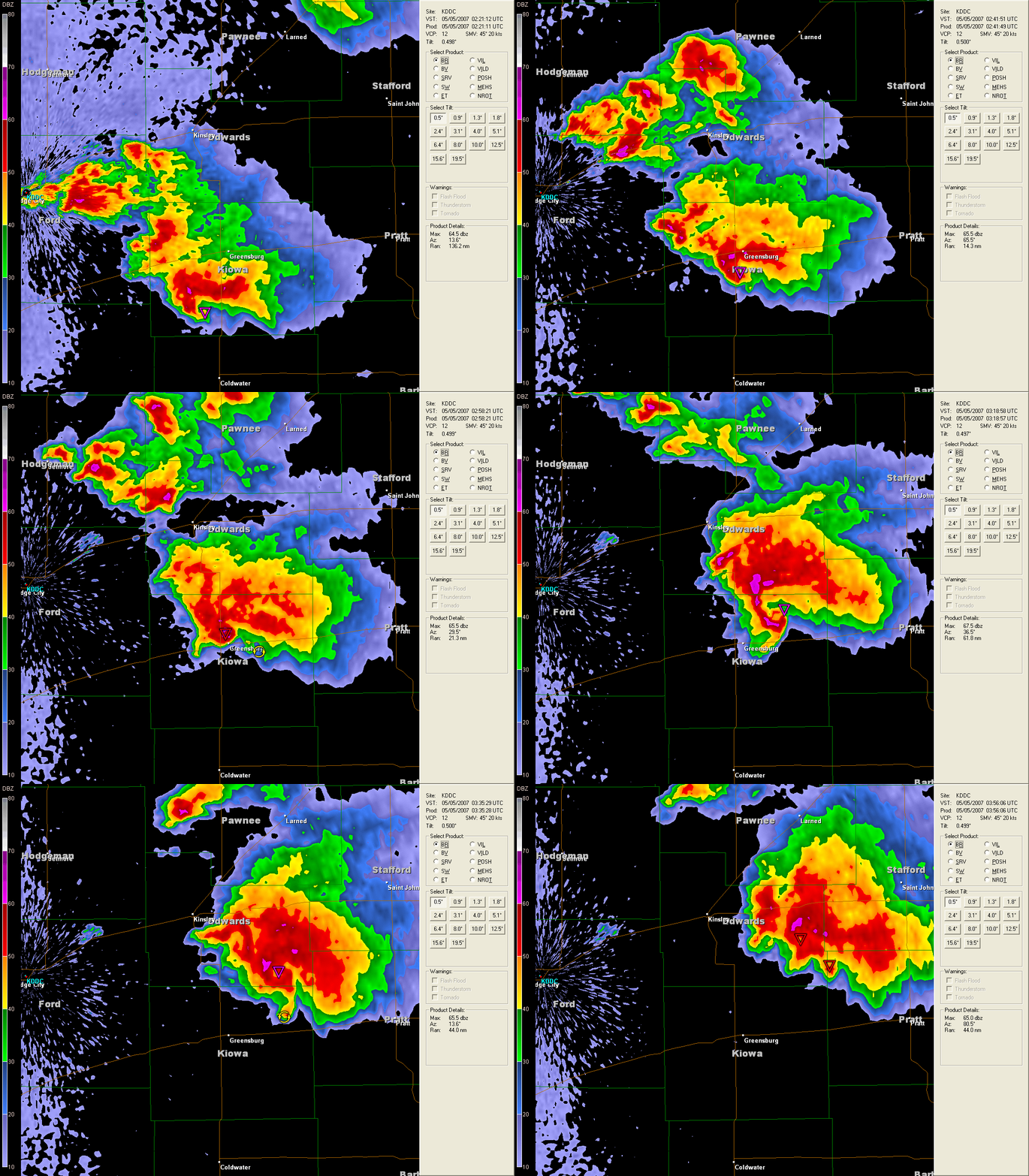

.svg)
.png/250px-En.wikipedia.org_wiki_NASA_Astronaut_Group_3(iPhone_12_Pro).png)