


Nikon Z7II
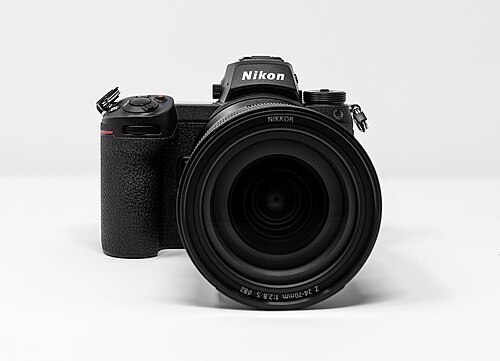 Nikon Z7II paired with the Nikkor Z 24-70mm f/2.8 S lens | |
| Overview | |
|---|---|
| Maker | Nikon |
| Type | Full-frame mirrorless interchangeable-lens camera |
| Released | October 14, 2020 |
| Intro price | $2,999.95 |
| Lens | |
| Lens mount | Nikon Z-mount |
| Sensor/medium | |
| Sensor type | Back-illuminated CMOS sensor |
| Sensor size | Full frame (35.9 × 23.9 mm) |
| Sensor maker | Sony |
| Maximum resolution | 8,256 × 5,504 (45.7 effective megapixels) |
| Film speed | Native range of ISO 64–25,600 (expandable to 32–102,400) |
| Recording medium | 1 × CFexpress Type B / XQD, 1 × SD (UHS-II) |
| Focusing | |
| Focus |
|
| Focus modes |
|
| Focus areas | 493 points (single-point AF) with 90% coverage |
| Exposure/metering | |
| Exposure | TTL metering using camera image sensor |
| Exposure modes |
|
| Exposure metering |
|
| Metering modes |
|
| Flash | |
| Flash | Built-in: No Hot shoe |
| Shutter | |
| Frame rate | Up to 10 fps in extended high-speed continuous |
| Shutter | Electronically controlled vertical-travel focal-plane mechanical shutter; electronic front-curtain shutter |
| Shutter speeds | 30s – 1/8000s |
| Viewfinder | |
| Viewfinder | Quad-VGA (1280 × 960) EVF (3690000 dots) |
| Image processing | |
| Image processor | Dual Expeed 6 |
| White balance |
|
| General | |
| Video recording | 1080p video at up to 120 fps, and 4K video at up to 60 fps |
| LCD screen | 3.2-inch tilting TFT LCD with 2.1 million dots with touchscreen |
| Battery | EN-EL15c (backwards compatible with EN-EL15b batteries with slightly faster drain) |
| AV port(s) | USB Type-C, HDMI Type-C |
| Data port(s) | IEEE 802.11b/g/n/a/ac/Wi-Fi, Bluetooth Low Energy |
| Body features | In-Body Image Stabilization |
| Dimensions | 134×100.5×69.5 mm (5.28×3.96×2.74 in) |
| Weight | 615 g (body only) |
| Latest firmware | 1.70 / 3 June 2025[1] |
| Made in | Thailand |
| Chronology | |
| Replaced | Nikon Z7 |
The Nikon Z7II is a high-end full-frame mirrorless interchangeable-lens camera (MILC) produced by Nikon, and is the successor to the Nikon Z7.[2][3] The camera was officially announced on October 14, 2020, alongside the Nikon Z6II, and became available for purchase on November 5. It uses Nikon's Z-mount system.
Features
[edit]- The most notable upgrade over the Nikon Z7 is the inclusion of a second memory card slot. The Z7II features an SD card slot and a CFexpress/XQD card slot.
- The camera features dual Expeed 6 image processing engines, a first for Nikon cameras. This improves autofocus performance and enables 4K video recording at 60 fps.
- Low light sensitivity has been improved to -3 to +17 EV.
- The frame rate for photos is increased from 9 fps in extended high-speed continuous to 10 fps with a larger buffer as well (increased from 23 12-bit lossless RAW files to 77).
- The electronic viewfinder refresh rate and blackout time is improved from the original Z7.
- The autofocus system has improved with a new Wide-Area AF option with eye autofocus for both people and animals.
- Battery life has been increased from ~330 to ~360 CIPA-rated shots (or from 85 min to 105 min of video recording).
- In video recording, the camera can now record 4K "Ultra HD" footage at 60p with a 1.08x crop.[4]
References
[edit]- ^ "Z 7II Firmware 1.70". Retrieved 14 June 2025.
- ^ "Nikon Z6 II and Z7 II boast dual processors and gain a second card slot". DPReview. DPReview. 2020-10-14. Retrieved 2020-10-16.
- ^ "Nikon Z 7 II". PCMag. 19 February 2021. Retrieved 2021-03-07.
- ^ "Nikon Z6 II: Digital Photography Review". www.dpreview.com. Retrieved 2021-02-05.
External links
[edit]
Wikimedia Commons has media related to Nikon Z 7II.
 | This camera-related article is a stub. You can help Wikipedia by expanding it. |